
 3 weeks ago
37
3 weeks ago
37
ASRock was founded in 2002 as a spin-off from Asus, originally tasked with producing value-oriented motherboards for cost-sensitive markets. Over the following two decades, it grew into a serious competitor across the motherboard and graphics card spaces, eventually expanding into monitors, mini PCs, and industrial compute platforms. The PSU market, however, was conspicuously absent from its catalog until recently, when the company announced a broad simultaneous launch of nearly twenty power supply models spanning four distinct series: Taichi, Phantom Gaming, Steel Legend, and Challenger. It was not a cautious entry at all. ASRock came in with a full lineup covering wattages from 550W to 1650W, certifications ranging from 80Plus Bronze to Titanium, and a ten-year warranty across its premium tiers, signaling a serious long-term commitment to the segment.
The Steel Legend PSU series sits in the middle of that hierarchy. The base "G" variants are Gold-certified, fully modular, and aimed at mainstream builders. The "P" variants, of which the SL-1200P is one, step up to Platinum efficiency and add higher wattage headroom, dual 12V-2x6 connectors, and a set of engineering refinements that make a valiant effort to justify the premium. With all its merits, the ASRock Steel Legend SL-1200P deserves a spot in our list of best power supplies.
Specifications and Design
Swipe to scroll horizontally
RAIL |
+3.3V |
+5V |
+12V |
+5Vsb |
-12V |
MAX OUTPUT |
25A |
25A |
100A |
3A |
0.3A |
| Row 2 - Cell 0 | 150W |
150W |
1200W |
15W |
3.6W |
TOTAL |
1200W |
Row 3 - Cell 2 | Row 3 - Cell 3 | Row 3 - Cell 4 | Row 3 - Cell 5 |
AC INPUT |
100 - 240 VAC, 50 - 60 Hz |
Row 4 - Cell 2 | Row 4 - Cell 3 | Row 4 - Cell 4 | Row 4 - Cell 5 |
MSRP |
$180 |
Row 5 - Cell 2 | Row 5 - Cell 3 | Row 5 - Cell 4 | Row 5 - Cell 5 |
In the Box
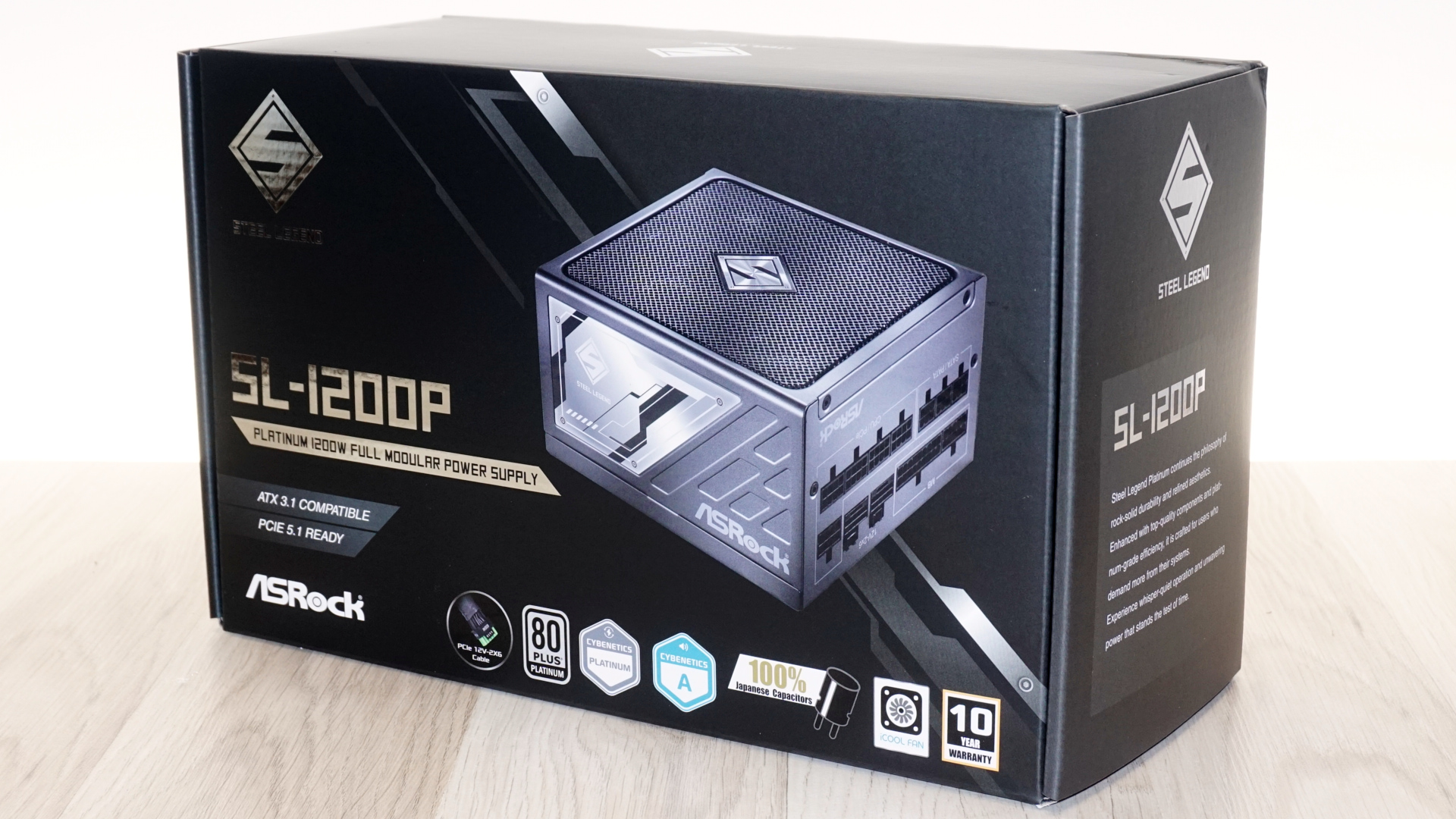
The SL-1200P ships in a substantial cardboard box. The packaging uses a metallic stripe motif with a picture of the unit on the front, serious in tone and consistent with the Steel Legend branding. Inside, the PSU is wrapped in a protective pouch and surrounded by foam inserts.
Latest Videos FromTom's Hardware
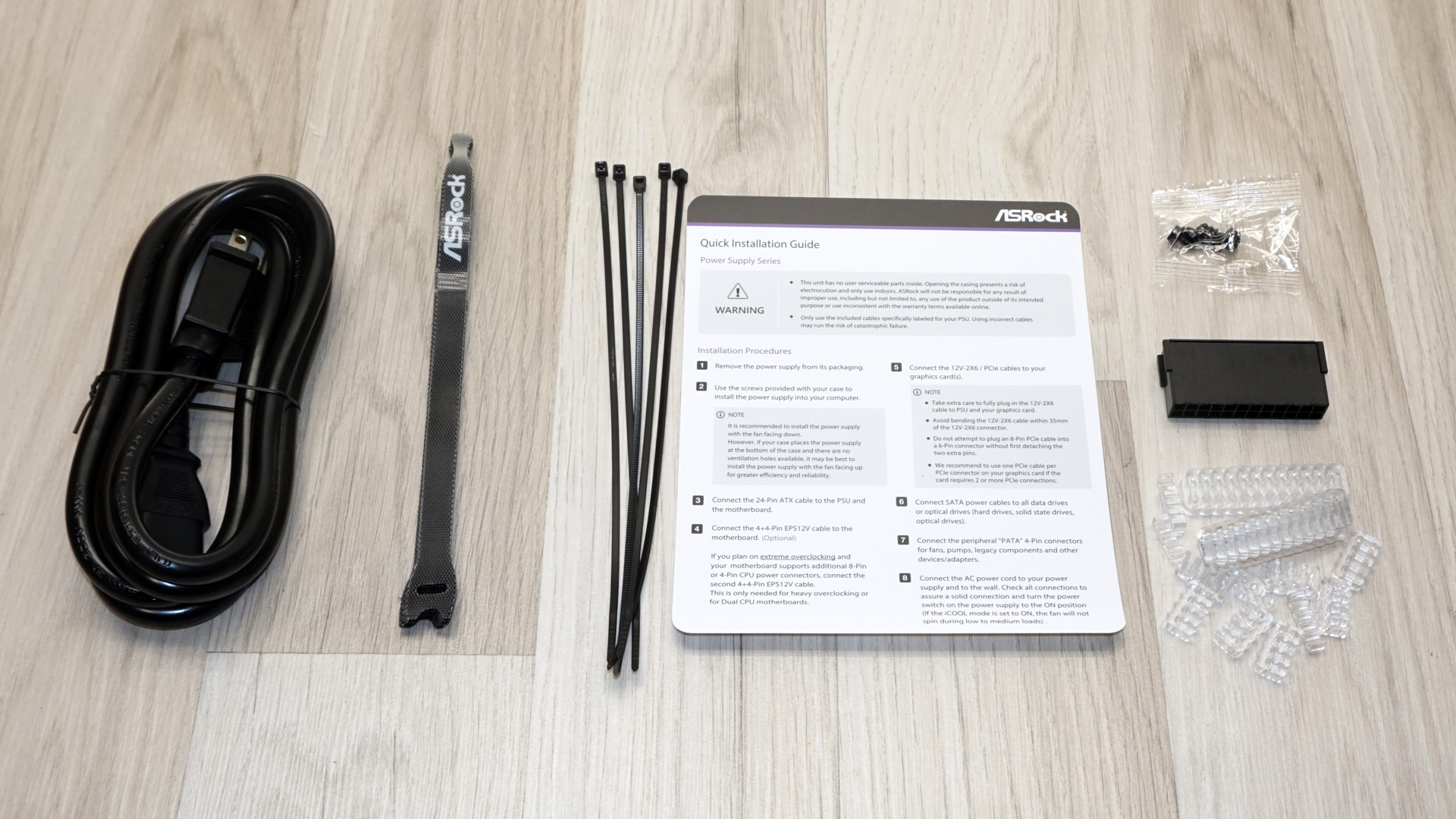
The accessory bundle is genuinely good: mounting screws, an AC cable, cable ties, reusable cable straps, a jump-start adapter for bench testing, and clear cable combs. There is no full manual, but a concise quick-start installation guide covers what most users need.
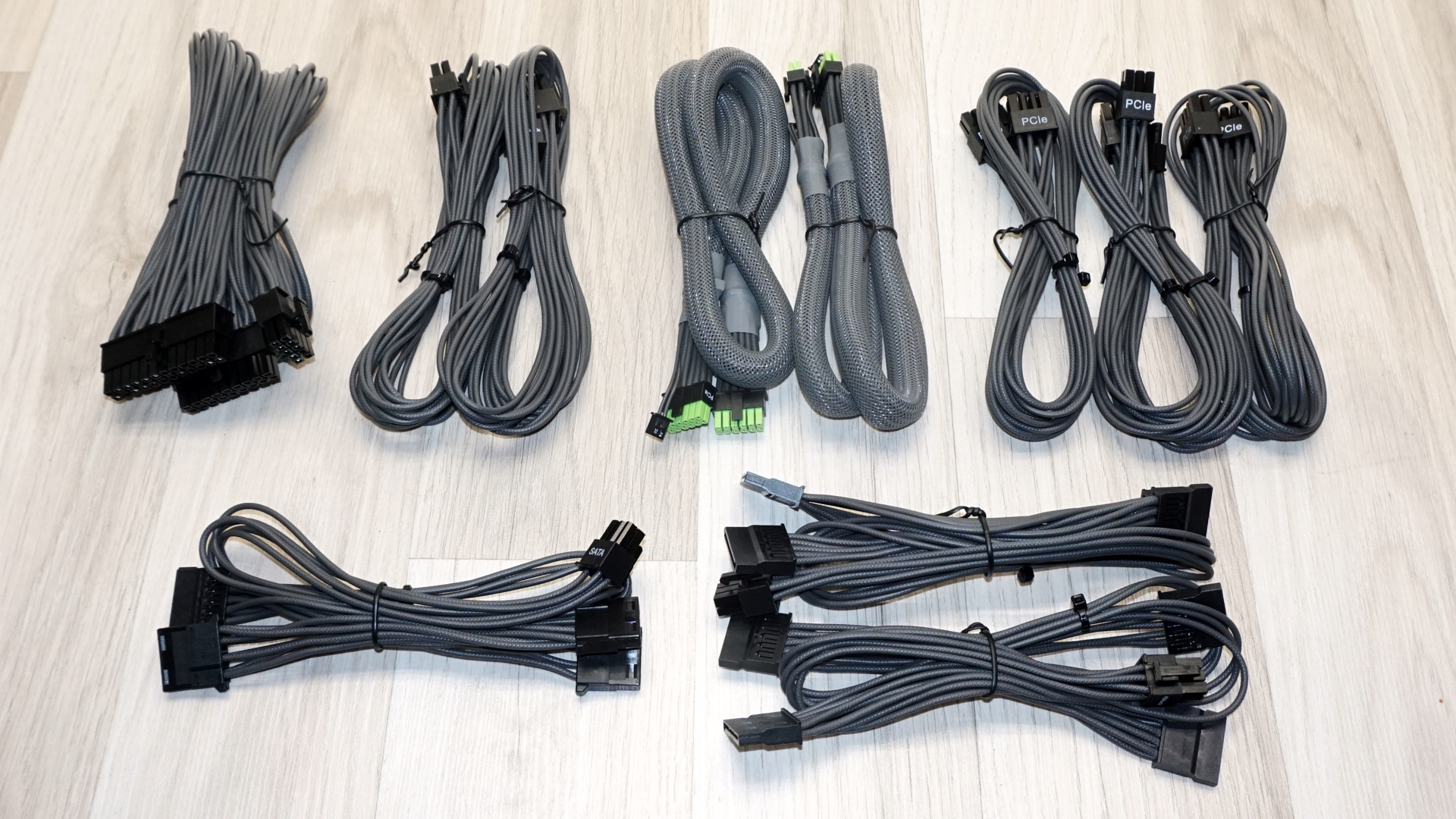
The cables are immediately distinctive. Where virtually every other manufacturer ships black cables, ASRock chose grey per-wire sleeving with black connectors. It is a deliberate aesthetic decision and one that works well, particularly in lighter or open-frame builds. The two 12V-2x6 cables receive additional nylon sleeving and feature partially neon-green connectors. The green section disappears from view once the connector is properly seated, functioning as a simple visual confirmation of correct insertion.
More importantly, each 12V-2x6 cable carries an embedded temperature sensor with a two-pin connector that feeds back to the PSU. If the cable overheats, the unit shuts down. It is an inelegant solution to a problem that arguably should be handled at the connector standard level, but it is a functional one and preferable to doing nothing. Three 6+2 pin PCI Express connectors round out the cable configuration, and the total connector count for a 1200W unit is very good.
Swipe to scroll horizontally
ATX 24 Pin |
- |
1 |
EPS 4+4 Pin |
- |
1 |
EPS 8 Pin |
- |
1 |
PCI-E 5.0 |
- |
2 |
PCI-E 8 Pin |
- |
3 |
SATA |
- |
9 |
Molex |
- |
3 |
Floppy |
- |
- |
External Appearance
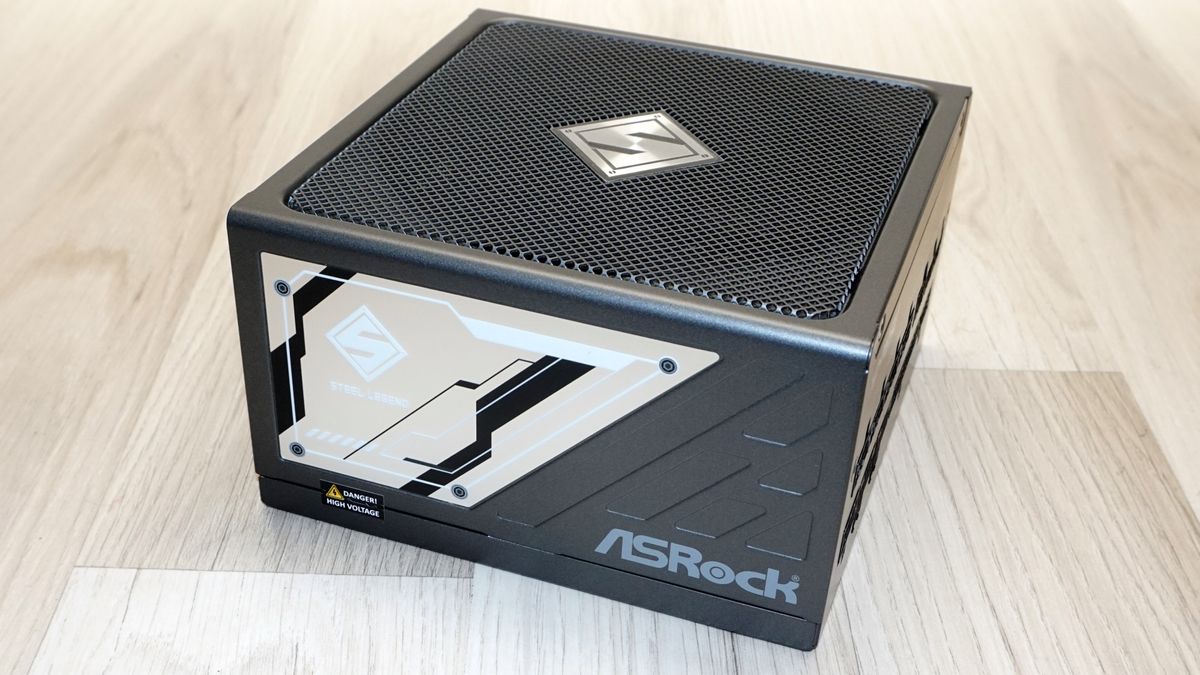
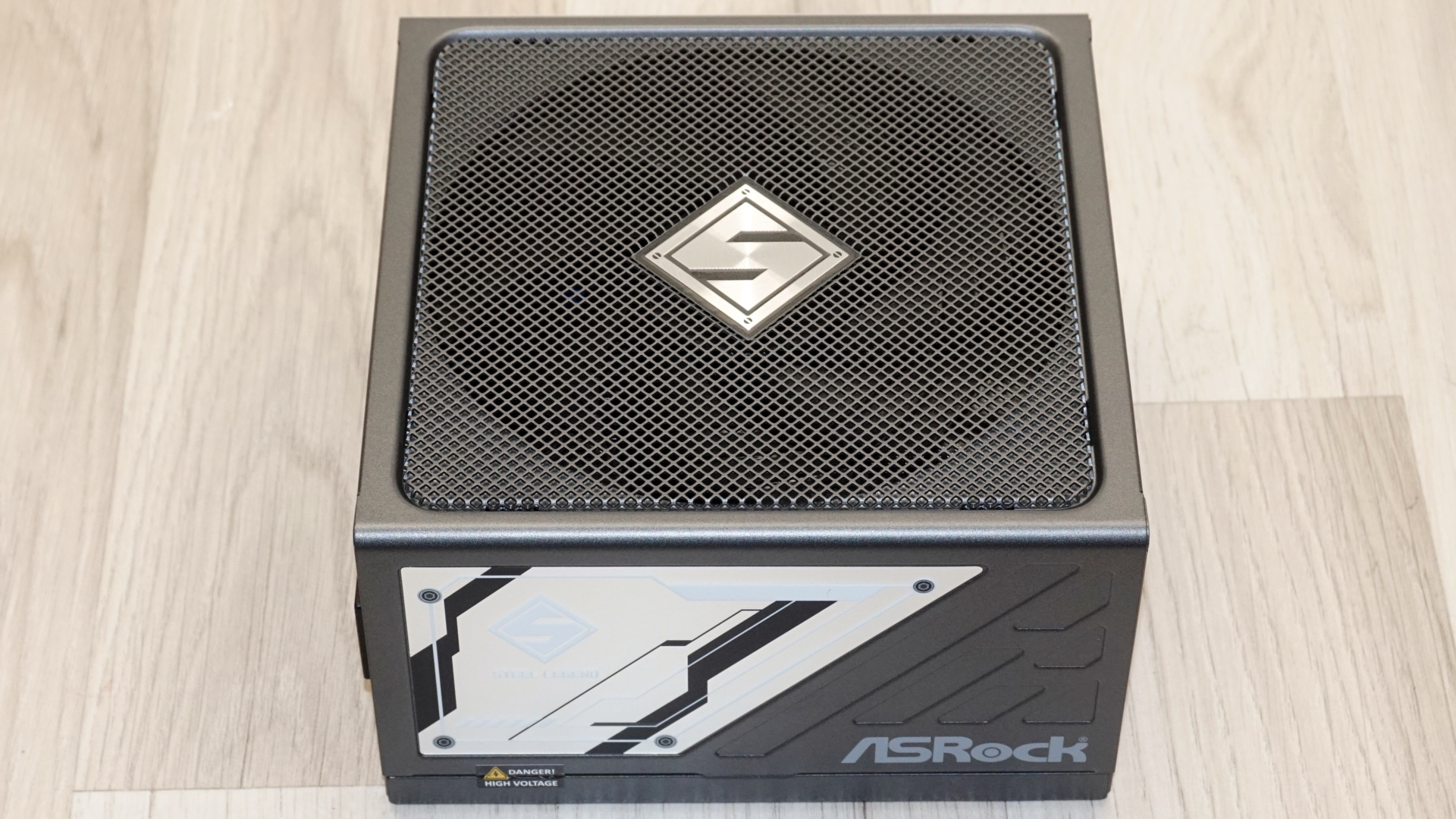
At 150 mm in length, the SL-1200P is marginally longer than the ATX specification recommends, but this should present no practical challenge in any quality modern case. The chassis is visually busy by PSU standards and is neither black or white – the SL-1200P is grey, much like its cables, making it visually unique amongst its competitors.
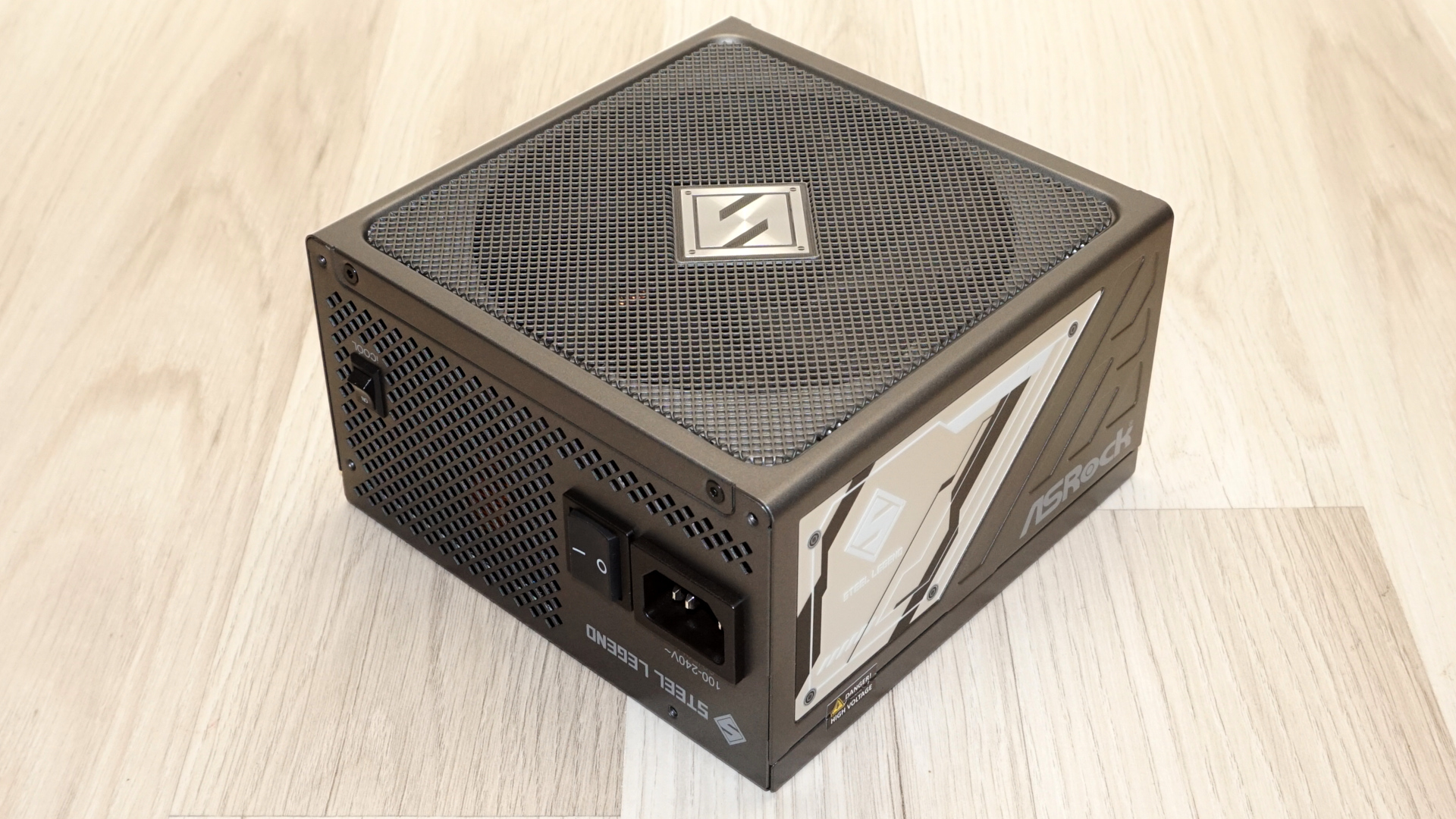
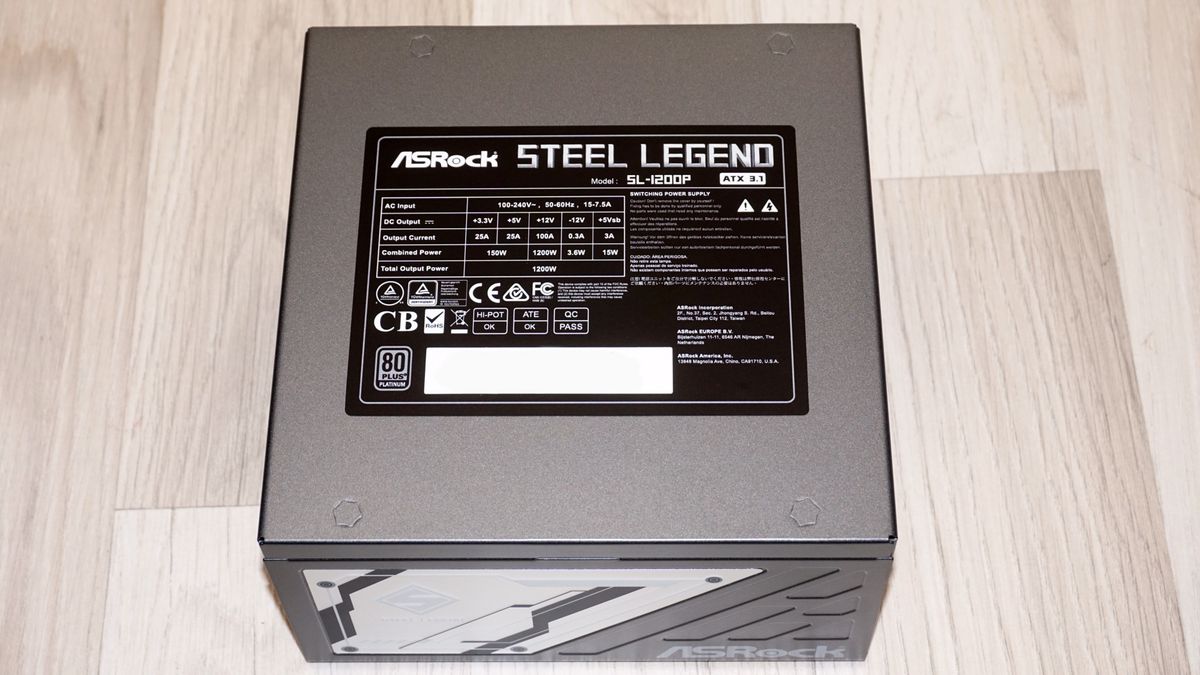
Metallic embossments and decorative elements cover the left and right side panels. The bottom is dominated by a dense mesh fan guard that spans the full width of the unit, with the Steel Legend series logo positioned above the fan motor. The top panel is home to the electrical specifications and certification sticker.
Image 1 of 2
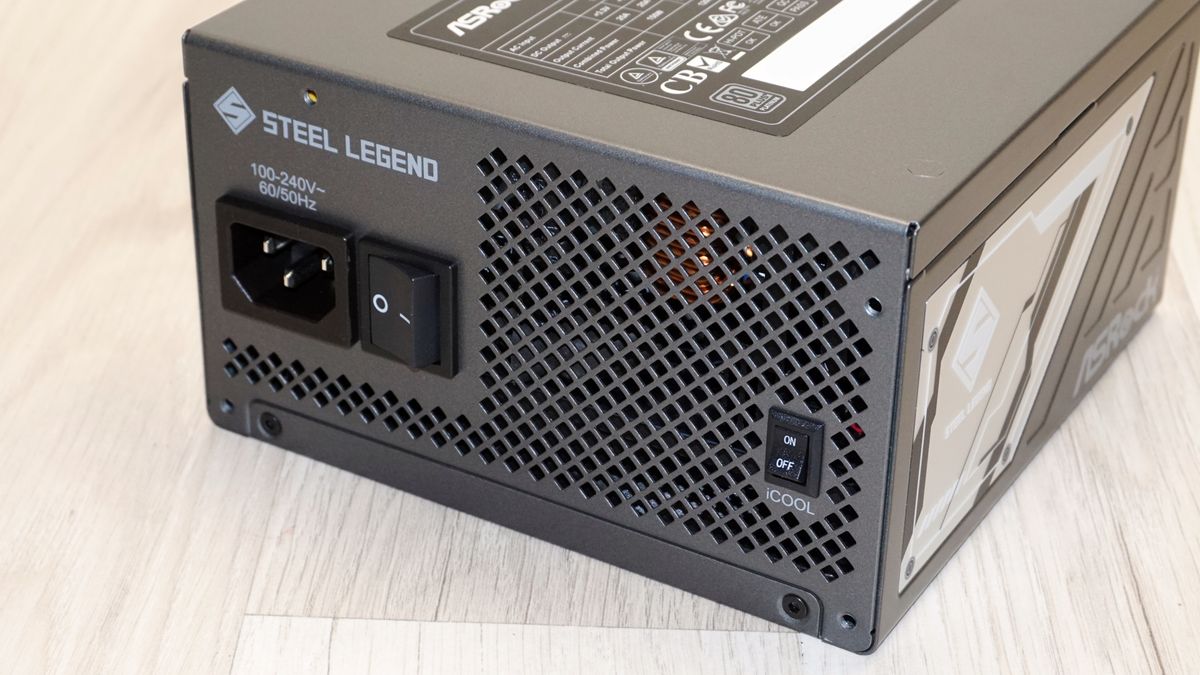
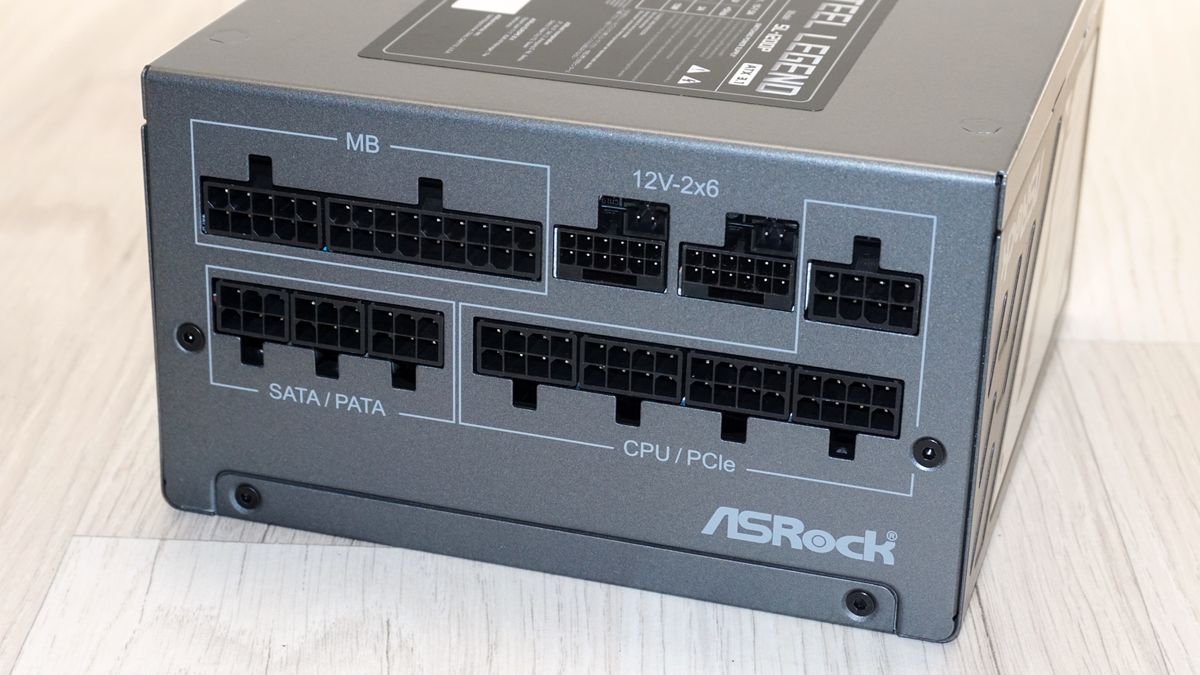
The front of the unit houses the AC receptacle, the main power switch, and a toggle for the hybrid fan mode, the last of which forces the fan to run continuously rather than remaining stationary at low loads. The modular connector panel on the rear is logically laid out, with printed white legends identifying each port type. The small two-pin sensor connectors for the 12V-2x6 cables are visible adjacent to those ports.
Image 1 of 2
Internal Design
The SL-1200P uses a Globe RL4Z S1352512EH-3M 135 mm fan with a fluid dynamic bearing engine, rated to a maximum of 2300 RPM. That is a high ceiling for a PSU fan, though not surprising for a 1200W unit that will occasionally need to move meaningful airflow. FDB fans tend to wear well over time and strike a reasonable compromise between longevity and acoustic performance.
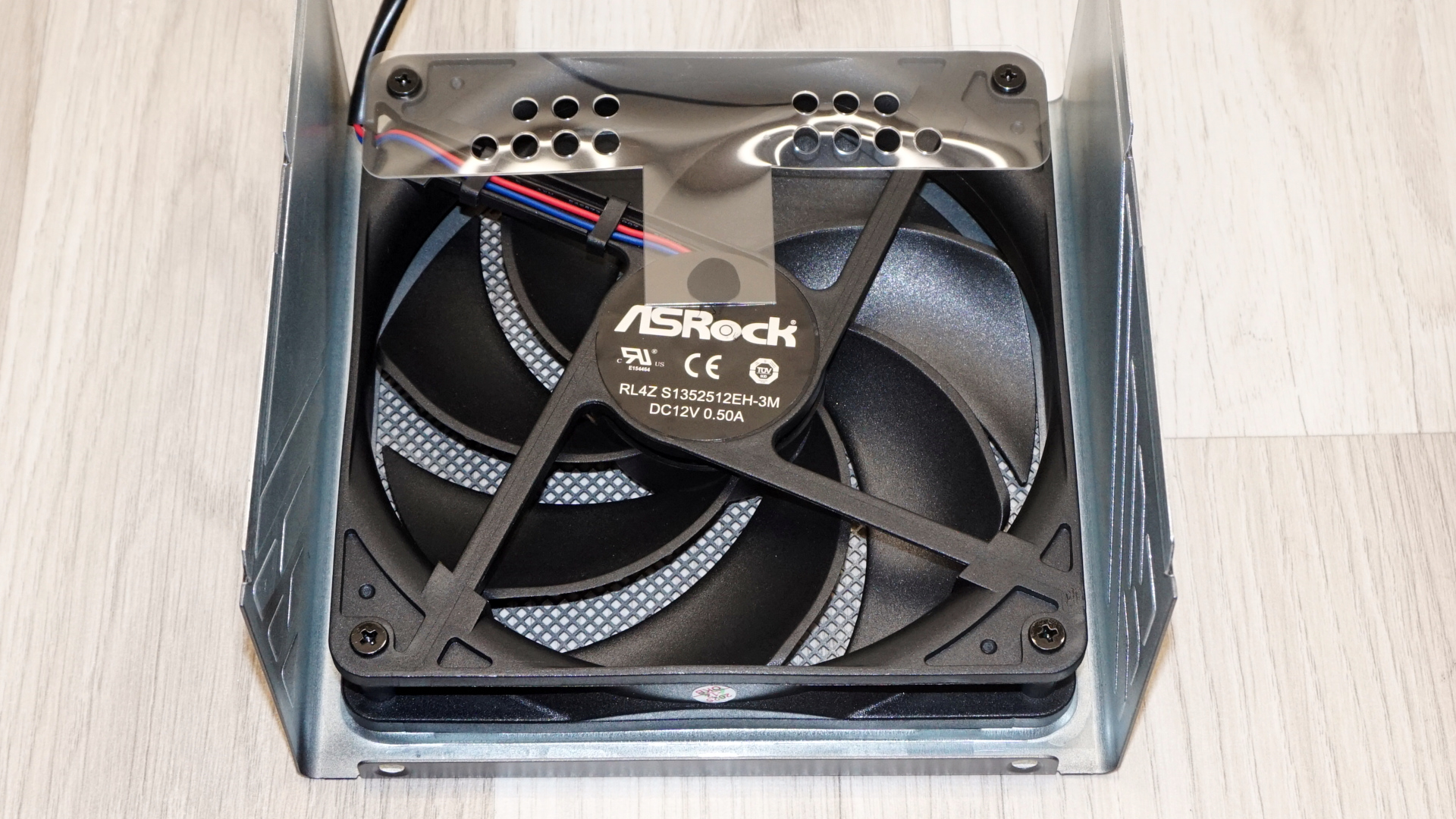
The OEM behind the entire Steel Legend platform is HEC, also known as Heroichi or Compucase, a Taiwanese manufacturer with decades in the PSU industry. HEC has historically been associated with mid-tier designs, but their more recent platforms for 1000W and above have demonstrated meaningful progress in topology refinement and component selection. ASRock's collaboration with them here appears to have pushed that a little further.
Image 1 of 2
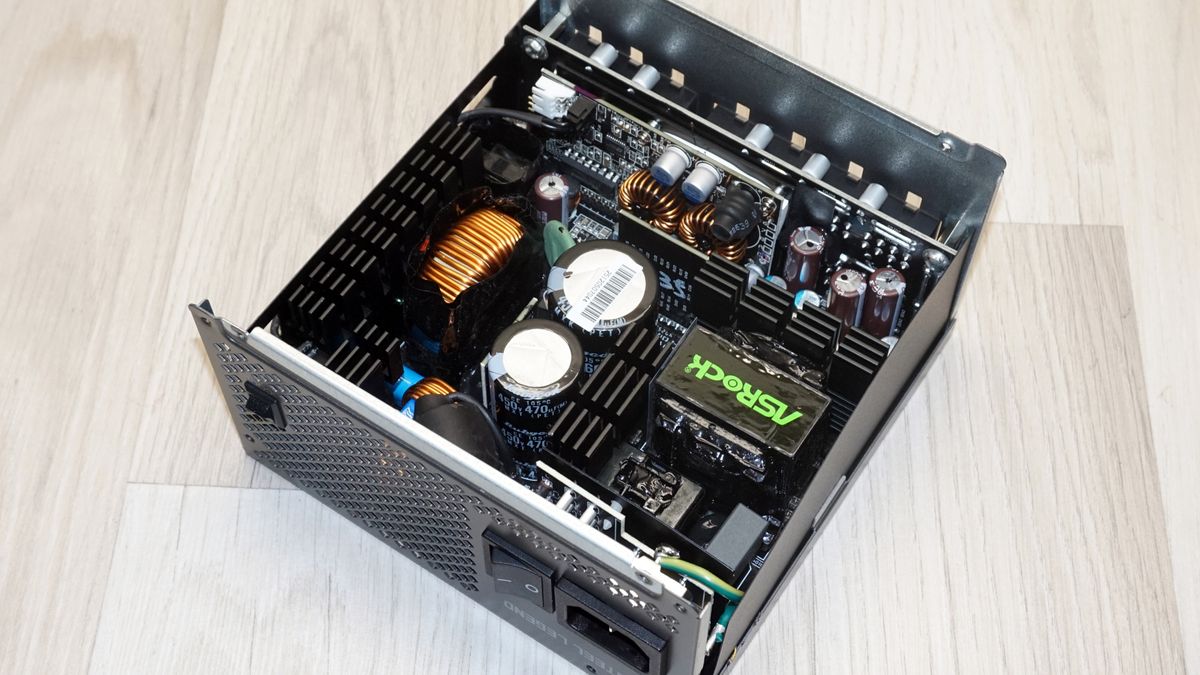
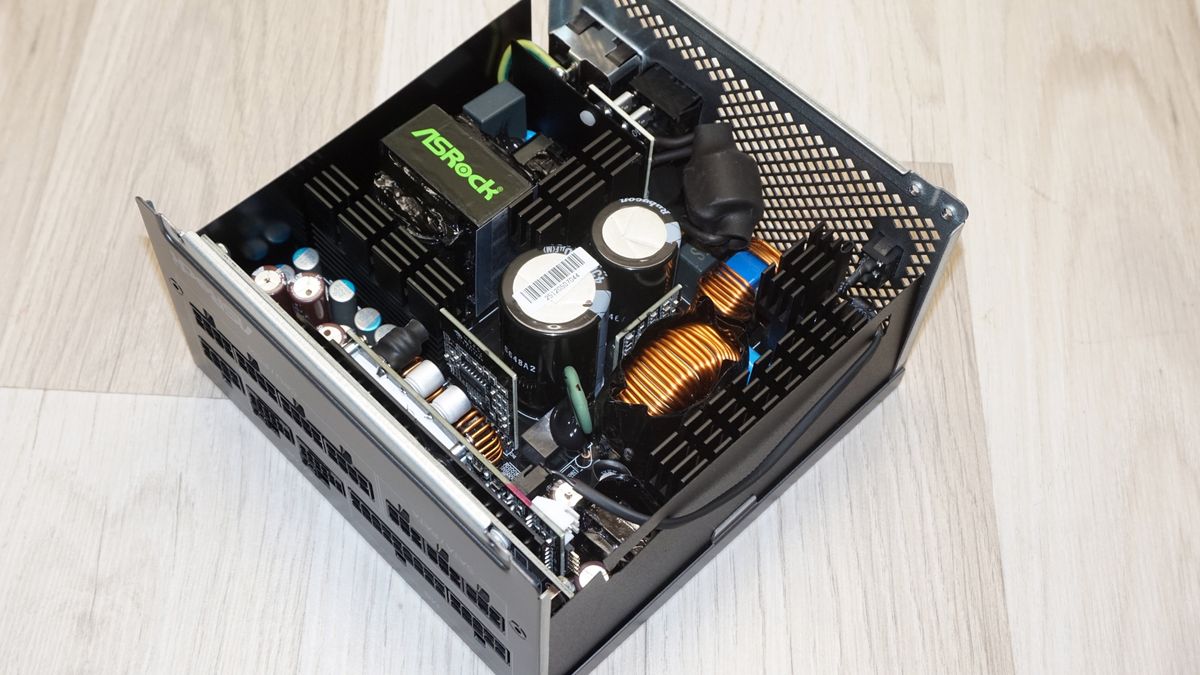
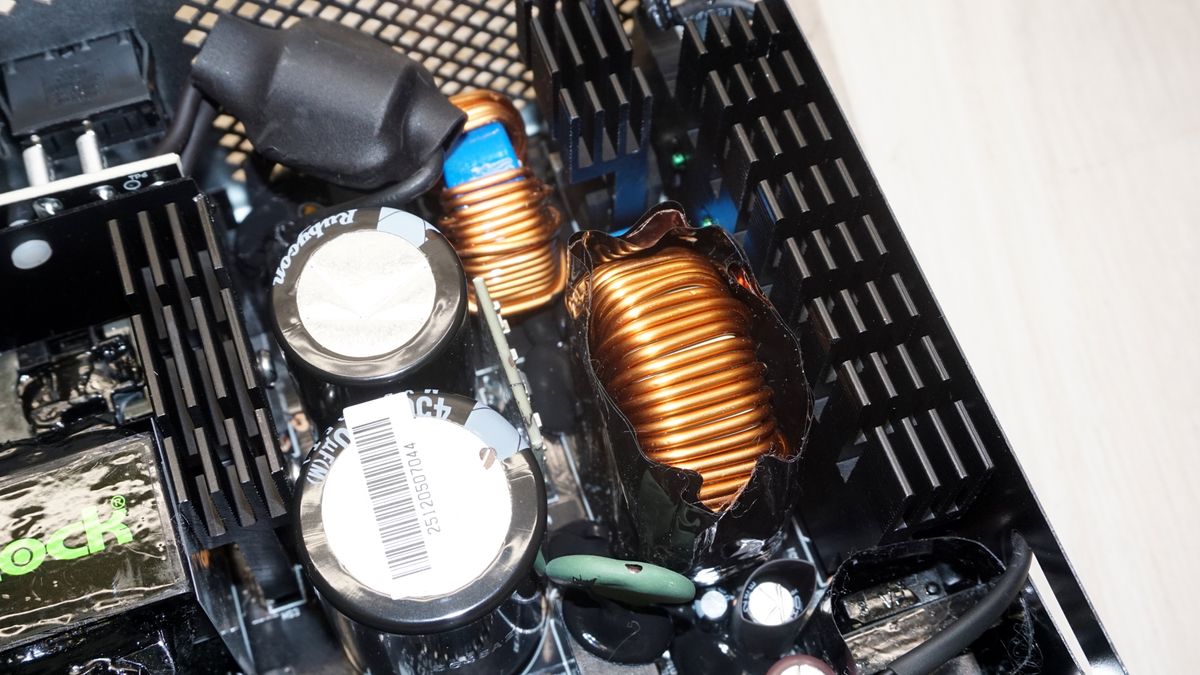
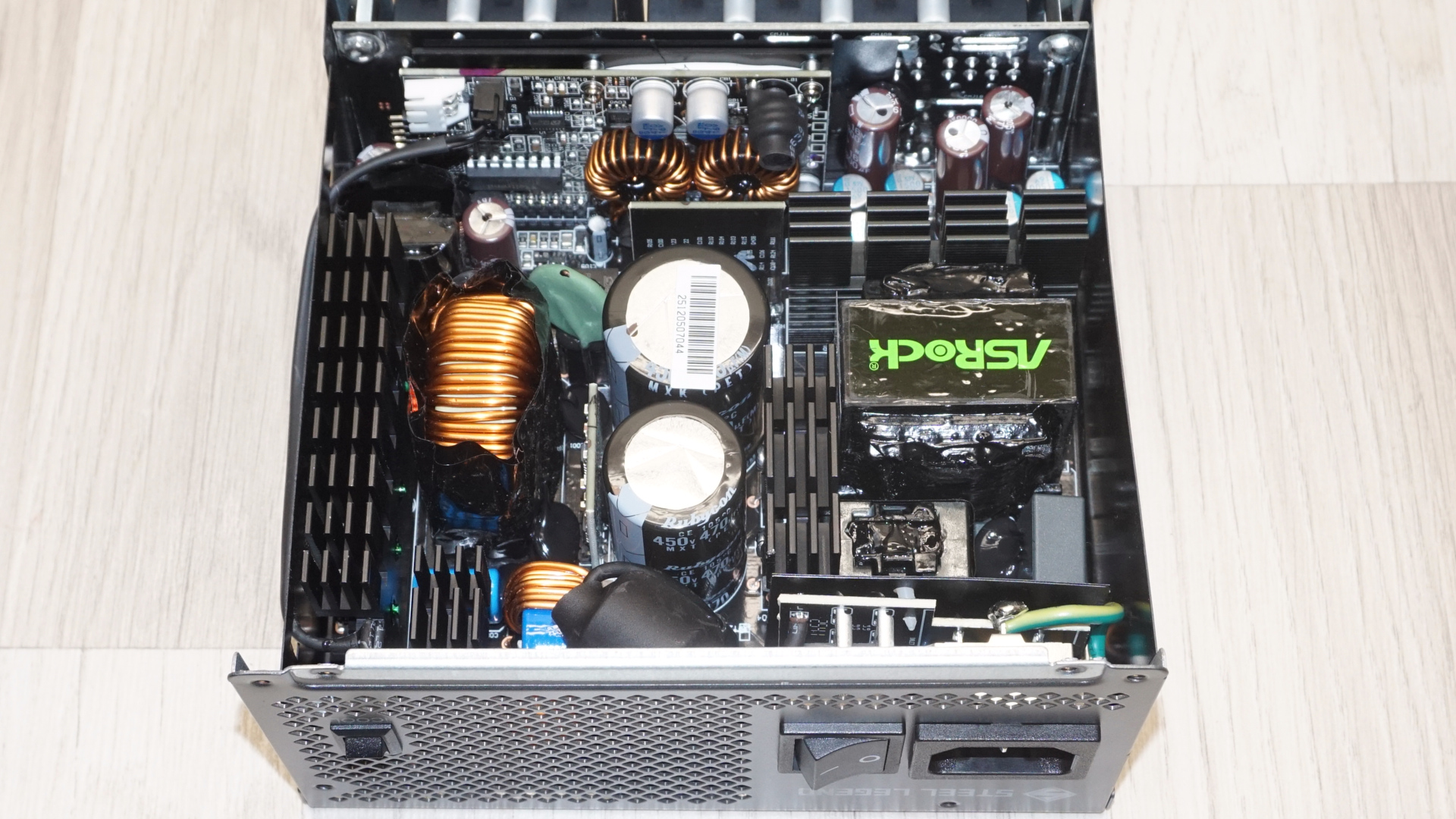
The filtering stage is adequate, comprising four Y capacitors, three X capacitors, and two inductors. Most of this circuitry is mounted on a small PCB soldered directly to the AC receptacle, a space-efficient arrangement. Two rectifying bridges sit on a modest but functional heatsink immediately after the filtering stage.
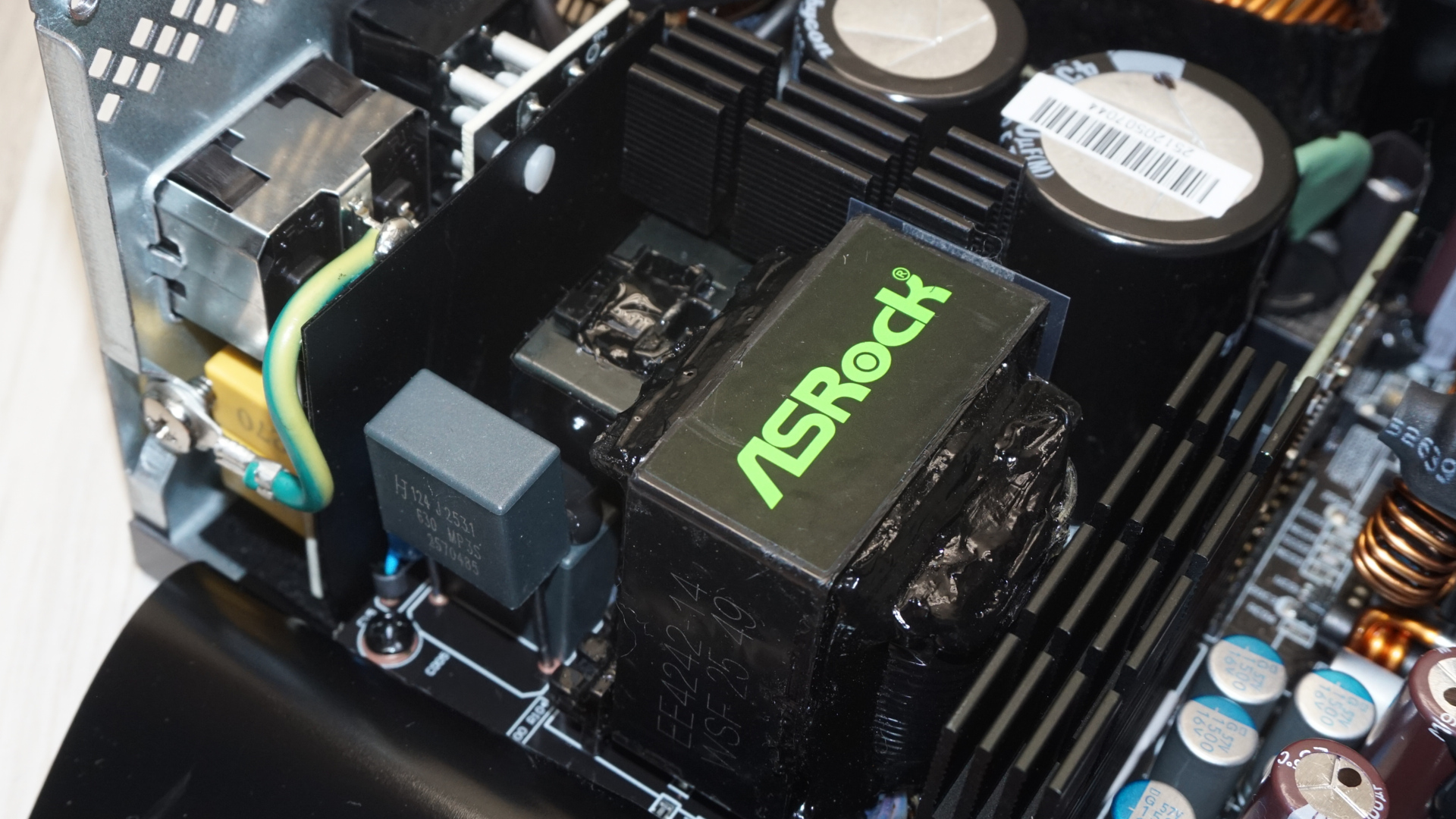
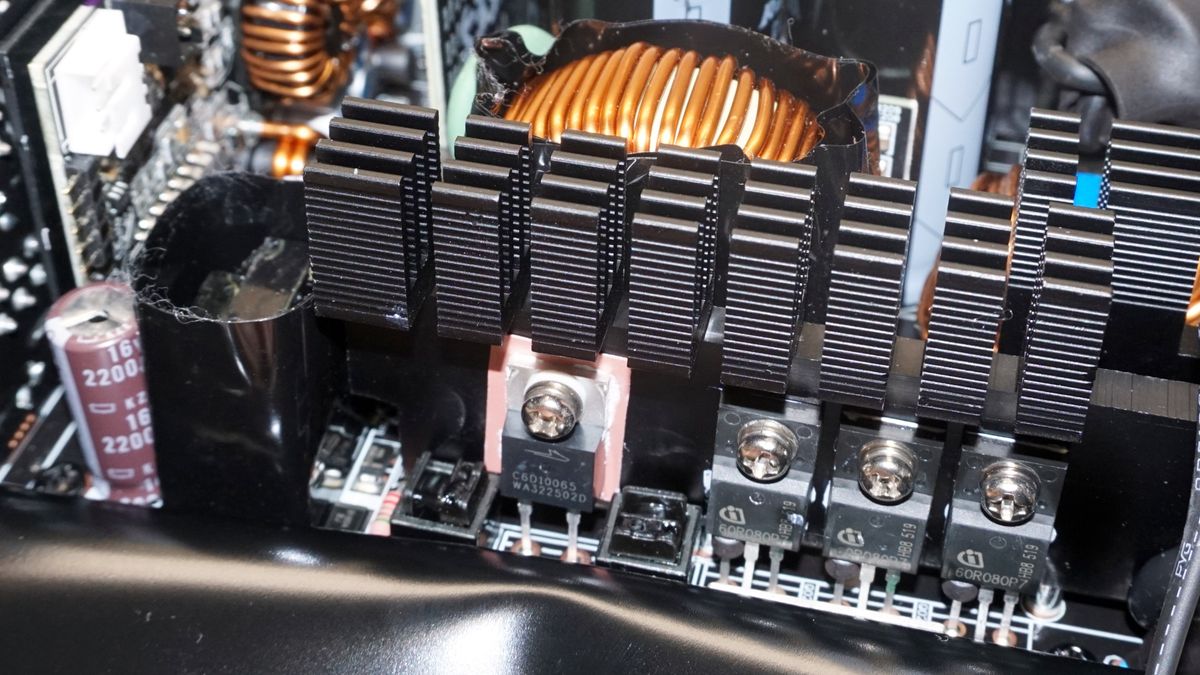
The APFC stage uses three Infineon 60R080P7 CoolMOS MOSFETs and a diode, mounted on the unit's largest heatsink along its inner edge. The passive components are a large inductor wrapped with insulative tape and two Rubycon electrolytic capacitors rated at 560 and 470 μF respectively. The primary inversion stage is a half-bridge LLC topology comprising two Infineon 60R080P7 MOSFETs on a dedicated heatsink ahead of the main transformer.
Image 1 of 2
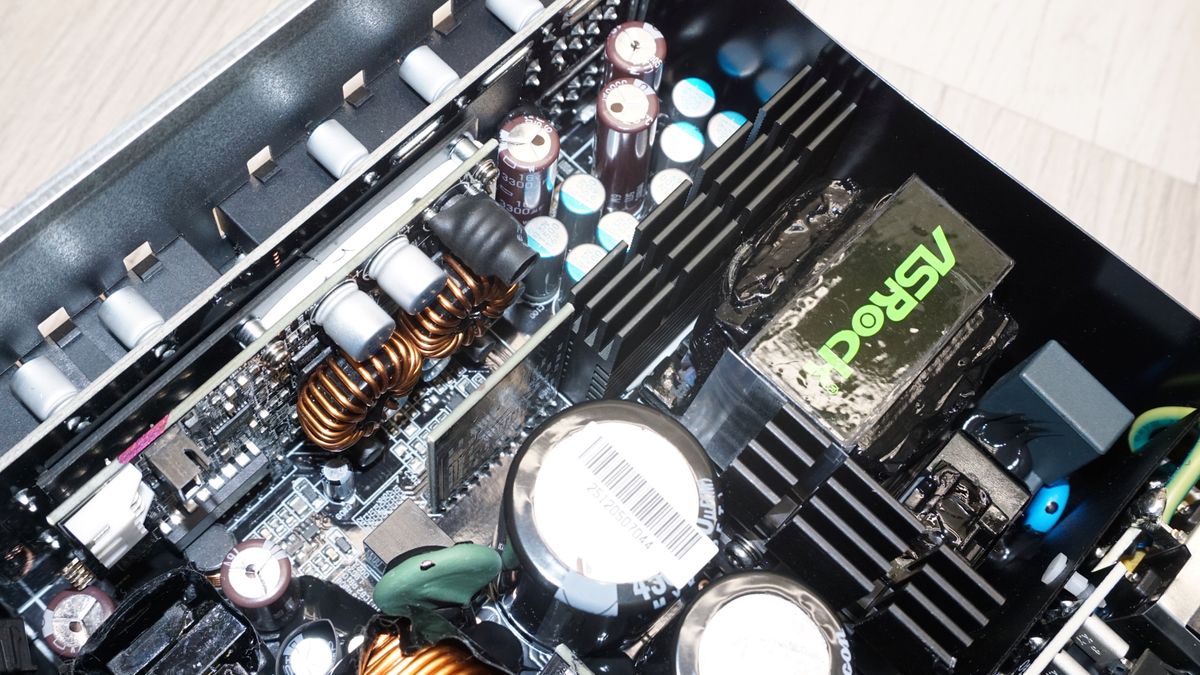
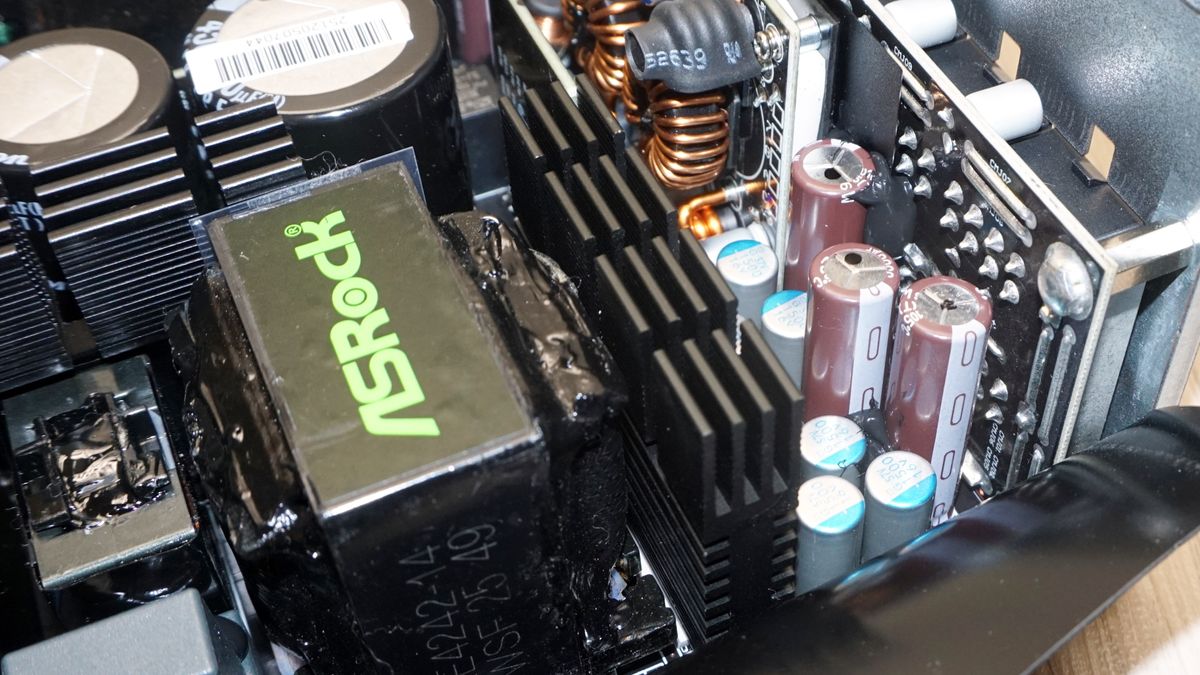
On the secondary side, eight ChongQing PingWei Enterprise C012N04ES MOSFETs generate the 12V rail in a synchronous rectification arrangement. The minor rails are derived from DC-to-DC converters on a vertical daughterboard. Every secondary-side electrolytic and solid-state capacitor in the unit comes from Nippon Chemi-Con. That level of component quality consistency on the output stage is notable and contributes directly to the clean electrical performance.
Image 1 of 2
Cold Test Results (25°C Ambient)
Cold Test Results (25°C Ambient)
For the testing of PSUs, we are using high precision electronic loads with a maximum power draw of 2700 Watts, a Rigol DS5042M 40 MHz oscilloscope, an Extech 380803 power analyzer, two high precision UNI-T UT-325 digital thermometers, an Extech HD600 SPL meter, a self-designed hotbox and various other bits and parts.
Image 1 of 5
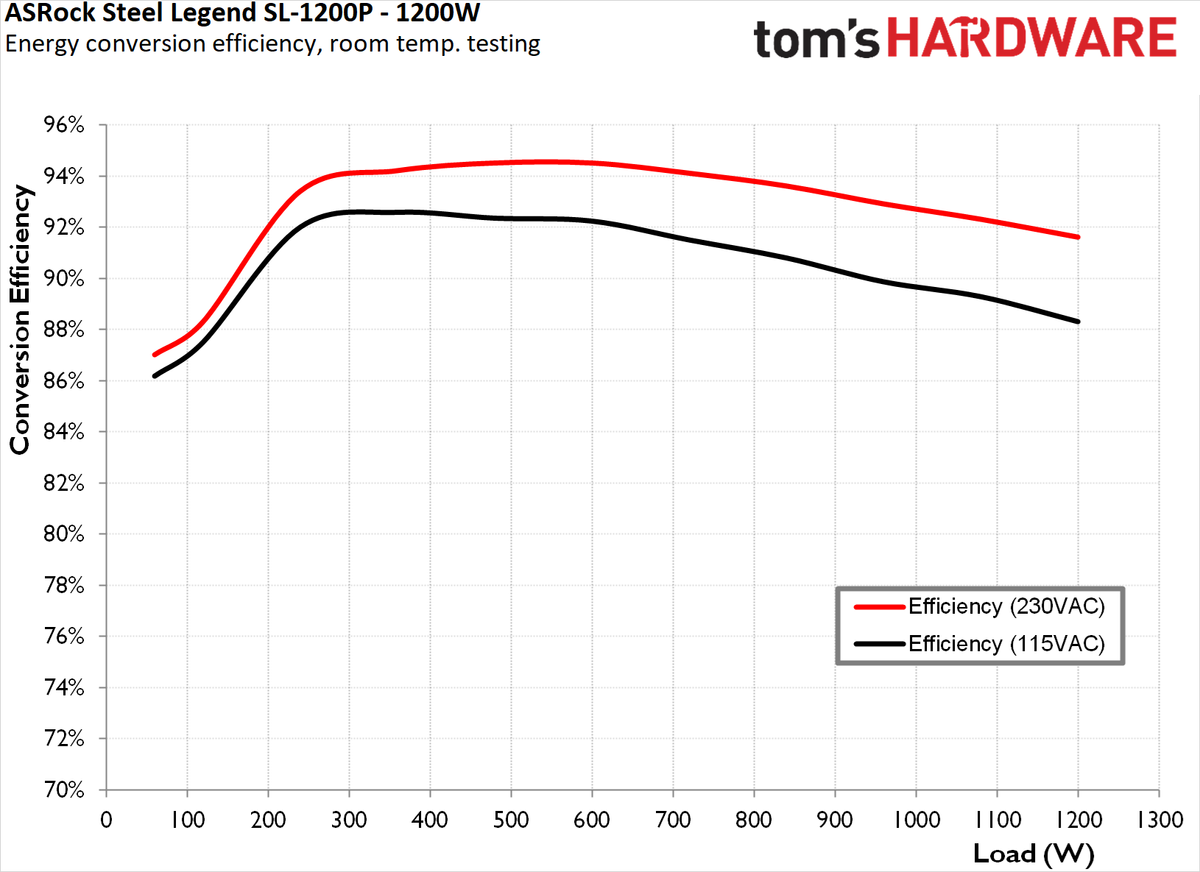
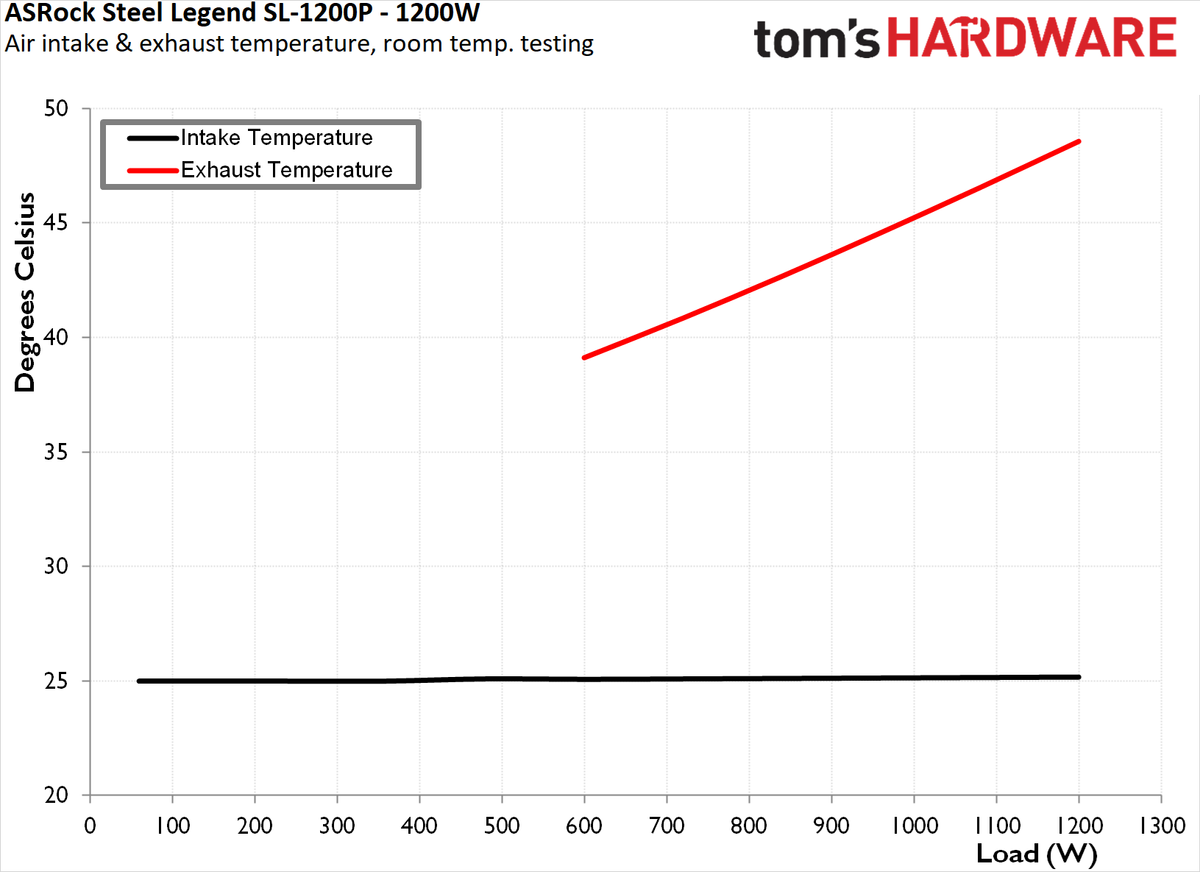
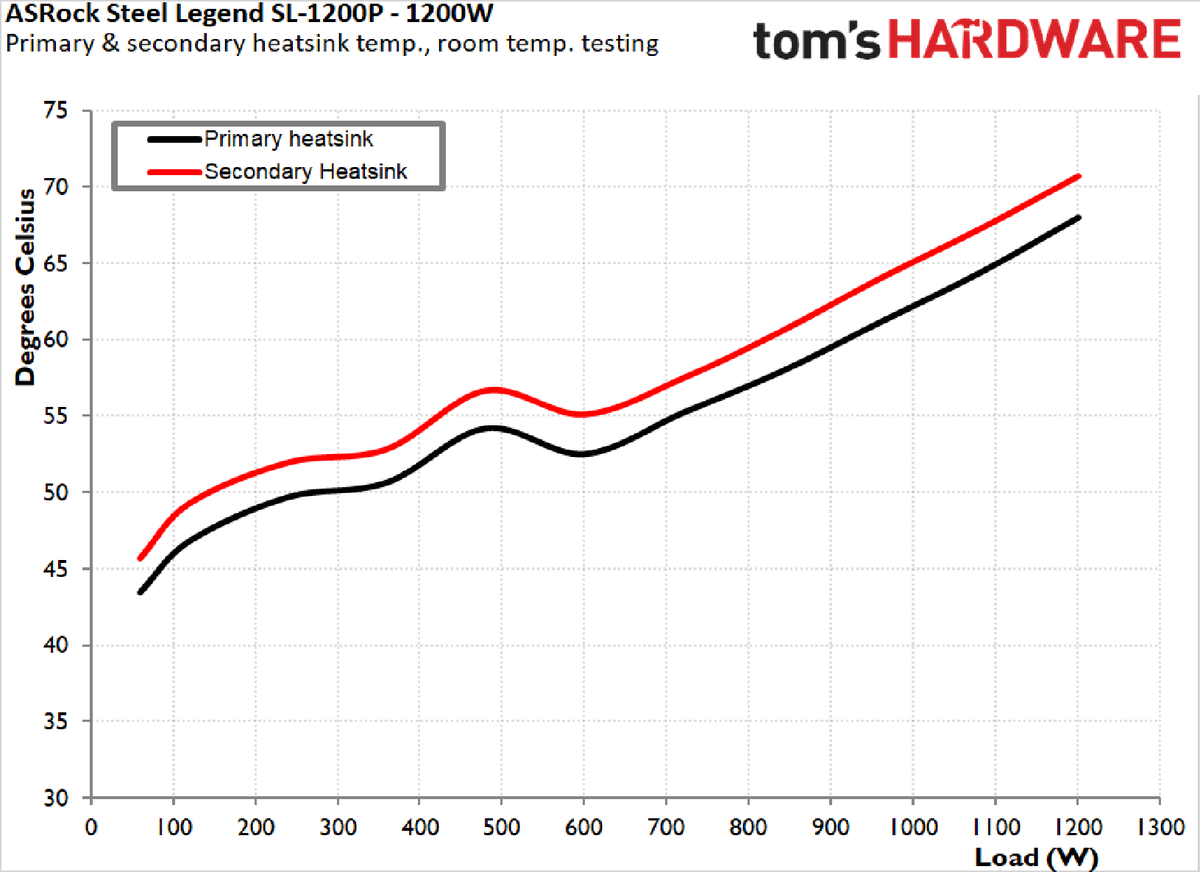
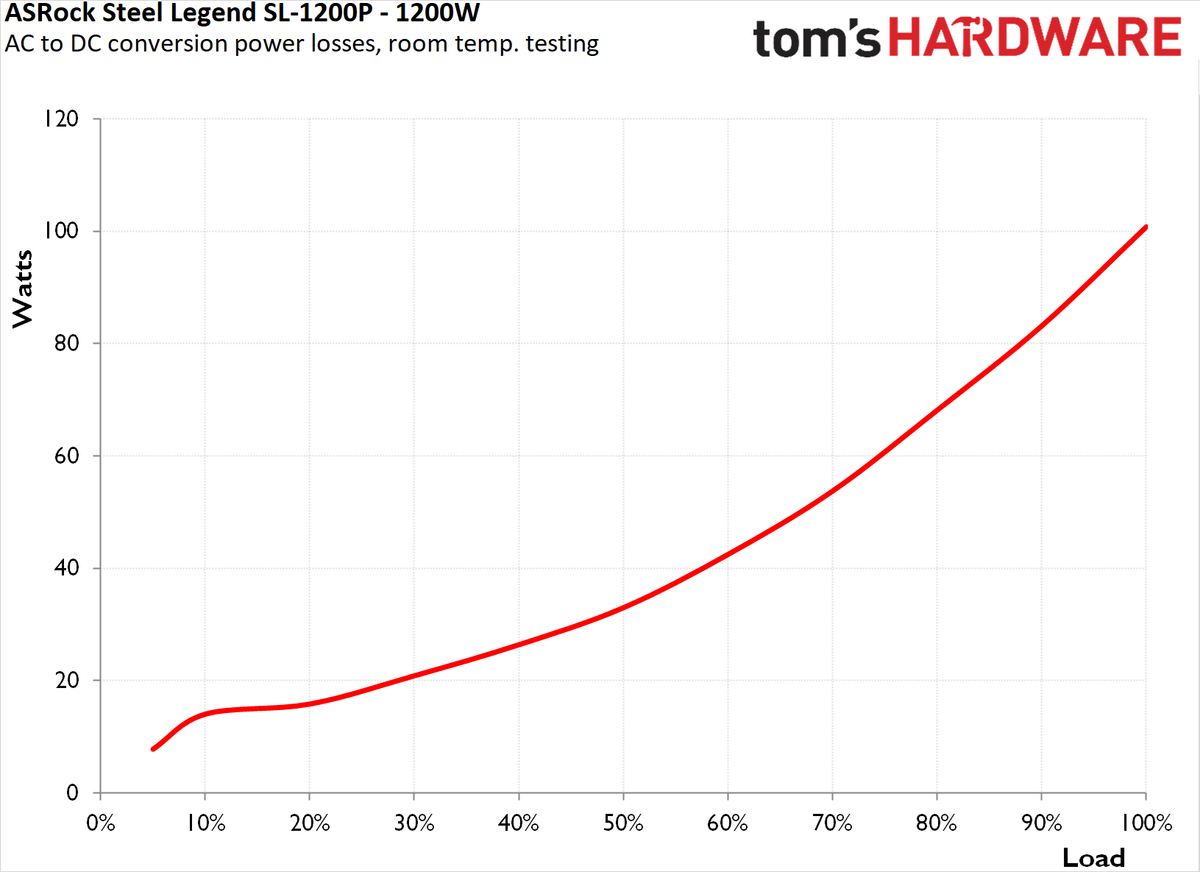
At 115 VAC, the SL-1200P averaged 90.6% efficiency across the nominal load range. At 230 VAC that figure rose to 92.9%. Our testing numbers satisfy the Platinum certification thresholds under Cybenetics and CLEAResult's 80Plus methodology, which use different test parameters but arrive at the same conclusion here. The efficiency curve is stable across most of the load range, peaking around 50% load. Low-load efficiency is very strong. The unit does, however, show a meaningful input voltage sensitivity: dropping from 230 to 115 VAC costs close to 2% efficiency across most of the range, which is worth noting for North American users. Still, it does meet the Platinum-level certification requirements.
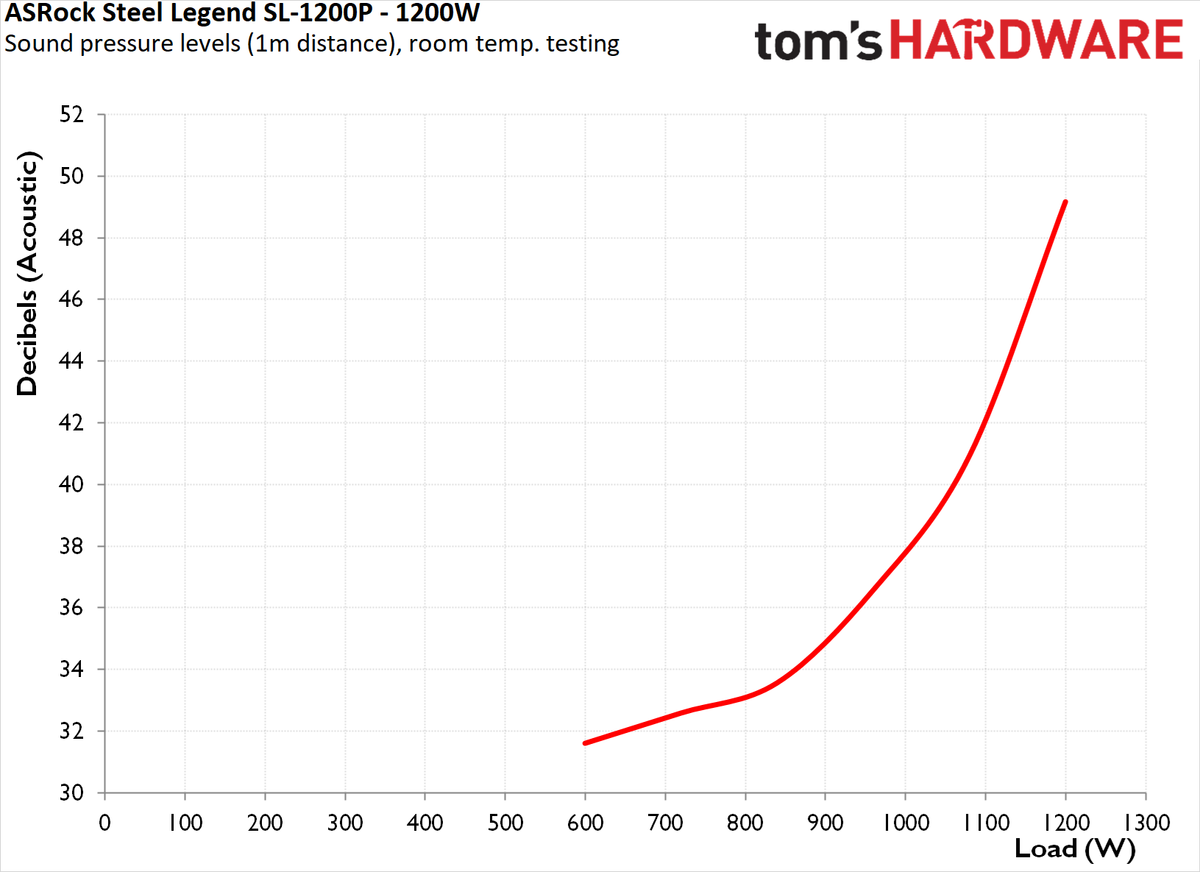
Fan behaviour under cold conditions is unobtrusive. The fan remains off below approximately 550W, engages quietly at that threshold, and climbs steadily with load. At full rated output it reaches roughly 75% of its maximum speed. Acoustic performance under cold conditions is good.
Hot Test Results (~45°C Ambient)
Hot Test Results (~45°C Ambient)
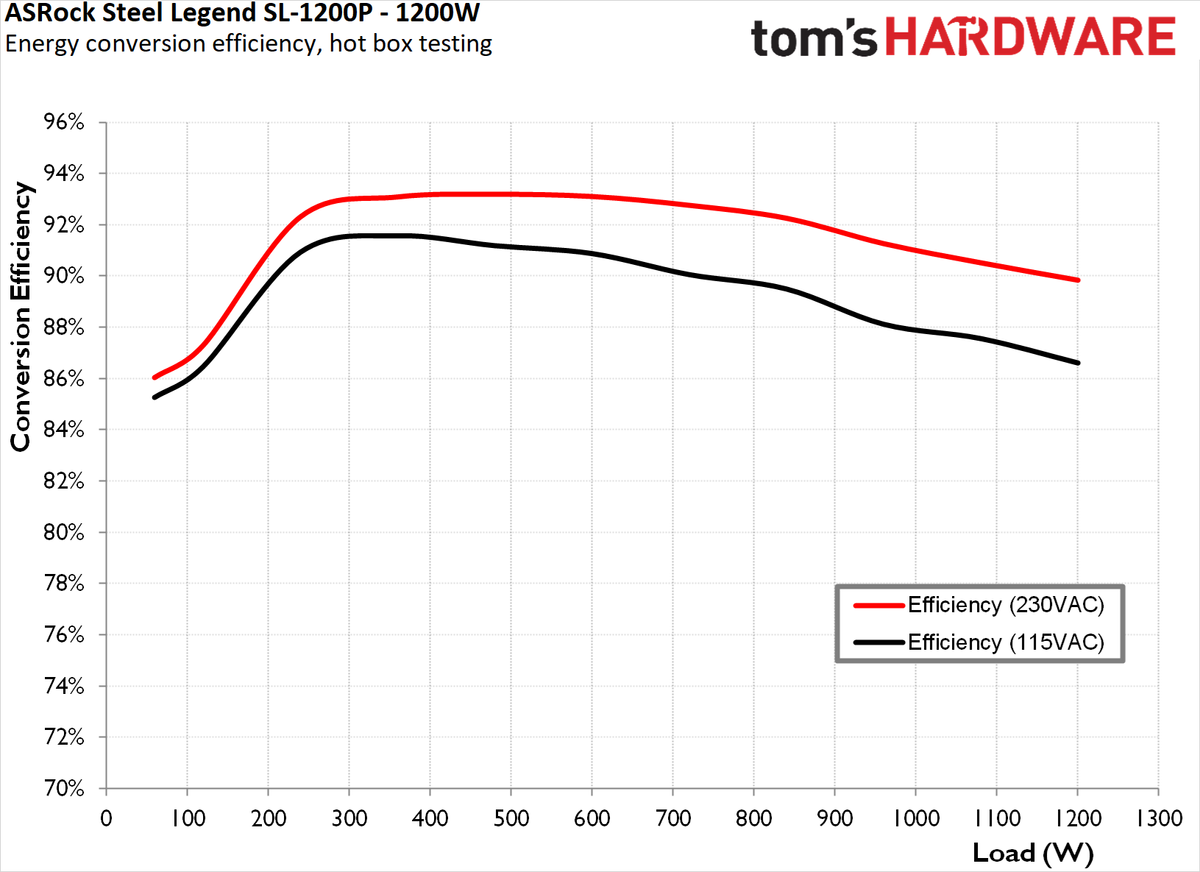
Hot ambient temperature brings average efficiency down to 89.3% at 115 VAC and 91.6% at 230 VAC. The drop relative to cold testing is meaningful, though somewhat consistent with what physics demands. The unit showed no signs of thermal stress or output instability, which matters more than the efficiency figure itself.
Image 1 of 5
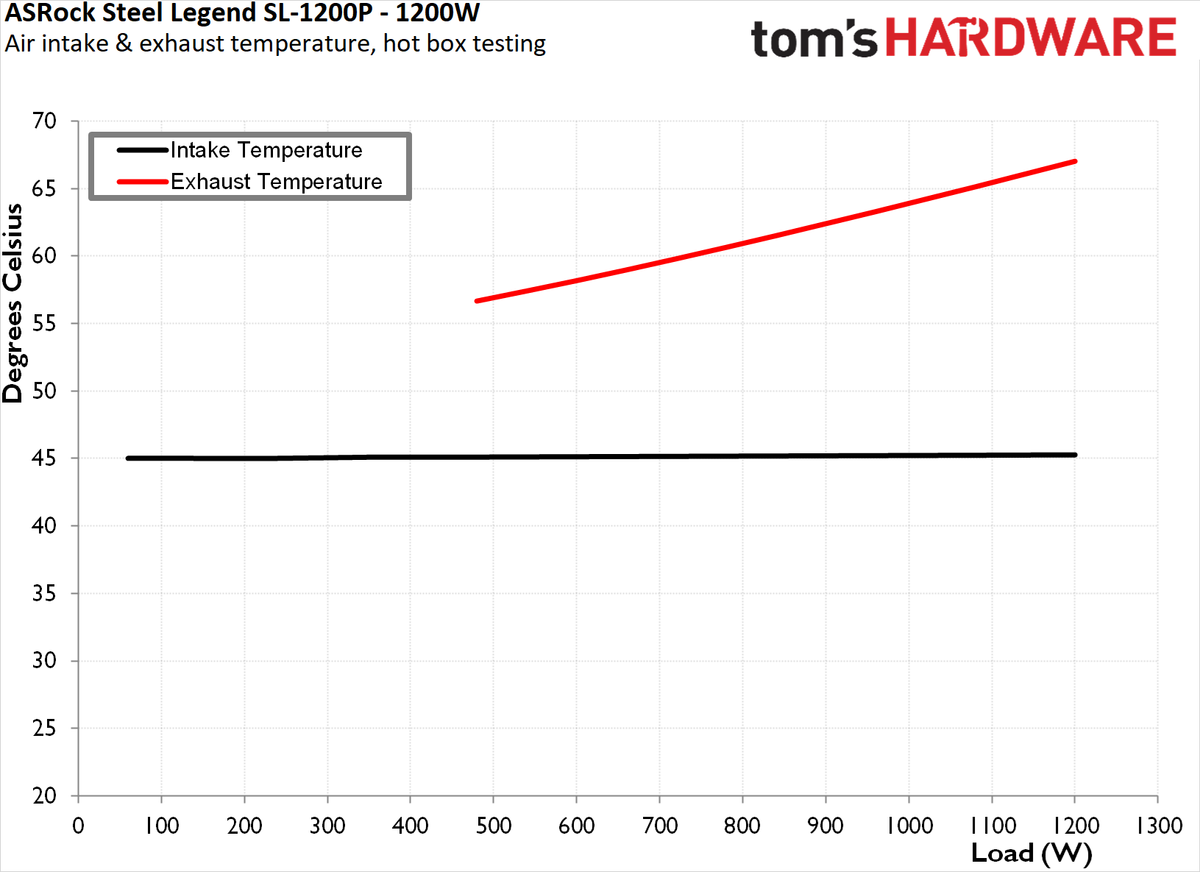
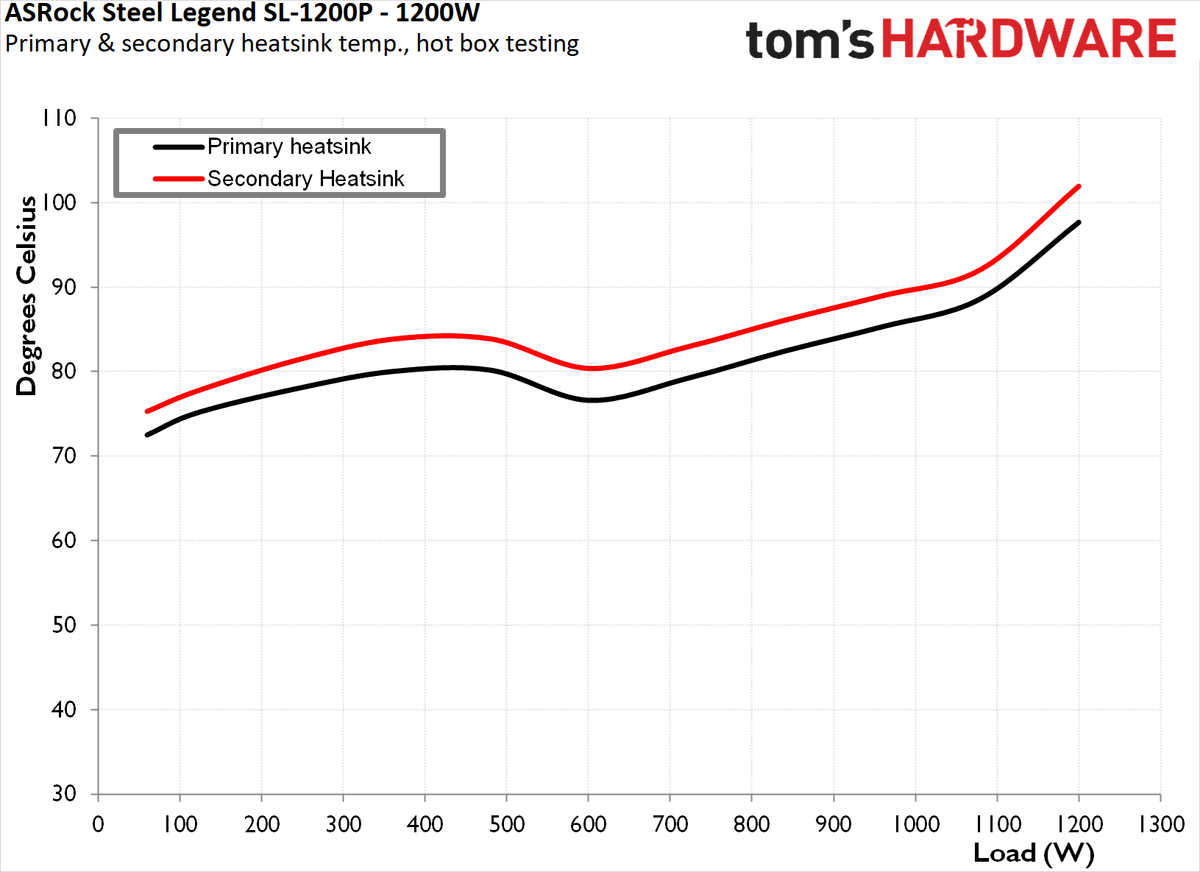
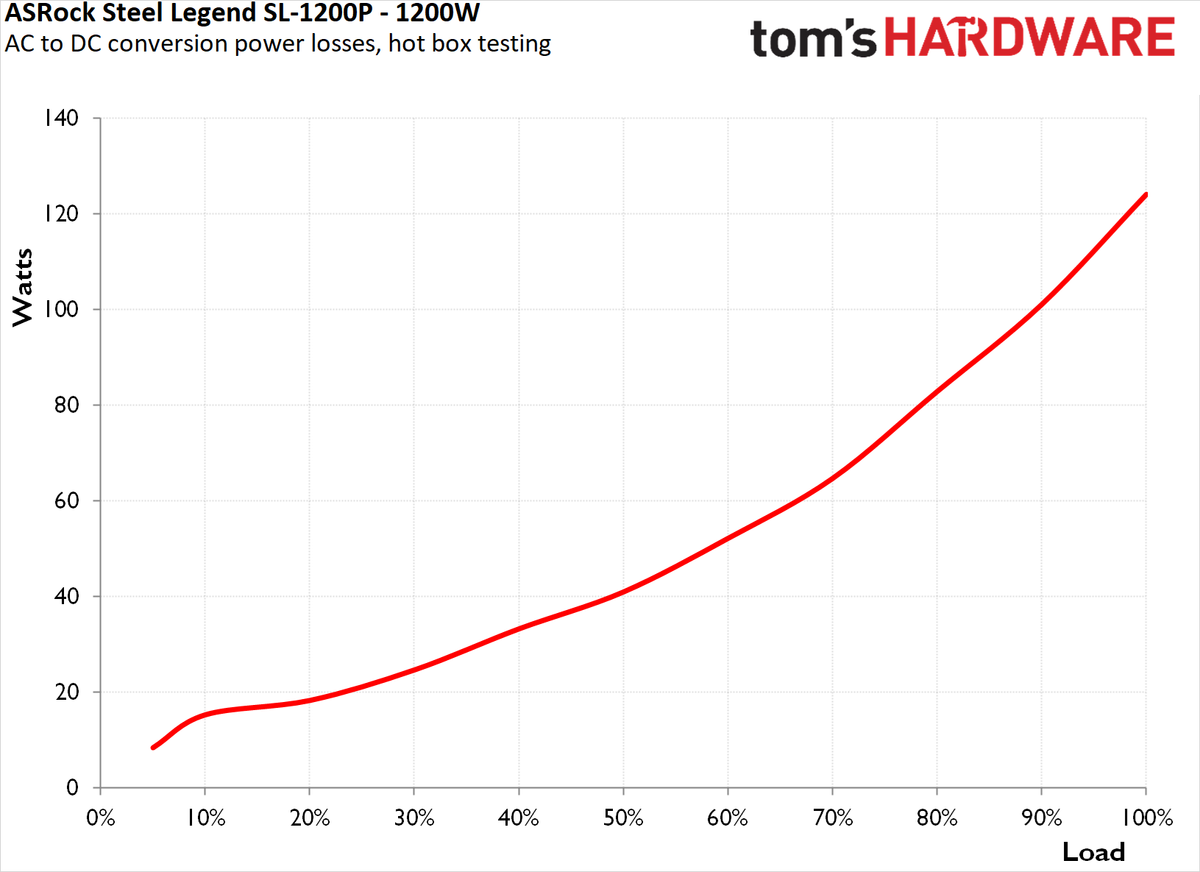
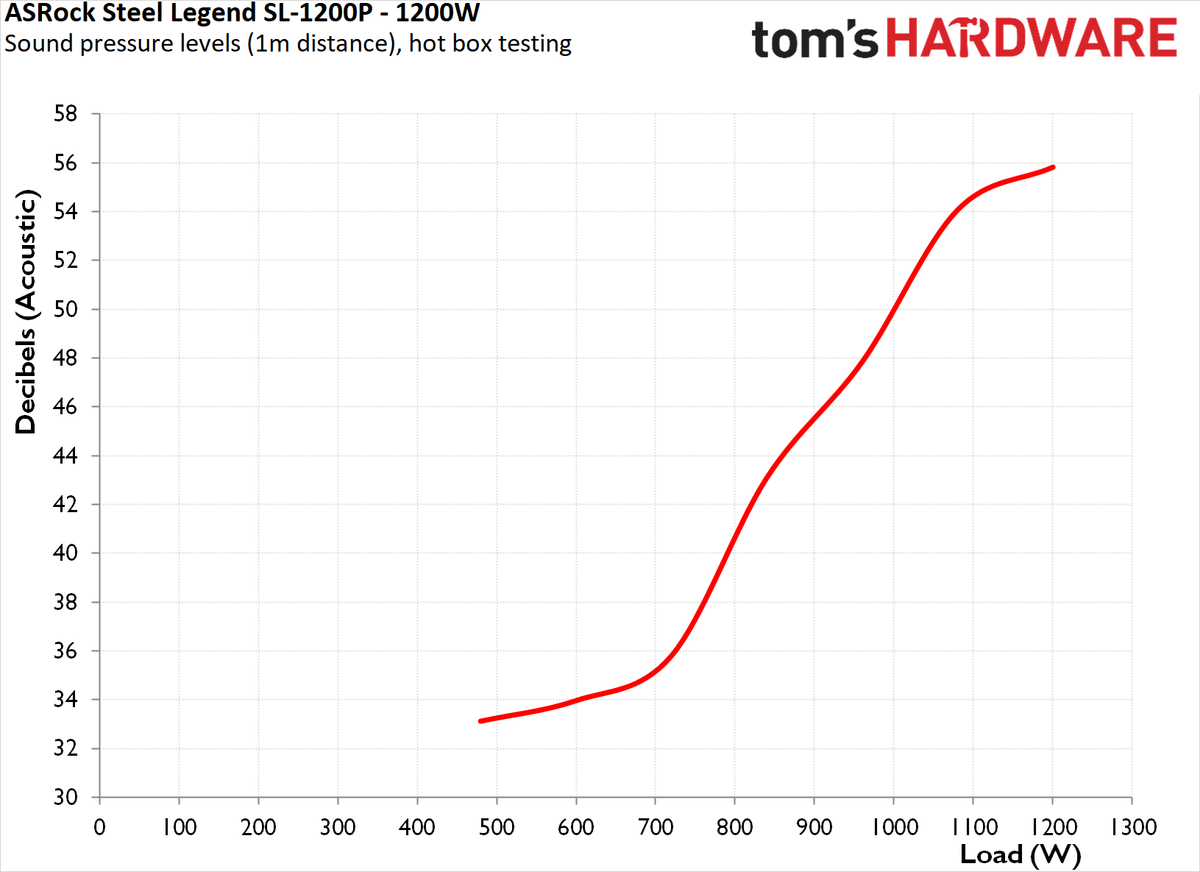
The fan activates sooner under heat, engaging around 450W, and accelerates more aggressively. It reaches its maximum speed by 90% load. Internal temperatures are controlled up to that point, but climb notably in the final 10% of the load range. The fan simply cannot keep pace with the thermal losses at that level, even though the heatsinks are sizable. Still, the unit remains within safe operational limits and our readings were well clear of any OTP event. At full load under these conditions the unit is intrusively audible. Under moderate loads it remains quiet.
PSU Quality and Bottom Line
Power Supply Quality
Voltage regulation is solid on the 5V and 3.3V rails at 0.5% and 0.8% respectively, and good on the 12V rail at 1.3%. That last figure does sit fractionally above the 1% threshold that many treat as a benchmark on a top-tier product. It is not a practical concern in virtually any build, but it is worth acknowledging in a unit at this price point. Ripple suppression is excellent across all three rails: 36 mV on the 12V, 28 mV on the 5V, and 26 mV on the 3.3V. These are genuinely impressive power quality numbers and reflect well on both the design and build quality of the unit.
During our thorough assessment, we evaluate the essential protection features of every power supply unit we review, including Over Current Protection (OCP), Over Voltage Protection (OVP), Over Power Protection (OPP), and Short Circuit Protection (SCP). All protection mechanisms were activated and functioned correctly during testing.
OCP limits are set at 128% for the 3.3V rail, 120% for the 5V rail, and 114% for the 12V rail. OPP triggered at 116% during hot testing. These are very tight margins for an ATX 3.1 certified unit. While a conservative OCP/OPP tuning prioritizes hardware safety, it does introduce a small theoretical risk of nuisance shutdowns during sustained power spikes. Engineers made a deliberate call here, and it is defensible, but users pairing this unit with two power-hungry GPUs under sustained loads should be aware.
Swipe to scroll horizontally
Load (Watts) |
241.74 W |
Row 0 - Cell 2 | 600.94 W |
Row 0 - Cell 4 | 899.39 W |
Row 0 - Cell 6 | 1194.38 W |
Row 0 - Cell 8 |
Load (Percent) |
20.14% |
Row 1 - Cell 2 | 50.08% |
Row 1 - Cell 4 | 74.95% |
Row 1 - Cell 6 | 99.53% |
Row 1 - Cell 8 |
| Row 2 - Cell 0 | Amperes |
Volts |
Amperes |
Volts |
Amperes |
Volts |
Amperes |
Volts |
3.3 V |
2.3 |
3.38 |
5.75 |
3.37 |
8.63 |
3.37 |
11.51 |
3.36 |
5 V |
2.3 |
5.03 |
5.75 |
5.02 |
8.63 |
5.02 |
11.51 |
5.01 |
12 V |
18.41 |
12.08 |
46.02 |
12.01 |
69.03 |
11.98 |
92.04 |
11.93 |
Swipe to scroll horizontally
Line |
Regulation |
Voltage Ripple (mV) |
|||||
| Row 1 - Cell 0 | (20% to 100% load) |
20% Load |
50% Load |
75% Load |
100% Load |
CL1 |
CL2 |
3.3V |
0.8% |
18 |
20 |
22 |
26 |
20 |
26 |
5V |
0.5% |
20 |
20 |
26 |
28 |
22 |
26 |
12V |
1.3% |
28 |
30 |
32 |
36 |
36 |
30 |
Bottom Line
At $180, the ASRock Steel Legend SL-1200P is priced firmly but not unreasonably. It delivers dual 12V-2x6 outputs, certified Platinum efficiency, excellent output quality, and a visual identity that is genuinely uncommon in a category dominated by black enclosures. We think that the grey cable aesthetic alone will be a selling point for a meaningful portion of the market, and unlike many cosmetic choices in PC hardware, it costs nothing in terms of functionality.
The HEC platform here performs at a higher level than that OEM's historical reputation might suggest. HEC has spent decades producing competent but, bluntly put, unremarkable mid-tier designs, and the SL-1200P represents a genuine step forward for them. ASRock's component choices reinforce this, with the exclusive use of Nippon Chemi-Con across the entire secondary stage, Rubycon capacitors in the APFC section, and Infineon CoolMOS transistors throughout the primary side active circuitry. These are not budget substitutions. The result is a unit that measures like it was built seriously, with ripple figures that comfortably outperform most of the competition at this wattage.
The cable temperature sensors are a feature worth dwelling on. It addresses a failure mode that has caused real damage in real systems. The implementation is inelegant in the sense that a properly specified connector standard should not require an external thermal workaround, but the engineering intent is sound and the execution is functional. For anyone running a power-hungry GPU at sustained loads, the peace of mind it provides is not trivial. To further address this issue, the OCP and OPP thresholds are tight for an ATX 3.1 design and reflect a deliberate engineering priority toward hardware protection over tolerance of transient excursions. This is the right call in most scenarios, but users pairing the SL-1200P with two GPUs known for aggressive power spiking should keep it in mind.
We could not identify critical issues that would undermine the overall case for the SL-1200P. The PSU market at 1200W is competitive, and there are capable alternatives from established names. What this unit offers that most of them do not is a very good balance — a coherent combination of genuine Platinum performance, dual 12V-2x6 wiring with active thermal monitoring, premium components throughout, and an aesthetic that actually stands out. For users building or upgrading around a current-generation high-wattage GPU and want strong electrical performance plus a PSU that looks different from everything else in the segment, it earns a clear recommendation.
MORE: Best Power Supplies
MORE: How We Test Power Supplies
MORE: All Power Supply Content






 English (US) ·