
 4 weeks ago
68
4 weeks ago
68
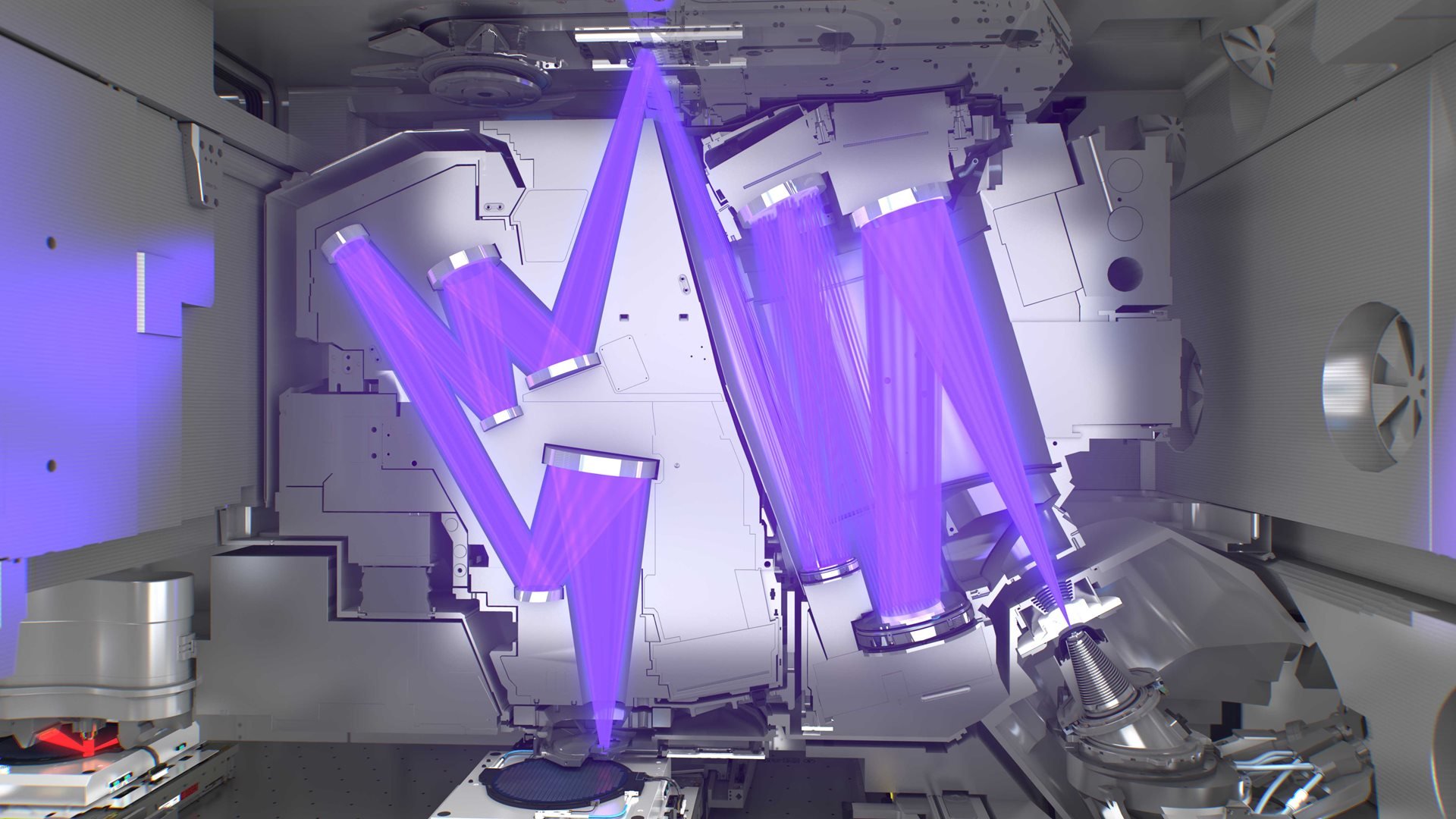
ASML is reportedly considering increasing prices of its existing Low-NA EUV lithography tools. The potential price hikes have already upset TSMC, ASML's largest client, reports The Information. But can ASML rapidly raise the prices of the tools it sells to chipmakers? Price adjustments are not going to happen overnight, said Roger Dassen, CFO of ASML, said during the company's quarterly earnings call. But there is one thing to remember about ASML's price hikes: They are going to affect the entire semiconductor industry.
"When it comes to Low-NA [EUV tools] pricing, of course, you know that we keep on increasing the productivity of the Low-NA tool, [which] gives us a pretty strong runway for potential price improvements going forward," said Roger Dassen, chief financial officer of ASML, during the company's quarterly earnings call. […] Given the long order lead times that we have, that does not translate into pricing effects tomorrow."
ASML just reported record results for its second quarter of 2026, with total net sales of €9.326 billion ($10.67 billion) and net income of €2.918 billion ($3.338 billion). The company now expects net sales between €43 billion ($49.2 billion) and €45 billion ($51.5 billion) in 2026, a range that comfortably exceeds its own guidance and the expectations of industry analysts.
More complex, more expensive
ASML has generally increased the average selling price of EUV scanners over successive generations as they increase in complexity and productivity, so the idea of higher pricing of EUV tools is not particularly new. The company calls the concept of 'value-based pricing' and gradually increases its average selling price (ASP) based on the value that its tools provide to its operators.
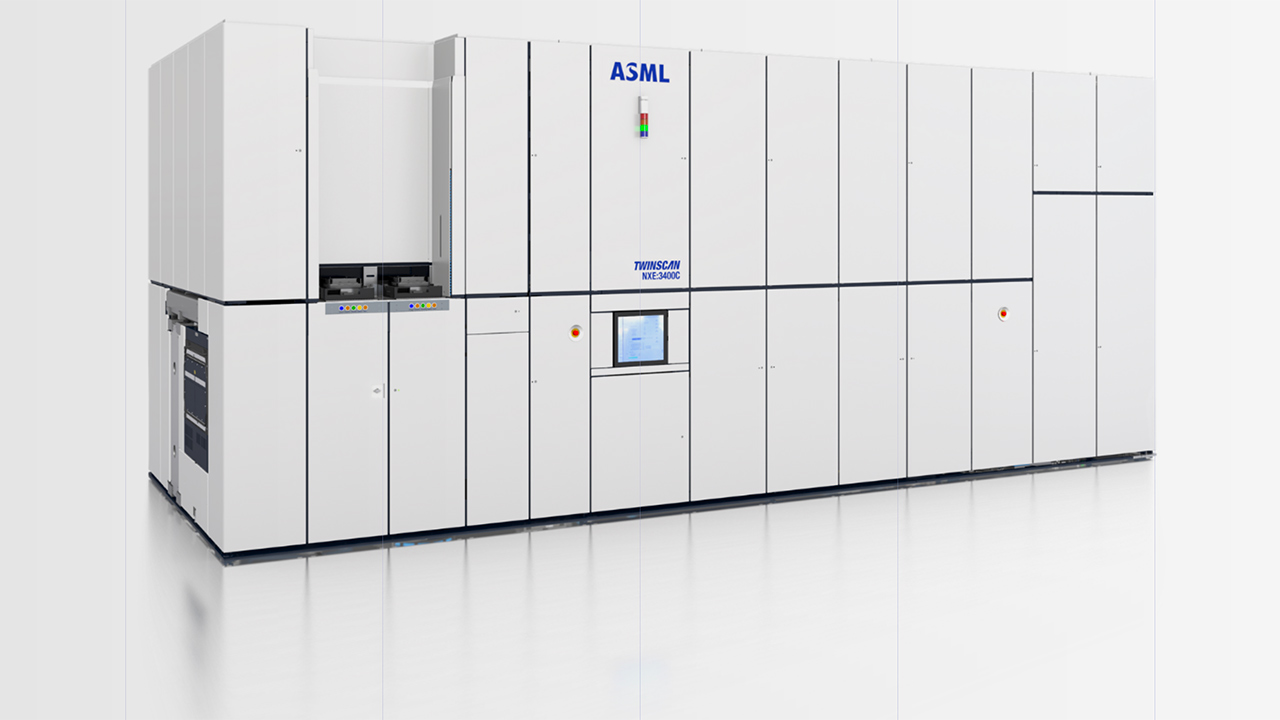
Early ASML Twinscan NXE systems were commonly discussed in the roughly €100 million–€120 million ($115 million-$137 million) range, while later production models such as the NXE:3400C and NXE:3600D moved toward roughly €140 million–€170 million ($160 million-$195 million). The latest NXE:3800E is climbing even further. High-NA EXE systems represent another major step up, at more than €350 million ($400 million) per machine according to industry reports.
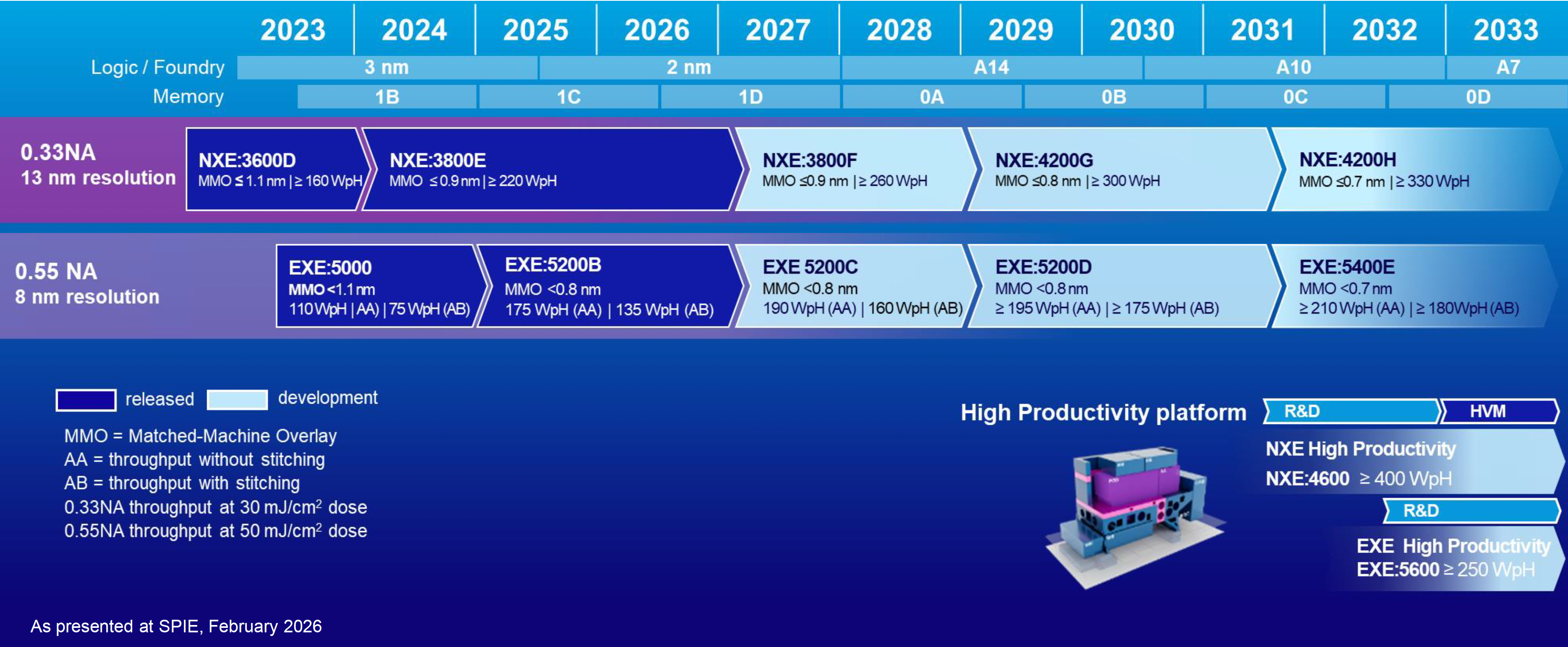
Meanwhile, both productivity and performance of ASML's Twinscan NXE systems have been steadily increasing: While the NXE:3400C and NXE:3600D can process 160 – 170 wafers per hour (WPH) and feature a matched machine overlay (MMO) of ≤ 1.1nm, the NXE:3800E and NXE:3800F increase productivity to 220 WPH and 260 WPH, respectively, while increasing MMO to 0.9nm. With the NXE:4200G and NXE:4200H (which will likely feature an all-new light source), we are looking at productivity beyond 300 WPH and MMO of ≤0.8nm - ≤0.7nm.
ASML makes no secret that more advanced EUV lithography tools carry a higher average selling price than their predecessors.
"You should also recognize that the tool mix that we are going to ship next year is a different tool mix from the tool mix that we shipped this year," Dassen said. "When it comes to EUV in particular, the tool mix that we are going to ship next year will be EXE: 3800E and EXE:3800F [tools], while this year it is a combination of EXE:3600D and EXE:3800E [systems]."
ASML's value-based pricing logic is essentially: if an upgraded Low-NA machine processes more wafers and therefore generates more economic value for a fab, ASML can capture part of that additional value through a higher system price. This is what ASML has been doing for some time. That said, the important nuance in Dassen's statement is that he appears to be discussing further price increases for Low-NA EUV tools.
ASML's EUV dominance
ASML is the only supplier of EUV lithography systems on the planet; every single chipmaker must comeq to the company to get one of these scanners, so the company sells these machines years in advance. This year, the company expects to have the capacity to build 65 EUV tools and intends to increase capacity by 30% next year to around 84 – 85 EUV systems. In 2028, ASML plans to produce 110 EUV scanners.
"For 2027, we are now close to being fully covered with orders for Low-NA EUV, and we are planning to increase our Low-NA EUV capacity by around 30%," Dassen said. "Looking ahead to 2028, we have already received a significant number of Low-NA EUV orders. Strong demand forecasts from our customers have led us to investigate a further 30% capacity increase for that year."
Given the strong demand for ASML's tools, the company is in a position to increase prices, at least according to the rules of the free market. As always, comments on pricing are made in opaque corporate language, so one can make a lot out of it, or nothing at all.
"Clearly, the environment that we live in today, with the [substantial] value that our products bring to customer, of course, gives us flexibility on pricing, more so than what you would have seen in the past," Dassen said. "Of course, we are executing on that as well."
However, it is not that easy for ASML to just hike prices overnight, and there are important things to note. When ASML gets an order, and that order enters the reported backlog (which totaled €38.8 billion as of late Q4 2025), it already carries a sales value (with a possibility of inflation adjustments), so there is necessarily an agreed or otherwise contractually determined price basis attached to it.
This makes Dassen's comments particularly interesting. If ASML is already close to fully booked for 2027 Low-NA EUV capacity and has received a significant number of Low-NA orders for 2028, then much of that capacity is already represented by customer orders with associated sales values. As a result, unless ASML can subsequently renegotiate the fixed price before delivery, it cannot hike prices on tools that it intends to ship in 2027 and part of 2028. This essentially means that ASML could only book new orders that it intends to ship in 2028 (presumably for the second half of the year) and onwards at higher prices. However, ASML has not confirmed this directly.
ASML's next-generation NXE:4200G is on track to arrive in 2029. That scanner is poised to be more expensive than the NXE:3800E/NXE:3800F anyway, so the company's Low-NA EUV ASPs will inevitably get a bump that year. Of course, ASML is set to continue shipping its EXE:3800-series after 2029. The big question is whether the company will adjust the prices of these units that will ship starting in 2028 or not.
We do not know the answer to this question, unfortunately. But during the conference call, ASML's financial chief implied that the company would like to get 'rewards' from its customers not only for improved productivity, but also for other improvements of its tools, which means that ASML will stick to its value-based pricing model, but may adjust the pricing for the EXE:3800 model.
"We have always been able to show customers not just productivity upgrades, but also the value from better imaging, the value of better overlay, etc.," Dassen said. [But] you got this very strong correlation between throughput improvements and ASP. That is just the way things panned out, which, put in another way, customers were paying for the productivity upgrade, and the value that we gave them for free was the value associated with, let us say, overlay improvement, imaging quality […]. In the current environment, with the value that we bring, we are also having conversations with customers on how we get rewarded for that additional value."
TSMC's backlash against the price hikes
As ASML will likely not be able to hike prices on EUV tools that have already been pre-ordered and which are set to be delivered in the course of the next two years, existing chipmakers like TSMC will not feel the effects of the price increase at least over the next 24 months. Of course, if ASML adjusts prices of its EXE:3800-series scanners due to ship in 2028 – 2028, nobody is going to be happy. And yet, TSMC seems to be so upset that the sentiment has made it to the press. There are several reasons behind the reported backlash, but the major one seems to be strategic.
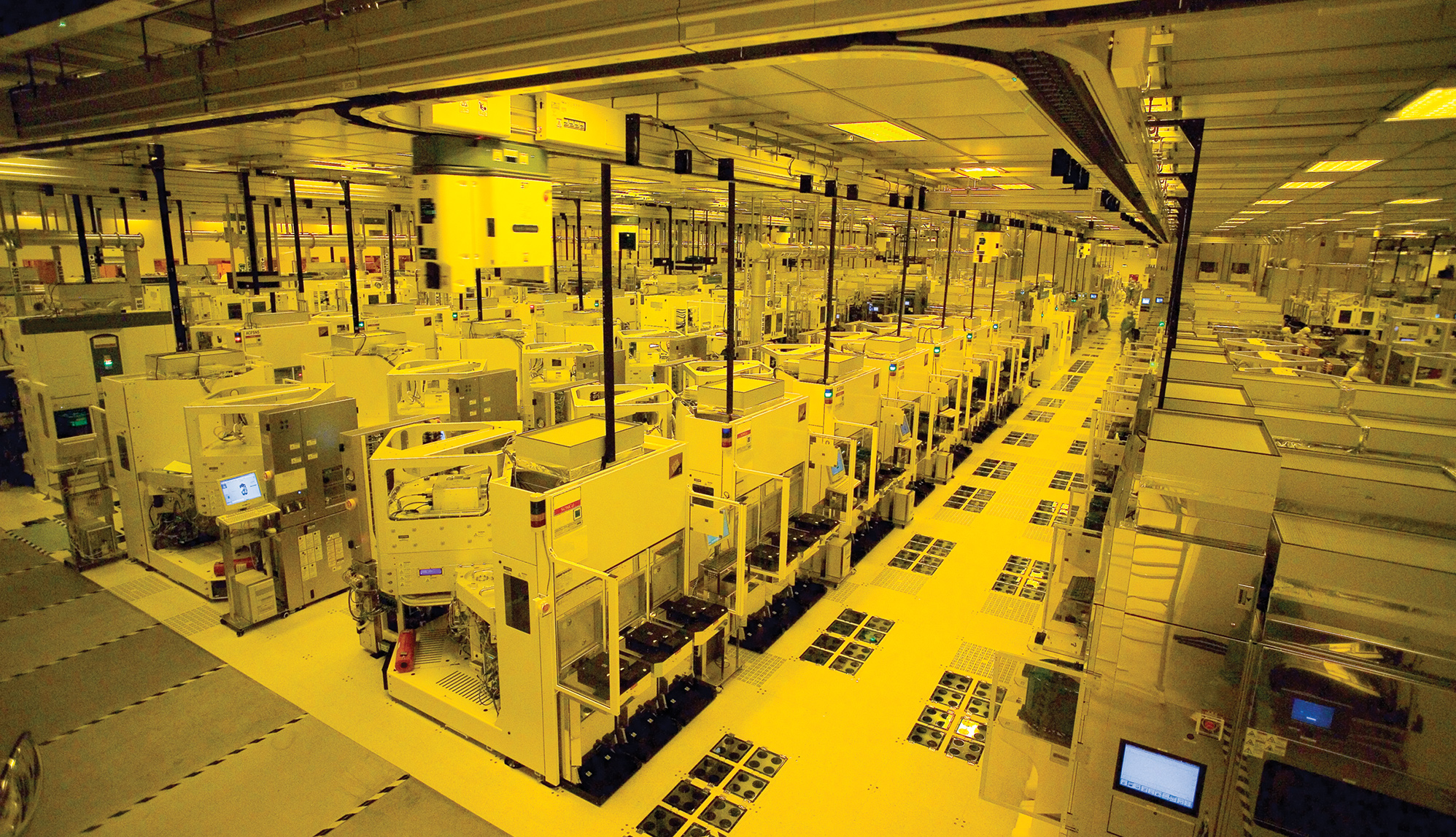
For years, TSMC has said that ASML's High-NA EUV lithography tools were too expensive, and that the company's engineers can continue innovating using Low-NA EUV systems. Also, adopting all-new High-NA EUV scanners will not be an easy undertaking in general, as the transition also requires new photoresists, photomasks, pellicles, metrology equipment, design rules, computational lithography flows, and numerous other supporting technologies and process innovations.
TSMC's mid-term expansion strategy, as well as a leading-edge roadmap through 2030, has been built around extracting more performance and resolution from conventional Low-NA EUV scanners using techniques such as improved masks, computational lithography, and multi-patterning where necessary. If ASML proceeds with its price hikes for Low-NA EUV tools, this can seriously hit one of the key economic foundations of TSMC's strategy.
TSMC's intention to avoid the usage of High-NA EUV scanners until at least 10A-class (1nm) process technology has an important economic advantage. A High-NA EUV system costs more than €350 million, whereas Low-NA systems are substantially cheaper. As a result, TSMC can choose its own trade-off between additional process steps and buying much more expensive lithography equipment. In contrast, Intel, which is set to adopt High-NA EUV lithography for its 14A fabrication process, has much less flexibility: If a particular process technology is designed around High-NA EUV layers, these extremely expensive scanners, along with other ingredients, become part of the manufacturing flow and affect wafer pricing.
One of the reasons TSMC would like to extend usage of Low-NA EUV systems is that it already has the world's largest install base of these tools, as well as mature processes, established flows, and plenty of innovations that enable it to stay ahead of the competition. However, if ASML systematically ties productivity improvements of each new Low-NA EUV generation to higher prices, the cost advantage of staying with Low-NA EUV gradually narrows, which greatly undermines TSMC's strategy.
There are several other reasons for TSMC to be particularly unhappy with ASML. Firstly, TSMC needs an enormous number of tools for its upcoming fabs in Taiwan, the U.S., and Japan. All of the company's leading-edge process technologies through 2029 rely on Low-NA EUV production tools. Even a relatively modest percentage increase applied to dozens of Low-NA EUV scanners can add billions of dollars to the company's capital expenditure (CapEx).
Secondly, ASML is essentially arguing that it deserves a share of its customers' improved economics. From TSMC's perspective, potential price adjustments are very different from charging more because a new scanner is materially more expensive to manufacture. ASML is effectively saying: 'Your fabs are more profitable, and our tools are more productive, therefore we want a piece of that.'
Thirdly, pricing negotiated today determines pricing and TSMC's economy for years to come. Now that ASML is sold out for 2027 and a significant part of 2028, it is negotiating terms for the second half of 2028 and onwards. Accepting a substantial increase now will inevitably carry through to dozens or hundreds of future Low-NA EUV systems, which directly affects TSMC's economics.






 English (US) ·