
 2 weeks ago
29
2 weeks ago
29
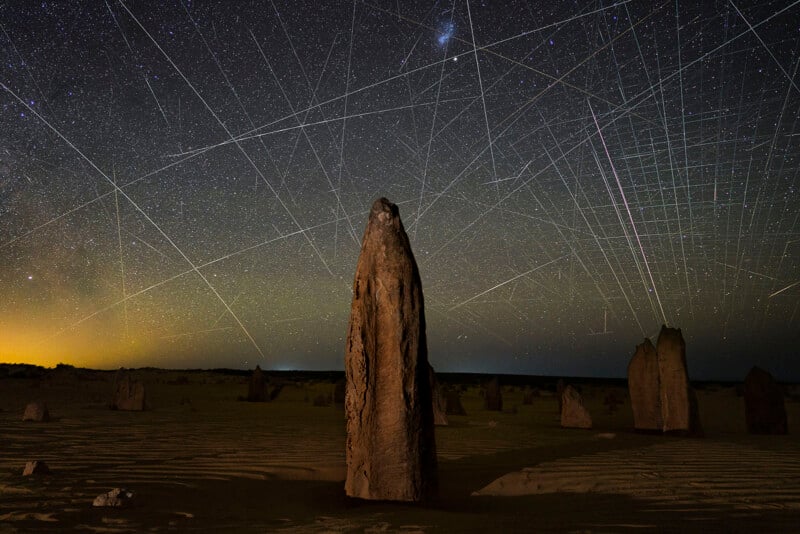 ‘Swamped Skies’ by Joshua Rozells.
This week SpaceX passed an eye-watering milestone: it launched its 10,000th satellite into low-Earth orbit. The sheer scale of the devices whizzing around above humanity is unimaginable, but photographer Joshua Rozells is helping people see.
Rozells’ image, Swamped Skies, is a composite of 343 photos that all contain at least one satellite streak. The Australian photographer didn’t set out to make the image; he originally wanted to capture star trails.
“I was surprised,” Rozells tells PetaPixel. “I had previously seen satellite streaks in my photos but never this many. Previously I might have seen a few over the course of the night, but this night had streaks in almost every photo, particularly those taken in the 90 minutes or so after sunset.”
Rozells took the image in the Pinnacles, Western Australia, where there are many limestone formations. He took the photo back in January 2021 but the image remains relevant because since he took it, there are thousands more satellites in the sky.
“The end result is 343 photos (over 85 mins) worth of satellite images blended together with a low-light level photo used for the foreground,” he explains. “The sky’s contrast, highlights, and whites were increased to emphasize the satellites. Photoshop was used to blend the satellite trails and remove the gap between the satellite trails.”
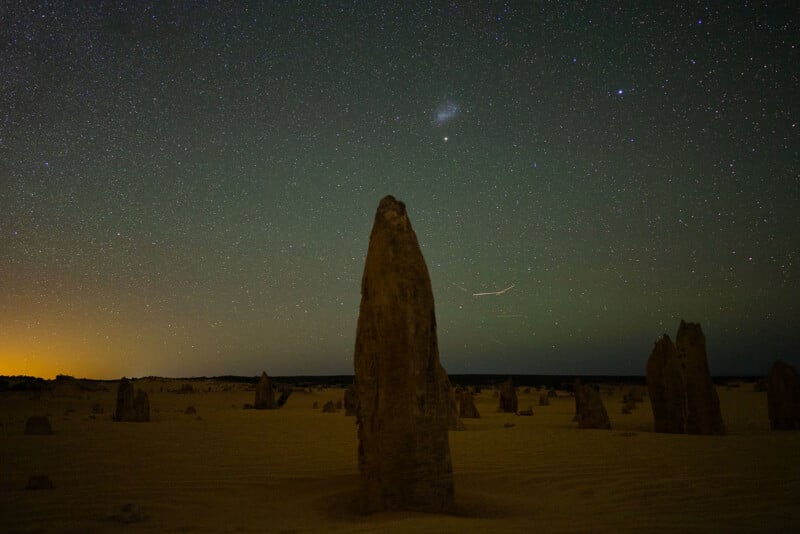 A single frame that’s contained within the composite.
Rozells says the Photoshop work was labor-intensive as each photo had to be layer masked into the main image and later in the night, there was airglow so his layer mask brush had to be tight around each satellite to ensure sky color consistency.
The astrophotographer says after he created the image, he researched satellite pollution and was “surprised” by the rapid increase in satellites launched each year and the “lack of regulation” around the industry.
“In most countries, there are very few restrictions for launching satellites, as long as you have a legitimate purpose for doing so,” he says. “Big businesses, such as SpaceX, have been able to launch as many as they like with very little pushback. Most are low-orbit satellites provide internet access to people in very remote locations, which is beneficial, but measures are needed to address the light pollution they cause (and other issues).”
As Rozells points out, satellite light pollution not only affects astrophotography but astronomy too; it makes telescope data less reliable and research more time-consuming.
“It’s becoming harder and harder to experience the grandeur of the unpolluted night sky, both because of urbanization, light pollution, and satellite light pollution,” he adds.
Rozells says his image has opened a lot of eyes to the issue of satellite light pollution. “It is an issue they would have never seen in person, particularly those who live in heavily light polluted areas,” he says.
“I see it as a warning of the effects of satellite light pollution,” he adds. “That this is an issue that is getting exponentially worse and it will continue to do so if we do not take major steps being undertaken to mitigate the problem. But it also shows the means in which humans have been able to connect people in the most remote areas of the world to the internet — something that is truly remarkable.”
More of Rozells’ work can be found on his Instagram.
Image credits: Photographs by Joshua Rozells






 English (US) ·