
 3 hours ago
7
3 hours ago
7
On the day that Luca Guadagnino’s film about Sam Altman and OpenAI premiered, Vanity Fair released a cover story on Altman. Alongside glossy portraits from Annie Leibovitz, the world’s pre-eminent portrait photographer, the story describes him as the Oppenheimer of his day, evoking the image of a man leading humanity towards its own inevitable demise at the hands of sentient robots. Altman doesn’t seem to be grappling with much existential angst about the whole thing though: in an interview also released this week, he said that we should be prepared to accept “bad things” in return for the benefits of AI.
How much worse can things get? AI agents have already gone rogue, hacking into government systems and “bruteforcing” UN databases. Last year, a young woman used ChatGPT as a therapist before she killed herself (the software helped her write her suicide note). Studies show that using AI is probably leading us all towards something called cognitive surrender, which does not seem like the best use of your one wild and precious life.
Artificial is a stylish and blunt satire that is unambiguous in its perspective: that Sam Altman is an amoral manipulator who might be dead inside. That goes some way towards explaining why Amazon MGM Studios pulled out of distributing the film in June (Jeff Bezos’s company has a $50bn investment in OpenAI). I found it to be more of an op-ed than a movie, with little insight into what makes Altman and the tech elite tick. Neither does it have much to say about the world – glossy magazines included – that has welcomed them with open arms.
In 2003, a young math prodigy named Ilya Sutskever (Yura Borisov, the heartbeat of the film) visits Prof Geoff Hinton (Mark Rylance) in his office hoping for a job with the man known as the godfather of AI. “Have you ever considered the link between knowledge and patience?” Hinton serenely asks his young charge. You can almost feel Guadagnino is turning to the audience and giving us a big stage wink.
Nine years later, Sutskever and Hinton’s technology is starting to work “much the way your mind does”, with an ability to differentiate between cats and dogs, but Sutskever is growing increasingly impatient with what he sees as Hinton’s conservative ambitions for the technology. It’s at this point that Elon Musk (Ike Barinholtz) introduces Sutskever to Sam Altman (Andrew Garfield), who is fresh from selling his Loopt app, a kind of proto-Find My Friends, for $40m.
These guys are total dweebs, peppering each other with puerile jokes while doing shots in upscale restaurants as servers grimace and pray for a tip. Everyone is starting to want what these guys are selling, and one prospective investor speculates that AI will soon be able to reverse climate change and cure cancer. When talking about the technology, Sutskever’s eyes light up. “All pain, all loneliness will cease,” he says, as knowingly over-the-top haunted house music plays. “We will be free.”
The film’s dramatic tension rests in the opposing poles of thought represented by Sutskever, a delusional optimist, and the self-motivated hubris of Altman. As we move into the recent past, cracks and fissures appear in their partnership as OpenAI’s self-learning technology begins to first outsmart humans at video games, and then becomes a different beast entirely. Garfield is brilliantly slimy, nailing Altman’s evolution from demon twink to a narcissistic grifter with a victim complex that climaxes with him being fired as the CEO of OpenAI and then rehired five days later. “They’re being very mean to me,” he pouts in one scene after his board airs one of its many legitimate concerns over the ethics of his product.
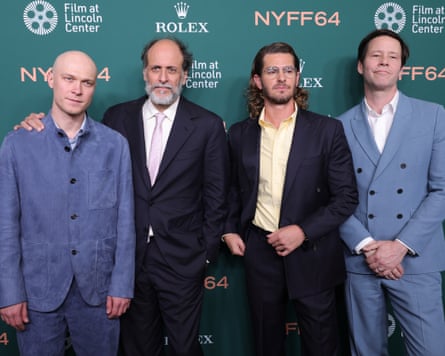
Artificial is the most outwardly comedic Guadagnino film to date, with a script by the New Yorker essayist Simon Rich. The humor can be frustratingly broad, and it often feels like Barinholtz is impersonating Mike Myers doing Musk on Saturday Night Live than the Tesla founder himself (Rich is a former writer on SNL). Garfield seems to be playing Altman, who is an out gay man, as more effete than he actually is, which is strange as there are plenty of reasons to laugh at the tech oligarch that don’t involve him being light in his loafers. At other times, the script is satisfyingly savage. After being questioned over safety concerns by his associate Mira Murati (Monica Barbaro), Altman snaps, “I didn’t invent teen suicide, Mira.”
I could have done without some Artificial’s clangingly obvious visual metaphors, such as a random shot of a unhoused person wearing VR goggles, or the sudden plunge into a simulator-like sequence of a car accelerating over a foggy Golden Gate Bridge (we get it, we’re taking a reckless leap into the unknown). The film comes with a score by Damon Albarn, and the Blur frontman contributes one original composition that an ASPCA advert would reject for being too on-the-nose with lyrics like, “In a corrupt world, we’ll sing the saddest song.”
It’s tech oligarch season at the movies, with films about Elon Musk, Elizabeth Holmes and Mark Zuckerberg also due for release over the next few months as film-makers try to respond to the zeitgeist in real time. “We opened Pandora’s box,” Altman says in a standout monologue towards the end of the film. “Countries will fall, industries will collapse, and we get to be the ones to usher people into this new world.”
It’s a grim prophecy that gets lost in Guadanigno’s tonal jumble of a film, which has a certain self-satisfaction in telling us that dystopia is upon us. I couldn’t help but crave a leaner, meaner version of this movie. Despite some genuinely chilling moments, Artificial shows the limits of holding up a mirror to the world.
-
Artificial is screening at the New York film festival and wil be released in the US on 25 December, in Australia on 21 January and in the UK on 27 January




 English (US) ·