
 3 weeks ago
59
3 weeks ago
59
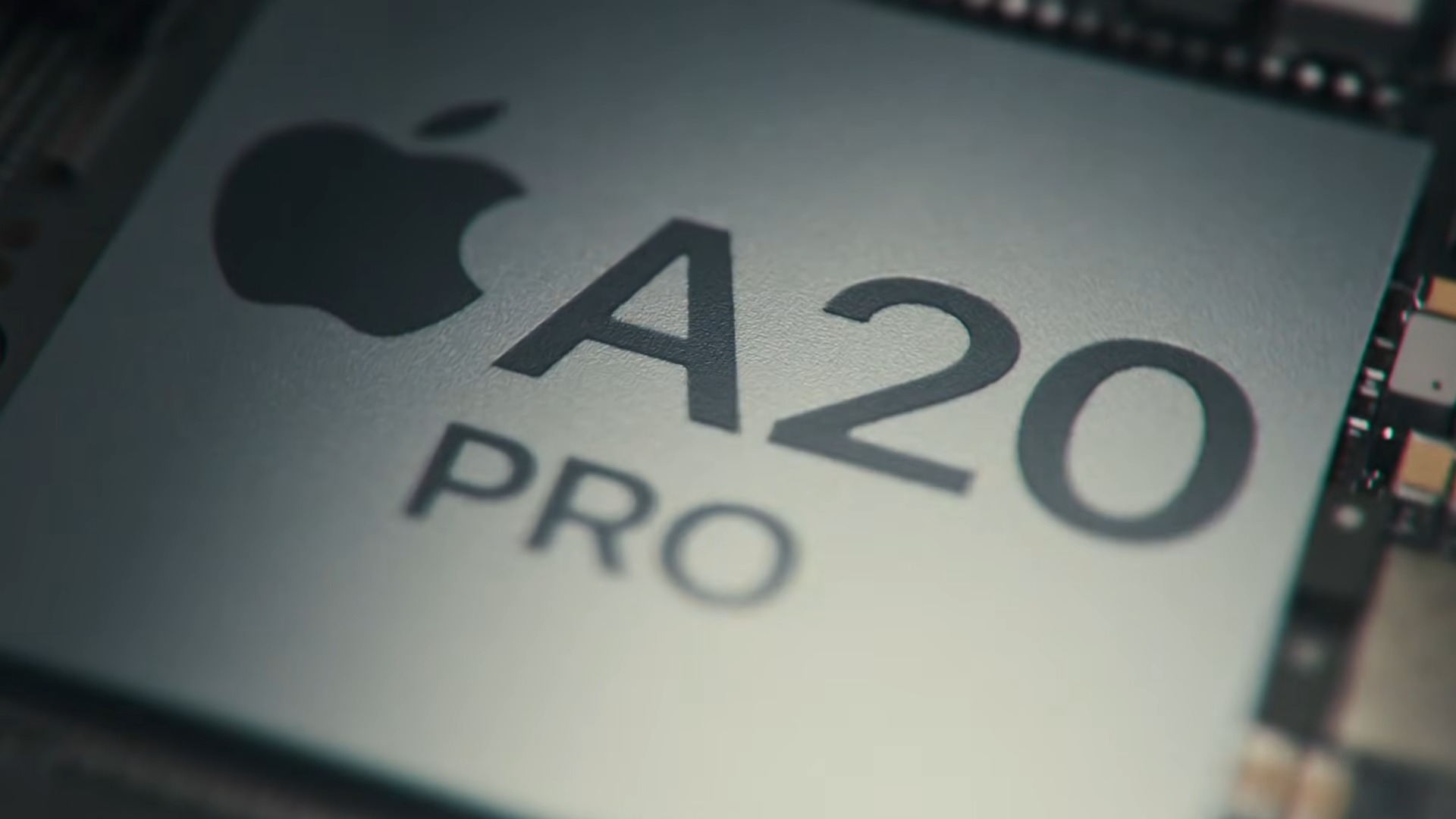
Architectural enhancements and significantly higher clock speeds enable Apple's A20 Pro application processor (AP), used in the company's latest iPhones, to deliver not only a substantial generation-to-generation performance boost but also to outperform leading desktop CPUs from AMD and Intel by up to a whopping 32% in the single-thread Geekbench 7 benchmark, setting the record for the highest single-thread performance. While high-end PC CPUs still have more oomph for multi-threaded workloads, the tiny A20 Pro is still faster than mainstream laptop CPUs even when many threads are involved.
Fastest smartphone SoC
Swipe to scroll horizontally
| Row 0 - Cell 0 | A20 Pro |
A19 Pro |
A18 Pro |
A17 Pro |
A16 Bionic |
General specifications |
2P+4E, up to 4.93 GHz |
2P+4E, up to 4.26 GHz |
2P+4E, up to 4.0 GHz |
2P+4E, up to 3.77 GHz |
2P+4E, up to 3.46 GHz |
Single-Thread |
4006 |
3249 |
3082 |
2641 |
2405 |
Multi-Thread |
11460 |
9016 |
8185 |
7050 |
6600 |
Apple's A20 Pro system-on-chip (SoC) delivers 4,006 points in single-thread and 11,460 points in the multi-thread Geekbench 7 benchmark, which represents a 23.3% higher ST performance and 27.1% higher MT performance compared to the immediate predecessor, the Apple A19 Pro, according to an early submission (which may or may not demonstrate performance of actual A20 Pro-based products, so take the results with a grain of salt).
Swipe to scroll horizontally
Generation |
Single-thread |
Improvement |
Multi-thread |
Improvement |
A16 Bionic |
2,405 |
— |
6,600 |
— |
A17 Pro |
2,641 |
9.80% |
7,050 |
6.80% |
A18 Pro |
3,082 |
16.70% |
8,185 |
16.10% |
A19 Pro |
3,249 |
5.40% |
9,016 |
10.20% |
A20 Pro |
4,006 |
23.30% |
11,460 |
27.10% |
The new SoC delivers the highest generation-over-generation performance improvement for Apple's smartphone processors in years and is currently the highest-performing mobile AP. Furthermore, the A20 Pro beats AMD’s 16-core Ryzen 9 9950X3D by 26% and Intel’s Core i9-14900KS by 32% in single-thread performance.
Swipe to scroll horizontally
| Row 0 - Cell 0 | A20 Pro |
Snapdragon 8 Elite Gen5 (SM8850) |
Xring O3 |
Exynos 2600 (S5E9965) |
Dimensity 9400 (MT6991) |
Tensor G5 (GS501) |
Kirin 9050 Pro |
General specifications |
2P+4E, up to 4.93 GHz |
2P+6E, up to 4.74 GHz |
2X+4P+4E, up to 4.36 GHz |
1X+3P+6E, up to 3.80 GHz |
1X+3P+4A, up to 3.62 GHz |
1X+5P+2E, up to 3.78 GHz |
1X+2P+4E+2LP, up to 3.10 GHz |
Single-Thread |
4006 |
3047 |
2996 |
2694 |
2273 |
2011 |
1028 |
Multi-Thread |
11460 |
10212 |
11777 |
10580 |
7745 |
5859 |
4794 |
When it comes to the single-thread Geekbench 7 benchmark, Apple's A20 Pro outperforms its closest rivals — Qualcomm's Snapdragon 8 Elite Gen5 (SM8850) and Xiaomi's XRing O3 — by 31.5% - 33.7%. In fact, both SM8850 and XRing O3 perform on par with Apple's two-years-old A18 Pro. The six-core A20 Pro also beats the eight-core SM8850 by 12.2% in multi-thread workloads in Geekbench 7 and offers roughly similar multi-thread performance to the 10-core XRing O3.
Swipe to scroll horizontally
SoC |
Single-thread |
A20 Pro advantage |
Multi-thread |
A20 Pro advantage |
A20 Pro |
4,006 |
— |
11,460 |
— |
Snapdragon 8 Elite Gen 5 |
3,047 |
31.50% |
10,212 |
12.20% |
Xring O3 |
2,996 |
33.70% |
11,777 |
−2.7% |
Exynos 2600 |
2,694 |
48.70% |
10,580 |
8.30% |
Dimensity 9400 |
2,273 |
76.20% |
7,745 |
48.00% |
Tensor G5 |
2,011 |
99.20% |
5,859 |
95.60% |
Kirin 9050 Pro |
1,028 |
289.70% |
4,794 |
139.00% |
Compared with other flagship smartphone processors, Apple's A20 Pro holds a commanding lead in Geekbench 7. It is 76% faster in single-thread and 48% faster in multi-thread performance than MediaTek's eight-core Dimensity 9400, while it nearly doubles the performance of Google's eight-core Tensor G5, with advantages of 99% and 96%, respectively. But the most striking gap of A20 Pro is with Huawei’s Kirin 9050 Pro: Apple's flagship is 290% faster in single-thread and 139% faster in multi-thread Geekbench 7 workloads.
A great laptop CPU
While Apple's A20 Pro continues to feature 'only' six cores like many generations before it, this time around the processor packs two 'super' desktop-class general-purpose cores running at up to 4.93 GHz, four efficiency cores running at lower clocks, and a memory interface that delivers +50% higher memory bandwidth compared to its predecessor (allegedly using a 96-bit memory I/O).
The architectural enhancements of advanced CPU cores running at nearly 5 GHz, along with a more capable memory subsystem, not only enable a massive generational performance uptick, but also allow the chip to offer unbeatable single-thread performance and massive multi-thread performance that is comparable to that of laptop CPUs, including previous-generation laptop CPUs from Apple.
Swipe to scroll horizontally
| Row 0 - Cell 0 | A20 Pro |
A19 Pro |
M5 |
M4 |
M3 |
Ryzen 9 9950X3D |
Core i9-14900KS |
Core Ultra X9 388H |
Core Ultra 5 325 |
Core Ultra 5 332 |
General specifications |
2P+4E, up to 4.93 GHz |
2P+4E, up to 4.26 GHz |
4S+6E, up to 4.6 GHz |
4P+6E, up to 4.40 GHz |
4P+4E, up to 4.05 GHz |
16P/32T, 4.30 GHz - 5.75 GHz |
8P+16E/32T, 3.20 GHz - 6.0 GHz |
4P+8E+4LP/16T, up to 5.1 GHz |
4P+0E+4LP, up to 4.6 GHz |
2P+0E+4LP, up to 4.40 GHz |
Single-Thread |
4006 |
3249 |
3739 |
3351 |
2808 |
3182 |
3024 |
2694 |
2297 |
2134 |
Multi-Thread |
11460 |
9016 |
18671 |
15806 |
12061 |
30428 |
21145 |
18121 |
11107 |
6976 |
Indeed, Apple's A20 Pro is 7% faster than M5, 20% faster than M4, and 43% faster than M3 in single-thread performance. Its six-core design cannot match its multi-thread performance, trailing the 10-core M5 by 39% and the 10-core M4 by 27%. Yet, it is only 5% behind the eight-core M3.
Swipe to scroll horizontally
Processor |
ST score |
A20 Pro ST advantage |
MT score |
A20 Pro MT advantage |
A20 Pro |
4,006 |
— |
11,460 |
— |
A19 Pro |
3,249 |
23.30% |
9,016 |
27.10% |
Apple M5 |
3,739 |
7.10% |
18,671 |
−38.6% |
Apple M4 |
3,351 |
19.50% |
15,806 |
−27.5% |
Apple M3 |
2,808 |
42.70% |
12,061 |
−5.0% |
Ryzen 9 9950X3D |
3,182 |
25.90% |
30,428 |
−62.3% |
Core i9-14900KS |
3,024 |
32.50% |
21,145 |
−45.8% |
Core Ultra X9 388H |
2,694 |
48.70% |
18,121 |
−36.8% |
Core Ultra 5 325 |
2,297 |
74.40% |
11,107 |
3.20% |
Core Ultra 5 332 |
2,134 |
87.70% |
6,976 |
64.30% |
When compared to Intel's Panther Lake, the A20 Pro is 48.7% faster in single-thread performance than the flagship Core Ultra X9 388H, yet the 16-core Panther Lake processor is 63% faster in multi-thread workloads. Against lower-end Panther Lake parts, the A20 Pro is 74% – 88% faster in ST workloads and even leads the Core Ultra 5 325 and Ultra 5 332 by 3% and 64%, respectively, in multi-thread benchmarks.
The particularly striking results of Apple's A20 Pro are the 26% – 33% single-thread advantage over flagship AMD and Intel desktop CPUs, though the desktop processors remain dramatically faster in multi-thread workloads.
First 2nm smartphone SoC
When Apple transitioned to TSMC's N3B (3nm-class) process technology from N4 (4nm-class) with its A17 Pro SoC back in 2023, the new processor was barely 9.8% faster in ST and 6.8% faster than its predecessor A16 Bionic. By contrast, with its first 2nm smartphone SoC made on TSMC's N2 node, Apple offers a massive performance boost over the A19 Pro produced on N3P.
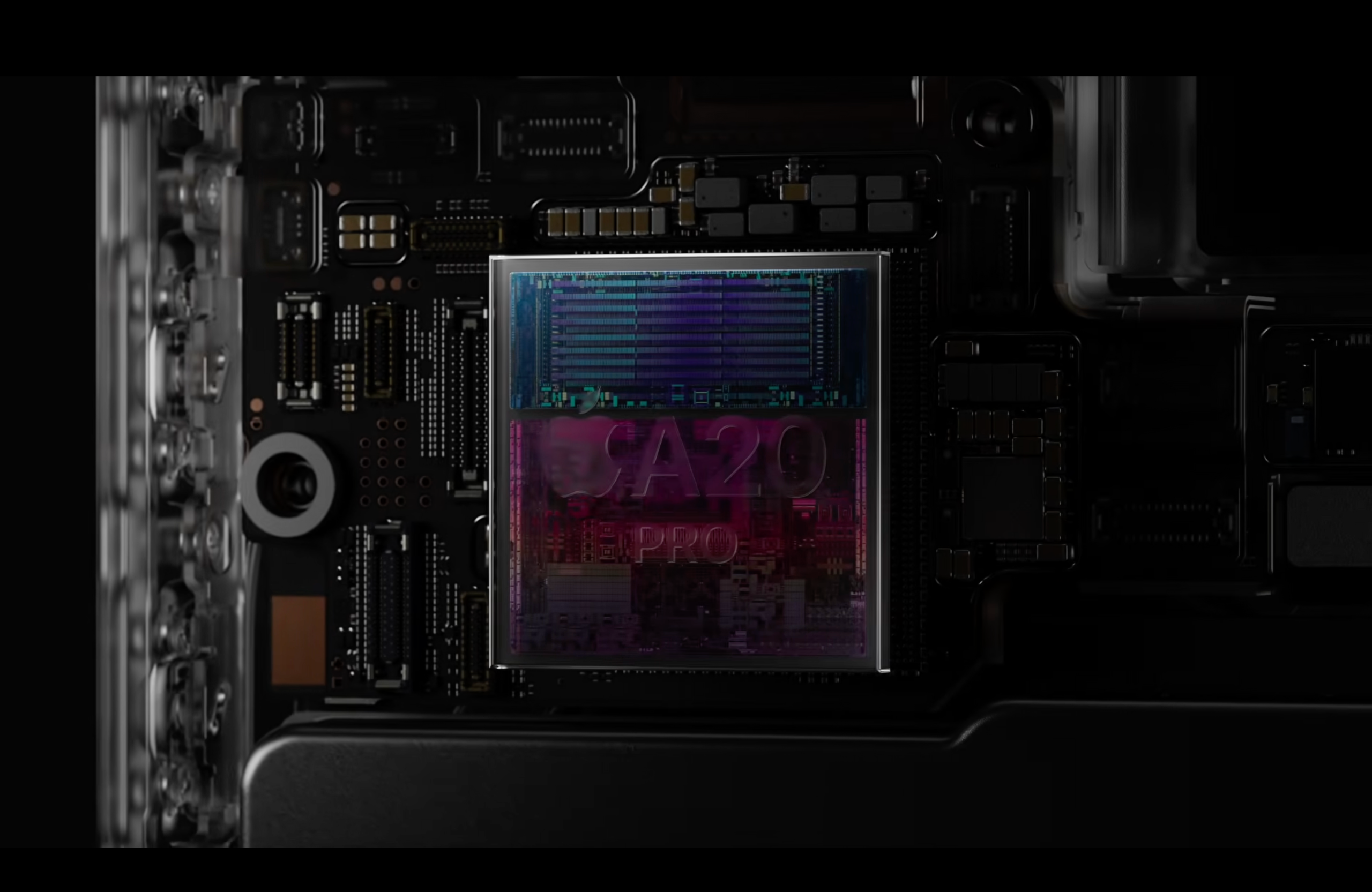
Indeed, Apple's A19 Pro packs two 'desktop-class' 'super cores' whose design is 'driven in part by increased front-end bandwidth, a new cache hierarchy, and enhanced branch prediction,' as Apple described its 'super cores' inside the M5 processor earlier this year. Such architectural enhancements obviously massively increase performance in single-thread workloads at the cost of increased die size, transistor count, and power. Apparently, N2 enabled Apple's designers to squeeze two desktop-grade CPU cores into a smartphone SoC.
Speaking of M5, it is noteworthy that A20 Pro delivers 7.1% higher single-thread performance than M5 while running at a clock speed that is 7.1% higher than that of M5, which is probably a good indicator that Apple's A19 Pro uses the same 'super cores' as M5.
While some may consider using PC-grade general-purpose CPU cores in a smartphone chip an overkill, Apple is known for using and supporting PC technologies in its mobile SoCs (NVMe, PCIe, DisplayPort-over-USB-C, hardware virtualization, etc.). Keeping in mind that Apple also uses A-series SoCs inside iPads and inexpensive laptops, it makes a great sense to have these technologies in its smartphone application processors. With desktop-grade cores inside the A20 Pro, the company greatly expands use cases of these CPUs while also solidifying their position in traditional segments that they will address in the coming quarters.
Without any doubts, Apple's transition to TSMC's N2 starts with a massive general-purpose performance increase, driven by 'fat' super cores and a memory subsystem featuring 50% more bandwidth compared to the A19 Pro. Over the next few weeks, we are also going to learn how Apple upgraded the GPU, NPU, and other aspects of the A20 Pro, and we are going to find out whether the upgrades are as impressive or incremental. In any case, so far, the A20 Pro looks very good.

Follow Tom's Hardware on Google News, or add us as a preferred source, to get our latest news, analysis, & reviews in your feeds.





 English (US) ·