
 5 hours ago
10
5 hours ago
10
Hannah Waddingham clears her throat. Her voice is a little scratchy. Two days before we meet, the star of Ted Lasso hosted the TV comedy show Saturday Night Live UK. She took part in almost all of the sketches that night, from a skit about “two top-heavy, Reading-based drama teachers” called Janet, to a musical number about how many glasses of wine to drink at a bar, to a bit in which she played the stern northern leader of a speed awareness course. In her opening monologue, she zipped through a variety of accents and impressions. “You see?” she told the cheering crowd. “Range! Range.”
I should have remembered this line when making small talk. We are tucked away in the hidden private dining room of a hotel in London, the city where the actor was born and raised and where she still lives with her young daughter, Kitty. When Waddingham walks through the lobby, people notice her. She is tall, striking, and wearing the pulled-down baseball cap that is an actor’s day-off uniform. During lockdown, Ted Lasso – the amiable football series in which she plays Rebecca Welton, the owner of a fictional team called AFC Richmond – made her famous on both sides of the Atlantic. In 2021, it won her an Emmy award for outstanding supporting actress in a comedy series. At 47, after a long but unflashy career on stage and screen, there was a sense that her time had come.
It’s funny, I tell her cheerfully, as we exchange pleasantries and settle in, but for years I thought you were northern. “No, really?” she replies, gamely. “Well, my mum was from the Isle of Man, so there’s probably that.” I plough on, expanding my theory. You know, I continue brightly, you’ve got northern energy, in a barmaid-at-the-Rovers-Return sort of way. “Oh my God,” she says, laughing, though the air has taken on a sudden chill. “Is that a compliment? I don’t think so.” It’s a massive compliment, I say, though I suddenly realise that to her it does not sound that way. Clearly, I have got Waddingham all wrong. “I think that comes from theatre … I’m just taking a moment. I don’t think anyone’s ever said that.” I dig myself in deeper. I mean you have a kind of brassy campness. It’s a good thing! “OK,” she replies. “It’s switch-on-able, and switch-off-able, I assure you. It’s just wanting to make people smile and laugh.”
Now 51, Waddingham is in her Hollywood era. Over the last few years, she has starred in massive feature films like Mission: Impossible – The Final Reckoning, alongside Tom Cruise, and The Fall Guy, with Ryan Gosling and Emily Blunt. She is here today, enduring me and this conversation, to talk about the return of Ted Lasso, and about her new series, Ride or Die, a comedy-drama caper in which she co-stars with Octavia Spencer. In it, Waddingham is an undercover assassin who loves drinking and men. In the first episode, she athletically jumps out of a first-floor window in order to avoid giving her number to the barman she picked up that night.
It is lunchtime. We look at the menu. She is a real foodie, she says. “Oh, doesn’t it all look gorgeous? Obviously, I’m going to have the shrimp cocktail.” That is very camp, I joke. It is too soon. “Is it? I just like shrimp.” She orders the tomato and burrata salad.
Having watched her co-present the Eurovision song contest in 2023, having read about all those years in musical theatre, having seen her appearance as a guest judge on RuPaul’s Drag Race, and her theatrical Christmas revue for Apple TV, you can see why people like me might make assumptions about her. “Trust me, I would be very bored of myself if I were perpetually camp,” she says. I am surprised that she is surprised by this, but to her it is a reductive read of her career. Even when it comes to the Christmas special? “It’s too simple to say that it’s camp, or that I’m camp. What I wanted for my Christmas special was a timeless example of my voice, and something to make people smile.” She uses her theatre background to pepper her performances with lightness, she explains. “Even my monologue from the other night was trying to create something that is light and joyful and removes people from the humdrum of every day.” You did judge the Rusical (the drag queens’ musical) on RuPaul’s Drag Race … “Yes. From musical theatre. What I’m saying is, it signs me off to say that I’m camp, or that I’m a northern barmaid.”
I feel as if I’ve insulted you, I say, and that wasn’t my intention. “There’s just a lot more to me than that,” she says. And besides, she adds, I haven’t insulted her. “It’s just, I would be sad if people’s perceptions of me were just that. We’re all the sum of different parts.”
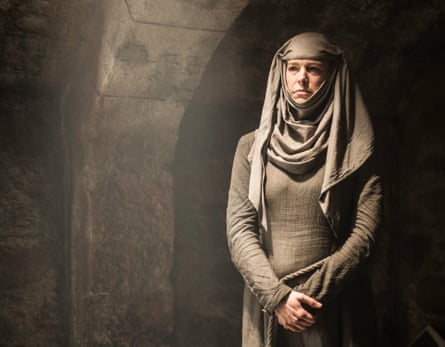
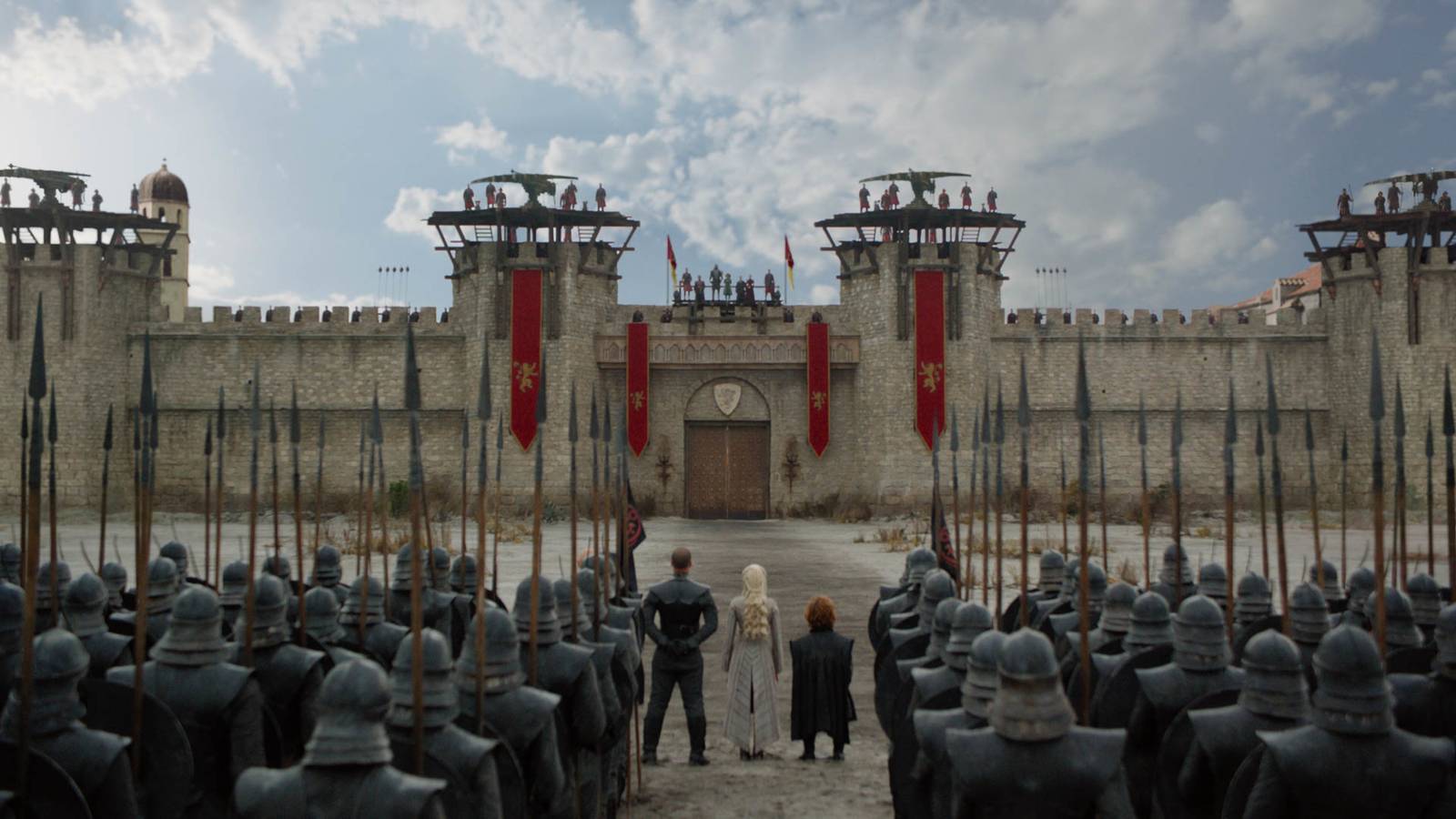
Waddingham grew up among creative people. Her first jobs were in theatre. After years of grafting, of taking small TV roles while performing, and winning awards, in the West End and on Broadway, she had a series of breakthrough performances on screen. There was her small but mighty role in Game of Thrones, as the “shame nun” Septa Unella, who rang her bell over a shaven-headed Cersei Lannister. It remains a popular meme today. On Sex Education, she was parent to the school’s sensitive chief jock, Jackson. Then, during Covid, she joined that small group of actors who found themselves stuck at home and also suddenly, newly famous on a different scale, because they were in the shows that everyone was watching.
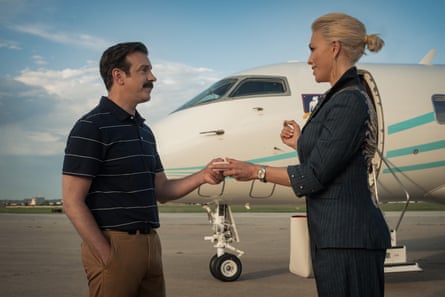
Her show was Ted Lasso. In it, her character took over AFC Richmond as part of a divorce settlement with her cheating husband Rupert, played by the late Anthony Head. In the first season, Rebecca sets out to destroy her ex’s beloved club by hiring the inept American football coach Ted Lasso, played by Jason Sudeikis. But over the course of three seasons, he grows into the job, and she grows to love the game. The sweetness of her friendship with Sudeikis’s titular coach/manager gave it an appealing, big-hearted warmth.
Now, it is back for a fourth run, three years later, with a women’s football team at its centre. Was Waddingham as surprised as fans that it was returning? “There were always rumblings. Of course, we finished with Keeley [Juno Temple] handing Rebecca the women’s team, so I actually thought it was going to come around quicker than it has. When it didn’t, you start to think, is that it? Is that ebbing away?” The cast, she says, remain “thick as thieves”, and are constantly in touch, but she had begun to feel sad about the possibility she might never play Rebecca again. “It sounds silly and theatrical, but if you’ve really felt a bond with them, losing a character is like losing a friend.”
Does she follow women’s football? “I’m more into women’s football than men’s.” Karen Carney messaged her before SNL to wish her luck. She met the Lionesses Leah Williamson and Jill Scott in the early days of Ted Lasso. “They are such pioneers for my daughter’s generation,” she says. Her father is in his mid-80s, and he, too, prefers to watch women’s football. We chat, briefly, about the hostility still aimed at female players. “I was out with Mary Earps, recently. And she was saying, the amount of grief she got from her autobiography …” Earps experienced a considerable backlash, following comments in the book about the England manager Sarina Wiegman and her former international teammate Hannah Hampton. “My jaw was on the floor,” says Waddingham. “I had a level of incredulity that she [Earps] actually found funny. Maybe I’m naive, but I found the things she was saying unfathomable.”
On the subject of hostility, Waddingham, who has a no-nonsense way about her, seems to be adept at dealing with difficult characters herself. In an interview with Glamour in 2023, she talked about modelling in her 20s, being on the receiving end of misogyny, and how she always called it out when she saw it. In 2024, she was set to host the annual Olivier awards in London. As she arrived on the red carpet, a paparazzo asked her to “show leg”. Her response went viral. “Oh my god, you’d never say that to a man, my friend,” she said, waving a finger at the culprit. “Don’t be a dick, otherwise I’ll move off.” People were supportive of what looked to be a stand against sexist double standards, and her response became a news story. “I know where you’re going with this,” she says, warily, when I bring it up.
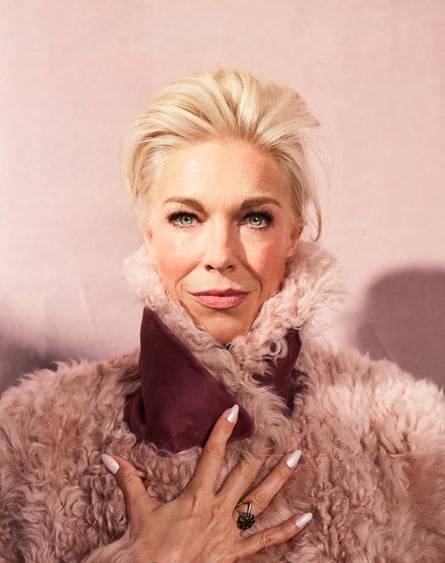
Well, people liked that you stood up to him. “Because I’ve known him for 20 years and have immense respect for him,” she says. So this is another case where public perception and reality are not aligned? “That’s why I said, at the end of my sentence, ‘You wouldn’t say that to a man, my friend.’” He was actually a friend? “No, not my friend, but he’s someone I’ve respected as a photographer for 20 years, and we’re fine now. He took it on the chin, I called him out, he emailed me, I emailed him back. I was like, ‘Dude, that’s not cool,’ and fair play to him, he was apologetic, and I said, ‘You can’t do that.’”
So do you think he was being jokey? “No, I think he forgot himself. There was an overfamiliarity. I just thought, don’t do that, because this is a bespoke Marchesa gown. It stopped on the mid-thigh, and it had a beautiful, diaphanous over-layer,” she says. “I was going off to host an entire evening live, and my sadness at the time was that [the evening] had been reduced to that, instead of my live performance directly after that, which is one of the greatest achievements of my life.” The others, she says, are the birth of her daughter, being a single mother, her Christmas special, “and how I hold myself, for younger women. The flip side of that is calling out moments that need to be shut down.”
Good manners are important to Waddingham. She mentions them several times during our conversation. “Good manners are more important to me than work in any form. Manners first, always,” she says. “I’m always mindful that my daughter is watching. So I try to be elegant and have a firm kindness about myself.” Where does she think that imperative to stand up for herself comes from? “That’s just inherent in how I’ve been brought up. It’s the old school – if you can’t say something nice, don’t say anything at all.” She pauses. “I’m just aware that we’re not talking about my work as much as my conduct,” she says, steadily.
How do you mean? “Just, the photographer …” But this is a profile of you, I say. I’m trying to find out who you are. I don’t think people know a lot about you. “Purposefully so,” she nods. “What I mean by not talking about the work is that it’s easy to get caught up in – oh, I call people out. Yes, I do, and I’m proud of that.” Again, she explains, she does not want to be reduced to something she is not, but also, those good manners do matter to her. “We, as the females in society, us older ones, we need to encourage the younger ones, to make sure that we are respected, because it’s too easy for us to just take it on the chin.”

To the work, then. Waddingham grew up in Wandsworth, south-west London, and spent her childhood in and around the theatre. Her father was a marketing director and a special constable in the river police. Her mother was a professional opera singer who took 11 years off to bring up Waddingham and her brother, then returned to work in the chorus at the English National Opera. “Which is why I wanted to film my Christmas special there,” Waddingham says. “Apple were saying, ‘Do it at Radio City Music Hall, Carnegie Hall, the Royal Albert Hall. I said, ‘No, it can only be the London Coliseum, because I’ve run around there since I was a little girl.’”
It sounds as if it was almost predestined that Waddingham would become a performer. “I don’t remember ever wanting to do anything else. I don’t know whether I would have been very good at anything else.” When she was younger, she was obsessed with Whitney Houston and Ella Fitzgerald. She wanted to be the singer people would listen to, on their Walkmans, with their heads on their pillows, having big feelings. “And I knew I wanted to be an actor as well. I didn’t really have any intention of doing them together on stage.” It just happened to turn out that way. “I auditioned for things, because you will need to get on the ladder and work. And it just kind of snowballed.”
She was always a homebody. She went to drama school, but chose one two roads over from the house in which she grew up. She still lives in south-west London. “Again, because I’m old-fashioned. I have a big thing about being around my parents until I don’t have them, and then I’ll move.” I ask if she still has her parents. Her father is still alive, but “I don’t have my mum,” she says, sadly. Her mother died two Christmases ago, and she has found that she has only recently been able to talk about her. Tell me if I’m prying. “No, no, it’s fine. It’s good, because she should be celebrated.” She wants to speak about her. “I know that I’m known for being a spokeswoman for theatre as well, but that’s her, and it’s good that I talk about her, and I don’t mind getting upset, because it is the love that you feel for someone, still.”
It sounds as if they were very close. “I suppose that’s why I prickle at the idea of ‘theatrical being big’, or whatever,” she says. “Being an opera singer, I used to tease her, that they would all come out and stagger, stagger, sing, stagger, drama, everything giant. But she was a very quiet, self-effacing, glorious, gentle, soft, uber-talented woman. And she was pure theatre.” Later, she reiterates that she feels defensive about the theatre world. “I always fight the corner of theatre people, because they’re certainly not in it for money or fame, and that’s where I come from,” she says. Suddenly, the sharper angles of our conversation begin to make more sense.
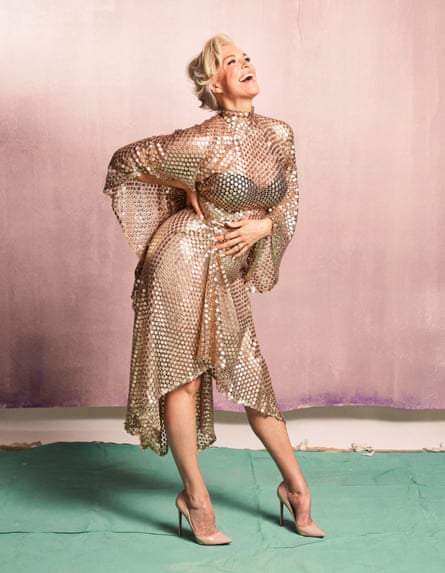
What was her mother’s name? “Melodie Kelly. I think her parents called her Melodie because of their love of music, and now I hear my daughter singing in the shower, naturally operatic, and I think the gene pool is alive and kicking.”
Waddingham gave birth to her daughter just weeks before filming that infamous “Shame!” scene in Game of Thrones. She had enjoyed an acclaimed career in musical theatre, having made her West End debut in 1998, and for a long time she was a jobbing TV actor, too, doing the rounds with small parts in Brookside, Doctors, Hollyoaks and Benidorm. She auditioned for Septa Unella in Game of Thrones because she wanted to be seen by its show runners, David Benioff and Dan Weiss, though she did not expect to get it. “I was eight months pregnant,” she explains. “Pregnant from the nose out!” Like her mother, she planned to take time away from work to be with her daughter. But the show was “a juggernaut”, she says, and when they offered it to her she couldn’t turn it down. She took her daughter, then nine weeks old, on set. She could hear the baby crying during the walk of shame scene. “And I just thought, oh my God, what am I doing?” Part of her brain told her that she was working, that she was providing for her family. “The other part was going, I’ve got terrible separation anxiety. So when I watch it back, I just see a woman who doesn’t know whether she’s coming or going.”
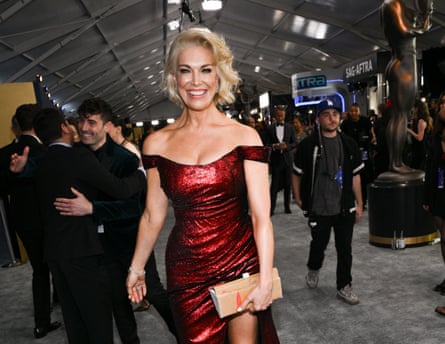
Waddingham split up with her daughter’s father, Italian luxury hotel manager Gianluca Cugnetto, when Kitty was small – she is now 11 – and has been a single parent since then. At the Screen Actors Guild awards, in 2024, keen eyes will have spotted that Waddingham’s handbag was made of cardboard, painted in rainbow colours, with the word “Epic” scrawled on the top. Her daughter had made it at home. “I picked it up and went, ‘It’s actually got more space in it than a normal, designer, ridiculous handbag, so I’m going to take it up the red carpet.’ I did it on purpose, to show her that she’s never far away from me.” She still feels guilty about being away when she has to work. “God, all the time. I’m about to go away to do press for the next season of Ted [Lasso], and the mummy guilt descends. But I have to try and combat it.” She has not done her beloved theatre since the early 2010s, in part because the hours are so demanding. “I don’t think my daughter is ready.” She wants to be able to do eight shows a week, for at least six months, because she firmly believes that theatre audiences, paying high prices for tickets, deserve that level of commitment from performers. “I need to find the time to be able to go, ‘I’m taking this coat off for now and I’m putting my theatre coat back on.’”
Waddingham took Kitty with her to Prague for five months and enrolled her in an international school, in order to shoot Ride or Die. Her character is a forensic accountant called Judith, whose entire life is a cover for her real career as a trained assassin. Judith skis, she shoots, and she loves a glass of wine. “She’s an assassin of some 30 years,” Waddingham says. She was asked to be in the series by her co-star Octavia Spencer, whom she calls “my magnificent counterpart”, and says she still pinches herself that Spencer wanted her to do it. The series is heavy on action sequences. “I did 75-80% of my own stunts. But, Rebecca, it was partly not a good idea, because I did mangle myself senseless.” At its heart, though, it is a show about female friendship. Spencer plays Judith’s best friend, Debbie, who inadvertently gets roped into the assassin lifestyle. “It’s about calling each other out, holding each other up, and showing that women in their 50s can be all things, when they decide to chop and change.”
Fame came late to Waddingham, who has experienced her own chopping and changing, from stage to screen. “I’ve talked about it to a couple of people, who’ve had that thing of the ‘overnight success’ later in their careers. There are a few of us who have been right in the belly of things, working in places that are not as la-di-da as you would have in TV,” she explains. “An overnight success after 25 years is delicious. And I’m fine with it, because I’m very at peace with who I am. I’m more than happy to share that I’m 51 and proud of it.”
Waddingham looks at her phone and panics. “Oh my lord, how long have we been talking?” She had told me she needed to leave after 45 minutes; we have been chatting for almost 90. “I hope I’ve improved your initial …” she says, with a laugh. Look, I say, I’m a big fan of camp. “I’m a big fan of camp as well,” she says. “But I like these profiles, because it’s important for people to see that, as with anyone else, there’s light and there’s shade.” She is rushing off to her daughter’s school, to an event that her “little one” had forgotten to tell her about until this morning. “I’m always conscious,” she says, putting her baseball cap back on, “that with her school, if I’m late, they’re going to think, oh, bloody actors …”





 English (US) ·