
 1 hour ago
9
1 hour ago
9
On paper, the AMD Radeon RX 9060 XT 8 GB makes a whole lot of sense. I was particularly impressed by the RX 9060 XT 16 GB when I tested it last year, and the 8 GB version is usually substantially cheaper. In fact, out of all of AMD and Nvidia's current-generation graphics cards, it's the most affordable of the lot. Dropping the VRAM to 8 GB can't make that much of a difference, can it?
Well, I hate to be the bearer of bad news, but yes it can. Not all the time, of course. Certain games at high settings, though, will hamper the AMD card's performance quite badly—and crucially, in a more significant way than its main competition, the Nvidia RTX 5060 Ti 8 GB.
Does that make the RX 9060 XT 8 GB a total write off? Nope. In fact, if the Nvidia card didn't exist, I'd be tempted to call the AMD GPU's performance pretty good for its paltry MSRP of $299. The RTX 5060 Ti 8 GB doesn't have it all its own way in my benchmarks, either. Sometimes the AMD contender pulls ahead, so it's not a super clear-cut thing.
But there are a couple of caveats to be aware of. One, you won't find one of these for less than $350 right now, and the RTX 5060 Ti 8 GB tends to bottom out around $390-$400. And two, when the RX 9060 XT 8 GB drops off the pace, it's sometimes by a significant amount. Again, these drops are in certain games at certain settings, so it's not a completely consistent thing. But it's enough to give me pause, and I think you should consider your options, too.
It's far from a bad graphics card, and one that'll serve you fine if money's a real concern and you need something that can cope with modern gaming. But the RTX 5060 Ti 8 GB handles VRAM-constrained situations significantly better in many of my tests, and that's the sort of headroom that I think's worth paying for. At least when the price difference between the two is this tight.
Buy if:
✅ You can't stretch to the RTX 5060 Ti 8 GB: While the little Nvidia card is more expensive, it's got less issues operating within its VRAM constraints. Still, cheaper is cheaper, and the AMD card isn't completely outclassed.
✅ You want excellent thermals: It's quite astonishing how cool this card runs under duress, which makes it a good candidate for small form factor builds.
Don't buy if...
❌ You're a high settings + high resolution gamer: The RX 9060 XT 8 GB can struggle with the settings turned up, more so than its competition on average.
❌ You're a Cyberpunk 2077/open world fanatic: Night City gives this GPU trouble with ray tracing enabled, and it has a tendency to drop behind the RTX 5060 Ti in VRAM-heavy games in general.
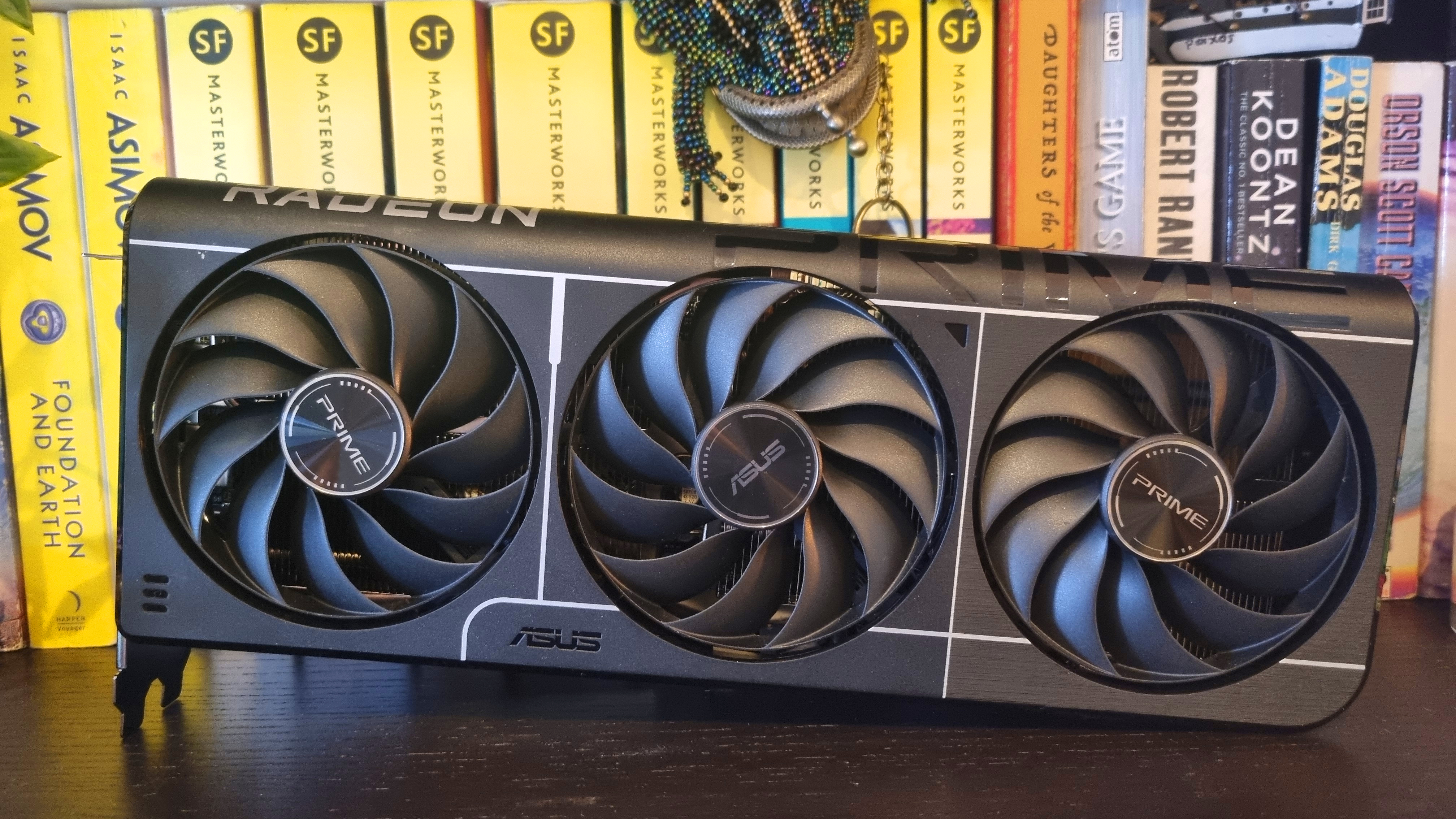
If there were any RX 9060 XT 8 GB models available for its $299 MSRP, I'd likely be scoring it a lot higher. But while the Nvidia RTX 5060 Ti 8 GB can be found for just $40-$50 more than the AMD card's $350 retail price, the difference in performance between the two doesn't quite add up.
The RX 9060 XT 8 GB can struggle when its 8 GB of VRAM is pushed to its limits, and the performance is slightly underwhelming. On a very tight budget? It's still worth considering. Otherwise, I'd save my pennies for something less hamstrung instead.
RX 9060 XT 8 GB - Features
Swipe to scroll horizontally
| Row 0 - Cell 0 | RX 9060 XT 8 GB |
GPU | Navi 44 |
VRAM | 8 GB GDDR6 |
Shader Cores | 2048 |
Boost clock (MHz) | 3130 |
Base clock (MHz) | 1700 |
TMUs | 128 |
ROPs | 64 |
Compute Units | 32 |
RT Cores | 32 |
Matrix Cores | 64 |
L0 Cache | 32 KB per WGP (2 per CU) |
L1 Cache | 4 MB |
L2 Cache | 32 MB |
MSRP | $299 |
The RX 9060 XT 8 GB uses the same Navi 44 chip as the 16 GB version, based on AMD's RDNA 4 architecture. With that comes a loadout of 2048 Shader Cores, 32 Compute Units, 32 dedicated Ray Accelerators, and 64 Matrix Cores—essentially the equivalent of Nvidia's mixed precision, AI inferencing Tensor Cores.
While both the RX 9060 XT 8 GB and the RTX 5060 Ti 8 GB have the same RAM loadout in terms of size, the Nvidia card uses speedy GDDR7 over a 128-bit bus for a total max memory bandwidth of 448 GB/s, while the AMD equivalent uses slower GDDR6 over the same sized bus. That means a max memory bandwidth of 322.23 GB/s, significantly less than the RTX 5060 Ti.
The RX 9060 XT has 32 KB of L0 cache per workgroup processor (essentially two Compute Units), 4 MB of L2 cache, and 32 MB of L3. This multi-layered system is again in contrast to Nvidia's cache handling, which equates to 128 KB per Shader Module of L1 cache, and 32 MB of L2.
In terms of clock speeds, the stock RX 9060 XT has a base clock of 1700 MHz, a "game clock" of 2530 MHz, and a max boost clock of 3130 MHz.
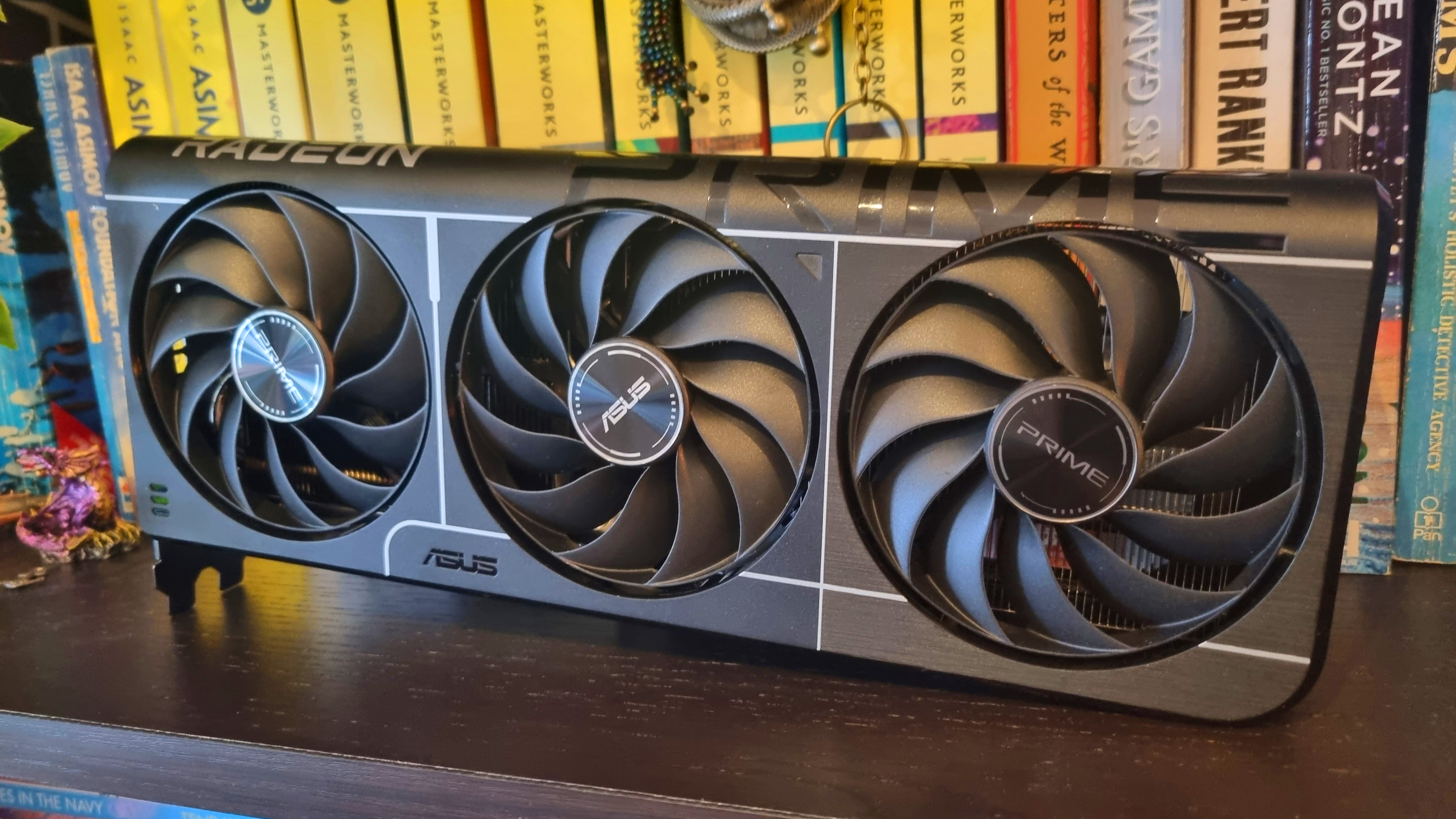
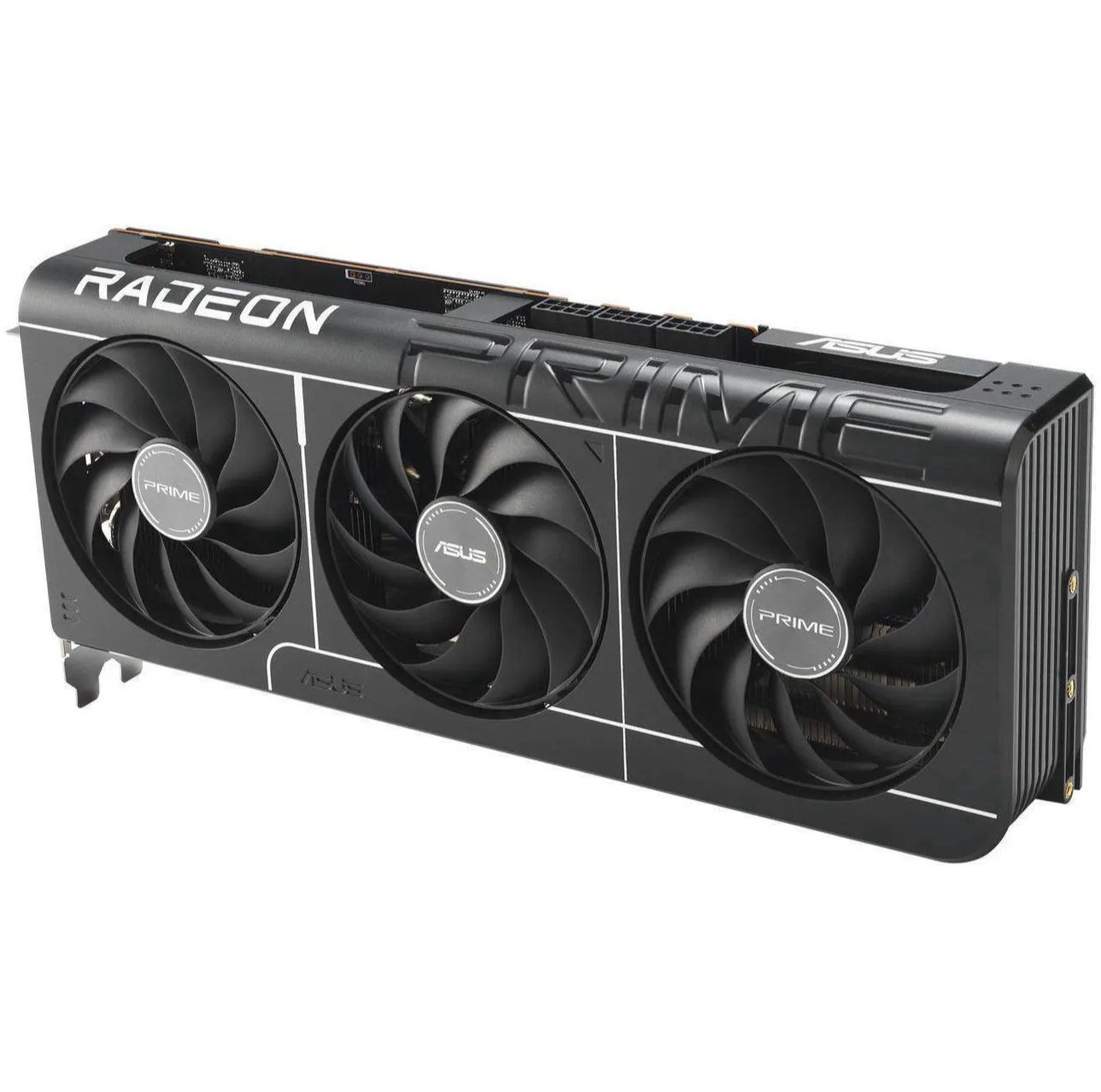
The game clock figure represents the average sustained speed during a typical gaming workload, although my particular review sample, the Asus Prime Radeon RX 9060 XT OC Edition, lists a higher sustained game clock figure of 2760 MHz—likely due to the fact it has a surprisingly large, tri-fan, 2.5 slot cooler.
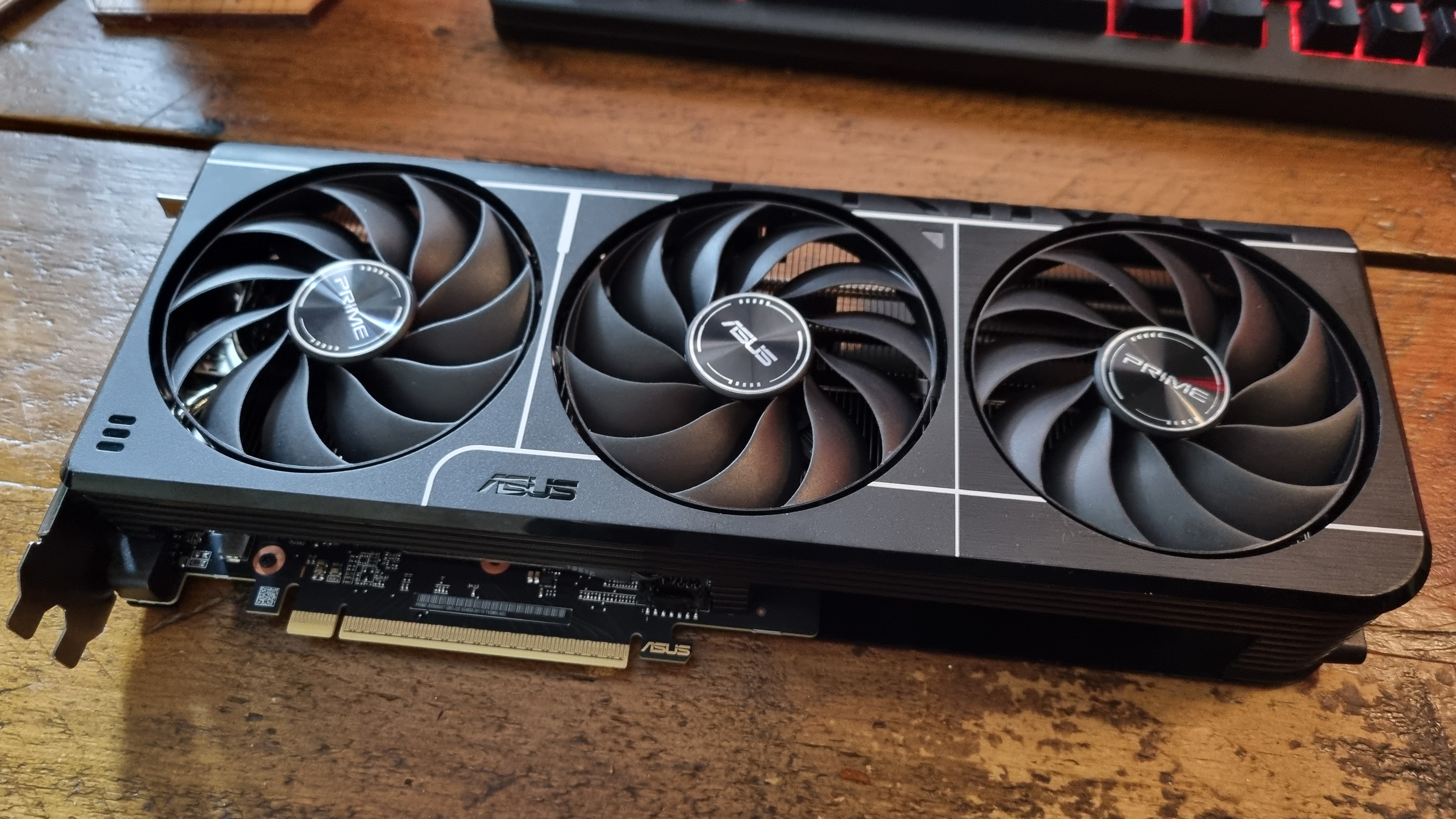
This seems a little overkill for an RX 9060 XT, which has proven itself to be a cool-running graphics chip even with the small, twin-fan cooler equipped to the 16 GB version I tested last year. I found that card to regularly sustain somewhere near its top max boost speeds while keeping temperatures low, and this Asus 8 GB sample is much the same.
Asus doesn't list the exact TGP of this particular variant, but it does suggest a 550 W power supply, 100 W more than the official minimum spec. The default RX 9060 XT 8 GB has a TGP of 150 W, although I've recorded a peak power draw of this card at 175 W under extremely heavy load.
Again, the default RX 9060 XT 16 GB sample I reviewed previously also liked to jump over its 160 W TGP at points, managing an even larger peak of 182 W.
Around the back is a single HDMI 2.1b port, and two 2.1a DisplayPort connections. One last thing to note about this particular Asus card is the addition of a small switch tucked into the backplate, which allows you to switch between Performance and Quiet fan modes. I've left it in performance mode for my testing, as this card runs quiet even when pushed to its maximum.

Score: 3
Not a bad set of specs for a budget GPU, but the slower VRAM does spoil the pot a little.
RX 9060 XT 8 GB - Performance
And so, to the meat and potatoes: gaming performance. Initially, I was pleased to see that the cheaper RX 9060 XT 8 GB managed to get within three frames of the RTX 5060 Ti 8 GB in Black Myth Wukong at 1080p on average, which suggested to me that I was likely to have a fight on my hands between the two.
In Cyberpunk 2077, however, the wheels really come off for the AMD card.
1080p gaming benchmarks | RX 9060 XT 8 GB
RX 9060 XT 8 GB Asus Prime
RTX 5060 Ti 8 GB Palit Dual
RTX 5060 Ti 16 GB Palit Infinity 3
| RX 9060 XT 8 GB Asus Prime | 71 Avg FPS, 58 1% Low FPS |
| RTX 5060 Ti 8 GB Palit Dual | 74 Avg FPS, 62 1% Low FPS |
| RX 9060 XT 16 GB XFX | 73 Avg FPS, 63 1% Low FPS |
| RTX 5060 Ti 16 GB Palit Infinity 3 | 75 Avg FPS, 65 1% Low FPS |

A 41 fps average result at Ultra RT settings, compared to the 52 fps average of the Nvidia contender, is seriously off the pace. At this level, while both GPUs fail to meet the 60 fps "gosh that's smooth" minimum, an 11 frames per second difference is very significant.
That being said, I found the RTX 5060 Ti 8 GB to fly through Night City once the settings were dropped to Medium RT in my 8 GB vs 16 GB VRAM testing, so I looked back at my in-game results and… yeesh.
Cyberpunk 2077 - VRAM usage and performance
In-game testing, Medium RT settings
RX 9060 XT 8 GB Asus Prime
RTX 5060 Ti 8 GB Palit Infinity 3
RTX 5060 Ti 16 GB Palit Infinity 3
| RX 9060 XT 8 GB Asus Prime | 72 Avg FPS, 51 1% Low FPS, 7.68 Avg. VRAM |
| RTX 5060 Ti 8 GB Palit Infinity 3 | 91 Avg FPS, 44 1% Low FPS, 7.32 Avg. VRAM |
| RX 9060 XT 16 GB XFX | 85 Avg FPS, 67 1% Low FPS, 9.46 Avg. VRAM |
| RTX 5060 Ti 16 GB Palit Infinity 3 | 91 Avg FPS, 63 1% Low FPS, 8.76 Avg. VRAM |
The RX 9060 XT 8 GB is a full 19 frames off the pace at 1080p in Cyberpunk's open world, even with the settings turned down—although it does manage a significantly higher 1% low result.
At 1440p, however, the AMD card is still 13 frames behind the RTX 5060 Ti 8 GB, and the 1% lows plummet, too. The RX 9060 XT 8 GB gains some ground back with upscaling and frame generation enabled, though, which is some small comfort.
Going back to my 1080p benchmarks for a second, it's clear that it's not just Cyberpunk 2077 that gives this card some trouble compared to its competition. It's behind the pack in all but two of my tests, although with much less of a margin.
It does manage to beat the RTX 5060 Ti 8 GB by a full nine frames in Total War: Warhammer 3, though, and even manages to surge ahead of the 16 GB version.
1440p gaming benchmarks | RTX 9060 XT 8 GB
RX 9060 XT 8 GB Asus Prime
RTX 5060 Ti 8 GB Palit Dual
RTX 5060 Ti 16 GB Palit Infinity 3
| RX 9060 XT 8 GB Asus Prime | 48 Avg FPS, 43 1% Low FPS |
| RTX 5060 Ti 8 GB Palit Dual | 50 Avg FPS, 43 1% Low FPS |
| RX 9060 XT 16 GB XFX | 48 Avg FPS, 44 1% Low FPS |
| RTX 5060 Ti 16 GB Palit Infinity 3 | 51 Avg FPS, 45 1% Low FPS |
Switching things up to 1440p, the RX 9060 XT 8 GB drops behind once again in all but two of my tests, although the margins are a fair bit closer on average. Cyberpunk 2077 proves to be this card's Achilles' heel, which suggests the ray tracing demands may be a little too much for its 8 GB loadout.
It's also worth noting the difference between the 8 GB GPU and its 16 GB-equipped bigger brother. This difference can be quite pronounced in certain games, particularly in Homeworld 3, where the RX 9060 XT 8 GB posts a 75 fps average frame rate result to the 16 GB version's 97 frames.
Again, I have to remind myself that this 8 GB card is by far the cheapest of all my contenders. But with the $40-$50 more expensive RTX 5060 Ti 8 GB ranging ahead on average, sometimes by significant amounts, I do have to wonder if that saving is really worth it.
Real-world gaming performance | RX 9060 XT 8 GB
RX 9060 XT 8 GB Asus Prime
RTX 5060 Ti 8 GB Palit Dual
RTX 5060 Ti 16 GB Palit Infinity 3
| RX 9060 XT 8 GB Asus Prime | 76 Avg FPS, 68 1% Low FPS |
| RTX 5060 Ti 8 GB Palit Dual | 79 Avg FPS, 68 1% Low FPS |
| RX 9060 XT 16 GB XFX | 78 Avg FPS, 69 1% Low FPS |
| RTX 5060 Ti 16 GB Palit Infinity 3 | 86 Avg FPS, 72 1% Low FPS |
Thankfully, my upscaling and frame generation testing gives the RX 9060 XT 8 GB something to celebrate. This tightens up the difference between the two 8 GB cards on average, and even leads to some eyebrow-raising figures.
Take F1 24, for example. We've observed this game posting astonishing frame rate scores with AMD's FSR tech enabled before (check out the massive 292 fps result in our RX 9070 XT review, for example), and that tracks with the 146 fps average here.
If you really want to see an AMD GPU fly, though, check out the RX 9060 XT 16 GB further down the chart. 190 fps?!? That beats the RTX 5060 Ti 16 GB by a full 54 frames. And the 8 GB card by *checks calculator* 44 fps. What a difference an extra 8 GB of VRAM makes, ey?
And check out those The Talos Principle 2 figures, while we're at it. It also seems to prefer FSR over DLSS, which suggests that F1 24 might not be the only game that likes what AMD brings to the table.
Still, while the upscaling results muddy the waters a little, it's clear that the little RX 9060 XT 8 GB is bested in most of my tests by its more expensive competition. And bringing some more real-world, in-game testing into the mix makes that clearer.
The Last of Us Part 1 - VRAM usage and performance
In-game testing, Ultra settings
RX 9060 XT 8 GB Asus Prime
RTX 5060 Ti 8 GB Palit Dual
RTX 5060 Ti 16 GB Palit Infinity 3
| RX 9060 XT 8 GB Asus Prime | 79 Avg FPS, 52 1% Low FPS, 6.61 Avg. VRAM |
| RTX 5060 Ti 8 GB Palit Dual | 89 Avg FPS, 48 1% Low FPS, 6.92 Avg. VRAM |
| RX 9060XT 16 GB XFX | 113 Avg FPS, 93 1% Low FPS, 11.47 Avg. VRAM |
| RTX 5060 Ti 16 GB Palit Infinity 3 | 113 Avg FPS, 92 1% Low FPS, 9.84 Avg. VRAM |
I've picked The Last of Us Part 1 for a reason. Despite many, many patches since its release, it's still known as something of a VRAM hog, and can soon trip up lower-spec cards with the settings turned up. And while the RX 9060 XT 8 GB still manages smooth frame rates in this game at Ultra settings, it really does show the difference between this GPU and my other tested cards.
The AMD card is 20 frames behind the RTX 5060 Ti 8 GB at 1080p on average, and 35 fps behind the RX 9060 XT 16 GB. Switch the resolution to 1440p, and it just about squeaks a 60 fps average while the other GPUs are ranging off into the high 70s and low 90s.
Even frame generation can't quite make up the difference for the RX 9060 XT 8 GB, which again ends up far behind all our other cards.
4K gaming benchmarks | RX 9060 XT 8 GB
RX 9060 XT 8 GB Asus Prime
RTX 5060 Ti 8 GB Palit Dual
RTX 5060 Ti 16 GB Palit Infinity 3
| RX 9060 XT 8 GB Asus Prime | 25 Avg FPS, 22 1% Low FPS |
| RTX 5060 Ti 8 GB Palit Dual | 26 Avg FPS, 21 1% Low FPS |
| RX 9060 XT 16 GB XFX | 25 Avg FPS, 22 1% Low FPS |
| RTX 5060 Ti 16 GB Palit Infinity 3 | 28 Avg FPS, 25 1% Low FPS |
If you need some further proof that 16 GB of VRAM can sometimes make a difference, you only have to look at the 4K results. No-one is suggesting that any of these GPUs are built for 4K gaming, nor do they need to be. But the averages are still interesting as an example of how these graphics cards can behave when pushed to their absolute limits.
Both our 8 GB contenders suffer more than their 16 GB equivalents overall, although the RTX 5060 Ti 8 GB still manages to surprise on occasion. The little RX 9060 XT 8 GB does beat it by two frames in The Talos Principle 2, though, and also manages to match its 16 GB variant in two of my tests, albeit at crunchy frame rates. Small wins, and all that.
PC Gamer test platform
Supplied by Cyberpower | MSI
CPU: AMD Ryzen 7 9800X3D | Motherboard: MSI MPG X870E Edge Ti WiFi | RAM: Kingston Fury Beast RGB 32 GB (2 x 16 GB) @ 6,000 MT/s | Cooler: MAG CoreLiquid i360 White | SSD: Spatium M480 Pro 2 TB | PSU: MPG A1000GS PCIe 5 | Case: MAG Pano 100R White

Score 2.5
It's not a total washout for the RX 9060 XT 8 GB, but it's clear that it's off the pace overall compared to the Nvidia competition.
RX 9060 XT 8 GB - Thermals & Power
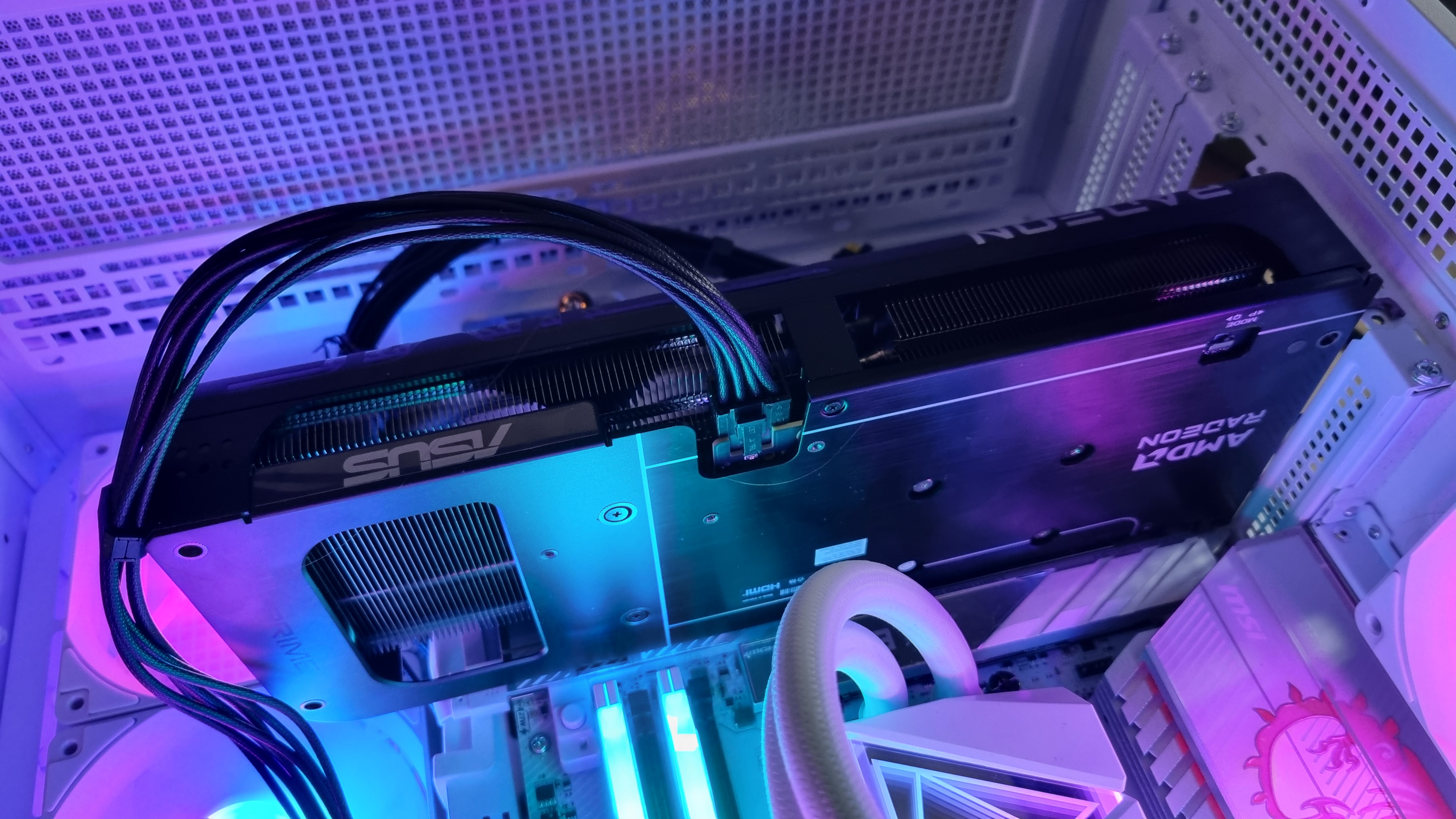
It should be no surprise to learn that this particular Asus Prime variant is a very cool running GPU, given that it's got a hilariously-oversized cooler for a budget graphics card. What's interesting, though, is that the extra size (and fan) results in a 6 °C lower temperature than my 16 GB sample, which has a small, dual-fan, dual-slot cooler.
Gaming temperatures | RX 9060 XT 8 GB
Thermals
RX 9060 XT 8 GB Asus Prime
RTX 5060 Ti 8 GB Palit Dual
RTX 5060 Ti 16 GB Palit Infinity 3
| RX 9060 XT 8 GB Asus Prime | 51 Peak temperature (°C), 48 Average temperature (°C) |
| RTX 5060 Ti 8 GB Palit Dual | 68 Peak temperature (°C), 64 Average temperature (°C) |
| RX 9060 XT 16 GB XFX | 57 Peak temperature (°C), 48 Average temperature (°C) |
| RTX 5060 Ti 16 GB Palit Infinity 3 | 67 Peak temperature (°C), 65 Average temperature (°C) |
With a 51 °C peak result and a 48 °C average, the Asus Prime RX 9060 XT 8 GB OC Edition is one of the most chilled out graphics cards I've ever tested. You're trading these temps for some considerable bulk, though, and it's more common to see dual-fan coolers on most examples.
Both our RTX 9060 XT samples run much cooler than the equivalent Nvidia cards, which likely means that most dual-fan versions should be good candidates for small form factor builds. Just not this Asus variant. You'd have some trouble cramming it in.
Power benchmarks | RX 9060 XT 8 GB
Higher is better
Performance per watt
RX 9060 XT 8 GB Asus Prime
RTX 5060 Ti 8 GB Palit Dual
RTX 5060 Ti 16 GB Palit Infinity 3
| RX 9060 XT 8 GB Asus Prime | 0.22 4K frames per J, 0.56 1080p frame per J |
| RTX 5060 Ti 8 GB Palit Dual | 0.23 4K frames per J, 0.56 1080p frame per J |
| RX 9060 XT 16 GB XFX | 0.28 4K frames per J, 0.65 1080p frame per J |
| RTX 5060 Ti 16 GB Palit Infinity 3 | 0.23 4K frames per J, 0.62 1080p frame per J |
The RX 9060 XT 8 GB has a 150 W TGP, but just like the 16 GB card (and many others), it will occasionally peak significantly beyond that under heavy load. I recorded a maximum peak of 175 W and an average power use of 164 W under repeated runs of the Metro Exodus Enhanced Edition benchmark, using this Asus Prime example.
Averaging that out by frame rate results in a score of 0.56 frames per joule at 1080p, and 0.23 frames per joule at 4K. That's almost identical to the RTX 5060 Ti 8 GB Palit Dual sample I tested, once the performance gain is factored into its 180 W power limit.

Score: 4
A very cool runner, and the power usage isn't anything hair-raising, either.
RX 9060 XT 8 GB - Sound
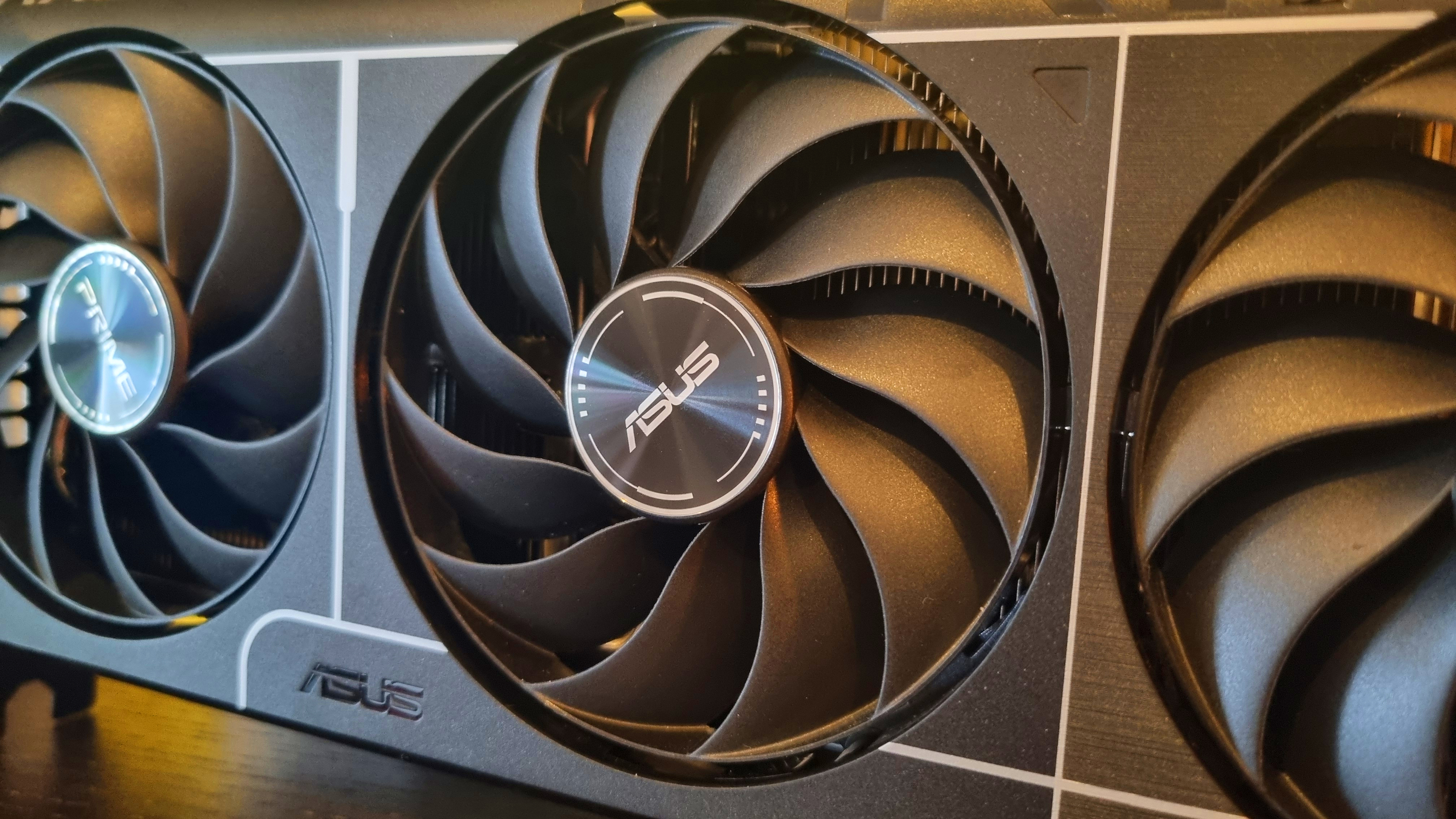
Given that my review sample has an aforementioned massive cooler, it's remarkable how little it has to push to keep the RX 9060 XT 8 GB chilled. Don't be fooled by those three large fans—they make very little noise, even when this card's pushed to its limits.
That being said, the twin-fan cooler on the Palit Dual RTX 5060 Ti 8 GB is even quieter. Whichever way you look at it, though, this is one hushed-up GPU.
Score: 4
Not quite silent, but it's darn quiet regardless.
RTX 9060 XT 8 GB - Software
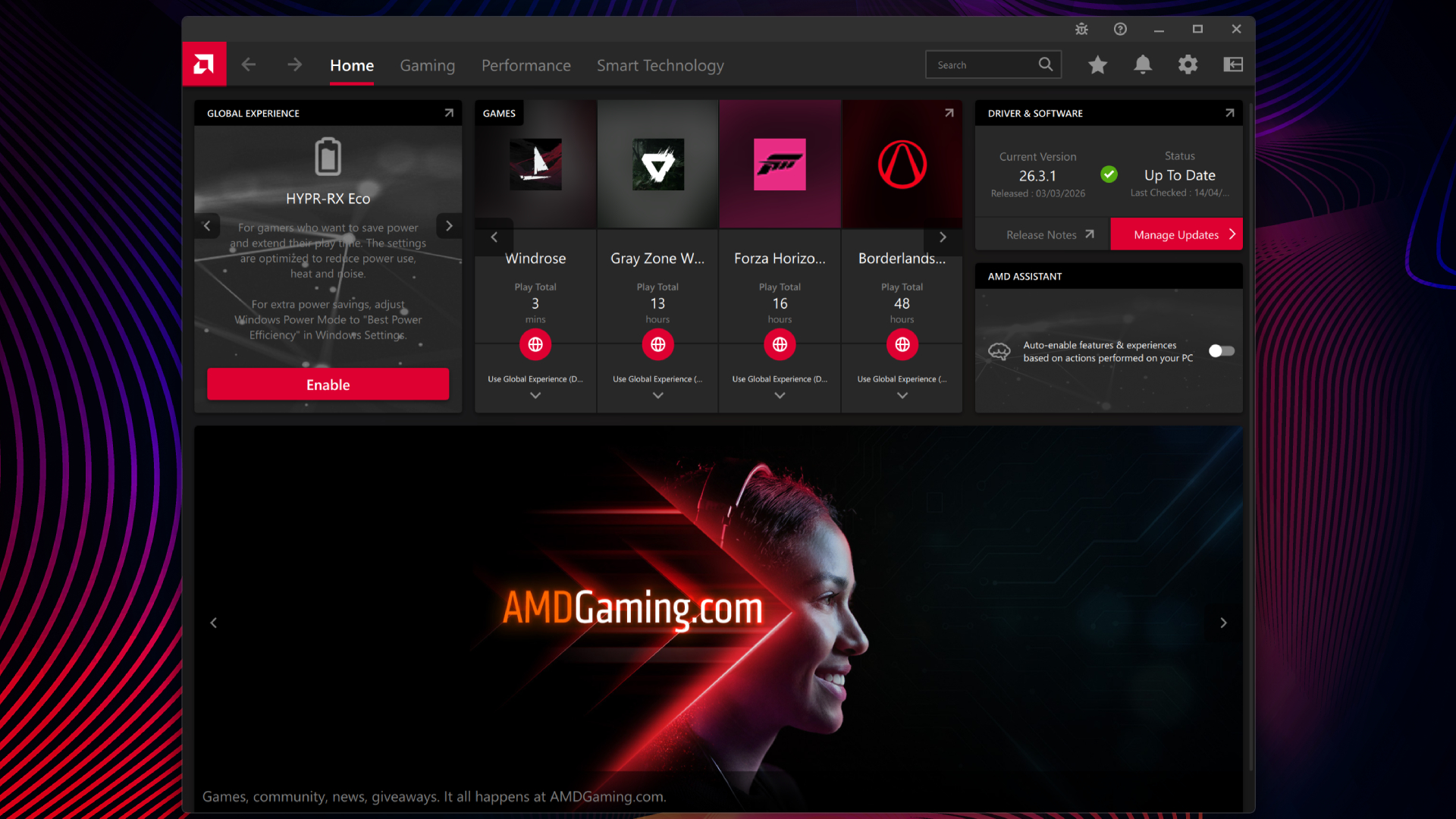
I've got a fair bit of experience with AMD Adrenaline, and can confirm that it's pretty good these days at allowing you to get involved with your graphics card. It provides easy access to overclocking tools and driver updates, a handy homepage listing of your most recently played games and the average recorded frame rate, and lots of extra features that can be enabled on a per-game basis, like AMD Fluid Motion Frames.
While the Nvidia App looks quite different, the functionality between the two is pretty comparable, so you won't be missing out on anything vital if you opt for team red over team green.
In terms of software provided by Asus, well, you could always download Asus GPU Tweak III, an overclocking tool that I'm also rather fond of. It's not pretty, but GPU Tweak III is a straightforward way of pushing most modern graphics cards to their absolute limits.
It's arguably a bit redundant given that this GPU can be overclocked directly within AMD Adrenaline, but hey, extras are extras. Although it's not really an extra, as anyone can use it for free without purchasing an Asus card. Anyway, software and driver wise? I've had zero issues with either, and the RX 9060 XT 8 GB certainly isn't left wanting as a result.
Score: 4
AMD Adrenaline works well, and I've had no driver issues to speak of, either.
RX 9060 XT 8 GB - Value
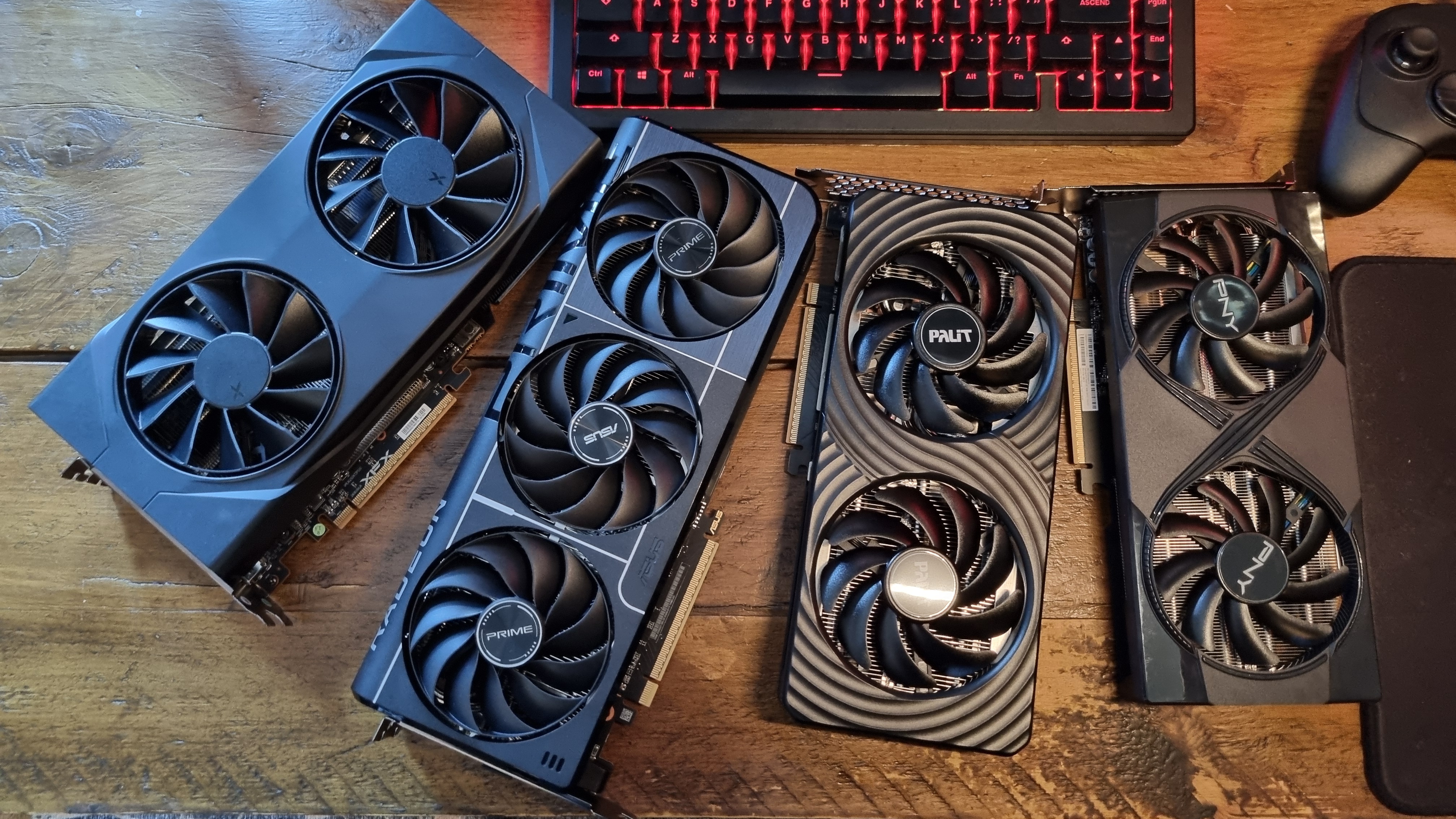
You can make the argument that, given its very reasonable price, the RX 9060 XT 8 GB is still a decent budget graphics card for gaming. And that's true. But, as the RTX 5060 Ti 8 GB is capable of leaping ahead when the VRAM constraints become tight, it's tough to argue that the Nvidia card isn't worth the extra cash.
If you could find an RX 9060 XT 8 GB for its $299 MSRP, I'd be much more inclined to give it a higher score. However, we keep a beady eye on graphics card pricing all year long, and the cheapest version we can find at the time of writing is $350. That's still fairly reasonable given the performance (and in today's memory crisis-influenced market), but when the RTX 5060 Ti 8 GB can be found for $40-$50 more, I know which I'd be picking.
The Nvidia card beats the little AMD in most of my benchmarks, and in VRAM-constrained scenarios, it's much better at holding its drink. And while I've got no crystal ball available to look into the future, I'd say it was a safe bet that if an 8 GB VRAM limit can cause significant performance loss now, it's unlikely to get any better as time goes on.
Futureproofing is a dirty word in my business, but it's still prudent to buy a graphics card with a decent degree of headroom now to prevent having to upgrade it sooner than you'd like. And while the RTX 5060 Ti 8 GB has some of the same issues as the 8 GB AMD card (lower overall performance compared to its 16 GB version), the fact that the drop between the two is lesser makes the Nvidia GPU the better buy.
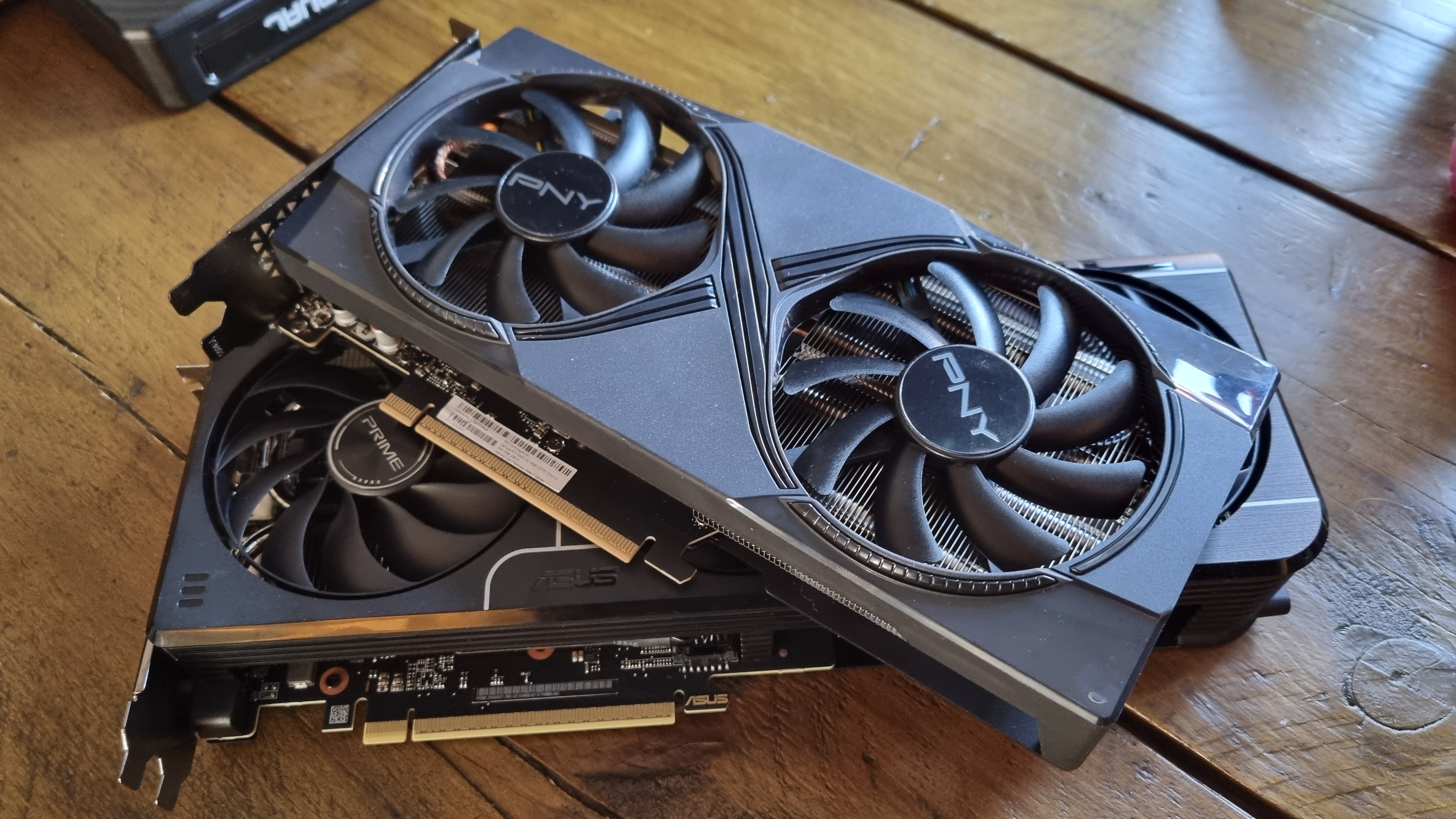
That being said, if money's super tight and you can't stretch to the Nvidia card (or the RX 9060 XT 16 GB), then the RX 9060 XT 8 GB isn't too bad. It still posts reasonable frame rates in many of my tests, and it's encouraging to see that the addition of upscaling and frame generation can tighten up the performance gap in many scenarios.
Still, I can't help but be slightly underwhelmed by AMD's 8 GB effort overall. Even this Asus Prime Radeon RX 9060 XT 8 GB OC Edition variant is a tad disappointing, especially when you consider it's currently $500. For that price? No way.
A lesser-cooled card for $350? Sure, in a pinch. But whenever I played a game where the frame rate crunched, I think I'd be wondering whether the RTX 5060 Ti 8 GB would have gained me a few frames—or perhaps even a lot more in certain scenarios. And, it must be said, whether I should have put an extra $50 towards a different GPU instead.
Score: 2.5
Sure, it's cheaper than the rest. You do pay for that in overall performance, though.









 English (US) ·