
 4 hours ago
7
4 hours ago
7
AMD has shared the first official benchmarks for its forthcoming EPYC 'Venice' CPUs, which will be the first chips to use the Zen 6 architecture. The flagship 256-core model hasn't been detailed in full, but AMD claims it offers 3.3 times the performance of the Nvidia Vera CPU in a rack-scale implementation with a fixed power budget of 100kW.
Go deeper with TH Premium: CPU
The constraints of this test completely change the framing of the results, so it's worth highlighting them first. AMD is looking at performance from the level of a rack, not an individual component on a single socket. AMD's results are modeled around a 100kW deployment, showing the performance across the rack rather than the performance on a single socket, or even a dual-socket system.
AMD did not, however, actually test all of these deployments. There's a lot of modeling going on here, which AMD details in its methodology paper that was published alongside the results. First, AMD estimated power based on the processor TDP and additional components, and it used that to calculate the number of nodes (2P system for each node) within a 100kW power budget. Then, it multiplied that number of nodes by single-node performance measured in a handful of benchmarks.
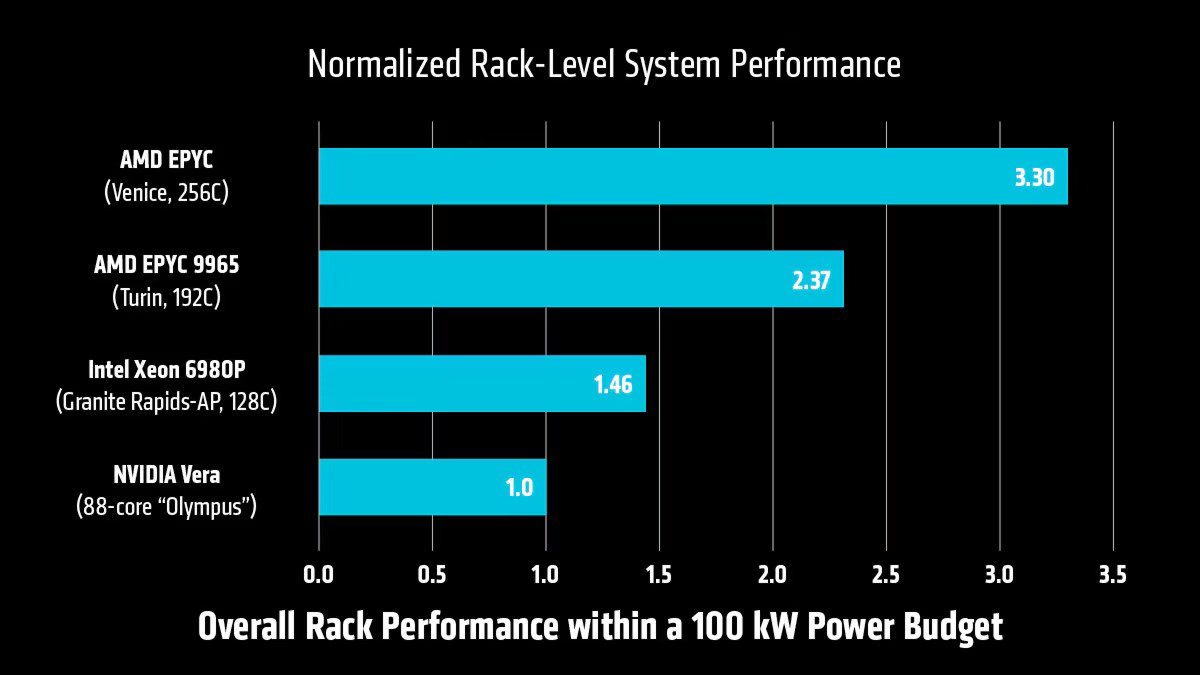
That's just the start of the stipulations. AMD doesn't have its hands on Vera, so the performance here is an estimate. AMD took benchmarks it had for Nvidia's Grace chip and multiplied them by a scaling factor of 1.63x based on Vera results published by Phoronix. AMD also says that its 256-core EPYC Venice results are derived from an estimated 1.7x scaling factor over the EPYC 9965, along with "internal testing."
AMD's methodology ends with this line: "[These results] are intended to provide directional comparison rather than direct measured rack benchmarks." As you can tell from the three paragraphs of stipulations above, that sentence carries a lot of weight on its shoulders. You can't simply scale the performance of a single "node" (a dual-socket system, in this case) up in a linear fashion. Interconnects, as well as thermal and power limitations, will become a factor as you scale up.
Regardless, AMD frames the results here around agentic AI, though the benchmarks it's using are focused on general-purpose data center tasks. The topline result is from SPEC CPU 2017, specifically looking at integer throughput. AMD used the following benchmarks, as well:
- Server-side Java based on SPECjbb 2015
- WRK Tool for load on an NGINX web server
- Redis-benchmark for in-memory workloads
- Memory caching with Memcached
- Database performance with TPROC-C on MySQL
These "results" are mostly a way for AMD to fire back at Nvidia after Phoronix published a list of results for Vera that were curated by Nvidia. AMD is laying the groundwork for its Advancing AI event next month, where we expect to hear more about Venice, Zen 6 more broadly, and AMD's enterprise roadmap in much greater detail.

Follow Tom's Hardware on Google News, or add us as a preferred source, to get our latest news, analysis, & reviews in your feeds.






 English (US) ·