
 Image via Warner Bros. Pictures
Published Jun 1, 2026, 12:11 PM EDT
Jeremy has more than 2500 published articles on Collider to his name, and has been writing for the site since February 2022. He's an omnivore when it comes to his movie-watching diet, so will gladly watch and write about almost anything, from old Godzilla films to gangster flicks to samurai movies to classic musicals to the French New Wave to the MCU... well, maybe not the Disney+ shows.
His favorite directors include Martin Scorsese, Sergio Leone, Akira Kurosawa, Quentin Tarantino, Werner Herzog, John Woo, Bob Fosse, Fritz Lang, Guillermo del Toro, and Yoji Yamada. He's also very proud of the fact that he's seen every single Nicolas Cage movie released before 2022, even though doing so often felt like a tremendous waste of time. He's plagued by the question of whether or not The Room is genuinely terrible or some kind of accidental masterpiece, and has been for more than 12 years (and a similar number of viewings).
When he's not writing lists - and the occasional feature article - for Collider, he also likes to upload film reviews to his Letterboxd profile (username: Jeremy Urquhart) and Instagram account.
He has achieved his 2025 goal of reading all 13,467 novels written by Stephen King, and plans to spend the next year or two getting through the author's 82,756 short stories and 105,433 novellas.
Sign in to your Collider account
Christopher Nolan doesn’t exclusively make big movies, but that kind of thing is what he’s become famous for, especially since about the mid-2000s. The last film of his that probably wasn’t definable as a blockbuster was The Prestige, and even then, it was still a decently large film in some ways, and certainly an overall cinematic and ambitious one. Insomnia was almost on the same scale, and then Following and Memento – his first two movies – were a good deal smaller in scope (which doesn’t stop Memento, by any means, from remaining one of his very best films).
If something cost more than $100 million, and if it ultimately made such a budget back and then some, it’s being counted as a blockbuster, for present purposes. At the time of writing, The Odyssey looks set to be another blockbuster, qualifying as one for its budget, and it’d be a surprise if it didn’t do well financially, too. But any movie that hasn’t already been mentioned will be ranked below, starting with the decent blockbusters Nolan’s helmed, and ending with the all-time great ones.
8 'Batman Begins' (2005)
 Image via Warner Bros. Pictures
It’s possible to appreciate Batman Begins for what it did, for comic book movies, while still finding it a bit underwhelming, especially compared to its first sequel. Those Nolan-directed Batman movies have a similar trajectory quality-wise to the first three X-Men movies and the Sam Raimi Spider-Man movies, in that the first movie in each trilogy was very important for the overall superhero genre, the second movie was even better, and then the third movie proved quite divisive and/or over-ambitious.
Here, the assertion that the third of Nolan’s Batman movies is better than Batman Begins might be controversial, but that third film's got some high highs alongside those infamously low lows. For what it’s worth, it also feels like a bit more of a blockbuster, and was an overall huge movie in terms of its budget and worldwide box office gross (the highest-grossing of all Nolan’s movies).
7 'The Dark Knight Rises' (2012)
 Image via Warner Bros.
And here’s the third of the Batman/Dark Knight movies: The Dark Knight Rises. This is a bombastic and kind of unwieldy movie that’s technically a little sloppier on a writing front than what came before, but it’s technically a bit more proficient – and ultimately more spectacular – than Batman Begins. This won’t result in it being more enjoyable for everyone, but if you want something big, you do get a lot here, for better or worse.
Tom Hardy hams it up as Bane, there’s a nuclear bomb and an almost Gangs of New York-style battle in the streets involved in the climax, and then anyone still alive by the end of it all gets a kind of sappy send-off. Christopher Nolan was potentially juggling a little too much here, all at once, though parts of The Dark Knight Rises are quite thrilling, and few superhero movies have ever been attempted on a scale quite this size.
6 'Tenet' (2020)
 Image via Warner Bros. Pictures
Tenet belongs in a similar camp to The Dark Knight Rises in the sense that it might be trying to do a few too many things at once, yet it can also be appreciated, despite – or perhaps even because of – all the messiness. It’s a sci-fi/action/thriller movie about objects and people being able to move backward in time, all the while interacting with things going forward in time.
Well, that’s oversimplifying things, and it has to be acknowledged that Tenet is not a simple movie. This is sometimes frustrating, and yet it’s also what sometimes makes Tenet incredibly engaging and exciting. It’s one that feels worth rewatching, even if there’s a sense that you might well need more than just a couple of viewings to crack what’s going on here, particularly if you want a little more than to be swept along for the ride (still, even then, it’s a pretty great ride, at least at times).
5 'Dunkirk' (2017)
 Image via Warner Bros.
It might not qualify as an epic, seeing as it’s a pretty short film in the overall scheme of things (and short by the standards of a Christopher Nolan movie), but Dunkirk is still going to be counted here as a blockbuster. It’s not an epic in terms of runtime, but it is ambitious in scope in other ways, not to mention engaging because of how it depicts what sounds like a fairly straightforward premise: the story of how the Dunkirk evacuation was pulled off, which happened within the first year of the Second World War.
There isn’t a Memento or Tenet-level of time-warping here, but Nolan does still do the time warp again, to some extent, since the three perspectives the evacuation is shown from play out across different spans of time. The effect is a little hard to put into words, yet in execution, it’s quite mesmerizing, adding a great deal of intensity and an extra sense of unpredictability to the depiction of an event you're already going to know the outcome of, ahead of time.
4 'Oppenheimer' (2023)
 Image via Universal Pictures
Weirdly enough, Oppenheimer does count as a blockbuster, owing to it being so much larger in scope than most biopics, and also because it made an immense amount of money (not to mention being critically acclaimed, and eventually a big Academy Award winner). It’s a movie about J. Robert Oppenheimer and his involvement in developing the first nuclear bombs, the deployment of which were used at the end of the Second World War, though the anxieties surrounding such weapons have continued to persist long after.
If a somewhat non-typical film can do a whole lot better than a good many more action-packed and crowd-pleasing blockbusters, then that’s probably a good indication that cinema’s not dead.
And Oppenheimer, as a film, grapples with that ongoing anxiety in an appropriately heavy sort of way, with the grimness of the movie making it a further surprise just how successful it was. You wouldn’t really think it’d have mass appeal, but if a somewhat non-typical film can do a whole lot better than a good many more action-packed and crowd-pleasing blockbusters, then that’s probably a good indication that cinema’s not dead or anything just yet.
3 'Inception' (2010)
 Image via Warner Bros. Pictures
There’s a nice balance with Inception, in terms of it getting a little more complex than your average science fiction blockbuster, but not in an out-of-control way, like you could argue happened with Tenet. This film’s about a heist that involves going into dreams within dreams, and implanting an idea in one’s mind instead of stealing something, though it lays out all the rules pretty thoroughly, and makes a fair amount of exposition decently entertaining, too.
Also, Inception builds in spectacle in an incredibly satisfying way, since there’s quite a bit of action before the main mission starts, and then the action sequences get grander in scope the further down into the subconscious the main characters go. There are plenty of familiar beats and narrative choices, especially if you’ve watched your fair share of heist movies, yet they're all remixed and put into this movie in genuinely inventive ways. At the end of the day, there’s simply a great deal to be entertained by here.
2 'Interstellar' (2014)
Though Interstellar is a bit shorter than Oppenheimer, it might well be the most epic of Nolan’s films, just because it ends up covering a great deal of time and space. It’s about a mission into a wormhole done to find a new planet that humanity could potentially move to, since Earth is shown to be dying. From there, things do get more complicated, especially with different characters ultimately experiencing the passage of time very differently.
It’s very heavy on sci-fi elements, making it more or less a hard science fiction film, yet it’s also going for an emotional thing in a way Nolan’s movies hadn’t typically done, up until that point. Interstellar has a lot to say about the human condition alongside being quite technical, detail-focused, and realistic (as realistic as it can be, at least) with many of its sci-fi elements. It’s bold to go in both those directions at once, but Interstellar makes it work, and it ends up being a tremendously satisfying sci-fi epic, no matter what you're potentially looking for out of such a film.
1 'The Dark Knight' (2008)
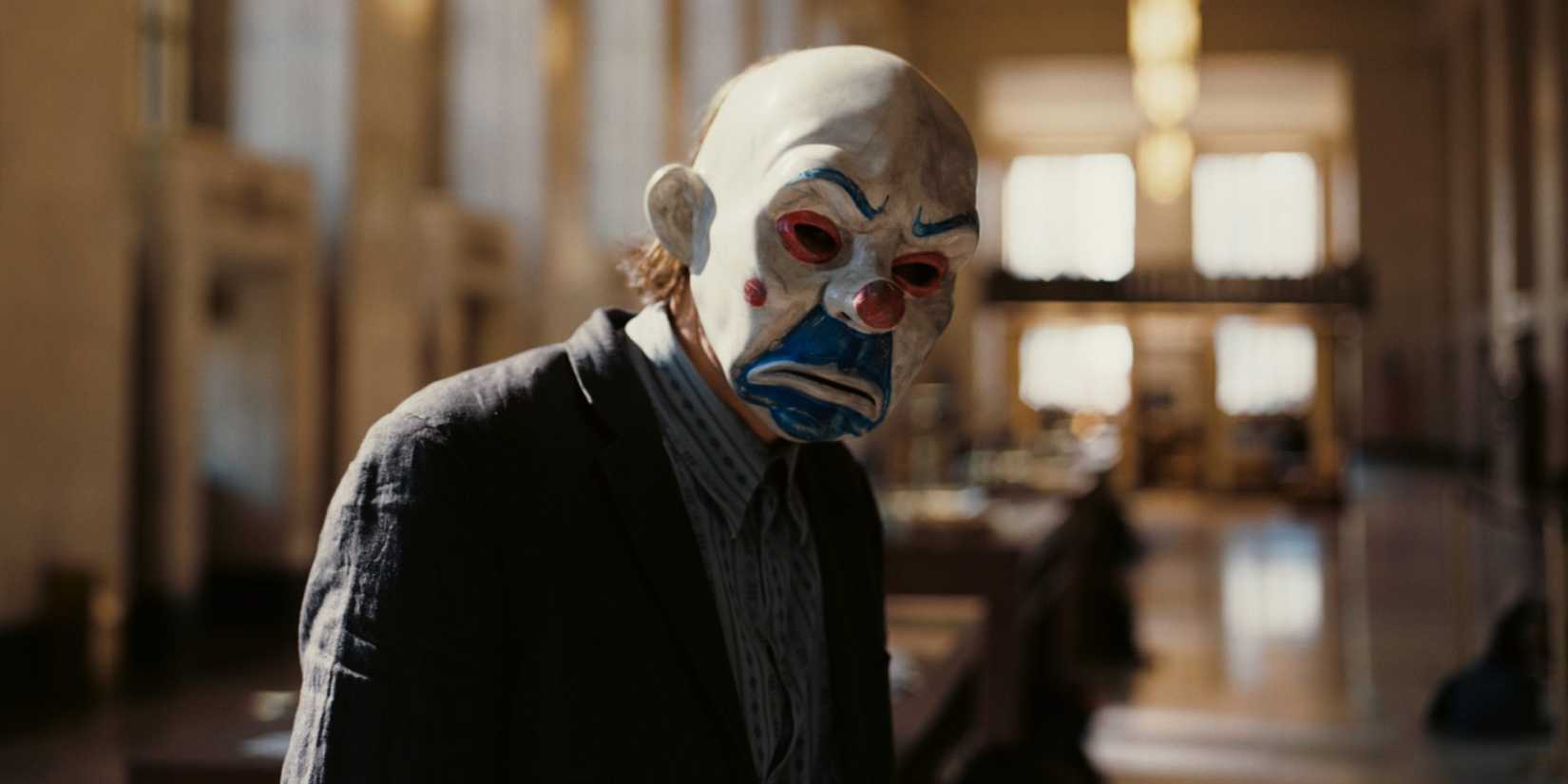 Image via Warner Bros.
If The Dark Knight is eligible to be part of some kind of (positive!) ranking, it’s almost always going to be right near the top of said ranking. It’s just that good, and also that well-liked, so apologies if it’s boring to put it here, but it is the best of Nolan’s blockbusters, and also quite easily the greatest of his three superhero movies, thanks in part to it standing out from a good many superhero movies in the right sort of ways.
The potential of Batman Begins paid off here, because The Dark Knight feels like a more confident and compelling film in just about every way. It looks better, it’s paced better, the central conflict is more interesting, and the big action sequences stand out so much more. It’s a movie that begins incredibly well, then never really slows down for the entirety of its 2.5-hour-long runtime, never failing to be a blast to rewatch, no matter how many times you’ve seen it already.




 English (US) ·