Jeremy has more than 2700 published articles on Collider to his name, and has been writing for the site since February 2022. He's an omnivore when it comes to his movie-watching diet, so will gladly watch and write about almost anything, from old Godzilla films to gangster flicks to samurai movies to classic musicals to the French New Wave to the MCU... well, maybe not the Disney+ shows.
His favorite directors include Martin Scorsese, Sergio Leone, Akira Kurosawa, Quentin Tarantino, Werner Herzog, John Woo, Bob Fosse, Fritz Lang, Guillermo del Toro, and Yoji Yamada. He's also very proud of the fact that he's seen every single Nicolas Cage movie released before 2022, even though doing so often felt like a tremendous waste of time. He's plagued by the question of whether or not The Room is genuinely terrible or some kind of accidental masterpiece, and has been for more than 12 years (and a similar number of viewings).
When he's not writing lists - and the occasional feature article - for Collider, he also likes to upload film reviews to his Letterboxd profile (username: Jeremy Urquhart) and Instagram account.
He has achieved his 2025 goal of reading all 13,467 novels written by Stephen King, and plans to spend the next year or two getting through the author's 82,756 short stories and 105,433 novellas.
Jane Schoenbrun is definitely one of the most interesting filmmakers to make some kind of mark on the horror genre – and blow up – in recent years. That’s saying quite a lot, because the last decade or so has been a good one for new talent within the genre, with Schoenbrun being worthy of consideration alongside the likes of Ari Aster, Robert Eggers, Coralie Fargeat, Zach Cregger, and Jordan Peele, as far as that whole new wave of horror directors are concerned (admittedly, Cregger and Peele were known for other things before pivoting to horror, but still). Schoenbrun’s three movies to date all broadly belong to the horror genre, and all deal with similar things thematically (especially concerning identity), even if tonally, there are some major differences, with it also being noteworthy how each one focuses on a different kind of media or forms of entertainment.
These three feature films make up what feels like a thematic trilogy, and they're all compelling, strange, and memorable in their own ways. They're also movies that can be kind of difficult to describe, and they're probably not for everyone, but they are worth giving a shot if you're fond of horror movies that take risks and go to various places other horror movies might not ordinarily go. You’ve got three visually bold, tonally eclectic, and atmospherically haunting movies here, and Schoenbrun’s consistency to date, as a director, makes ranking those films kind of hard, yet that’s what the following intends to do anyway.
3
'We're All Going to the World's Fair' (2021)
Image via Utopia
It’s hard to find information on when exactly We're All Going to the World's Fair was filmed, though it is shot in a manner that makes it feel like a COVID-era production, and it was first screened in 2021. There are very few characters, and people don’t really spend time together in the same frame, owing to how much of the movie takes place on various online platforms, with the few characters who are in the movie communicating over the internet. So, it was a creative workaround to the physical restrictions imposed throughout 2020 or, if it was filmed before any lockdowns happened, then it was oddly prescient for how the first couple of years of the 2020s kind of felt. As for the plot itself, it’s about a teenage girl named Casey who keeps going down some strange online rabbit holes, finding herself psychologically unraveling to a particularly dramatic extent after taking part in a viral trend dubbed the World's Fair Challenge.
Most other movies that involve online interaction to this extent don’t understand the internet nearly as well as We’re All Going to the World’s Fair.
If you’ve ever found yourself spending more time than you really want within various online spaces, We're All Going to the World's Fair does capture that unease and sense of time slipping away from you pretty viscerally. Narratively, it doesn’t move quite as well as Schoenbrun’s other films, and it’s definitely not as adventurous or dazzling as those visually, but as more of an experience, it feels very grounded and eerie at times. Most other movies that involve online interaction to this extent don’t understand the internet nearly as well as We’re All Going to the World’s Fair, so it shouldn't be too surprising if it ends up being a pretty great time capsule for a certain space in the broader online world circa the late 2010s/early 2020s. For Schoenbrun, it was also a confident and mostly compelling debut, though they did indeed go on to bigger and better things, cinematically speaking, in the years following We’re All Going to the World’s Fair’s release. Case in point…
2
'Teenage Sex and Death at Camp Miasma' (2026)
It’s a movie called Teenage Sex and Death at Camp Miasma, so of course it’s pretty wild. It’s still surprising how many opportunities this movie takes to go big and get weird, and it’s not like it had a budget large enough to feel like a blank-check sort of project, but Jane Schoenbrun did make use of a bigger budget than either of their first two movies (the second, which will be gotten to in a bit, was also a step-up in scope compared to We're All Going to the World's Fair). Teenage Sex and Death at Camp Miasma also has a good deal more comedy compared to what came before, finding ways – sometimes broad, and sometimes more underhanded – to comment on, satirize, and homage horror movies that came before. There are points, though, where things are so much homaged, but name-dropped, but then again, there’s not a joke about how Halloween’s villain is called Michael Myers while there’s also an actor named Mike Myers, but the joke is more about how overplayed that joke is. There are layers there, in that one moment, and then so many other layers throughout the whole of Teenage Sex and Death at Camp Miasma, making it head-spinning to try to keep up and maintain a hold on exactly what’s going on at what level.
There’s something to be said for just going with the flow, and not trying to understand something like this 100%. It’s recent, so this might not end up being true, but for now, it feels like the kind of movie that would really benefit from multiple viewings. As for the first viewing? It’s still quite a lot of fun, being about a queer filmmaker who’s tasked with rebooting a kind of popular – but also quite dated – horror franchise called Camp Miasma, which is most comparable to Friday the 13th, and then second most comparable to Sleepaway Camp. The filmmaker protagonist here goes very far in trying to realize her vision, becoming dead-set on getting the lead actress from the first Camp Miasma movie back in the lead role, and then things get weird. What the series means to these two women, and what they might do within the series going forward, is what the film’s mostly about. It is also postmodern in a way that pushes much further than the likes of Scream (the whole series, really) and The Cabin in the Woods, which are other horror movies with comedic meta elements. The same itch is scratched by Teenage Sex and Death at Camp Miasma, but the scratching is done far more vigorously, enough so that it draws blood in a few places. But if you're into that – and if you're willing to go along for the ride and have a ton of wild things thrown at you – then it’s well worth checking out.
1
'I Saw the TV Glow' (2024)
Image via A24
While Jane Schoenbrun’s other two movies have seven-word titles, their best overall, I Saw the TV Glow, stands out for its title being “only” five words, so if Schoenbrun next makes a movie with even fewer words in its title, you know you're going to be in for something absolutely revolutionary. No, not really. It’s actually a bit difficult to say that this one is better than Teenage Sex and Death at Camp Miasma, since there’s a good argument to be made that each film Schoenbrun’s directed has been a little better than the last. The ambition of that third movie is quite staggering, especially with trying to comprehend everything it’s going for, but there is a certain impact I Saw the TV Glow has by being more to-the-point. Labeling it more straightforward, though, doesn’t feel quite right, since there is still a lot going on here, with television being the focus here, rather than online spaces (like in We’re All Going to the World’s Fair) or cinema (Teenage Sex and Death at Camp Miasma). There are two main characters in this second film of Schoenbrun’s, and both bond as teenagers because of their love (or possible obsession) with a TV show called The Pink Opaque.
They reconnect as young adults, both with very different worldviews, with the narrative becoming about how making or not making a choice at a pivotal moment can haunt one for potentially the rest of their lives. Saying something does a thing “quietly” is a bit overdone, at this point, but I Saw the TV Glow is eerie in a quiet sort of way, so that description does honestly really apply here. It’s not hugely scary in the moment, outside a couple of alarming moments visually speaking, yet the film as a whole does feel eerie when you're looking back on it, realizing what it had to say about identity and the trans experience (which is the main allegory here, and even if it’s not subtle about that, the way it explores that topic is undeniably unique). I Saw the TV Glow is all a bit hard to put into words, and it’s very depressing in some ways, though even with all that, it remains the easiest Jane Schoenbrun film to recommend, especially if you want an idea of their style and thematic interests summed up relatively well in one movie. It’s a film that lingers in the mind, and the idea of it aging well in the years – or maybe even decades – to come doesn’t feel too extreme at all.

 Image via MUBI
 Image via Utopia
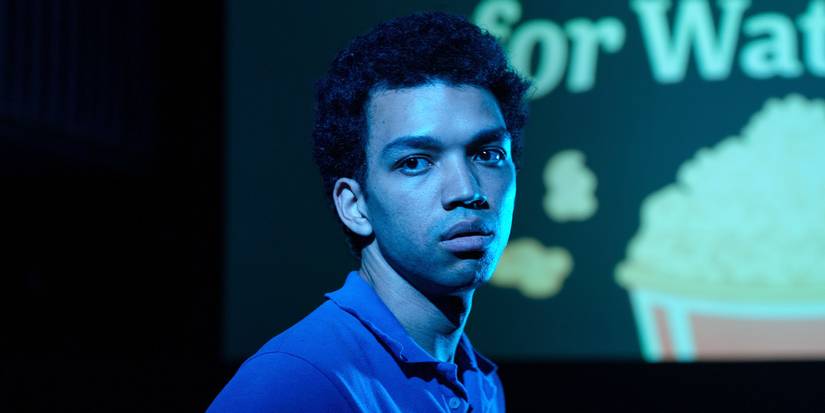 Image via A24





 English (US) ·