
 Image via Universal Pictures
Published Aug 6, 2026, 7:21 PM EDT
Marcel is a writer who is passionate about most movies and series. He will watch anything that's good. He is a content manager by day and a videographer when needed. Marcel used to work at a major streaming service based in Asia Pacific as a Content Specialist and was the Distribution Manager for a local movie distribution company.
Sign in to your Collider account
Christopher Nolan is one of my favorite filmmakers working today. Just like cinephiles all across the world, I did have to fight for my IMAX 70mm ticket for The Odyssey months before its release and even travel to the theater's location. Nolan is probably one of the few directors who could make us spend a little more money just to see his films as he intended. As a fan, ranking his movies honestly feels a little impossible. Some directors have obvious highs and lows, but the low in Nolan's filmography is still an objectively high point compared to other movies.
It does not matter whether you discovered his movies from his Dark Knight days, his major feature debut with Memento, or even recently thanks to his Oscar win with Oppenheimer, because you're in for a treat nonetheless. Some may disagree with the ranking on this list, and few may agree. Nevertheless, with Christopher Nolan, we're always spoiled by great cinematic experiences.
13 'Following' (1998)
 Image via Momentum Pictures
Following follows a young, unemployed aspiring writer in London, played by Jeremy Theobald, who has an unusual hobby of following strangers through the city for his first novel's inspiration. When Cobb (Alex Haw), one of his targets, notices him, he develops a friendship and even accompanies Cobb on his even more peculiar hobby of committing burglaries for fun, leading to more complications for the writer.
As his feature film debut, Following is remarkable for how confidently it introduces many of the themes that would define his career, especially his penchant for non-linear narrative. Shot on a shoestring budget with shooting schedules that accommodated the cast and crew's day jobs, the movie was inspired by Nolan's own experience of being burglarized. The film is shot in black-and-white 16mm film over fourteen weekends. With a short runtime of 70 minutes, the film is a fascinating and effective noir film. It may not have memorable characters or ambitious narratives as his subsequent films, but it is still a solid debut feature.
12 'Insomnia' (2002)
 Image via Warner Bros.
Insomnia follows veteran Los Angeles detective Will Dormer (Al Pacino), who is sent to Alaska to investigate the murder of a teenage girl with his partner. After a chase goes wrong and he accidentally causes the death of his own partner, Dormer is ridden by guilt and the real killer begins to manipulate him. To make matters worse, the town's perpetual daylight begins to consume Dormer's psyche.
Among Nolan's films, Insomnia is perhaps the most understated. The film itself is a remake of a 1997 Norwegian film starring Stellan Skarsgård, but it plays well to Nolan's sensibilities. The film focuses on character psychology and moral compromise for its tension. Al Pacino delivers one of his most underrated performances, while Robin Williams is chilling in one of his rare dramatic villain roles. It's a gripping crime thriller with excellent atmosphere and some memorable ethical dilemmas. It's an often-overlooked gem in Nolan's increasingly bombastic filmography that demonstrates Nolan's ability to craft tension without too many complicated narrative gimmicks.
11 'The Dark Knight Rises' (2012)
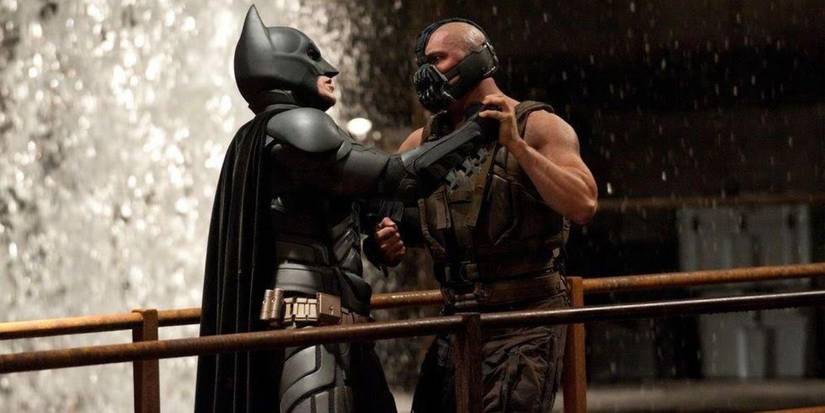 Image via Warner Bros.
In The Dark Knight Rises, the false peace in Gotham is ruined by the arrival of Bane (Tom Hardy), who seeks to reveal the truth and take the city hostage. The older and physically broken Bruce Wayne and Batman (Christian Bale) are forced out of hiding to face the ruthless mercenary, while forming an uneasy alliance with Selina Kyle (Anne Hathaway).
Judged on its own merits, The Dark Knight Rises is an outstanding blockbuster packed with memorable action and moments, emotional stakes, and Hans Zimmer's thunderous score. Its biggest challenge is following one of the greatest superhero films ever made, and comparisons with The Dark Knight have perhaps been harsher than deserved. The plot may be too busy at times, but the film succeeds in delivering a satisfying ending to the trilogy. It's an ambitious, rewarding finale that would comfortably rank near the top of many directors' careers, even if it lands lower among Nolan's remarkably consistent filmography.
10 'Dunkirk' (2017)
 Image via Warner Bros.
Told through three interconnected storylines, Dunkirk recreates the evacuation of Allied soldiers trapped on the beaches of France during World War II. The film follows young soldiers stranded on land over the course of a week, civilian volunteers crossing the English Channel during a single day, and Air Force pilots battling German aircraft within a single hour.
As one of the most intense World War II films, Dunkirk is arguably Nolan's most technically accomplished film. With minimal dialogues, the movie immerses audience through practical effects and spectacle, emphasized by the cinematography, loud sound design, and Hans Zimmer's relentless ticking score. The film could easily be a conventional war film but Nolan employed his signature style of non-linear narrative, this time with three different timelines. It also featured stunning performances from the ensemble cast that includes Tom Hardy, Cillian Murphy, Barry Keoghan and Mark Rylance. It's an achievement that demonstrates Nolan's mastery of visual storytelling.
9 'Batman Begins' (2005)
 Image via Warner Bros.
Batman Begins reimagined the creation of the Caped Crusader for a new generation. After his plan to avenge the murder of his parents did not go as planned, Bruce (Christian Bale) travels the world searching for purpose, until he is trained by the League of Shadows. Returning to Gotham City, he adopts the identity of Batman to fight corruption and organized crime, while also facing enemies like Scarecrow (Cillian Murphy).
Batman Begins is a highly influential film, not only for the superhero genre but for blockbuster movies in general. The film took a refreshingly grounded take on Batman's origin story, and made him so believable that he could have appeared in our current world. Then not a household name, Christian Bale delivers an excellent portrayal of Bruce Wayne, which immediately catapulted him into legendary status. He is supported by one of the strongest supporting cast that includes Michael Caine, Gary Oldman, Morgan Freeman, and Liam Neeson. Balancing action with character development, Batman Begins remains one of the finest superhero films ever made.
8 'Tenet' (2020)
 Image via Warner Bros.
Tenet follows a CIA operative known only as the Protagonist (John David Washington), who is recruited into a secret organization tasked with preventing a catastrophic event. Armed with the technology that can inverse time, he joins fellow agent Neil (Robert Pattinson) to stop arms dealer Andrei Sator (Kenneth Branagh) from unleashing a bomb that could end the world.
For many, Tenet is undoubtedly Nolan's most divisive film, but it is a movie that is unmistakably his and probably his boldest. The film trusts the audience by presenting a complex world that moves at a breakneck pace. The whole film is like the next level after Memento and Inception, and it is a giant puzzle waiting to be solved. The result is a sci-fi actioner that rewards repeat viewings more than perhaps any other film in his filmography. It is simply impossible not to admire the sheer confidence and originality behind the project, while it also plays with one of the simplest tricks in the book, which is just reversing the footage you just shot, only on a much grander scale. Tenet simply stands in a class of its own.
7 'Memento' (2000)
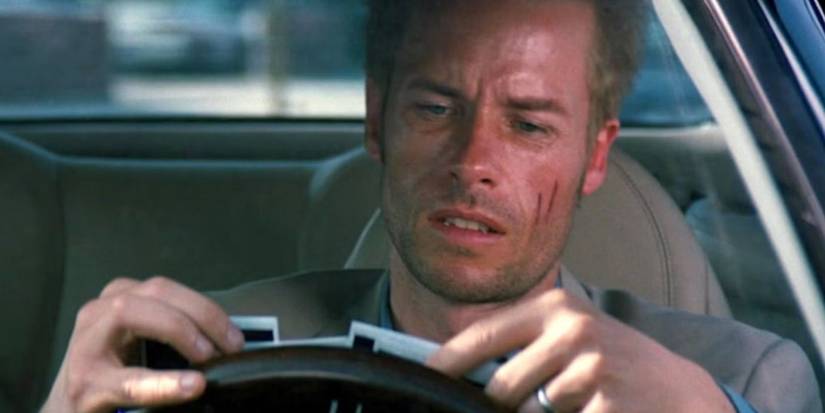 Image via Newmarket Films
In Memento, Leonard Shelby (Guy Pearce) suffers from anterograde amnesia, leaving him unable to form new long-term memories after the brutal attack that killed his wife. To continue his search for her murderer, he relies on notes, photographs, and tattoos permanently etched onto his body to remind himself of important clues.
Unfolding in reverse chronological order, Memento announced Christopher Nolan as one of the most inventive filmmakers of his generation. Its reverse narrative reflects the character's state of mind, and it serves the film perfectly, not just as a gimmick. Every new piece of information changes the meaning of the previous scenes, putting the audience in Shelby's perspective. More than two decades later, Memento remains one of the finest psychological thrillers ever made and the most ambitious example of non-linear storytelling. If you've seen Memento, you'll find traces of it in Nolan's subsequent films too.
6 'Interstellar' (2014)
 Image via Melinda Sue Gordon/©Paramount Pictures/courtesy Everett Collection
In Interstellar, Earth is facing an environmental collapse and NASA is looking into other planets in search of a new home. Former pilot Cooper (Matthew McConaughey) is recruited for the mission, leaving his children on Earth. As he travels through a wormhole to another galaxy, his mission is also to get back home as fast as possible to reunite with his family.
Interstellar stands as one of the best sci-fi films in the 21st century. It marries scientific ambition and emotions effectively, making it resonate even years after its release. The visuals are simply breathtaking, thanks to the gorgeous cinematography and practical effects. It also has an Oscar-nominated Hans Zimmer score that is instantly recognizable. While the film takes the audience to an out-of-this-world experience (pun intended), it grounds itself with a deeply human story about family and love. The film recently celebrated its 10-year anniversary with sold-out IMAX screenings all over the world.
5 'Inception' (2010)
 Image via Warner Bros. Pictures
Inception follows Dom Cobb (Leonardo DiCaprio), a skilled extractor who infiltrates people's dreams to steal valuable secrets hidden within their subconscious. Haunted by his late wife and unable to return home to his children, Cobb is offered one final job, not to steal an idea, but to plant one. Assembling a specialized team to achieve this almost-impossible act, Cobb has to dive into multiple layers of dreams to make this work.
Inception represents Christopher Nolan flexing his ideas at the peak of his blockbuster filmmaking powers. Fresh off The Dark Knight, expectations were high and this film exceeded them. It's unlike anything Hollywood has offered before. The intricate rules and mechanics of the world are presented well so that the audiences can follow the story and the action. The visuals in this movie are instantly memorable, from the streets of Paris folding together to the iconic zero-gravity corridor fight. Its now-iconic ending has fueled discussion and debates for years. These qualities only reflect how Inception is one of the defining films of the 21st century, and one of Nolan's greatest works.
4 'Oppenheimer' (2023)
 Image via Universal Pictures
Christopher Nolan's biographical epic chronicles the life of physicist J. Robert Oppenheimer (Cillian Murphy), the brilliant scientist who led the Manhattan Project during World War II. Oppenheimer follows the man from his beginnings in university, his involvement in the creation of the atomic bomb and the political fallout with Lewis Strauss (Robert Downey Jr.).
Oppenheimer is unlike any other conventional biography. The film has all the qualities that make a Christopher Nolan film, including immersive cinematography, great score, non-linear plot and practical filmmaking. Cillian Murphy delivers a career-defining, Oscar-winning performance as Oppenheimer, while Robert Downey Jr sheds his Tony Stark persona for the best performance so far in his career. Despite being a three-hour film centered largely around conversations and political hearings, it's as gripping as any film Nolan has made. The film entered the zeitgeist when it was paired with Barbie, turning both movies into a cultural and box office phenomenon. The film was awarded seven Oscars, including Best Picture and Nolan's first Best Director win.
Collider Exclusive · Oscar Best Picture Quiz
Which Oscar Best Picture
Is Your Perfect Movie?
Parasite · Everything Everywhere · Oppenheimer · Birdman · No Country
Five Oscar Best Picture winners. Five completely different visions of what cinema can be — and what it can do to you. One of them is the film that was made for the way your mind works. Ten questions will figure out which one.
🪜Parasite
🌀Everything Everywhere
☢️Oppenheimer
🐦Birdman
🪙No Country for Old Men
FIND YOUR FILM →
01
What kind of film experience do you actually want? The best movies don't just entertain — they leave something behind.
ASomething that pulls the rug out — that makes me think I'm watching one kind of film and then reveals I'm watching another entirely. BSomething overwhelming — funny, sad, absurd, and genuinely moving, all at once. CSomething grand and weighty — a film that makes me feel the full scale of what I'm watching. DSomething formally daring — a film that pushes what cinema can even do. ESomething lean and relentless — pure tension with no wasted frame.
NEXT QUESTION →
02
Which idea grabs you most in a film? Great films are driven by a central obsession. What's yours?
AClass, inequality, and what people are willing to do when desperation meets opportunity. BIdentity, family, and the chaos of trying to hold your life together when everything is falling apart. CGenius, moral responsibility, and the catastrophic weight of a decision you can never take back. DEgo, legacy, and the terror of becoming irrelevant while you're still alive to watch it happen. EEvil, chance, and whether moral order actually exists or if we just tell ourselves it does.
NEXT QUESTION →
03
How do you like your story told? Form is content. The way a story is shaped changes what it means.
AGenre-twisting — I want it to start in one lane and migrate into something completely different. BMaximalist and genre-blending — comedy, action, drama, sci-fi, all in one ride. CEpic and non-linear — cutting between timelines, building a mosaic of cause and consequence. DA single unbroken flow — I want to feel like I'm living it in real time, no cuts to safety. ESpare and precise — every scene doing exactly what it needs to do and nothing more.
NEXT QUESTION →
04
What makes a truly great antagonist? The opposition defines the protagonist. What kind of opposition fascinates you?
AA system — invisible, structural, and almost impossible to fight because it has no single face. BThe self — the ways we sabotage, abandon, and fail the people we love most. CHistory — the unstoppable momentum of events that no single person can stop or redirect. DThe industry — the machinery of culture that chews up talent and spits out irrelevance. EPure, implacable evil — a force so certain of itself it becomes almost philosophical.
NEXT QUESTION →
05
What do you want from a film's ending? The final note is the one that lingers. What do you want it to sound like?
AShock and inevitability — a conclusion that recontextualises everything that came before it. BEarned emotion — I want to cry, laugh, and feel genuinely hopeful, even if the world is a mess. CDevastation and grandeur — an ending that makes me sit in silence for a few minutes after. DAmbiguity — something that leaves enough open that I'm still thinking about it days later. EBleakness — an honest refusal to pretend the world is tidier than it actually is.
NEXT QUESTION →
06
Which setting pulls you in most? Where a film takes place shapes everything — mood, stakes, what's even possible.
AA gleaming modern city with a hidden underside — beauty masking rot, wealth masking desperation. BA collapsing suburban life that opens onto something infinite — the multiverse of a single ordinary person. CThe corridors of power and science at a world-historical turning point — where decisions echo for decades. DThe grimy, alive chaos of New York and Hollywood — fame as both destination and trap. EVast, indifferent landscape — desert and highway where violence arrives without warning or reason.
NEXT QUESTION →
07
What cinematic craft impresses you most? Every great film has a signature — a technical or artistic element that makes it unmistakable.
AProduction design and mise-en-scène — every frame composed to carry meaning beneath the surface. BEditing and tonal control — the ability to move between registers without losing the audience. CScore and sound design — music that becomes inseparable from the dread and awe of what you're watching. DCinematography as performance — the camera not recording events but participating in them. ESilence and restraint — what's left unsaid and unshown doing more work than any dialogue could.
NEXT QUESTION →
08
What kind of main character do you root for? The protagonist is the lens. Who you choose to follow says something about you.
ASomeone smart and resourceful who makes increasingly dangerous decisions under pressure. BSomeone overwhelmed and ordinary who turns out to be capable of something extraordinary. CA brilliant, tortured figure whose gifts and flaws are inseparable from each other. DA self-destructive artist whose ego is both their superpower and their undoing. EA quiet, principled person trying to make sense of a world that has stopped making sense.
NEXT QUESTION →
09
How do you feel about a film that takes its time? Pace is a choice. Some films sprint; others let tension accumulate slowly, deliberately.
AI love a slow build when I know the payoff is going to be seismic — patience for a devastating reveal. BGive me relentless momentum — I want to feel breathless and emotionally spent by the end. CEpic runtime doesn't scare me — if the material demands three hours, give me three hours. DI want it to feel propulsive even when nothing is technically happening — restless energy throughout. EDeliberate and unhurried — I want dread to accumulate in the spaces between the action.
NEXT QUESTION →
10
What do you want to feel walking out of the cinema? The best films leave a mark. What kind of mark do you want?
AUnsettled — like I've just seen something I can't fully explain but can't stop thinking about. BMoved and energised — like the film reminded me what actually matters and gave me something to hold onto. CHumbled — like I've been in the presence of something genuinely important and overwhelming. DExhilarated — like I've just seen cinema doing something it's never quite done before. EHaunted — like a cold, quiet dread that stays with me for days.
REVEAL MY FILM →
The Academy Has Decided Your Perfect Film Is…
Your answers have pointed to one Oscar Best Picture winner above all others. This is the film that was made for the way your mind works.
Parasite
You are drawn to films that operate on multiple levels simultaneously — that begin in one genre and quietly, brilliantly migrate into another. Bong Joon-ho's Parasite is a film about class, desire, and the architecture of inequality that manages to be darkly funny, deeply suspenseful, and genuinely shocking across a single extraordinary running time. Your instinct is for cinema that hides its true intentions until the moment it's ready to reveal them. Parasite is exactly that — a film that rewards close attention and punishes assumptions, right up to its devastating final image.
Everything Everywhere All at Once
You want it all — and this film gives you all of it. The Daniels' Everything Everywhere All at Once is one of the most maximalist films ever made: action comedy, multiverse sci-fi, family drama, existential crisis, and a genuinely earned emotional core that sneaks up on you amid the chaos. You are someone who responds to ambition, who doesn't want cinema to choose between being entertaining and being meaningful. This film refuses that choice entirely. It is overwhelming by design, and its overwhelming nature is precisely the point — because the feeling of being crushed by infinite possibility is exactly what it's about.
Oppenheimer
You are drawn to cinema on a grand scale — films that understand history not as a backdrop but as a force, and that place their characters inside that force and watch what happens. Christopher Nolan's Oppenheimer is a film about the terrifying gap between what we can do and what we should do, told with the full weight of one of the most consequential moments in human history behind it. You want your films to feel important without feeling self-important — to earn their ambition through sheer craft and the gravity of their subject. Oppenheimer does exactly that. It is enormous, complicated, and refuses easy comfort.
Birdman
You are drawn to films that foreground their own construction — that make the how of the filmmaking part of the what it's about. Alejandro González Iñárritu's Birdman, shot to appear as a single continuous take, is cinema examining itself through the cracked mirror of a fading actor's ego. You respond to formal daring, to the feeling that a film is doing something that probably shouldn't be possible. Michael Keaton's performance and Emmanuel Lubezki's restless camera create something genuinely unlike anything else — a film that is simultaneously about creativity, relevance, self-destruction, and the impossibility of ever truly knowing if your work means anything at all.
No Country for Old Men
You are drawn to cinema that trusts silence, that refuses to explain itself, and that treats dread as a form of meaning. The Coen Brothers' No Country for Old Men is a film about the arrival of a new kind of evil — implacable, arbitrary, and utterly indifferent to the moral frameworks we use to make sense of the world. It is one of the most formally controlled films ever made, and its controlled restraint is what makes it so terrifying. You want your films to haunt you, not comfort you. You are not interested in resolution if resolution would be dishonest. No Country for Old Men is honest in a way that most cinema never dares to be.
↻ RETAKE THE QUIZ





 English (US) ·