

Published Jul 24, 2026, 11:59 AM EDT
Motor City became Alan Ritchson's latest chance to transform himself, as he discusses acting, action, Reacher, DC and more.
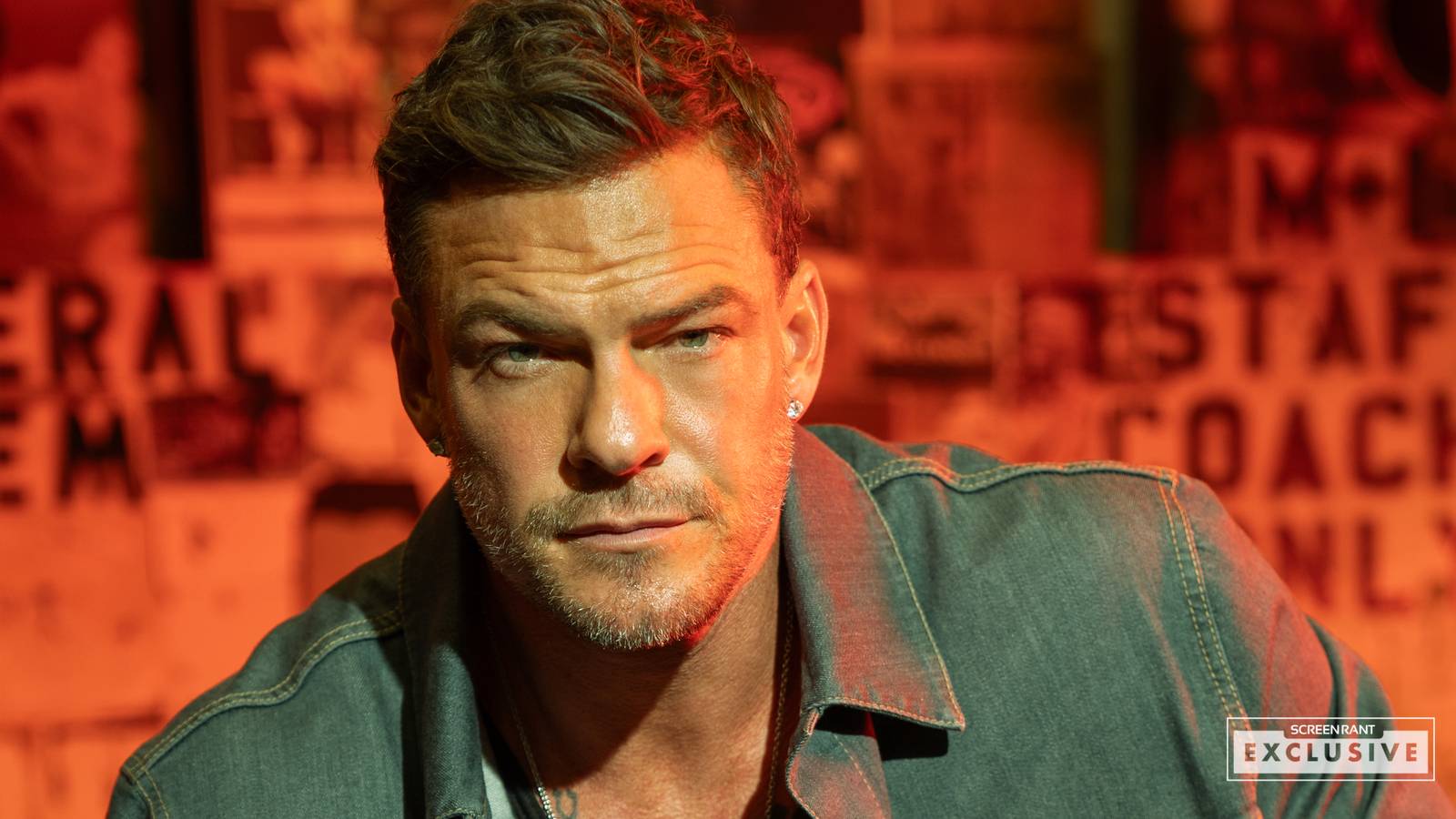
After Reacher changed the scale of his career, Alan Ritchson chose Motor City, a nearly wordless action film that allowed him to rebuild himself from the teeth up.
Alan Ritchson says he woke up to roughly 40 offers on the Monday after Reacher Season 1 aired. Motor City was one of them.
What caught his attention was what the 1970s set revenge film asked him to do. Ritchson had become more visible than at any previous point in his career, but Motor City gave him the chance to build a character through movement, appearance, reaction, and silence. It also suited the way he is approaching this stage of his career: every new role should feel distinct from the one audiences just watched.

I’ve spoken with Ritchson at a few very different points in that career. He visited our convention media suites to talk Titans, and years ago, while promoting his feature directorial debut, Dark Web: Cicada 3301, we played Among Us together. More recently, we spoke again for ScreenRant’s exclusive War Machine cover story, before the film became Netflix’s most-watched movie of 2026 with a sequel greenlit. A lot has changed since Reacher made him one of Hollywood’s most in-demand action stars, but the interest in doing something unexpected was already there.
“After Reacher Season 1 aired, I woke up to a lot of offers the following Monday, and this was one of them. I think I had like 40 offers right out of the gate, and this is just a wholly unique film. I like the fact that I was able to help bring to life something that I think advances art and action in a way that we haven’t really seen before, so this was one I felt very passionate about.”
Forty offers is a pretty good Monday, but it also means careful decision-making is a priority. When audiences see an actor everywhere, performances can start bleeding together. The same gestures return, the same physical rhythms become familiar, and the actor becomes easier to see than the character. Ritchson is hyper aware of this and its guiding his career.
Alan Ritchson Explains How He Transformed For Motor City

"I've never wanted to be a persona actor. I'm allergic to trying to see myself on screen. And because I'm working so frequently, I have a lot of projects coming out. I'm trying to curate a lineup where people won't get tired because they don't recognize the person that they had just seen, right?"
That philosophy shaped every aspect of Ritchson's appearance in Motor City. When we asked how much input he had in designing the character who was framed and wrongfully sent to prison, his answer was immediate.
"All of it."
I’ve never wanted to be a persona actor. I’m allergic to trying to see myself on screen.
Ritchson says he worked closely with the filmmakers on everything from the wardrobe to the hair, beard, teeth, scars and prosthetics.
"It's honoring the time, the place, the person."
With so little dialogue in Motor City, those visual choices had to tell part of the story. The character's appearance reflects the years he spends in prison, with the hair, beard, scars and prosthetics helping communicate what he's lived through before he says a word. The teeth, Ritchson says, were another deliberate choice to separate the character from the polished image audiences associate with Reacher.
Motor City Left Alan Ritchson With Nowhere To Hide
The challenge was there on the page before Ritchson ever stepped in front of a camera. Because Motor City contains so little dialogue, its screenplay is filled with scene direction. He remembers opening it and finding unusually dense pages.
That would normally concern him. Ritchson often tells writers that a screenplay should "lay on the page easy," without huge blocks of ink slowing everything down. Chad St. John's script was the rare exception.
"It was a breeze to read. Chad St. John is an incredible writer."
Ritchson says St. John built Motor City around a simple goal: tell a story audiences could follow without language becoming a barrier. Every scene had to communicate through movement, expression and emotion just as much as dialogue.
A performance is still rooted in emotion, whether you’ve got dialogue in the scene or not.
"A performance is still rooted in emotion, whether you've got dialogue in the scene or not, and listening is still a key element to pulling a scene off, which is sort of what you're required to do in a movie like this."
The demands changed once the camera lingered on those moments. Every look lasted longer, every reaction carried more weight and every beat had to communicate clearly. Ritchson credits director Potsy Ponciroli with helping him find that balance.
"Accessing those emotions and feelings, it's all similar, but because you're lingering so long on looks, you do really want to make sure that you aren't overcooking anything or under-delivering, that the message is being conveyed properly, and that comes down to the director.
"Potsy Ponciroli is an incredible filmmaker. I hope we do many more projects together. I think we really made some cool art, but I learned to trust him really quickly. I'm such a skeptic. I have a really hard time trusting anybody, sort of until they earn the trust. And right away, I realized he's a genius. He's got a great eye, amazing taste, and could guide that performance in a way where it was like, 'Hey, just let me know on this lens if we're doing enough or not enough.' He would push and pull appropriately every time, and I felt very safe in his hands."
Alan Ritchson On Working With Shailene Woodley & Ben Foster In Motor City

Before cameras rolled, Ritchson says the cast spent their time talking. He describes working with Shailene Woodley and Ben Foster as "a privilege and gift," watching the pair explore every layer of a scene before deciding how to perform it.
"Shailene Woodley and Ben Foster, it was a privilege and gift to work with them and to get inside their process for a little bit. They both explore relentlessly every aspect of a scene, every aspect of character, and how they relate to one another. We could spend hours talking about the emotional threads of a scene. And then once that was done, now you have to also deal with blocking, right? How are we going to move throughout the scene? Where does it climax? Where does it crescendo? So it's a bit of a ballet. We would take our time, and we wouldn't shoot a frame until we felt like we were all on the same page and in agreement about what the best ideas were and felt like it was the most resonant version of what we could shoot."
For Ritchson, rehearsal grew out of those conversations. Once the cast understood a scene emotionally, they worked together to shape its movement and rhythm before filming began.
Alan Ritchson Helped Design Motor City's Action

Ritchson says he helped shape many of Motor City's action sequences alongside stunt designer Ryan Tarran, his longtime stunt double. The pair wrote fights "the way that we would write a scene for a movie," mapping out "specific actions, props, beats" before sharing them with director Potsy Ponciroli and the rest of the team. It became "a pretty fun process" because "it was so collaborative," while giving Ritchson the chance to "exercise a muscle that's been pretty strengthened over the years," particularly after spending so much time on Reacher.
One of the biggest challenges came during a fight inside a moving convertible. Ritchson describes it as a sequence where "these two men want to kill each other so much that they sort of abandon the idea of protecting themselves," while the car is "careening down the street" through traffic, intersections and parked cars.
"We originally had five days on the schedule to shoot an expanded version of that car fight and, as happens in film all the time, things change. Some days you go over, you're in overtime, and things get more expensive. Financing falls through. Whatever. You need to start making compromises as you shoot the thing, and what we ended up with, we had a five day schedule for the fight, it was down to one day, no second unit, and we had a night shoot to figure that out, and it was tough.
"So we compressed the fight into the essential beats, and some of the coolest stunts that we could pull off in that amount of time."
Even after the schedule changed, Ritchson says the experience stayed rewarding because of the actors around him. He calls Ben Foster "a willing partner" who "really wanted to give it," while Pablo Schreiber "wanted to go full send."
"When you're in the dance with people who are wanting to be there and take their shots, it makes it a lot of fun to figure that part out."

Motor City arrived during one of the busiest stretches of Ritchson's career. After telling ScreenRant he woke up to roughly 40 offers following the debut of Reacher Season 1, the actor said the series continues to dictate much of his schedule. At the time of our conversation, every script for Reacher Season 5 was complete and production was set to begin this week, as we revealed.
"We start shooting on Monday... The last half of my year is going to be all Reacher Season 5."
That schedule also affects the franchises fans keep asking him about. When we last interviewed Ritchson, we asked whether he'd be interested in returning to DC as a villain after previously playing heroes like Smallville's Aquaman and Titans' Hawk. His answer hasn't changed.
"I've always wanted to play... I want to play the bad guy."
Ritchson says conversations with DC are ongoing, though he wasn't ready to tease a specific project.
"There's always conversations going on with DC. I love DC. I would love to work something out with them, but yeah, at this exact moment, it's hard to say."
The same goes for Fast & Furious. Ritchson says he'd like to return following Fast X, but availability remains the biggest factor and he notes that Universal Pictures is committed to making this movie happen.
"We've been talking about it for a long time, and it's like anything. It comes down to my availability, and it's thin these days. So I would love to come back. I really enjoyed that."
On his character hanging off a literal cliff at the end of Fast X, Ritchson laughed.
"Yeah. It'd be a little tough not to figure that out."
He stopped short of confirming his return, adding that "we're just trying to work out... budget, schedule, all the things that make it tough to make a film," before saying he's "confident it'll get worked out eventually."
Motor City is now playing in theaters.




 English (US) ·