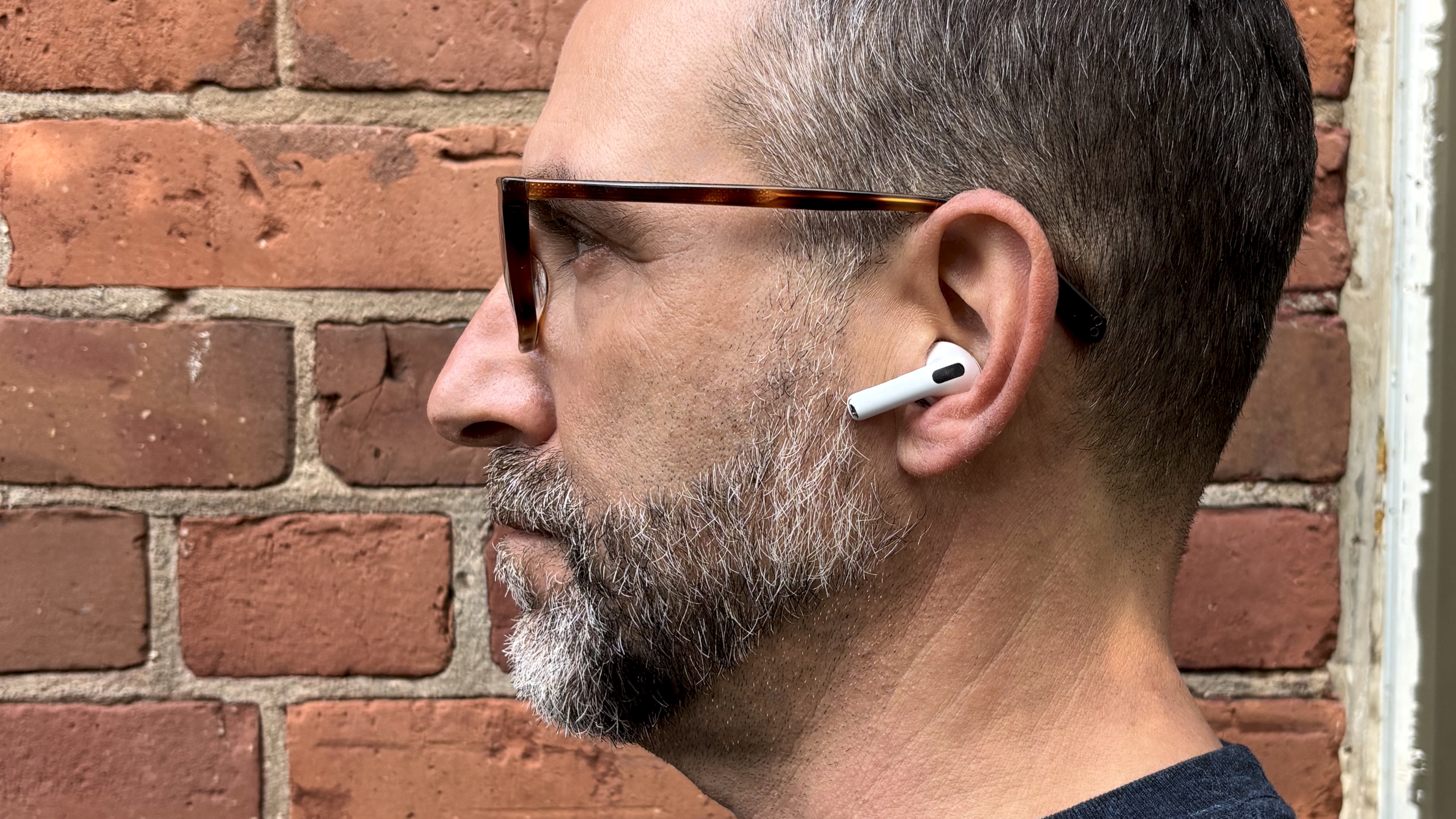
Here's something I never thought: What if my ears could see? The very idea of it conjures visions of earlobes with clusters of tiny, spider-like eyes.
Of course, now we're all considering this possibility thanks to what appears to be a stunning crack in Apple's typically rock-solid dome of product secrecy.
As we reported earlier this week, MacRumors dug into one of the macOS 27 release candidates and unearthed a short bit of video featuring a man wearing AirPods Pro earbuds but somehow using them with Apple Intelligence to save an image of a book for later.
The guy isn't wearing glasses, so it's not the rumored Apple iGlass or Apple Vision Wear at work here. Instead, everyone believes this is the first confirmation that Apple is working on AirPods with cameras or "AirPods Vision," a pair of Bluetooth earbuds also equipped with vision sensors that, in concert with your connected iPhone, can use Apple Intelligence to recognize objects and then store information about them for retrieval later.
Here is your first look at AirPods with Cameras in action using Visual Intelligence.This video file came from macOS 26.7 RC pic.twitter.com/yo7RI4MCeuAugust 18, 2026
I spent some time staring at the bud in the guy's ear, and it looks, from this angle, exactly like the current AirPods Pro 3 I currently wear. I assume that whatever sensors the buds are using live on the opposite side, facing out so they can "see" what you see.
I also got caught up in the book the guy is memorizing. Could, Should, Might, Don't, is a real book by former design head for Google X, Nick Foster. In it, he dives into four mindsets of, I guess, future ideation and innovation:
- "Could" revolves around the wild possibilities (probably why we watch and love Star Trek).
- "Should" is sort of the realist's approach to what we should do based on on-the-ground facts and data.
- "Might" appears to combine elements of the first two.
- "Don't" is the risk-averse part. It's all the reasons people don't want Artificial General Intelligence or robots running AGI living with, working with, and maybe ultimately controlling us.
While not anti-tech or anti-innovation, the book has a point of view and seems an odd choice to include in what might be an iPhone and AirPods tip video.
I look at the overall image and that book and think:
"Yeah, we Could do this, have AirPods that can see, but we Should think about the consequences of another sensor on our body, and while it Might be cool to have an always-aware system memorizing things for you, we Don't want other people to freak out when they see cameras in our ears."
Smart Glasses is a lesson
Usually, I would remind people that these are all rumors and Apple is always working on oddball stuff that will never see the light of day, but we have a tip video. Apple doesn't create tips for products it's never bringing to market.
I think there's a good chance we will get these "seeing" AirPods Pro this year. I understand the system probably isn't collecting and storing images of everything you see forever. It appears to be on demand, and the use of Apple Vision should mean that it takes the image, sends it to Apple's Private Cloud Compute, matches it with available data on the internet — "What is this book?" — and stores that data without the need for the actual photo or anything else the AirPods Pro's sensors detected.
Even with those assurances, consumers are in no mood for more wearable sensors. Just look at the growing negative sentiment around smart glasses, which some are now calling "creep glasses."
The difference, of course, is that such smart wearable cameras are meant to both analyze the world you see and to capture and store photos and videos. The "creep" factor comes in from people circumventing the onboard privacy controls (trying to hide the LED lights) so they can surreptitiously capture photos and videos.
If they see cameras on your AirPods, they will surely recoil and demand to know what they're for and if you are capturing images and video of them.
The problem with camera- or vision-equipped AirPods, though, is that people will have similar concerns. If they see cameras on your AirPods, they will surely recoil and demand to know what they're for and if you are capturing images and video of them. You might say no, but also secretly wish you had. The chance to document at least their face and name so you don't forget it the next time you see them would be too hard to pass up.
AirPods Vision, if that's what they're called, might not allow you to capture images of living things, something that could seriously limit their utility except for use in quiet, windowsless, and people-free rooms like the one that guy is standing in. Oh, wait, that has a window. What if someone walks by? Does the AirPods' vision system stop working?
In a few weeks, Apple will have a new CEO, John Ternus, who will want to put his stamp on the company. This could be his first opportunity. I know Tim Cook loved the idea of AR glasses and was definitely all in on sensor-filled wearables, especially ones that could improve your health and safety.
Ternus could recalibrate, though. I'm sure he'll continue to support the health and safety aspect, but maybe he pumps the brakes on glasses and these AirPods with cameras until he has a better understanding of public sentiment and the privacy implications. There's a lot to discover, and given the challenges in these markets, there's no need to rush into anything.

Follow TechRadar on Google News and add us as a preferred source to get our expert news, reviews, and opinion in your feeds.




 English (US) ·