
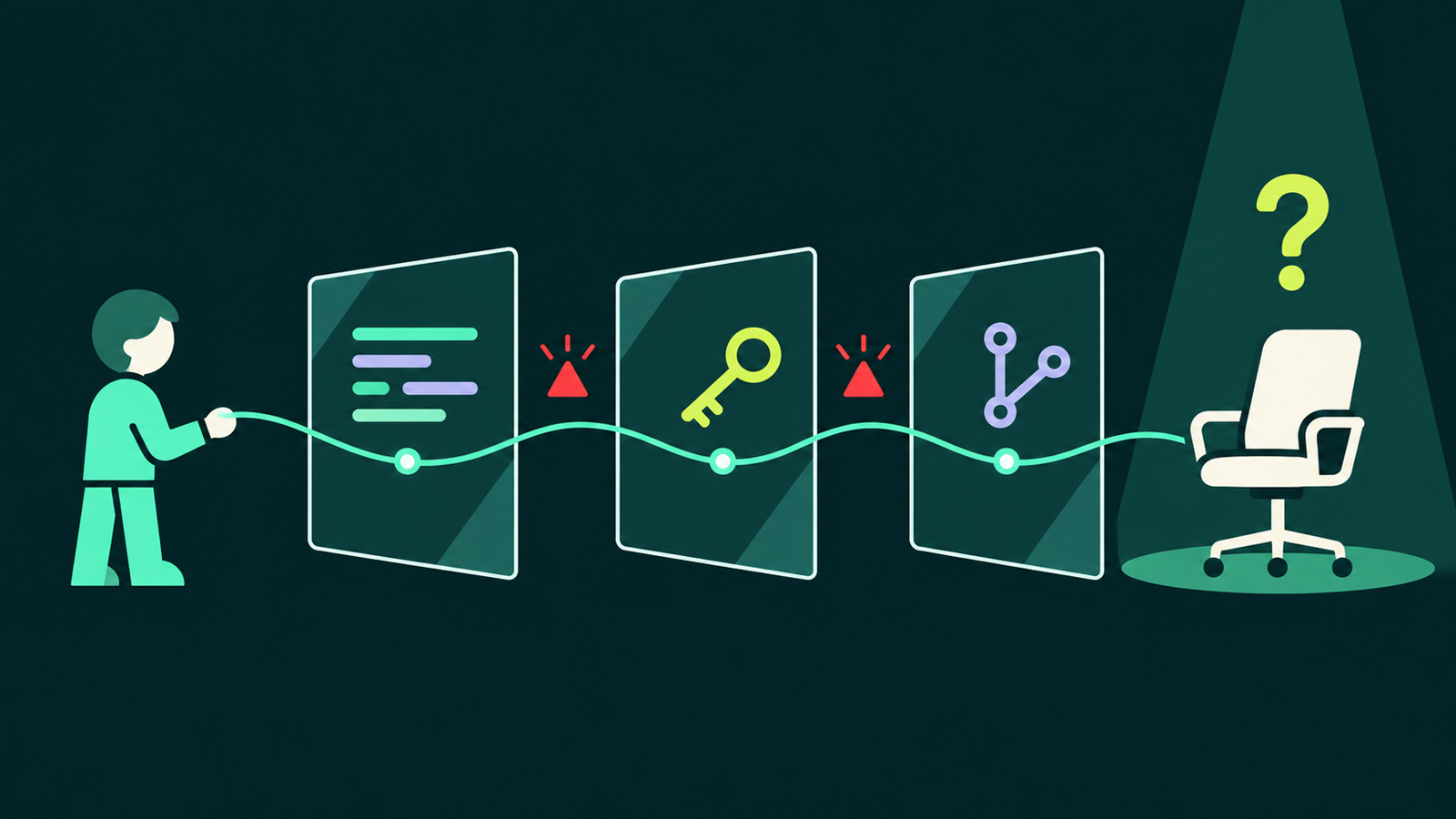
Frontier AI labs are very clear about their responsibilities: making the model more robust, better guarded, and harder to hijack. They are also clear about what they can’t do, which is understand the business context of an action. An agent deleting files from Google Drive could be malicious or perfectly normal. They can't tell.
That raises questions about the shared responsibility model for Agentic AI. In cloud security, there is a clear separation of responsibilities between cloud vendors and their customers. If you copy data from AWS into SFDC, each vendor is responsible for the data's infrastructure security while they have it, but the customer is responsible for the action.
The AWS Shared Responsibility Model is a classic example.
The separation isn’t nearly as clean for AI agents. Agents act as intermediaries between you and the request, and that intermediary isn't deterministic by nature. It sends authenticated, authorized requests that can be compromised or rogue.
The first scenario is somewhat clear and goes back to what the AI labs try to prevent: a rogue agent has either misunderstood something or acted in a way it shouldn’t. A human mistake, only not human and not necessarily a mistake.
Five organizations have published guidance on responsibility for AI agents: shared responsibility models from Microsoft, CSA and CoSAI, AWS's security guidance for AgentCore, and Anthropic's “Trustworthy agents in practice.” Only two assign ownership of an agent’s identity, and they split it differently. No one agrees on who is responsible for the agent's behavior.
A look at the existing approaches
The available guidance approaches responsibility from different angles. Some publications assign specific tasks to providers and customers; others describe security layers or broader stakeholder roles.
Together, they show why organizations need to determine who owns each agent, what permissions it has, and how it operates across the systems it uses.
| Company | Description | Focus |
| Microsoft | Publishes an AI agent shared responsibility model with a matrix for IaaS, PaaS, and SaaS deployments. | The customer remains accountable for agent actions across all three models. Agent identity and delegated token management, along with per-action authorization checks, are customer responsibilities in IaaS and shared responsibilities in PaaS and SaaS. |
| AWS | No agent-specific model, but AgentCore's security guidance applies AWS's general shared responsibility model. Closest match: the Agentic AI Security Scoping Matrix and its NIST comment. | Builders bear final responsibility for the behavior and permissions of the systems they assemble. AWS recommends enforcing security through infrastructure-level controls outside the agent and discusses agent identity, credentials, and delegation. |
| Anthropic | “Trustworthy agents in practice” describes four layers of an agent system: model, harness, tools, and environment. It does not provide a formal responsibility matrix. | Calls for defenses across all four layers and asks customers to consider which tools, permissions, and environments they give agents. In a separate NIST response, Anthropic identifies authentication and permissions across agent boundaries as an unresolved challenge. |
| CSA | Agent Shared Security and Safety Responsibility Model (Agent 3SRM) maps the CSA AI Controls Matrix to a ten-layer agent architecture. | Its public summary introduces an Agent Owner with ultimate, non-delegable accountability for agent actions and addresses accountability for sub-agent delegation. The summary does not detail its identity and authorization assignments. |
| CoSAI | The AI Shared Responsibility Framework V1.0 uses five layers, responsibility matrices, and autonomy levels L0 to L5. | Its general principle calls for one accountable party per component, and its identity and access management matrix assigns accountability to the end user or organization. Its autonomy guidance also describes shared accountability between the agentic provider and application developer at L4 to L5, creating an apparent tension with that principle. |
Let's say it goes wrong
Consider a coding agent that reads a support ticket through an MCP server. That ticket contains malicious instructions that cause the agent to push a change to GitHub using the developer's token.
It isn't a contrived case. In the organizations Token monitors, 60% of Claude Code and Desktop agents called two or more outside vendors, and 47% called three or more, in the span of one month.
Now to the million-dollar question: who's responsible for catching the malicious push and stopping it?
Could it be the harness?
The software that runs the agent has the most visibility: it knows where the instructions were (albeit not why they were there) and the command about to run.
Claude Code, for example, checks both. A server-side probe "scans incoming tool results and flags suspicious content before Claude reads it." In auto mode, now the starting mode for interactive sessions, a separate classifier blocks actions that appear "driven by hostile content Claude read."
OpenAI, Cursor, and GitHub each have their own versions of approval prompts, automated reviewers, network limits, and sandboxes.
This capability doesn't come with responsibility, though. Harnesses put that squarely on the user's shoulders, both within the interface and in their terms.
Will the MCP catch it?
The poisoned ticket came in over MCP, a protocol built for model clients. You might expect it to carry some of the load, because it's a door purpose-made for agents. At least conceptually, it could denote expanded responsibility for the people who built this door.
The MCP spec hands the load back to the client. Clients SHOULD validate tool results before passing them to the model, and "there SHOULD always be a human in the loop with the ability to deny tool invocations," it says.
The server's duties involve tokens, inputs, access controls, and rate limits.
And so, a typical MCP server will check who sent a request, not whether it should have been sent.
It all goes back to the MCP spec, which neither uses the term "prompt injection" nor provides the server with any verified information about its caller; client information is "self-reported." It says outright that "MCP itself cannot enforce these security principles at the protocol level."
Atlassian, for its part, calls the use of MCP clients with its products "a customer-elected action."
Could GitHub be the solution?
The push reaches GitHub with a valid token. Unless an admin has set up a branch protection rule for main, nothing stops it, and by default, those rules "don't apply to people with admin permissions to the repository."
GitHub's audit log includes an agent marker, actor_is_agent, for agents that run on GitHub. Nothing in the docs says it marks a local agent's push, though. And the terms are the same as everyone's: "You are responsible for all content posted and activity that occurs under your Account."
Do agent identities close the gap?
In an ideal scenario, every agent has its own identity, which should carry narrower, shorter-lived access.
Microsoft, for example, gives agents identities of their own: a Microsoft Entra agent identity is a service principal in your Entra tenant. Microsoft's framework also marks per-action authorization as shared.
But when an agent acts on behalf of a user, Microsoft's documentation says "risky activity is attributed to the user." A Conditional Access policy aimed at an agent identity "doesn't cover agent requests made on behalf of the user."
And that's the story in a nutshell, within one vendor. Even if the framework points to shared responsibility, the product attributes the risk to the user when it's actually time to act.
You share the responsibility
That leaves you. And it's probably going to remain the norm. While platforms could, in theory, do more, agents are considered extensions of our will, even though they often have a “will” of their own.
It's a novel scenario, and the only choice is to look at the risk honestly and decide how much of it we're willing to accept. And even that is easier said than done because you can't see the agent as a single thing.
The harness has its telemetry, Atlassian has its MCP log, and GitHub has the developer's push. Coding agents like this one run under the developer's credentials by default, so their actions appear to be the developer's.
No vendor in this chain sees the whole agent:
- The harness sees the instruction
- The MCP server sees a token
- GitHub sees a developer pushing code
Only the identity the agent uses crosses all three. That makes it the one place where a single owner can set scope, expiry, and revocation. Branch protection and allowlists help, but identity ties them together.
What to do about it
Ideally, you treat the agent as one identity, whatever number of vendors it touches:
- Inventory per agent, across vendors. For each agent, list credentials.
- Give agents identities of their own, scoped to the task and short-lived.
- Decide where your log trail for agentic decision-making and action lives.
- Turn on branch protection, read-only modes, tool allowlists, and everything else that can help.
- Build a revocation path and practice killing an agent's access across all vendors.
- Ask your vendors what they can show you about an agent that also acts elsewhere.
An organization cannot delegate accountability for an agent’s actions to a model provider or infer intent from an authenticated request. It can assign an owner, limit the agent’s access, connect its activity across systems, and test how to stop it.
Those decisions make agent adoption governable without assuming any single vendor can see the whole workflow.
If the responsibility is yours, it pays to be responsible.
When you’re ready to secure your AI Agents for growth, book a demo with the Token Security team.
Sponsored and written by Token Security.






 English (US) ·