
 4 hours ago
7
4 hours ago
7
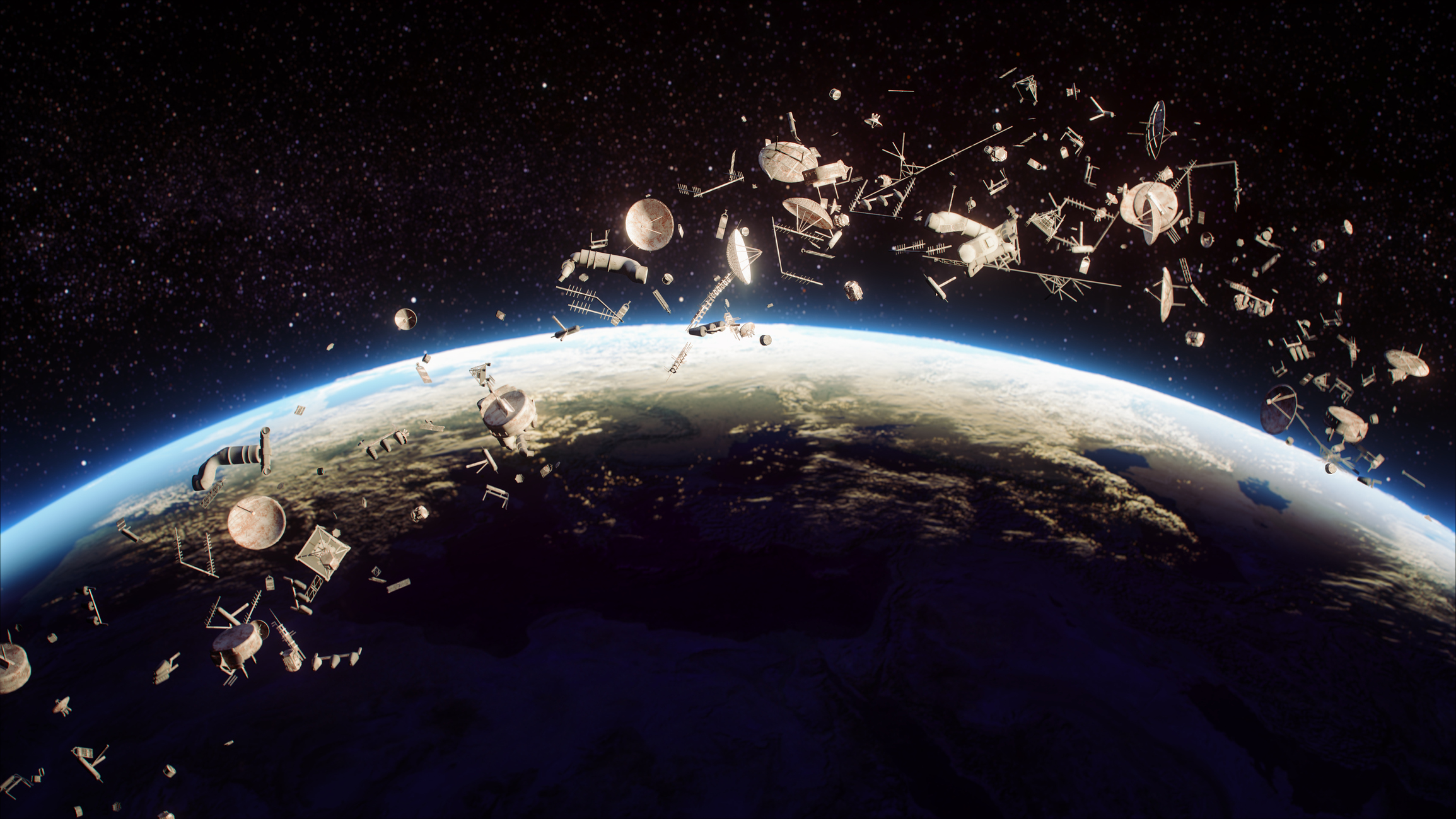
The 2013 sci-fi blockbuster film Gravity, starring Sandra Bullock and George Clooney, popularized the notion of the Kessler syndrome. In the movie, Russia shoots down a defunct satellite and creates a cloud of debris, leading to serious tension in orbit.
The movie is fantastic, a true thriller, and while some liberties were taken with the depiction of outer space, the basic premise of a cascading series of collisions rendering orbits too cluttered with debris to be usable is valid. The idea was first proposed by NASA scientists Donald Kessler and Burton Cour-Palais nearly half a century ago.
Still, the movie was science fiction, right?
Well, a lot has changed since Gravity‘s release. At the time that theatergoers were sitting on the edges of their seats and watching Bullock dodge debris, there were only about 1,000 active satellites in orbit. Today, that number is closer to 17,000, according to CelesTrak.
The preponderance of this growth has been driven by SpaceX’s Starlink constellation, which now has approximately 11,000 satellites in orbit, with many thousands more on the way. And SpaceX is not alone in the race to provide Internet from space. Amazon has launched hundreds of satellites, with thousands more to follow. Multiple Chinese Internet constellations are likewise in progress.
Then there are the orbital data centers, which may produce hundreds of thousands of satellites.
We’ve written a lot about these constellations, and they have generated a bunch of questions. Most prominent among them: Just how sustainable is all of this? Will we see the Kessler syndrome play out in real time? Here are some answers.
How bad is the situation?
It depends on who you ask, so let’s start with the glass-half-empty and glass-half-full outlooks.
Starting with the pessimists: A few years ago, one of the world’s experts in orbital debris, University of Texas at Austin professor Moriba Jah, told Ars that he worries a lot about the consequences of satellites and debris in low-Earth orbit.
“I think we are going to lose the ability to use certain orbits because the carrying capacity is going to get saturated by objects and junk,” Jah said. ” I also predict that we will see a loss of human life by (1) school bus-sized objects reentering and surviving reentry and hitting a populated area, or (2) people riding on this wave of civil and commercial astronauts basically having their vehicle getting scwhacked by an unpredicted piece of junk. I predict that both those things are going to happen in the next decade.”
At the other end of the spectrum is the person almost solely responsible for the remarkable growth in satellites over the last decade, SpaceX founder Elon Musk. His attitude has largely been that space is big, and things will probably be just fine. For example, during a SpaceX-produced interview this summer at the company’s Starlink terminal factory in Bastrop, Texas, Musk said, “Space is really big. It’s not like space is gonna get crowded. Space is enormous. If you actually look at it relative to the Earth, the satellites are so tiny you can’t even see them.”
So in one way of thinking, very, very bad things are coming. In another, everything’s fine. Where does the truth actually lie?
What’s really happening?
One of the most credible sources for this kind of information is the European Space Agency, which has long studied space debris and its impacts on various orbits.
Fortunately, it just released its annual Space Environment Report a week ago. The European agency has produced such a report over the last decade to provide a transparent overview of global space activities and assess the quality of efforts to preserve the sustainability of spaceflight.
There are some striking—and concerning—changes this year. For example, the European report has dramatically increased its projections of future satellites in this year’s report after reassessing the current trajectory of large constellations.
“The notable increase in the index this year is primarily driven by the substantially larger future population resulting from the current extrapolation scenario,” the report states. “In particular, the growing influence of large constellations highlights the limitations of traditional mitigation approaches when applied to future traffic at unprecedented scales. At the same time, the results are affected by the limited availability of detailed and verifiable information on future deployment plans, operational practices, and end-of-life strategies of these systems.”
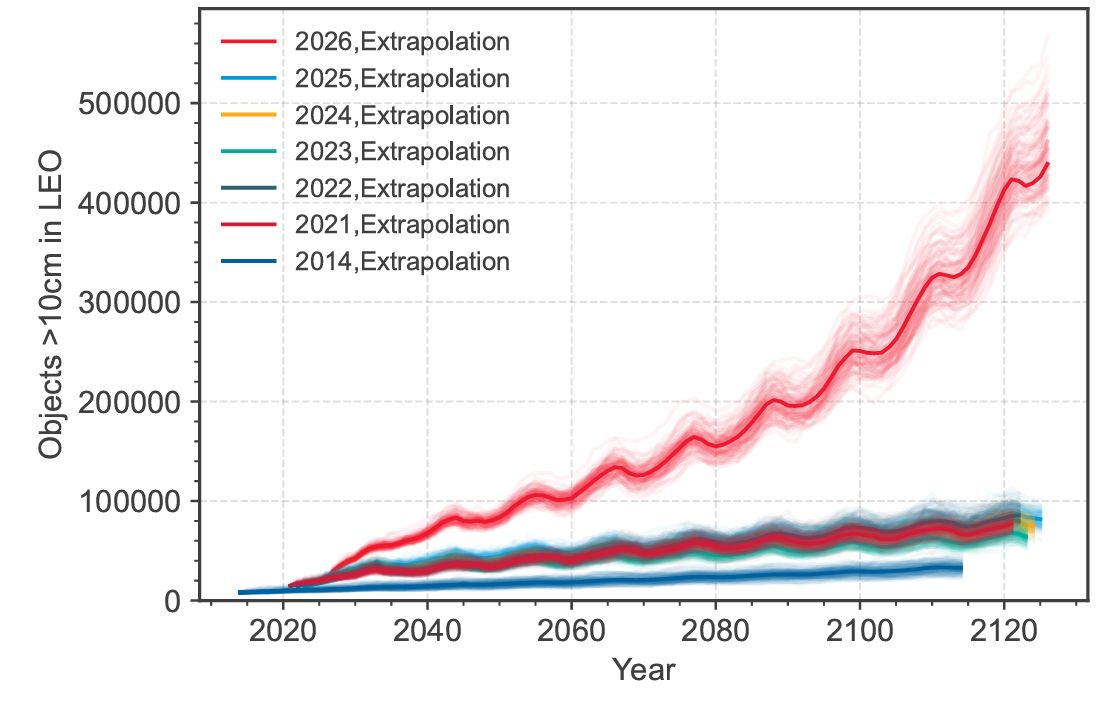
The projection for objects in orbit in this year’s report has gone up dramatically.
Credit: European Space Agency
The projection for objects in orbit in this year’s report has gone up dramatically. Credit: European Space Agency
More satellites mean an increasing probability of collisions, which helps to push us toward a Kessler-like scenario.
As part of the report, the European scientists modeled a number of different scenarios. Assuming that satellite launches continue to increase—by far the most likely trend—even if operators continue to follow best practices in terms of disposing of older satellites and avoiding collisions, the orbital environment will still become significantly more cluttered.
“The extrapolation of our current behavior, which assumes the continuation of explosion in orbits at current rates, adherence by constellations to at least the minimum desirable post-mission disposal success rates, and continuation of the currently estimated post-mission disposal success rates for all other objects, leads to an unstable environment with collision rates increasing exponentially,” the report states.
In its technically precise language, the European Space Agency is essentially saying we’re on a road that could ultimately lead to something like the Kessler syndrome. Such a scenario, with a dramatic growth in constellations using best practices for satellite disposal, looks like this in terms of collisions in orbit.
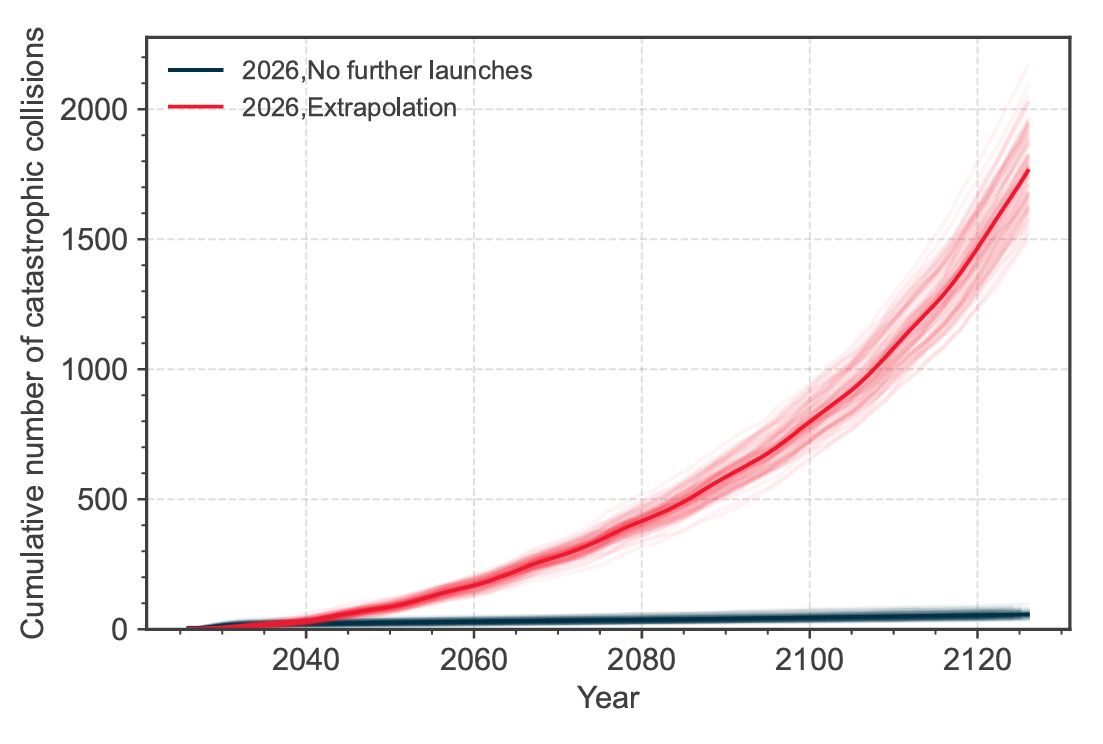
Number of cumulative collisions in low-Earth orbit in simulations.
Credit: European Space Agency
Number of cumulative collisions in low-Earth orbit in simulations. Credit: European Space Agency
It does indeed start to look pretty dicey by mid-century.
Also worth noting: The projections in ESA’s 2026 report do not include the new category of orbital data centers, as they exclude projects “still being prepared” for launch. It remains unclear whether these mega-megaconstellations of data centers in space will prove to be economically viable, but if they do, they could be the ultimate tipping point for orbital sustainability.
What is happening up there now?
The European Space Agency talks a lot about the need for responsible behavior, and in managing its massive Starlink constellation, SpaceX has been responsible. The company has been effective at deorbiting satellites that lose functionality and at managing a constellation of thousands of satellites. It’s an unprecedented task that the company has learned, on the fly, to carry out at a scale no government or company has attempted before.
We know from mandatory reporting to the Federal Communications Commission that SpaceX is frequently moving satellites around in orbit, making small but precise maneuvers to avoid collisions. Five years ago, its (much smaller) constellation made about 500 such maneuvers a month. During the most recent reporting period, through May 2026, that number had jumped to nearly 35,000 per month. That comes to one maneuver every 75 seconds.
It is important to characterize these properly. Each maneuver is not a “near miss.” Rather, SpaceX has significantly lowered the probability threshold to trigger a collision avoidance maneuver. The NASA standard for maneuver is 1-in-10,000. At the outset of Starlink, though, SpaceX used a 1-in-100,000 threshold and has since become even more conservative, with a threshold of 3-in-10 million, according to a 2025 letter to the FCC.
So it’s clear that SpaceX is not operating its Starlink constellation in a cavalier manner. But it’s also clear that the company’s constellation, and those like it, are cause for significant concern going forward.
What should we be worried about?
No credible experts are saying that the Kessler syndrome could happen imminently—a single collision won’t set off a Gravity-style cascade.
But space is getting more crowded, and some orbits, particularly from 520 km to 1,000 km above Earth. A 2025 paper by Hugh Lewis and Kessler (yes, that Kessler) found that some orbital bands in this region have already reached what is known as a “collisional-runaway threshold,” which is to say that any serious collisions there may create new debris faster over time than debris would be naturally removed by the pull of gravity, down into Earth’s atmosphere.
Another concern comes from spent “rocket bodies,” upper stages from rockets that were not properly disposed of after launch. This was more common in decades past, but some launches today still do not reserve enough propellant to properly deorbit a second or third stage. These school bus-sized stages are particularly problematic at altitudes of 840 and 975 km, said LeoLabs space debris expert Darren McKnight. They are winging around uncontrolled, of course. And the higher the altitude, the longer the debris hangs around, from decades to centuries.
Finally, because there is so much stuff flying around orbit, it would be relatively easy for bad actors to start shooting missiles at satellites in low-Earth orbit, creating debris fields that could potentially wipe out communications and cause massive financial damage. The probability of Kessler syndrome becomes much higher if humans start deliberately blowing things up in space. Did we mention that Iran recently became the ninth country to put a domestically built satellite into orbit?
What’s the bottom line?
In the near term, it seems unlikely that space will become unusable. But it will likely become more and more expensive to operate there when considering avoidance technology, people to manage all of this, and propellant for maneuvers. And finding launch windows that avoid known debris will become more difficult.
Longer term, perhaps as early as 15 years from now but more likely longer, a Kessler-syndrome type outcome may start to become increasingly plausible.
Eric Berger is the senior space editor at Ars Technica, covering everything from astronomy to private space to NASA policy, and author of two books: Liftoff, about the rise of SpaceX; and Reentry, on the development of the Falcon 9 rocket and Dragon. A certified meteorologist, Eric lives in Houston.






 English (US) ·