
 4 weeks ago
29
4 weeks ago
29
“We can’t quite afford to support everything that we have done in the past.”
A camera on NASA’s Juno spacecraft took this image of a high-altitude storm—a stealth superstorm plume—in Jupiter’s North Equatorial Belt on January 12, 2022. The head of the storm is white because of frozen ammonia crystals. The redder clouds are deeper in the atmosphere. UC Berkeley’s Michael Wong analyzed lightning produced by four stealth superstorms like this between 2021 and 2022. Credit: NASA/JPL-Caltech/SwRI/MSSS/Björn Jónsson © cc nc sa
Jupiter’s colossal storms generate lightning flashes at least 100 times more powerful than those on Earth, according to scientists analyzing data from NASA’s Juno spacecraft.
The findings were published March 20 in the journal AGU Advances. Researchers used data recorded by Juno in 2021 and 2022, after NASA granted an extension to the spacecraft’s operations upon completing a five-year science campaign at Jupiter. Juno remains in good health, but NASA officials have not said if they will approve another extension for the mission. The issue is money.
Questions about the future of Juno and more than a dozen other robotic science missions began swirling nearly a year ago, when the Trump administration asked mission leaders to submit “closeout” plans for how to turn off their spacecraft. Ars first reported the news soon after the White House released a budget request that called for slashing NASA’s science budget by nearly half.
Some of NASA’s Solar System exploration missions on the list have received NASA approval to continue operations. These include the OSIRIS-APEX mission, which brought asteroid samples back to Earth in 2023 and is now using leftover fuel to chase down another asteroid in 2029. NASA’s Lunar Reconnaissance Orbiter, the agency’s only active spacecraft at the Moon, will be funded for at least three more years.
Congress rejected most of the Trump administration’s proposed NASA cuts. Lawmakers passed a fiscal year 2026 budget with $2.54 billion for NASA’s planetary science division, far above the White House’s request, but about $220 million shy of last year’s funding.
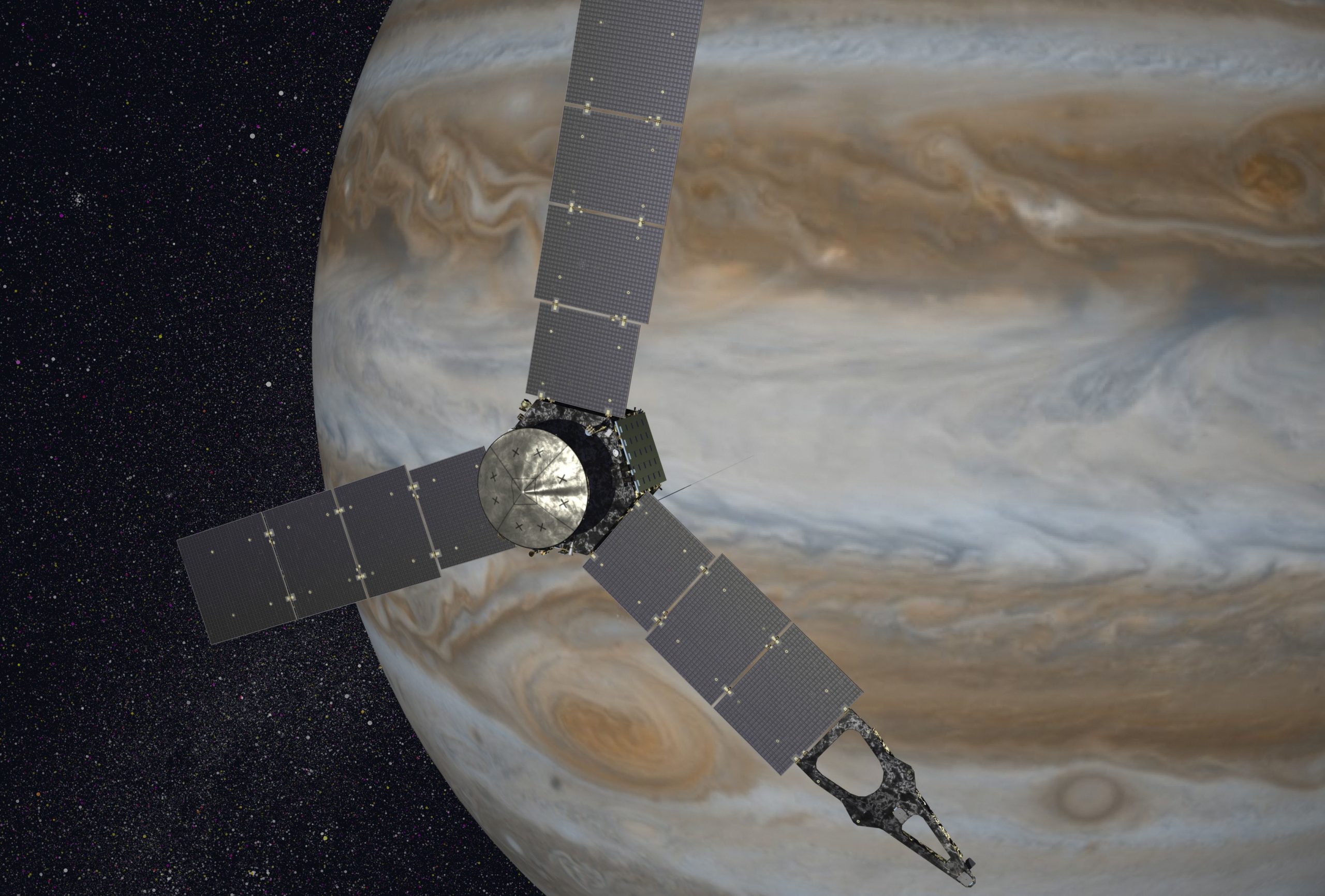
Artist’s illustration of the Juno spacecraft in orbit around Jupiter.
Credit: NASA
Artist’s illustration of the Juno spacecraft in orbit around Jupiter. Credit: NASA
NASA can’t afford everything
“We can’t quite afford to support everything that we have done in the past,” said Louise Prockter, director of NASA’s planetary science division, in a meeting of the National Academies’ Committee on Astrobiology and Planetary Sciences on Monday. The budget cut is forcing NASA officials to make “tough decisions,” she said.
One of these decisions is what to do with Juno, humanity’s only spacecraft currently operating between the orbits of Jupiter and Pluto. Its future remains uncertain, along with four missions at Mars. NASA lost contact with one of the Mars probes last year, and its mission is likely over anyway. Another one, Odyssey, is about to run out of fuel. The other two Mars missions up for a decision are the Mars Reconnaissance Orbiter and Curiosity rover, neither of which will be fully replaced anytime soon. These two are also the most expensive to operate.
Prockter said Monday the agency will announce its decision on these five missions when it submits its annual “operating plan” to Congress. The document is undergoing review by senior agency leadership and White House budget officials.
It is unusual for NASA to turn off a still-functioning planetary science probe as long as it has fuel, remains healthy, and still makes useful scientific observations. All of the missions still awaiting a decision from NASA were “ranked highly for science” by independent reviewers, Prockter said. But they come at a cost.
“There’s no doubt we’re still getting really great science from these missions,” Prockter said. “We’re spending about 10 percent [of NASA’s planetary science budget] on them. That doesn’t sound like a lot. It sounds like maybe it’s a reasonable amount. It was about $260 million … in ’25.”
Prockter is herself a planetary scientist. She is not a political appointee. Part of her job is finding the right balance between NASA’s multibillion-dollar flagship science missions, like Europa Clipper, and more focused, less expensive projects, such as the Psyche probe on the way to explore a metal asteroid. Even the cheaper missions in NASA’s planetary science portfolio usually cost hundreds of millions of dollars.
NASA must also balance its budget between building new missions, which infuse emerging technologies and seek to answer big science questions, and keeping alive successful spacecraft that taxpayers have already paid for. Questions about the future of NASA’s aging research satellites are not limited to planetary science. Budget limitations nearly caused NASA to shut down the Chandra X-ray Observatory, but Congress specifically directed NASA to continue operating Chandra.
Prockter said NASA wants to “start a conversation” within the space science community about the agency’s priorities, particularly with regard to extended missions. “When we say yes to something, we say no to something else.”
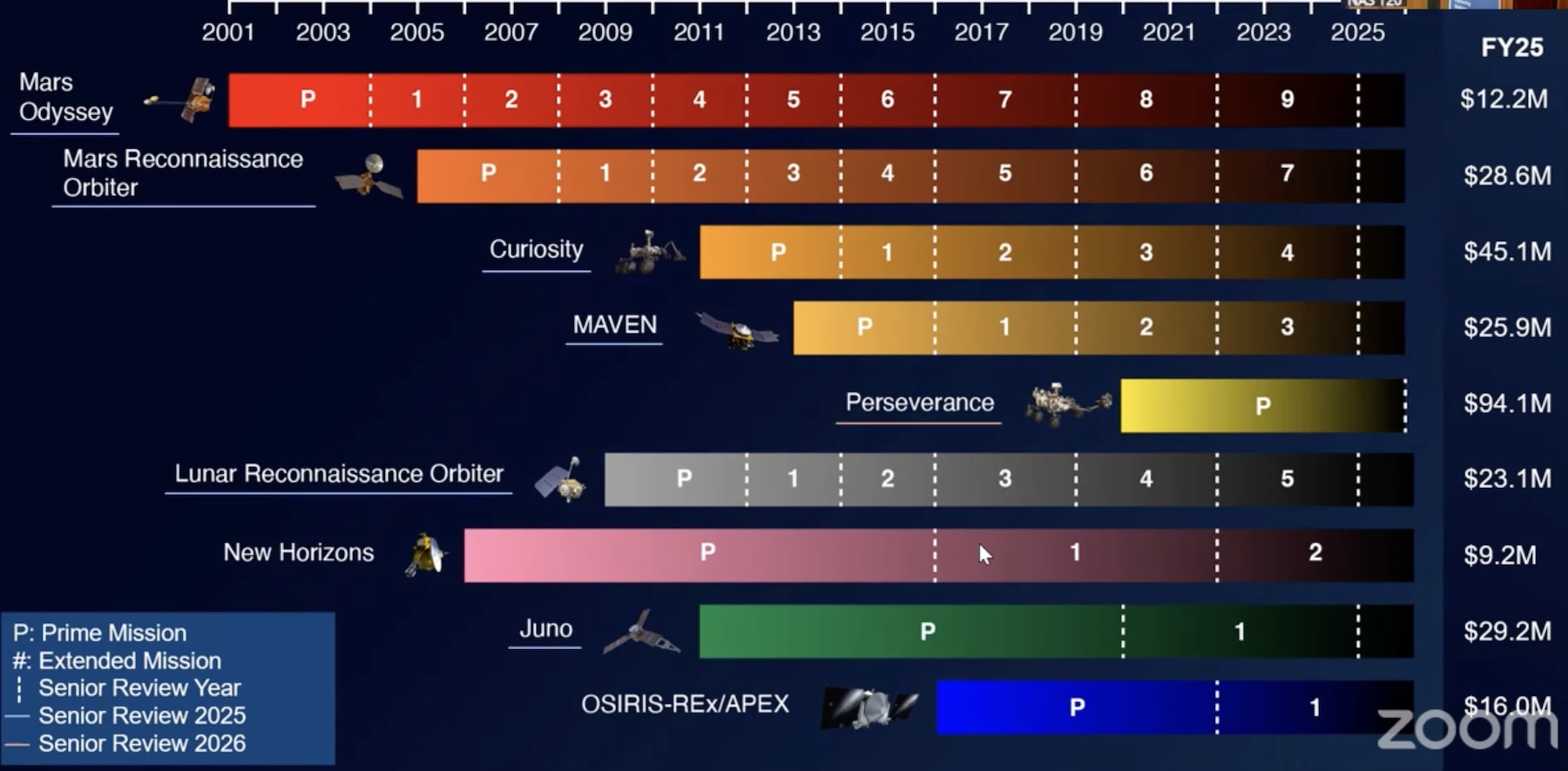
Louise Prockter, director of NASA’s planetary science division, presented this chart showing the agency’s oldest Solar System exploration missions, and their cost to operate each year.
Credit: NASA/Louise Prockter
Louise Prockter, director of NASA’s planetary science division, presented this chart showing the agency’s oldest Solar System exploration missions, and their cost to operate each year. Credit: NASA/Louise Prockter
NASA’s cadence of Solar System missions has declined since reaching a peak in the late 1990s and early 2000s, when the agency launched 11 Discovery-class robotic missions in a little more than 15 years. NASA has launched just three Discovery missions in the 15 years since then, and the next one won’t fly before 2030. A program for more expensive missions, called New Frontiers, has launched three missions over the last 20 years. The next New Frontiers mission is Dragonfly, a rotorcraft set to launch Saturn’s moon Titan in 2028.
NASA selects Discovery and New Frontiers missions in periodic competitions, when scientists submit proposals to send probes to other planets, asteroids, or comets. These missions missions have a cost cap. The most recent Discovery competition limited proposals to a development cost of less than $500 million.
Killing off NASA’s long-lived planetary science missions would open opportunities for new exploration, Prockter said.
“If we had an extra $260 million a year, that is the equivalent of about two Discovery missions over the next decade. I think, when we are looking at extended missions, we are starting to have more serious conversations about the value of the science compared to the value of future science that we are not doing,” she said.
“We’re just starting to have the conversations,” Prockter said. “The administrator (Jared Isaacman) has expressed his desire for us to get to science faster and look for ways that we can get more bang for the buck out of the program.”
Here’s a bang
It’s not easy to measure return on investment in scientific discovery, but there is an opportunity cost to ending a science mission too soon. For example, NASA’s Curiosity rover, one of the missions waiting for a possible renewal, collected data in 2022 and 2023 that led to a significant discovery about the carbon cycle on ancient Mars, with potential implications for past life. Curiosity made the measurements after NASA extended the rover’s operations a third time.
Farther into the Solar System, Juno is still returning interesting science results from Jupiter, where enormous cyclones and anticyclones spin through the atmosphere for years. The Great Red Spot, the most famous of Jupiter’s storms, has persisted for at least 190 years.
NASA’s Voyager 1 spacecraft first revealed the inner workings of Jupiter’s storms when it zoomed by the giant planet in 1979. Voyager’s discoveries included the first observations of lightning in Jupiter’s atmosphere.
For decades, scientists struggled to measure the power unleashed with Jovian lightning bolts. It is no surprise Jupiter produces more potent lightning than Earth, but clouds often obscure the full power of the flashes from optical cameras. NASA’s Juno mission, in orbit around Jupiter since 2016, carries an instrument that can detect microwave emissions from deep inside Jupiter’s atmosphere.
Jupiter’s storms are concentrated in belts that encircle the planet. Their close proximity to one another makes it difficult to pinpoint the sources of signals collected by Juno’s microwave radiometer instrument. A lull in storms in 2021 and 2022 allowed scientists to focus on one storm at a time.
Over the course of 12 passes, Juno detected 613 microwave pulses from lightning, with power ranging from about the same as a lightning bolt on Earth to at least 100 times more. There is uncertainty in the interplanetary comparison, so it’s possible Jupiter’s lightning flashes could have been a million times more powerful than those on Earth.
Lightning on Jupiter is likely sparked by a mechanism similar to what happens inside Earth’s atmosphere, where ice crystals within clouds obtain an electrical charge, and voltage differentials lead to cloud-to-cloud or cloud-to-ground lightning strikes.
There are notable differences between the planets, too. There is no true surface on Jupiter, and ice crystals inside the Jovian atmosphere contain water and ammonia. On Earth, it’s just water. Atmospheric convection also works differently at Jupiter, where moist air wants to sink because it is heavier than the surrounding hydrogen rich-atmosphere. Nitrogen, heavier than water, dominates Earth’s atmosphere, so moist air rises.
Therefore, it is not only Jupiter’s immense size than leads to such large and powerful storms. It requires much more energy to propel moist air upward, resulting in stronger winds and more intense cloud-to-cloud lightning. There is still a mystery about what drives lightning to be so extreme on Jupiter.
“Could the key difference be hydrogen versus nitrogen atmospheres, or could it be that the storms are taller on Jupiter and so there’s greater distances involved?” said Michael Wong, a planetary scientist at the University of California, Berkeley’s Space Sciences Laboratory. Wong is the lead author on the Jupiter lightning study.
“Or could it be that greater energy is available because with moist convection on Jupiter, you have a bigger buildup of heat needed before you can generate the storm to create lightning?” Wong said in a press release. “It’s an active area of research.”

Stephen Clark is a space reporter at Ars Technica, covering private space companies and the world’s space agencies. Stephen writes about the nexus of technology, science, policy, and business on and off the planet.







 English (US) ·