
NBC
We may receive a commission on purchases made from links.
People who used to watch the Harry Potter movies might recognize Jason Isaacs as the white-haired Lucius Malfoy, a wicked warlock with a pipsqueak son. Trekkies will recognize him as the evil Captain Gabriel Lorca, the "Star Trek" Mirror Universe sadist from "Star Trek: Discovery." Those who merely enjoy the craft of acting will recognize Isaacs from any number of his dozens and dozens of roles in film, on stage, and on TV that he has been slowly accruing since his professional career began back in the 1980s. In the beginning of his career, Isaacs was in a 1989 production of "Bent," appeared on the British comedy series "This is David Lander," and had a bit part in the feature film "The Tall Guy," and he has been working steadily ever since.
To focus on his career in TV, Isaacs starred in all 23 episodes of the drama "Capital City," six episodes of the series "Civvies," and 29 episodes of the well-received series "Brotherhood." In 2012, he landed the lead role in the high-profile NBC perhaps-supernatural drama "Awake," which we'll be focusing on in this article. "Awake" had a novel and interesting premise, but it wasn't well-regarded enough to last past a single 13-episode season. Jason Isaacs recovered well, continuing to work regularly. But "Awake" might be worth another look.
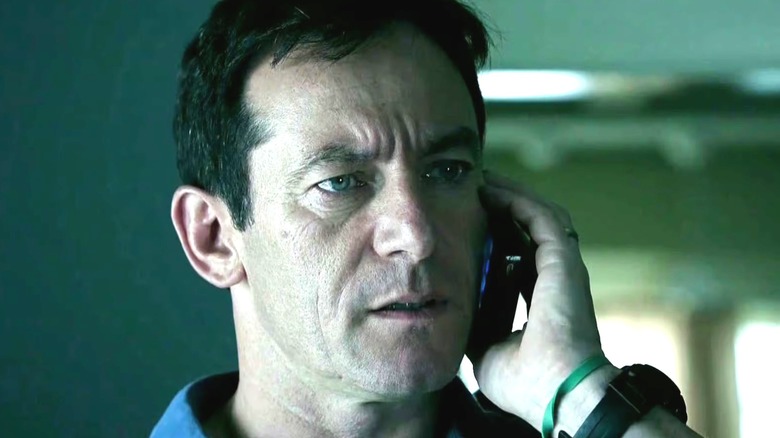
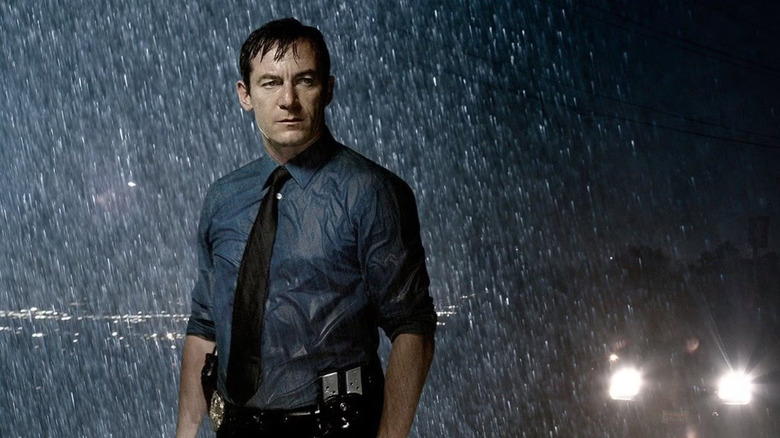
"Awake" takes place in two separate realities simultaneously. Detective Britten (Isaacs) has recently been in a violent car accident that seemingly forced him into two different timelines. In one reality, his wife Hannah was killed in the accident, while in the other, his son Rex is killed. In the reality where Hannah is killed, Britten wears a green wristband, and in the reality where his son is killed, he wears a red one. Britten passes between these two timelines without warning.
Awake was a multi-dimensional drama about grief
NBC
Naturally, Detective Britten isn't sure which of the realities is the "real" one. He seeks out the help of two different shrinks in the two different timelines. In the "green" world, he talks to Dr. Judith Evans, played by the amazing Cherry Jones. In the "red" world, he talks to Dr. Jonathan Lee, played by the amazing BD Wong. Of course, each shrink assumes that the other reality is the hallucination, created as a coping mechanism. Sadly for Britten, he has suffered a terrible loss in both worlds. Luckily for him, he alternately has access to his deceased family member. Hannah is played by Lauren Allen in the "red" world, and Rex is played by Dylan Minette in the "green" world.
In the two worlds, Britten also is assigned to two different partners on the job. In the "green" world, Britten works with his longterm partner, Detective Isaiah "Bird" Freeman, played by Steve Harris. In the "red" world, he is reassigned to be with Detective Efrem Vega, played by Wilmer Valderamma.
"Awake" is sort of like "Sliding Doors: LAPD," but where the main character lives out both timelines at the same time. Britten finds that he has to bear the full brunt of both his wife and his son mourning the death of the other, and sees them coping in various ways. He also begins having dreams of the "lost" family member, depending on what reality he is in. It's all very emotionally tricky. It's a good thing the wristbands are there to keep him correctly aligned. To give a visual indicator to the audience, the "red" and "green" worlds are photographed differently.
What did critics think of Awake?

NBC
If this weren't all complicated enough, "Awake" also poured in an over-arching mystery plot about the car accident that split Britten's realities. For one, Britten can't remember the accident, other than it happened. It also seems that Britten's bosses decide to pin the accident on a patsy, indicating that there was some sort of setup. It's a cop series as much as it is a reality-bending emotional experiment. Pretty ambitious for network television.
Initial critical reactions to "Awake" were positive, and the series has an 81% approval rating on Rotten Tomatoes based on 31 reviews. Emily Nussbaum, writing for The New Yorker, noted how complex and emotionally honest the series was when approaching grief. This was before grief was blisteringly common as a go-to theme in mainstream entertainment, so "Awake" was more striking in this regard than some of its contemporaries.
Writing for The Los Angeles Times, Robert Lloyd was also very positive, noting that "Awake" was effective as a philosophical exercise and stood stronger as a thought experiment. He also wrote, though, that the series was also set up as a post-"Lost" mystery box series, and that whatever the "practical" explanation for the bifurcated realities might be, it will invariably be disappointing; it's hard to imagine "Awake" continuing as a mystery, even if it's perfectly fine as a drama. Of course, if the series is called "Awake," it implies that Britten is caught up in a dream state, and that audiences are permitted to choose which reality is "real." Or perhaps it really is both. In a story like this, it seems that concrete solutions might hurt the overall drama.
The series is currently available on Prime Video.





 English (US) ·