
 2 weeks ago
29
2 weeks ago
29
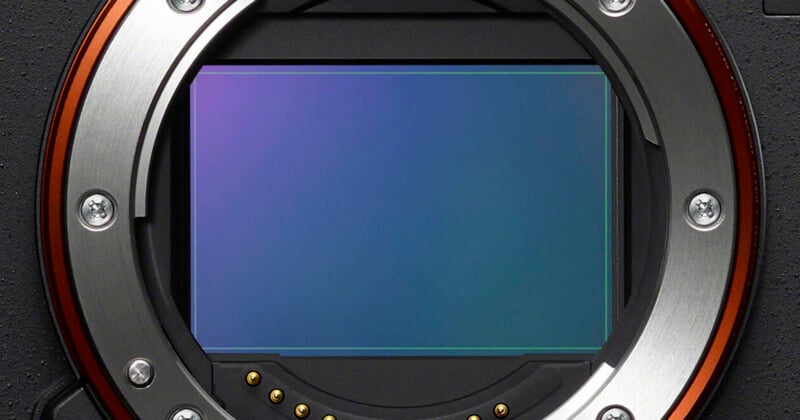
When new cameras are announced, dynamic range is often a significant part of the image quality discussion. When a camera offers particularly fantastic dynamic range, it’s big news. Likewise, when a camera’s dynamic range takes a big hit in exchange for other impressive features, that’s news, too. However, does dynamic range really matter that much?
In the latest episode of Adorama’s video series, “Ask David Bergman,” the eponymous photographer kicks things off by saying, “Dynamic range, I say it’s overrated.” It’s an explosive way to start a discussion about a huge, often confusing topic in digital photography. The discussion came up because this episode’s question from Alisa B.: “Whenever a new camera comes out, there’s always a lot of talk about its dynamic range. How important is dynamic range really?”
It’s a great question. As Bergman says, there are some photographers “who love to geek out about” dynamic range, and it is a prevalent topic in online photography communities. I write about dynamic range quite a lot, and I take it into account when evaluating cameras. You can safely put me in the dynamic range “geek” camp.
However, in many conversations, dynamic range is often treated like a stand-in for overall image quality. That’s the wrong way to look at it. Dynamic range is only one piece of the broader image quality puzzle, and image quality is but one component of a camera’s overall performance. Arguably, given how good nearly every new camera is these days, image quality is rarely a meaningful differentiator between competitors.
“When photographers talk about dynamic range, we’re talking about the range between the brightest highlights and the darkest shadows that a camera can capture in a single photo while still holding some detail,” Bergman says.
This is a fairly broad definition, but it gets the primary point. Scientific dynamic range testing determines the point at which a sensor’s noise level and signal equalize and then measures dynamic range from there, typically in stops. There is still subjectivity here, though. For example, William Claff’s excellent resource Photons to Photos uses what Claff calls “photographic dynamic range,” or PDR. This is the resource PetaPixel most frequently uses, as it seems more realistic and useful than what camera manufacturers themselves say, often boasting ludicrous claims about 15-plus stops of dynamic range.
There is a ton to say about measuring dynamic range, but the essential takeaway is that while dynamic range is very interesting, especially from an engineering perspective, there is so much more to image quality than dynamic range. All else equal, better dynamic range is good news for photographers, but “all else equal” does heavy lifting here because all else is rarely equal. Just because camera X has better dynamic range than camera Y does not mean that camera X has better image quality, and it surely doesn’t mean that camera X is the objectively superior camera.
In many cases, when comparing similar cameras at relatively close price points, the difference in dynamic range between one model and another is very small, and it only gets smaller outside ideal conditions (shooting at base ISO with a mechanical shutter). The real world is rarely optimal, and thus, practical differences in dynamic range shrink once a camera leaves the lab.
Consider five of the best full-frame cameras in Claff’s charts on Photons to Photos. The Sony a7R III, when using its Pixel-Shift Multi-Shot (PSMS) mode, is the best of the bunch with a PDR of 12.79. It’s a great camera, yes, but this mode is only useful for shooting a stationary subject from a tripod and requires external software. Next up is the Sony a7 V at 12.47. It’s a very impressive new camera with a ton of great features, but this dynamic range requires using the mechanical shutter at base ISO. The a7 V is a very versatile, fast camera, but its speedy shooting modes require its electronic shutter, which degrades dynamic range quite heavily.
Then there’s the Canon EOS R3 in third place with a PDR of 11.91. It’s a great result, but this is a flagship sports camera with a 24.1-megapixel stacked sensor. Sports is all about speed, which means using the camera’s electronic shutter and losing dynamic range. Further, Canon has baked-in noise reduction in its RAW files, which cleans up noise and inflates PDR results. While this noise reduction isn’t necessarily bad — the final results look good — it does mean you lose detail at the extremes. It’s the same situation with the Canon EOS R5 in fourth with 11.85 PDR. It also includes baked-in noise reduction in its RAW files.
Finally, rounding out the top five is the Leica M11. It’s a great camera, and its 11.82 PDR is certainly impressive. But it’s a very expensive rangefinder that uses similarly pricey manual focus lenses. The image quality is superb, but to say the M11 is a good choice for everyone by virtue of its dynamic range would be absurd. It is a great camera, but much of its appeal has nothing at all to do with its dynamic range performance.
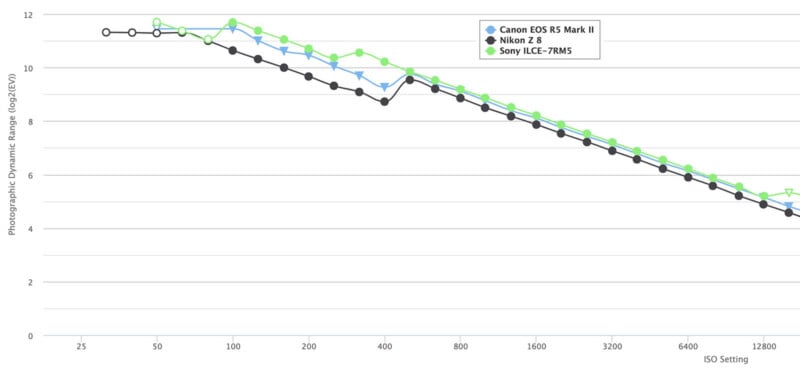 This photographic dynamic range (PDR) chart from Photons to Photos shows three high-res full-frame mirrorless cameras, the Canon EOS R5 II, the Nikon Z8, and the Sony a7R V. The dynamic range differences at base ISO values are small, and only get smaller as ISO increases.
Tossing out the a7R III’s results in PSMS mode, since that combines multiple images and has very niche applications, the range from the best to the worst of the cameras above is still very narrow, going from 12.47 to 11.82 PDR. In that same roughly 0.7 PDR range after the Leica M11 at 11.82, there are over 40 more full-frame cameras that Claff has tested, including many popular contemporary models.
You have to go back nearly 20 years to find full-frame cameras with PDR scores under 10, and plenty of photographers captured fantastic, gallery-worthy photos on those cameras, like the Nikon D3 with a PDR of 9.23. I happily used a D3 for years, and I’m hard-pressed to chalk up any of my improvement as a photographer since then to using cameras with more dynamic range.
My friend and industry peer, Richard Butler at DPReview, put it very well in 2023: “Judging a camera by its DR numbers is a little bit like being blindfolded and grasping an animal’s tail. You can guess at some things based on how far off the ground it is and how it feels, but ultimately you can’t be entirely sure if the tail is attached to an elephant or a donkey.”
You cannot know whether a camera is good, or, more complicatedly, the right camera for you, just because it has an impressive dynamic range.
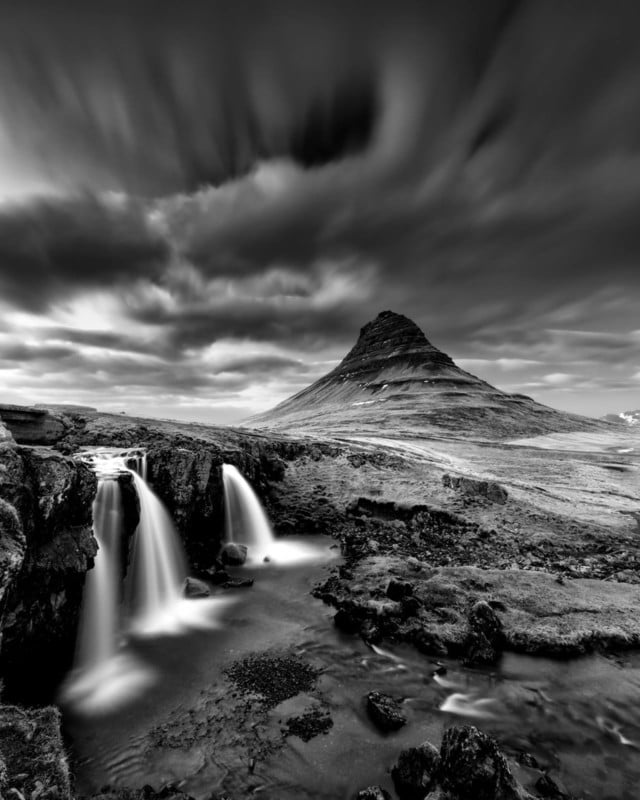 There are plenty of things I could have done to make this photo better, but I wouldn’t count using a camera with more dynamic range among them.
It’s easy to understand why photographers want cameras with good dynamic range, but the difference between good and great is very slim. What’s much more useful than a smidge more dynamic range is understanding how to get the most dynamic range from your preferred camera, which means shooting the highest-quality RAW file at base ISO using an excellent lens on a stable platform, and then expertly processing the file. Yes, that is a lot of hoops to jump through, but for those who care deeply about overall image quality, there is plenty you can do in the field to improve the technical aspects of your shots.
“I’m not saying [dynamic range] can’t help in some situations,” Bergman concludes. “But of all the issues I see in photography, almost none of them involve not recovering enough shadow detail.”
“The real issues are boring light, flat light, light coming in from all the wrong directions, or just a subject that’s not separated from the background with light.”
 Likewise, would more shadow detail in this shot make any better? I think not.
As Bergman rightly notes, sometimes you want contrast in your photo. Sometimes pure black makes a photo better, not worse. The same is true for highlights. A photo is not automatically better because it has a wider dynamic range, nor is one worse just because it has a narrower one.
In the end, dynamic range is but one way to measure the technological and engineering achievements of an image sensor, and I love that aspect of the photography industry. When a company develops an interesting image sensor and image processing pipeline that delivers just five percent more dynamic range, it excites me, and I want to understand how it was done. But dynamic range ≠ image quality, and image quality is not the end-all, be-all of a camera.
Image credits: Header photo is a crop of a Sony image. Dynamic range charts and data by Photons to Photos (William J. Claff).



 English (US) ·