


Published Jul 12, 2026, 2:49 PM EDT
Remus is a writer, editor, journalist, and author with an eye for detail and an extremely active imagination. He is an enthusiast of everything to do with the graphic medium, whether it's Western comics and their adaptations or manga and anime. Remus is also the author of the sci-fantasy novel Once Upon a Time in Hyperspace and several works of short fiction in the mystery, comedy, and horror genres.
Sign in to your Collider account
Horror literature in the 21st century has largely seen a shift from larger-than-life monsters to more intimate scares, with stories that take the fears hidden in everyday life and turn them into devices of psychological dread. Modern horror literature also blends various real-world issues and concurrent socio-cultural topics to further expand the genre’s scope. And in the process, we’ve been treated to some of the greatest, most terrifying books of all time.
The last 20 years of horror literature have seen the release of some of the most terrifying stories, ranging from psychological, social, and body horror to revivals of old myths, lore, and dark fantasies. From novels and novellas to manga, here’s our ranked guide to some of the best horror books of the past 20 years.
8 ‘Bird Box’ (2014)
 Image via Netflix
The debut novel of American writer and singer Josh Malerman, Bird Box is a post-apocalyptic story set against the backdrop of an inexplicable phenomenon where people go violently insane and suicidal when they look outside and see mysterious, unnamable creatures. The plot focuses on Malorie, who must find a way to safety for herself and her children while staying blindfolded to avoid seeing the unseen threat. The story is told in flashbacks, across three timelines, switching between Malorie’s efforts in the present to protect her family and the past when the event first began. The story continues in the sequel novel, Malorie, published in 2020.
Bird Box was a huge success at the time of its publication, earning critical acclaim and several accolades, including a nomination for the Bram Stoker Award for Best First Novel. Readers and reviewers both consider the book to be an absolute page-turner, praising the intense tension and chilling atmosphere, where the author replaces the impact of sight with sound and touch. Bird Box went on to be adapted into the eponymous 2018 film starring Sandra Bullock as Malorie.
7 ‘The Terror’ (2007)
 Image via AMC
A supernatural horror novel by sci-fi and horror novelist Dan Simmons, The Terror is a fictional account of Captain Sir John Franklin’s lost expedition to the Arctic to find the Northwest Passage on HMS Erebus and HMS Terror. Set in the mid-19th century, the story follows Capt. Franklin and his crew as they are plagued by diseases and starvation when their ships get trapped in ice, triggering an internal coup and cannibalism while trying to save themselves from an unknown monster. Several of the characters in the story are reimaginations of real members of Capt. Franklin’s crew, including Captain Francis Crozier, Dr. Harry D. S. Goodsir, and Commander James Fitzjames.
An epic survival tale combining maritime exploration, natural calamities, and supernatural monsters, The Terror is chillingly immersive. Reviewers and readers alike have praised the novel’s vivid expositions and dread-filled world-building, but have noted the novel’s extensive length and slow pace as negatives. The Terror was nominated for the 2006 British Fantasy Award and later adapted into a television series of the same name, developed by David Kajganich, which also became a horror icon in its own right.
6 ‘NOS4A2’ (2013)
 Image via AMC
The third novel by Joe Hill, published by William Morrow and Company, NOS4A2 (NOS4R2 in the UK), follows Victoria “Vic” McQueen, who discovers that she can find lost things by riding her bike over a particular covered bridge, which she calls Shorter Way, and landing at the destination of the lost object. She soon crosses paths with an immortal kidnapper named Charles Manx who abducts unhappy, troubled children and drains their souls. Years later, Manx returns to Vic’s life to kidnap her son.
NOS4A2 is a very inventive take on vampire stories and the mother trying to save her child trope, reimagining classic conventions into an engaging contemporary narrative. The story includes several references to Hill’s previous novels Horns, Heart-Shaped Box, and Locke & Key, and includes elements from his father Stephen King’s books like The Dark Tower and Doctor Sleep. NOS4A2 was nominated for the 2013 Bram Stoker Award for Best Novel, earned positive reviews from reviewers and readers, and was turned into a ten-episode AMC series in 2019.
Collider Exclusive · Horror Survival Quiz Which Horror Villain Do You Have the Best Chance of Surviving? Jason Voorhees · Michael Myers · Freddy Krueger · Pennywise · Chucky
Five killers. Five completely different ways to die — if you're not smart enough, fast enough, or self-aware enough to avoid it. Only one of them is the villain your particular set of instincts gives you a fighting chance against. Eight questions will figure out which one.
🏕️Jason
🔪Michael
💤Freddy
🎈Pennywise
🪆Chucky
TEST YOUR SURVIVAL →
01
Something feels wrong. You can't explain it — you just know. What do you do? First instincts are the difference between the survivor and the first act casualty.
ALeave immediately. I don't need to understand a threat to respect it. BStay quiet and observe. If I can see it, I can understand it. If I can understand it, I can avoid it. CStay awake. Whatever this is, I am not going to sleep until I feel safe again. DConfront it directly. Fear grows in the dark — I'd rather know what I'm dealing with. ECheck everything, trust nothing. The threat might be closer than I think — and smaller.
NEXT QUESTION →
02
Where are you most likely to find yourself when things go wrong? Setting is everything in horror. Where you are determines which rules apply.
ASomewhere remote — a cabin, a campsite, off the grid and away from people. BA quiet suburban neighbourhood where nothing ever happens. Except tonight. CIn my own head — the most dangerous place of all, depending on what's already in there. DWherever children are — because something about this place attracts the worst things. ESomewhere ordinary — a house, a toy store, a place where the last thing you'd expect is a threat.
NEXT QUESTION →
03
What is your most reliable survival asset? Every survivor has a quality the villain didn't account for. What's yours?
APhysical fitness — I can run, I can swim, I can outlast something that relies on brute persistence. BSpatial awareness — I always know the exits, the hiding spots, the fastest route out. CPsychological resilience — I've faced my worst fears before. They don't have the same power over me. DEmotional steadiness — I don't panic. Panic is what gets you caught. EScepticism — I don't underestimate threats because of how they look. Size is irrelevant.
NEXT QUESTION →
04
What kind of fear is hardest for you to fight through? Knowing your weakness is the first step to not dying because of it.
AThe unstoppable — something that will not stop, cannot be reasoned with, and is always getting closer. BThe invisible — a threat I can feel but can't locate, watching from somewhere I can't see. CThe psychological — something that uses my own mind and memories against me. DThe unknowable — something ancient, shapeless, that feeds on the fear itself. EThe mundane — a threat so ordinary-looking that no one will believe me until it's too late.
NEXT QUESTION →
05
You're with a group when things start going wrong. What's your role? Horror movies are brutally clear about who survives group situations and who doesn't.
AThe one who says "we need to leave" first — and means it, even when no one listens. BThe one who stays quiet, watches the others, and figures out the pattern before anyone else does. CThe one who holds the group together when panic sets in — because someone has to. DThe one who asks the questions nobody wants to ask — because ignoring them gets people killed. EThe one who takes the threat seriously when everyone else is laughing it off.
NEXT QUESTION →
06
What's the horror movie mistake you're most likely to make? Honest self-assessment is a survival skill. Denial is not.
AGoing back for someone — I know I shouldn't, but I can't leave them behind. BAssuming I'm safe once I've found a hiding spot. That's when it finds me. CFalling asleep when I absolutely cannot afford to. Exhaustion is its own enemy. DLetting my curiosity override my instincts — I always need to understand what I'm dealing with. EDismissing the threat because of how it looks. That's exactly what it wants.
NEXT QUESTION →
07
What's your best weapon against something that can't be stopped by conventional means? Every horror villain has a weakness. The survivors are always the ones who find it.
AThe environment itself — I use the terrain, the water, the geography against it. BPatience — I wait, I watch, and I strike at the one moment it doesn't expect. CLucidity — if I can stay in control of my own mind, it loses its primary weapon. DCourage — facing it directly, refusing to run, taking away the fear it feeds on. EImprovisation — I use whatever's at hand, however unconventional. Creativity over brute force.
NEXT QUESTION →
08
It's the final scene. You're the last one standing. How did you make it? The final survivor always has a reason. What's yours?
AI kept moving. I never stopped, never hid for too long, never let it corner me. BI figured out the pattern before anyone else did — and I used it against the thing following it. CI stayed awake, stayed lucid, and refused to give it the one thing it needed most. DI stopped being afraid of it. And the moment I did, everything changed. EI took it seriously from the start — and I never once made the mistake of underestimating it.
REVEAL MY VILLAIN →
Your Survival Odds Have Been Calculated Your Best Chance Is Against…
Your instincts, your strengths, and your particular way of thinking under pressure point to one villain you actually have a fighting chance against. Everyone else — good luck.
Jason Voorhees
Jason is relentless, but he is also predictable — and that is the gap you would exploit.
- He moves in straight lines toward his target. He doesn't strategise, doesn't adapt, doesn't outsmart. He simply pursues.
- Your ability to keep moving, use the environment, and resist the panic that freezes most victims gives you a genuine edge.
- The Crystal Lake survivors were always the ones who stopped running in circles and started thinking about terrain, water, and distance.
- You think like that. Which means Jason, for all his indestructibility, would face someone who simply refused to be where he expected.
Michael Myers
Michael watches before he moves. He is patient, methodical, and almost impossible to detect — until it's too late for anyone who isn't paying close enough attention.
- But you are paying attention. You notice the shape in the window, the car parked slightly wrong, the silence where there should be sound.
- Michael's power lies in the invisibility of ordinary suburbia — the fact that nothing ever looks wrong until it already is.
- Your spatial awareness and instinct to map every room, every exit, and every shadow before you need them is precisely the quality Laurie Strode had.
- You are not a victim waiting to happen. You are someone who already suspects something is wrong — and acts on it.
Freddy Krueger
Freddy wins by getting inside your head — using your own fears, your own memories, your own subconscious as weapons against you. That strategy requires a target who can be destabilised.
- You are harder to destabilise than most. You've faced uncomfortable truths about yourself and you haven't looked away.
- The survivors on Elm Street were always the ones who understood what was happening and chose to face it rather than flee from it.
- Freddy's greatest weakness is that his power evaporates in the presence of someone who refuses to give him the fear he feeds on.
- Your psychological resilience — the ability to stay grounded when reality itself becomes unreliable — is exactly the quality that keeps you alive here.
Pennywise
Pennywise is ancient, shapeshifting, and feeds on terror — but it has one critical vulnerability: it cannot function against someone who genuinely stops being afraid of it.
- The Losers Club didn't survive because they were braver than everyone else. They survived because they faced their fears together, and faced them honestly.
- You ask the questions others avoid. You look directly at what frightens you rather than turning away.
- That directness — the refusal to let fear fester in the dark — is Pennywise's worst nightmare.
- It chose the wrong target when it chose you. You are exactly the kind of person whose fear tastes like nothing at all.
Chucky
Chucky's greatest advantage is that nobody takes him seriously until it's already too late. He exploits the gap between how something looks and what it actually is.
- You don't have that gap. You take threats seriously regardless of how they present — and you never make the mistake of underestimating something because of its size or appearance.
- Chucky relies on surprise, on the delay between recognition and response. You close that delay faster than almost anyone.
- Your instinct to treat every unfamiliar thing with appropriate scepticism — rather than dismissing it because it seems absurd — is the exact quality that keeps you breathing.
- Against Chucky, not laughing is already winning. You are very good at not laughing.
↻ RETAKE THE QUIZ
5 ‘Horns’ (2010)
 Image via Dimension Films
Joe Hill's second novel, Horns is a dark fantasy horror novel that tells the story of Ignatius “Ig” Perrish. In the aftermath of his girlfriend Merrin’s brutal murder, he wakes up after a drunken night to find horns growing on his temples. When Ig realizes he also has the ability to force people to share their deepest, darkest thoughts, he turns his newfound powers into a diabolical weapon to find Merrin’s killer. The book is divided into five sections of 50 chapters, with each section consisting of 10 chapters.
Horns is a fast-paced revenge story with an exciting mix of the supernatural, crime, and modern gothic fiction. Critics and readers consider the book an emotional rollercoaster, featuring mystery, romance, horror, dark humor, and gripping tension. Horns was nominated for Best Novel at the 2010 Bram Stoker Award and has been adapted into a 2014 supernatural horror comedy film of the same name by Alexandre Aja, starring Daniel Radcliffe as Ig and Juno Temple as Merrin.
4 ‘Annihilation’ (2014)
 Image via Paramount Pictures
A cosmic horror novel by American author Jeff VanderMeer, Annihilation is the first book in his Southern Reach series and is followed by three more novels: Authority, Acceptance, and Absolution. Annihilation follows a team of four unnamed women, comprising a biologist, an anthropologist, a psychologist, and a military-trained surveyor, who are sent into a government-run uninhabited location called Area X to survey the land and its ecosystem. Their expedition is the 12th in a series of trials, with the previous attempts having failed due to mysterious disappearances, suicides, mental trauma, and aggressive cancers.
Annihilation is a creepy cosmic horror story with elements of gothic fiction and psychological horror that would thrill fans with its deliberate pacing and surreal atmosphere. The book earned mixed reviews from readers, but critics have found Annihilation to be an absolute page-turner, earning it the 2014 Nebula Award for Best Novel and the 2014 Shirley Jackson Award for Best Novel. In 2018, Alex Garland successfully translated the novel into an ambitious sci-fi horror film of the same name, which has also become a modern genre classic.
3 ‘Full Dark, No Stars’ (2010)
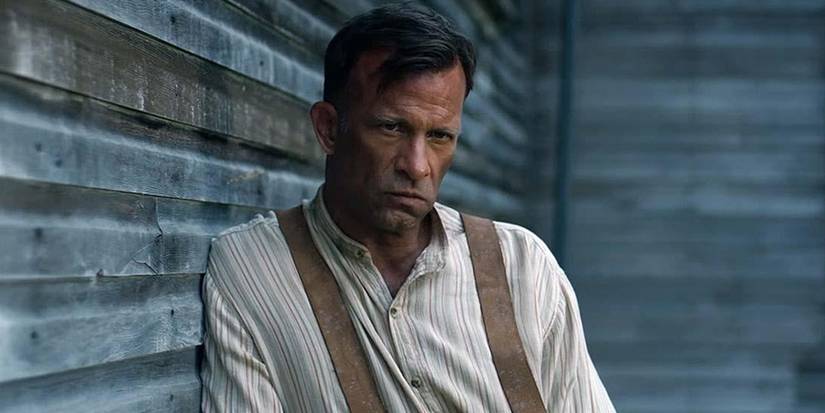 Image via Netflix
One of Stephen King’s most acclaimed short story collections of the 21st century, Full Dark, No Stars is a set of four novellas, all revolving around the theme of retribution. The book consists of the stories “1922,” "Big Driver," “Fair Extension," and “A Good Marriage." The collection explores the horrors of the human condition, depicting how ordinary people justify their most evil actions with uncanny, inexplicable consequences. A 2011 edition of the collection also includes an additional short story, “Under the Weather."
While Full Dark, No Stars enjoys rave reviews from both readers and reviewers, it also comes with a warning for its deeply disturbing depiction of the darkest sides of human nature. The King of Horror’s storytelling is satisfying as always, and the stories themselves are equally scary and unsettling, often heartbreaking. Full Dark, No Stars also went on to win the Best Collection awards at the 2011 Bram Stoker Awards and the 2011 British Fantasy Awards, with critics praising the collection as an engrossing and disturbingly fascinating read.
2 ‘The Strain’ (2009)
 Image via FX
Written by Guillermo del Toro with Chuck Hogan, The Strain is a vampire horror novel that is the first book in the trilogy, followed by The Fall and The Night Eternal. The Strain begins with a plane being grounded at JFK International Airport in New York City, and all passengers being declared dead except four. The CDC discovers a deadly virus that turns the affected into vampires, and the plague starts to spread rapidly, plunging the city into chaos and forcing scientists and survivors to fight for humanity.
The Strain reimagines vampires as a biological threat and depicts them as a parasitic virus, blending science and myth and putting an interesting spin on the conventional genre tropes. The book’s reviews have been vastly polarized, with one school of readers and critics finding it to be a high-concept, fast-paced story, while others find it predictable with horror movie cliches. The novel was later adapted into an FX series by Carlton Cuse, which earned several award nominations, including for Saturn Awards and Fangoria Chainsaw Awards.
1 ‘Uzumaki’ (1998–1999)
 Image via Adult Swim
A Japanese horror manga written and illustrated by Junji Ito, Uzumaki revolves around the people of the fictional town of Kurouzu-cho, a foggy coastal community plagued by a supernatural curse involving spirals. The titular pattern, representing the hypnotic secret shape of the world, manifests in everything, including human bodies, making people obsessed with the pattern and mutating them into spiraling monsters. As the madness spreads and the town is pulled into a darker, deeper path of no return, teenagers Kirie and Shuichi struggle to survive.
A cult classic among fans of manga, horror, and dark fiction, Uzumaki is hailed as one of the darkest manga ever and Junji Ito’s magnum opus. During its serialized release between 1998 and 1999, the manga earned numerous accolades, including an Eisner Award nomination for Best U.S. Edition of Foreign Material. Critics have praised the story’s dreamlike logic and unique premise, comparing the psychological dread and extreme body horror to the works of H.P. Lovecraft. The three volumes of Uzumaki have since been adapted into video games, a live-action film, and a four-episode anime miniseries of the same.



 English (US) ·