
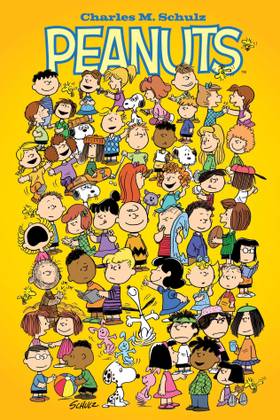
Although Peanuts is better known for its relatable punchlines, Charles M. Schulz's iconic comic has also presented beautifully illustrated strips and gags throughout its seven-decade history. Peanuts rejected the highly detailed style common in mid-century adventure strips, opting instead for the unmistakable trembling "Schulz lines" drawn with a flexible Nib pen that gives the artwork a distinct warmth. Schulz's style influenced generations of future comic strips like Bill Watterson’s Calvin and Hobbes, Patrick McDonnell’s Mutts, and the modern indie graphic novel movement, all of which adopted Schulz’s philosophy of minimal visual clutter.
However, Peanuts' art style wasn't fully formed at the strip's launch in 1950. In its earliest years, Peanuts featured children with perfectly round and exceptionally large heads atop tiny bodies, while Snoopy resembled a standard puppy with minimal facial expressions. As the decade progressed, Charles M. Schulz enlarged the characters' torsos, enlarged their cheeks, and introduced the unmistakably asymmetrical crooked mouths and drooping tired eyes that help them stand apart from all other comic strip characters. Likewise, Snoopy gained his droopy ears, expressive face, and slightly anthropomorphic body. These subtle changes allowed Peanuts' characters to project a wider and more relatable spectrum of human emotion.
Charles M. Schulz didn't need to make extreme changes to Peanuts' art style to create some of the most memorable comic strips of all time, with beautiful visual gags and minimalistic punchlines that withstand the test of time.
7 Charlie Brown, Snoopy, And Linus Look At The Moon
Peanuts' Nighttime Panels Adapt To The Characters Vision

Peanuts' moon admiration strip utilizes selective color theory and high-contrast lighting brilliantly to elevate a simple existential observation into a visually stunning piece of sequential art. The layout establishes a gorgeous visual rhythm by sandwiching bright, nighttime panels between deep glimpses directly at the moon. The header and the scenes where Charlie Brown and Linus talk showcase a vibrant purple night sky that radiates a serene cosmic energy, and they contrast beautifully against the pitch-black sky when Charlie, Linus, and Snoopy look directly at the moon.
These simple changes mimic the natural phenomenon of looking directly into a bright light source at night, which naturally drains the surrounding world of color. Besides, the characters are rendered in muted soft gray tones in the black sky panels as well, which creates a highly realistic sense of ambient moonlight reflecting off their skin, fur, and clothing. While simple, these subtle creative decisions are a nice additional touch to the strip's science-themed premise.
6 Rerun Van Pelt Is Secretly A Gifted Artist
Peanuts Pokes Fun At Its Own Art Style With Rerun's Classical Art

Rerun van Pelt's unexpected artistic genius produces a brilliant display of meta-artistic humor. The casual reveal of Rerun's Mona Lucy masterpiece breaks the expectations of Peanuts' cartoon medium, as even though the rest of the strip's art is rather unremarkable, the extremely high-quality art of Rerun's painting is precisely what makes the punchline so funny. When Lucy demands a painting of herself, a flustered Rerun casually makes a painting more detailed than his very reality.
Besides, this Peanuts strip goes the extra mile to replace the enigmatic smile of Leonardo Da Vinci's Mona Lisa with Lucy van Pelt’s smug expression, yet still wraps it in the authentic sfumato shading, delicate garment folds, and misty background oil-painting aesthetics of the original Renaissance artwork. In the end, Rerun's Mona Lucy raises the question of whether Peanuts' cast of characters are simply accustomed to their cartoon appearance or if they actually see each other as regular humans.
5 Charlie Brown Sings A Happy Song
Charlie Brown Makes Music Tangible

Peanuts integrates physical musical notation into its artwork to manifest Charlie Brown’s internal state of pure, unadulterated happiness. The massive central panel is filled with winding, sweeping musical staves that twist dynamically across the air. Charlie Brown is drawn multiple times, dancing, skipping, and singing along the path of these musical lines, literally walking through the melody of "Take Me Out to the Ball Game." The massive panel and the tangible music creates a larger-than-life feeling that mirrors Charlie Brown's infectiously optimistic joy.
Peanuts and other classic comic strips have a long history of materializing musical notes on the page, though Peanuts often deploys this visual tool as a negative indicator of noise or chaos. This strip subverts the trope, opting instead for an optimistic presentation where the undulating curves of the staff represent a comforting rhythm. The music itself serves as a dance floor that connects Charlie Brown to his favorite memories.
4 Charlie, Lucy, And Linus Watch The Starry Night Sky
The Blue Night Sky Is Brightly Lit By Golden Stars

A vibrant blue sky floods Charlie Brown, Linus, and Lucy van Pelt's most touching display of childhood curiosity, with the three kids feeling awe-struck at the sight of a night sky packed with a dense field of golden stars. The title card integrates seamlessly into this view, spelling out "Charlie Brown's Star" through a constellation of interconnected golden dots. This intentional burst of intense color sets a deeply serene, magical tone for the entire strip.
Besides the wonders of the night sky, several panels use bold perspective and positioning to emphasize the characters' profound fascination with the cosmos. Charlie, Lucy, and Linus are shown from above, from slightly below, from the back, in close-ups, and from afar, all of which makes the sky feel infinitely massive as it towers over the tiny children and masterfully captures a genuine sense of wonder. Immersed well enough, it's easy to picture oneself on the grass staring directly into the great unknown alongside the cast.
3 Snoopy Goes On A Long Journey To Tipperary
Snoopy Is One Adventurous Fellow

Snoopy’s longest adventure unfolds across a stunning collage of colorful landscapes that gradually reveal an epic cross-country trek. Charles M. Schulz relies heavily on pure visual world-building here, as Snoopy moves through an impressive sequence of changing terrains. The beagle explorer marches past rolling hills of vibrant green, steps carefully over a crisp blue forest stream, and navigates dense, tall grass under a bright afternoon sun. These rapid environmental transitions abandon Peanuts' traditional minimalist void and replace it with some of the richest scenic diversity in its seven-decade history.
There's also a clever contrast between each panel and the next. Snoopy climbs a steep cliff face before tumbling down a rock-strewn slope. He walks under the glow of the moon on a cold night right before the next panel shows him resting under a tree's shadow on a dangerously hot day. The sudden shift from bright open fields to a vibrant blue river to a backlit backdrop makes for a gorgeous strip where the colorful art is at the center.
2 Snoopy Finds The Day Too Snowy To Enjoy
One Must Imagine Snoopy Happy To Clear The Snow

A serene pitch-black winter sky serves as the engine for Snoopy's winter blues. Every frame is populated with a dense, unmoving pattern of white dots that convey a heavy snowfall that simply refuses to yield. This static backdrop barely changes from one panel to the next, and the complete absence of dialogue forces the reader to focus entirely on Snoopy's futile physical labor as his simple chore turns into a futile battle.
This strip is beautiful for the exact opposite reason as Snoopy's trip to Tipperary. Every panel is almost fully black-and-white and unchanging, and Snoopy struggles with a task that initially seems much easier than embarking on a multi-mile quest. It also holds back the vibrant red hue of Snoopy's iconic doghouse until a single mid-strip panel, which highlights the one brief moment the roof sits completely clear, before immediately burying it again under the uniform snowscape.
1 Linus Watches A Leaf Fall In Autumn
Peanuts' Minimalism Shines Through Linus' Quiet Reflection

Linus van Pelt's observation of a leaf's fall to the ground during Autumn captures the essence of Peanuts' minimalism. Charles M. Schulz keeps the camera completely stationary across the four panels and allows only the slow, rhythmic descent of a single leaf to disrupt the stillness of the frame. This lack of background noise or dramatic physical action forces total concentration onto the quiet connection between the child and nature, which shows how deep thought requires zero complex staging.
Besides adding a splash of color to the strip's minimalism, the intentional use of matching red hues across Linus’ striped shirt and the falling leaf suggests that Linus van Pelt is projecting his own thoughts and feelings onto the leaf. The leaf simply does what its nature tells it to do, but Linus possibly interprets it as his own desire to change. Though it comes from a young child, this kind of projection isn't rare in adults finding personal revelations in mundane events.
How would you rank these Peanuts strips?
Created by Charles M. Schulz
Movie(s) The Peanuts Movie, A Charlie Brown Christmas, A Boy Named Charlie Brown, Charlie Brown's All Stars!, A Charlie Brown Thanksgiving, It's the Great Pumpkin, Charlie Brown, It's the Easter Beagle, Charlie Brown
Character(s) Charlie Brown, Snoopy, Lucy van Pelt, Linus van Pelt, Sally Brown, Pig-Pen, Marcie (Peanuts), Peppermint Patty, Woodstock





 English (US) ·