

Published Nov 13, 2026, 3:00 AM EST
Tom is a Senior Staff Writer at Screen Rant, with expertise covering everything from hilarious sitcoms to jaw-dropping sci-fi epics.
Initially he was an Updates writer, though before long he found his way to the TV team. He now spends his days keeping Screen Rant readers informed about the best shows available to stream, whether it's recommending hidden gems that may have been missed or deep diving into ways your favorite shows have (or haven't) stood the test of time.
Tom is based in the UK and when he's not writing about TV shows, he's watching them. He's also an avid horror fiction writer, gamer, and has a Dungeons and Dragons habit that he tries (and fails) to keep in check.
Game of Thrones became a pop culture sensation for far more than the wait for Daenerys’ dragons to reach Westeros or the Night King to meet his end. Its greatest attraction was always the political backstabbing that made competing for the Iron Throne so dangerous. Carefully calculated betrayals and ever-changing loyalties gave almost every conversation potentially fatal consequences. It was always this intrigue-driven struggle for power that made the GoT so watchable rather than the huge battle scenes.
Even stripped of its fantasy trappings, that ruthless political drama of Game of Thrones would have made for addictive viewing. Elements like dragons and the White Walkers provided spectacle, but it was the cut-throat tapestry of shifting alliances that made the experience so satisfying. It’s an appeal that a more recent HBO series is also tapping into despite its genre being widely different. Dune: Prophecy, the prequel spinoff of Denis Villeneuve’s Dune movie trilogy, transfers Game of Thrones’ deadly contest for influence from a fantasy kingdom to an interstellar sci-fi empire where bloodlines still determine who gets to rule.
Across its six-episode first season, Dune: Prophecy focuses on the mysterious Sisterhood of the Bene Gesserit and their manipulation of competing dynasties roughly 10,000 years before the films. While the show initially gained attention because of its connection to Villeneuve’s Dune movies, many viewers walked away with the same opinion: it’s how much the show feels like a sci-fi version of Game of Thrones that makes it entertaining. Season 2 of Dune: Prophecy is in post-production and expected to arrive in 2027, meaning there’s never been a better time to dive into GoT’s science fiction cousin.
Dune: Prophecy Puts A Sci-Fi Spin On GoT’s Feudal Politics

Dune: Prophecy may take place thousands of years in humanity’s future, but its political system feels centuries old. Noble houses accumulate wealth, negotiate marriages, and protect their bloodlines while an emperor struggles to maintain central authority. For the nobility, loyalty to the figurehead on the throne is often simply a front put on while they secretly scheme to take it for themselves. In other words, it’s almost exactly the kind of feudal setup that defines the Seven Kingdoms in Game of Thrones.
Yes, space travel has expanded the territory available to fight over in Dune: Prophecy, but an abundance of interstellar real estate doesn’t make the rulers of grand galactic dynasties like Corrino, Harkonnen, and Atreides any less possessive than the likes of the Targaryens, Lannisters, or Starks. For Game of Thrones fans, the appeal is immediately obvious: this is a story about powerful families who view leadership as a birthright that’s owed to them, and everyone else suffers the consequences.
At the center of Dune: Prophecy’s story are Valya (Emily Watson) and Tula Harkonnen (Olivia Williams), two members of the mysterious Sisterhood (a precursor to the Bene Gesserit of the Dune movies). The Sisterhood cultivates influence through its positions beside powerful rulers though, of course, the line between advisor and puppeteer often becomes blurred. Meanwhile, Emperor Javicco Corrino (Mark Strong) is attempting to secure his dynasty through his daughter’s politically advantageous marriage. Of course, HBO’s series wouldn’t be such a great political thriller if this relatively simple goal went smoothly, so before long the betrothal of Princess Ynez (Sarah-Sofie Boussnina) to 9-year-old Lord Pruwet Richese (Charlie Hodson-Prior) is met with increasingly violent responses.
Dune: Prophecy may be a sci-fi show, but its core plot is driven by a web of political intrigue and maneuvering that Game of Thrones fans will feel instantly comfortable with. Understanding every detail of Dune’s vast science-fiction mythology matters less than recognizing who wants power and what they are willing to sacrifice to get it. Information and family connections are the most dangerous weapons in the show, giving quiet exchanges the tension of any vast spectacle-heavy battle. The enjoyment comes not from anything overtly sci-fi, but from watching elaborate plans collide with characters who refuse to cooperate and are only ever a hair’s width away from their next bloody betrayal.
HBO’s Dune TV Show Is Much Darker Than Denis Villeneuve's Movies

Image via Max
Dune: Prophecy may be gaining interest ahead of its second season thanks to its growing reputation as sci-fi’s answer to Game of Thrones, but this wasn’t initially the driving force to its success. Prior to the 2024 debut of season 1, the key selling point of the HBO series was returning to the universe of Villeneuve’s Dune films. However, while they share the same fictional universe, the tone and atmosphere of the Dune movies and their TV spinoff are vastly different. Where Villeneuve’s movies frame Paul Atreides’ epic rise to power as a sweeping adventure, Dune: Prophecy focuses much more intimately on the unpleasant and frequently bloody business of maintaining control.
The Dune movies are PG-13, but Dune: Prophecy wears its TV-MA rating with pride. Explicit sex and nudity alongside plenty of disturbing deaths mean that the tone and atmosphere is much closer to Game of Thrones than Denis Villeneuve’s trilogy. The killing of a child in the first episode immediately establishes that no characters are safe from violent on-screen deaths. Meanwhile, sexual relationships are frequently used as tools for secrecy and manipulation in ways that would make GoT’s Littlefinger (Aidan Gillen) proud.
The adult content makes the imperial court feel just as physically dangerous as it is politically unstable. Violence is often visceral and abrupt, with Dune: Prophecy never shying away from moments that the Dune movies would never show on-screen. Yes, there are dark themes in the films, but Dune: Prophecy makes its most challenging aspects much more explicit and direct. It's an approach that further strengthens its resemblance to Game of Thrones. Beyond the recognizable political intrigue and succession disputes, both shows pull no punches when it comes to depicting just how catastrophic unchecked lusting for power can truly be.
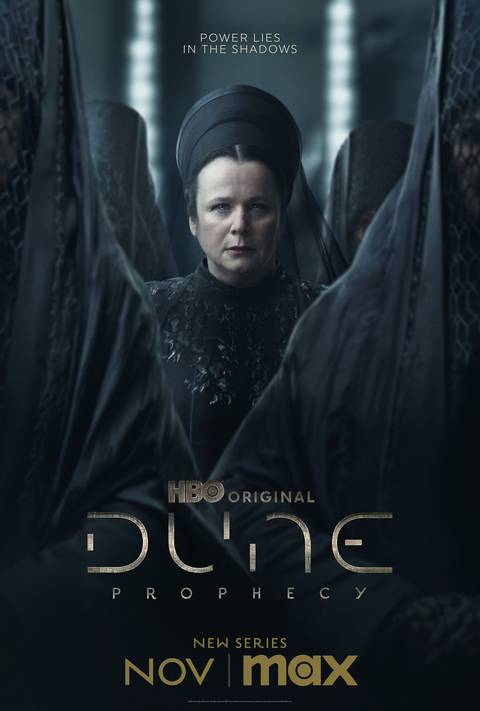
Release Date November 17, 2024
Showrunner Alison Schapker
Directors Anna Foerster
Writers Diane Ademu-John, Kevin J. Anderson, Brian Herbert, Frank Herbert
-

Emily Watson
Mother Superior Valya Harkonnen
-

Reverend Mother Tula Harkonnen




 English (US) ·