
 Image via 20th Century Studios
Published Jun 21, 2026, 6:01 AM EDT
Sign in to your Collider account
War movies are some of the hardest films to get right. Plenty of them can deliver impressive battle sequences, but not all of them can make the audience care about the people caught in the middle of the conflict. The truth is that spectacle alone isn't always enough. There’s no denying that wars shape history, but translating those events into compelling stories requires far more than explosions and intense combat sequences.
Now, there are plenty of films that strike that balance. However, some of the genre's most impressive achievements often get overlooked because they refuse to follow the traditional mold. Instead of simply recreating famous battles, they experiment with perspective, feature unconventional protagonists, or approach familiar conflicts from entirely new angles. Here are six such underrated war movies that break away from predictable tropes and are as close as it gets to perfection.
1 ‘Master and Commander: The Far Side of the World’ (2003)
 Image via Universal Pictures
Master and Commander: The Far Side of the World is a war movie that deserved to become a full franchise because of how grand its narrative was. Peter Weir’s epic is set during the Napoleonic Wars, and follows Captain Jack Aubrey (Russell Crowe), the commander of HMS Surprise, after his ship is ambushed and badly damaged by the French privateer Acheron. The story picks up when Aubrey decides to repair the ship at sea and continue the chase instead of returning to port because he believes that stopping Acheron is worth the risk. Now, this isn’t a predictable fast-paced naval action movie but a tense, slow-burning hunt, where every decision carries weight.
Weir doesn’t rush from one battle to the next. He lets the audience experience the boredom, fear, loyalty, and exhaustion of life at sea. Aubrey’s friendship with ship surgeon Stephen Maturin (Paul Bettany) is the film’s emotional core and grounds all the spectacle in something that feels human. Master and Commander: Far Side of the World comes pretty close to perfection thanks to its incredible sense of immersion. The HMS Surprise is a world in its own, and because the film spends so much time showing the crew as people, every conflict they find themselves in hits hard. Perhaps the film was a little too old-fashioned to be turned into a blockbuster franchise, but it’s definitely a war film that only gets better with time.
2 ‘The Thin Red Line’ (1998)
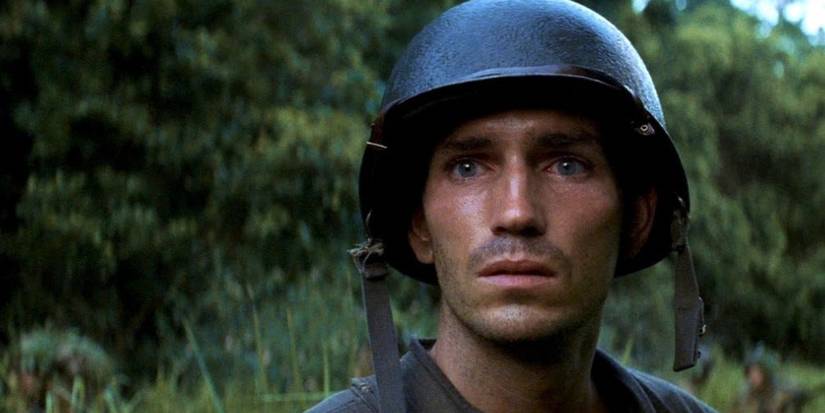 Image via 20th Century Studios
The Thin Red Line often gets overshadowed whenever discussions about great war films come up, primarily because it was released in the same year as Saving Private Ryan. However, Terrence Malick’s World War II epic sets out to do something completely different. The story takes place during the Guadalcanal campaign in the Pacific Theater and follows the soldiers of C Company as they are sent to capture a heavily fortified Japanese position. Along the way, the narrative shifts between multiple perspectives, including the idealistic soldier Private Witt (Jim Caviezel) and the cynical First Sergeant Welsh (Sean Penn), along with several other men struggling to survive a conflict they barely understand.
The Thin Red Line isn’t interested in the logistics of military strategy or grand war heroics. That’s not to say the film doesn’t feature some of the most impressive action sequences of all time, but the premise uses war as a lens to explore larger questions about humanity. The contrast between the violence unfolding on Guadalcanal and the breathtaking jungles, wildlife, rivers, and open skies really drives that point home. The Thin Red Line lingers on the quieter moments of war, including the impact it leaves on the soldiers caught in the crossfire. That approach may not be for everyone, but that doesn’t take away from the brilliance of The Thin Red Line.
Collider Exclusive · Action Hero Quiz
Which Action Hero Would Be
Your Perfect Partner?
Rambo · James Bond · Indiana Jones · John McClane · Ethan Hunt
Five legends. Five completely different ways of getting out alive — with style, with muscle, with charm, with luck, or with a plan so intricate it probably shouldn't work. Ten questions will reveal which action hero was built to have your back.
🎖️Rambo
🍸James Bond
🏺Indiana Jones
🔧John McClane
🎭Ethan Hunt
FIND YOUR PARTNER →
01
You're dropped into a dangerous situation with no warning. What do you need most from a partner? The first few seconds tell you everything about who belongs beside you.
ASomeone who already has three contingency plans running and is calmly working through all of them. BSomeone who reads the terrain instinctively and knows exactly how to use it against the enemy. CSomeone who keeps their nerve and their sense of humour when everything is falling apart. DSomeone who knows the history of wherever we are and what we're walking into. ESomeone with the right contact, the right cover identity, and the right exit already arranged.
NEXT QUESTION →
02
You have to get somewhere dangerous, fast. How do you travel? How you get there is half the mission.
AOn foot through terrain no one else would attempt — I move where vehicles can't follow. BOn a motorcycle, a cargo plane, or anything else that gets me there before I think too hard about it. CIn something that belongs to someone else — borrowed, stolen, or improvised under fire. DFirst class, with a cover identity and a gadget that does something I won't explain until it's needed. EBy whatever means are available — I've driven, flown, and once arrived by camel. The destination matters, not the method.
NEXT QUESTION →
03
You're pinned down and outnumbered. What does your ideal partner do? This is when you find out what someone is really made of.
ADisappears into the environment, flanks them silently, and ends it before I've reloaded. BCracks a one-liner, grabs a fire extinguisher or a chair, and improvises something that somehow works. CProduces a gadget specifically designed for this exact scenario and uses it with infuriating precision. DPulls out a whip, a pistol, and an archaeological insight that somehow gets us out alive. ENeutralises the threat with maximum efficiency and minimum words — they were already three moves ahead.
NEXT QUESTION →
04
The mission is paused. You have one evening to decompress. What does your partner suggest? Who someone is when the pressure drops is who they actually are.
AA bar with terrible lighting, cold beer, and absolutely no questions about feelings. BThe finest restaurant in the city, a bottle of something expensive, and a conversation that is equal parts brilliant and exhausting. CA local dig site, a museum after hours, or a long story about why that particular artefact matters to human civilisation. DPizza. Bad TV. Falling asleep halfway through a movie neither of you were watching anyway. EA debrief that turns into three hours of contingency planning that somehow becomes the most fun you've had all week.
NEXT QUESTION →
05
How do you prefer your partner to communicate mid-mission? Good communication is the difference between partners and a liability.
APrecise and minimal — tell me what I need to know and nothing else. Every word has a cost. BDeadpan and dry — keeping it light keeps me sharp, even when everything is on fire. CEnthusiastic and slightly chaotic — but always with useful information buried somewhere in the noise. DCalm and controlled through an earpiece, with a plan that covers every variable I haven't thought of yet. EBarely at all — silence is a language and they speak it fluently.
NEXT QUESTION →
06
Your enemy is powerful, well-resourced, and has the upper hand. How should your partner approach them? The approach to the enemy defines the partnership.
AInfiltrate their inner circle, learn everything, and dismantle them from inside out before they know we're there. BStudy the historical pattern — every villain of this type has a weakness written somewhere in the past. CGet them talking. The more they monologue, the more time I have to figure out how to beat them. DGo through them. Directly. With as much force as the terrain allows. EFind the one thing they haven't accounted for — there's always one thing — and make sure we're holding it.
NEXT QUESTION →
07
Things go badly wrong and you're captured. What do you trust your partner to do? Who someone is when you need them most is the only thing that matters.
ACome in alone, quietly, and get me out before anyone knows they were there. BHave already been working on the extraction since the moment I disappeared — the plan is already running. CCome in loud, come in fast, and worry about the collateral damage later — I'd do the same for them. DUse every resource, every contact, and bend every rule until I'm out — they don't leave people behind. ECharm their way in somehow, bluff through the hard part, and still manage to look good doing it.
NEXT QUESTION →
08
What does your ideal partner bring to the table that you couldn't replace? A great partner fills the gap you didn't know you had.
ATechnology that shouldn't exist yet and the training to use it under any conditions. BSurvival instinct so refined it borders on supernatural — and the scars to prove it's been tested. CKnowledge of history, language, and culture that makes them invaluable in places where force is useless. DThe ability to walk into any room in the world and immediately become the most trusted person in it. EStubbornness that refuses to accept a situation is hopeless — and the improvisational skill to back it up.
NEXT QUESTION →
09
Every partnership has a cost. Which of these can you live with? No one comes without baggage. The question is whether you can carry it together.
AA partner who never fully switches off — always watching exits, always calculating threats, even at dinner. BA partner who gets the job done brilliantly but has the emotional availability of a locked filing cabinet. CA partner who makes everything ten times more complicated than it needs to be — but who always comes through. DA partner who gets personally attached to every relic, ruin, and artefact we encounter, which slows everything down. EA partner who was not built for this and knows it — but shows up anyway, every time, without being asked.
NEXT QUESTION →
10
It's the final moment. Everything is on the line. What do you need from your partner right now? The last question is the most honest one.
AOne line. Absolutely dry. Delivered like the world isn't ending. Then we move. BNothing said at all — just a look that means we both already know what has to happen. CA plan I don't fully understand that somehow accounts for everything, delivered in thirty seconds flat. DA piece of historical context that reframes the entire situation and tells us exactly what to do next. ESomeone who steps forward instead of back — because that's who they've always been.
REVEAL MY PARTNER →
Your Partner Has Been Assigned Your Perfect Partner Is…
Your answers have pointed to one action hero above all others. This is the person built to have your back — for better or considerably, spectacularly worse.
Rambo
Your partner doesn't talk much, doesn't need to, and will have assessed every threat in your immediate environment before you've finished your first sentence. John Rambo is not a man of plans or politics — he is a force of nature shaped by survival, loyalty, and a capacity for endurance that goes beyond anything training can produce. He will not leave you behind. He has never left anyone behind who deserved to come home. What you get with Rambo is the most capable, most quietly ferocious partner imaginable — one who has been through things that would have broken anyone else, and who chose to keep going anyway. You'll never need to ask if he has your back. You'll just know.
James Bond
Your partner will arrive perfectly dressed, perfectly briefed, and with a cover story so convincing it'll take you a moment to remember what's actually true. James Bond is the most professionally dangerous person in any room he enters — and the most disarmingly charming, which is the point. He operates in a world of layers, where nothing is what it appears and every advantage is used without apology. You'll never be bored. You'll occasionally be furious. But when it matters — when the mission is genuinely on the line and the margin for error has collapsed to nothing — Bond is exactly the partner you want. He has survived things that have no business being survivable. He does it with style. That is not nothing.
Indiana Jones
Your partner will know the history, the language, the cultural context, and exactly why the thing everyone else is ignoring is actually the most important thing in the room. Indiana Jones is brilliant, reckless, and occasionally impossible — but he is also one of the most resourceful, most genuinely knowledgeable partners you could find yourself beside. He approaches every situation with a scholar's eye and a brawler's instinct, which is an unusual combination and a remarkably effective one. He hates snakes and gets personally attached to objects of historical significance, both of which will slow you down at least once. It doesn't matter. What Indy brings is irreplaceable — and the adventures you'll have together will be the kind people write books about. Assuming you survive them.
John McClane
Your partner was not supposed to be here. He does not have the right equipment, the right information, or anything approaching the right odds. He has a sarcastic remark and an absolute refusal to accept that the situation is as bad as it looks. John McClane is the greatest accidental hero in the history of action cinema — a man whose superpower is stubbornness, whose contingency plan is improvisation, and whose capacity to absorb punishment and keep moving would be alarming if it weren't so useful. He will complain the entire time. He will make it significantly more chaotic than it needed to be. And he will absolutely, unconditionally, without question come through when it counts. Yippee-ki-yay.
Ethan Hunt
Your partner has already run seventeen scenarios by the time you've finished reading the briefing, and the plan he's settled on involves at least two things that should be physically impossible. Ethan Hunt operates at the absolute edge of human capability — technically, physically, and intellectually — and he brings the same relentless precision to protecting his partners that he brings to dismantling organisations that shouldn't exist. He is not easy to know and he will never fully tell you everything. But he will carry the weight of the mission so completely, so absolutely, that your job is simply to trust him — and the remarkable thing is that trusting him always turns out to be the right call. The mission will be impossible. He will complete it anyway.
↻ RETAKE THE QUIZ
3 ‘Tae Guk Gi: The Brotherhood of War’ (2004)
 Image via Showbox.
Tae Guk Gi: The Brotherhood of War is one of the most successful films in South Korean history, but it remains surprisingly under the radar for many Western audiences. The war epic, directed by Kang Je-gyu, follows brothers Lee Jin-tae (Jang Dong-gun) and Lee Jin-seok (Won Bin), whose lives turn upside down when they are forcibly drafted into the South Korean army following the outbreak of the Korean War. That premise expands into a tragedy that stays with the audience long after the credits roll. The film’s greatest strength is how personal it feels despite its massive scale. The Korean War serves as the backdrop, but the emotional core is always the relationship between Jin-tae and Jin-seok.
Jin-tae's initial attempts to earn a military decoration so his brother can be sent home initially come from a place of love, but the horrors of combat slowly transform him into someone completely unrecognizable. Watching that transformation unfold is heartbreaking because the audience understands exactly why and how it happens. That emotional journey gives the film a level of weight that many war stories struggle to achieve. Of course, Tae Guk Gi: The Brotherhood of War also features its fair share of battle sequences that place viewers directly in the middle of the carnage. However, none of that is for the sake of pure shock value. Every explosion and casualty serves to reinforce the film’s central message about the devastating consequences of war. Tae Guk Gi: The Brotherhood of War refuses to portray its conflict as black or white, and that’s what makes it so powerful.
4 ‘’71’ (2014)
 Image via StudioCanal
'71 doesn’t focus on large-scale battles and military campaigns like most other war films. Instead of following an army, the film follows a single soldier trying to survive one terrifying night. The story is set during the early years of the Troubles in Northern Ireland, and centers on young British Army recruit Gary Hook (Jack O'Connell), who is deployed to Belfast in 1971. During a riot that spirals out of control, Hook becomes separated from his unit and is left stranded in hostile territory. Suddenly, he finds himself trapped in a city he barely understands, surrounded by armed groups, shifting loyalties, and people who may either help him or kill him. What makes '71 so effective is that it places the audience in the same position as Hook.
The film doesn't stop to explain every political faction or historical detail. Instead, viewers experience the confusion, fear, and uncertainty through the eyes of a young soldier who has been thrown into a situation he is not equipped to deal with at all. This sense of uncertainty results in a thriller where danger can come from almost anywhere, and trusting anyone is risky. The film conveys this urgency with its handheld camerawork, gritty production design, and relentless pacing that makes Belfast feel claustrophobic. '71 transforms history into a tense, immersive experience, and that approach works because it’s grounded in genuine fear instead of spectacle.
5 ‘A Bridge Too Far’ (1977)
 Image via United Artists
War movies usually build toward victory, but A Bridge Too Far doesn’t. Richard Attenborough’s epic tells the story of Operation Market Garden, the ambitious Allied plan to seize a series of bridges in the Netherlands and create a direct route into Germany that could potentially end World War II months earlier. The operation involved more than 35,000 airborne troops dropped behind enemy lines while British ground forces raced north to relieve them. On paper, it sounded brilliant. In reality, it became one of the most famous military failures of the war. Now, A Bridge Too Far doesn’t try to rewrite that history or paint defeat as triumph. The film carefully shows how a combination of overconfidence, flawed intelligence, communication failures, logistical problems, and plain bad luck gradually pushes the operation toward disaster. The story follows dozens of commanders and soldiers spread across the battlefield, including General Roy Urquhart (Sean Connery), Lieutenant Colonel John Frost (Anthony Hopkins), General James Gavin (Ryan O'Neal), and Major Julian Cook (Robert Redford).
Despite its stacked cast, the film does an impressive job of making the operation easy to understand for all kinds of audiences. A Bridge Too Far’s scale of production feels grand even today. Attenborough recreated airborne drops, armored advances, and urban battles using real aircraft, practical effects, and thousands of extras. Even critics who were divided on the film couldn’t help but acknowledge the sheer craftsmanship involved in bringing all this to life long before CGI became the standard. Aside from all that, though, A Bridge Too Far presents a different perspective on war and serves as a reminder that sometimes, the most compelling stories aren’t the victorious ones.
6 ‘Tigerland’ (2000)
 Image via New Regency Productions
Tigerland builds its entire story around the uncertainty faced by young men who know they will soon be sent to Vietnam. The film takes place in 1971, right as the United States was steadily losing the war, and follows rebellious draftee Private Roland Bozz (Colin Farrell), who is stationed at Fort Polk, Louisiana. Bozz openly despises the military and constantly challenges authority, but beneath all that defiance, he genuinely cares about the men around him. The protagonist forms an unlikely friendship with aspiring writer Jim Paxton (Matthew Davis) and becomes the unofficial protector of his fellow recruits while navigating the brutal final stages of training before deployment to Vietnam.
Tigerland is compelling because it isn’t really about combat. Instead, the film’s central conflict comes from the looming reality that hangs over these young men. The film explores how different recruits cope with that fear. Some embrace the military, some break under the pressure, and others desperately look for a way out. Bozz sits at the center of it all as a fascinating contradiction, and watching him clash with authority is the most fascinating part of the story. Tigerland strips away the spectacle usually associated with war movies and adopts a realistic, almost documentary-like style to focus on its characters. The film sets out to capture a specific moment in history instead of the entire war itself, and in doing so, it turned into one of the most thoughtful entries in the genre.

Tigerland
Release Date October 6, 2000
Writers Ross Klavan, Michael McGruther
-

-

Matthew Davis
Pvt. Jim Paxton



 English (US) ·