

Published Aug 17, 2026, 11:50 PM EDT
Kolt Day is a tenured freelancer who has brought invigorating and provocative takes to Screen Rant and ComicBook, alongside loads of writing experience in other realms. Outside of media journalism, Kolt loves music production and philosophy (particularly Nietzsche, Derrida, and Foucault).
There's a K-drama for everyone, but there's a particularly massive treasure trove of excellent action thriller dramas waiting. K-dramas' preferred themes, like cultural problems, inequality, and corruption, provide an extremely fertile soil for pulse-pounding stories that can keep viewers on the edge of their seats the whole time. K-dramas serve rich social commentary at the same time as they serve visceral tension, and while that's not a trait unique to the medium, it is something they're particularly great at.
K-dramas are experiencing a massive boom, dominating streamers like Netflix in recent years. Much like Western TV, discussion around K-dramas is largely driven by star power and name recognition. Unfortunately, that can be prohibitive to people trying to wade into them for the first time. Everyone has to start somewhere, and by stripping away the scaffolding, it's possible to distill a handful of popular, beloved stories that excel at one thing in particular: simply being really great shows every action thriller fan needs to watch once.
Bloodhounds
 Soyun Jeon, Seowoo Jung / Netflix
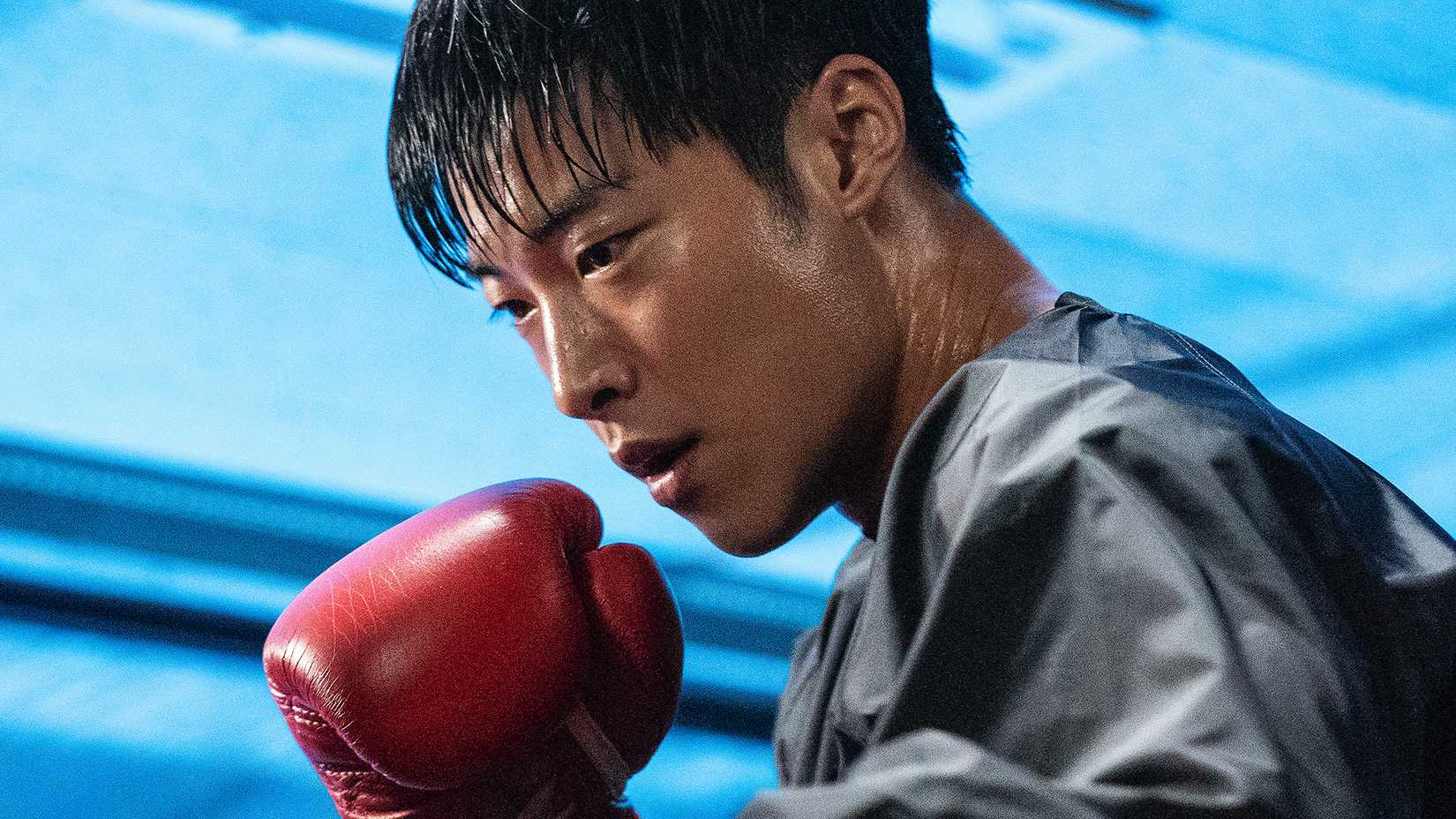
There's hardly a better starting place for those getting into action thriller K-dramas than Netflix's immensely popular Bloodhounds. Bloodhounds' premise is actually fairly simple: when Kim Gun-woo's (Woo Do-hwan) mother falls prey to a massive loan shark organization called Smile Capital, he puts his boxing skills to use by teaming up with lender Choi Tae-ho (Huh Joon-ho) and former Marine Hong Woo-jin (Lee Sang-yi) to wade into the underbelly of debt collection in a desperate attempt to take Smile Capital down at the root.
Like many K-dramas, Bloodhounds grounds its fantastical premise with a keen eye for the social politics at work. The CEO of Smile Capital is able to effectively pull off their illegal deeds without consequence, and there's a legion of people likewise down on their luck willing to do the dirty work to keep organizations like Smile Capital on top. Meanwhile, Bloodhounds operates with keen sincerity as it meditates on the often complicated pasts of its main cast.
While its first season is absolutely excellent and brings the mysterious action every thriller fan craves, the second season changes gears to an underground boxing league and a whole new set of dangers. Impressively, the second season is just as strong as the first, capitalizing on the excellent chemistry established in the first season with a slightly different formula. Bloodhounds is an immensely rewarding watch well worth anybody's time, but especially action thriller fans.
Weak Hero
 Image courtesy of Everett Collection
Weak Hero, in hindsight, deserves mention because it's a groundbreaking action thriller perfect for a certain type of fan. The other entries on this list might veer into themes which are more directly dark than Weak Hero's premise: the young and physically weak high schooler Yeon Si-Eun navigates a rough-and-tumble world full of bullies and violence alongside a growing group of scrappy outcasts. But it's a combination of two factors that make Weak Hero an unforgettable must-watch, and they go together cleanly.
The first is the sincerity of the solidarity Si-eun forges with those he befriends; the second is the cleverness with which Si-eun navigates his own physical limitations, using situational awareness and his studies to his advantage as he gains the upper hand in a brilliant variety of situations. In those senses, Weak Hero starts to seem a lot less like a K-drama in its own right and more like a pristinely adapted comic book or shōnen manga—which it effectively is, as a live-action adaptation of the eponymous webtoon from Seopass and Razen.
While other series on this list often create their drama through high stakes and brute force, Weak Hero navigates the full landscape of its effectiveness with expertly inventive and absolutely brutal fight choreography that serves as punctuation for the character-driven writing at its core. It tells a story which, while not necessarily rare, is rarely told so effectively, creatively, and unflinchingly.
The Worst Of Evil

A practical must-watch for action thriller fans looking to branch into K-drama, The Worst of Evil covers the tumultuous story of an undercover infiltrator into a drug ring who finds countless things he'd inadvertently been looking for all along. That description might seem trite, but looking beyond the action, The Worst of Evil speaks to something deeply human. When one's role in the world says they must categorically be against something or someone, what happens when one finds themselves aligning and identifying with it?
That's the general problem that undercover investigator Park Jun-mo (Ji Chang-wook) finds himself facing when he's charged with infiltrating the dominant Gangnam Union mob and lands in the company of up-and-coming enforcer Jung Gi-cheul (Wi Ha-joon)—whose first love happens to have also been Jun-mo's wife and fellow investigator Yoo Eui-jeong (Im Se-mi). Aside from its top-notch cinematography, winding plot, and thrilling action, The Worst of Evil represents something particularly excellent: its main cast comprises what are effectively complex character studies.
Jun-mo comes to appreciate the power, prestige, and camaraderie evident in Gangnam Union, while Eui-jeong serves to ground Gi-cheul's history, in turn positioning him as an empathetic character who is far more than a charismatic villain. The whole time, the growing tension between Eui-jeong and Jun-mo as the latter becomes more engrossed in the underworld provides a pulsing tension. The Worst of Evil is at its best when it goes beyond action thriller into a full-on psychological suspense masterpiece, and it does so constantly.
Mercy For None

Mercy for None realizes a common K-drama archetype: the revenge thriller. The aforementioned The Worst of Evil shares much in common with Mercy for None on the surface, but the meat that makes Mercy for None a standalone experience is precisely where they diverge. While both offer singular stories regarding infiltration of the criminal underworld, they do so from radically different vantages.
In Mercy for None, former enforcer Nam Gi-jun, who had mutilated himself to leave the criminal underworld and protect his younger brother, returns to exact revenge after his brother's death. Mercy for None steers directly toward a fantasy of penetrating the criminal underworld in the name of revenge against the backdrop of gang rivalries and corrupt institutions.
Like any good K-drama, Mercy for None is bursting with political intrigue, showing the intersection of multiple gang organizations, corporations, and even the Seoul police force itself. Through its brief seven-episode run, Mercy for None stunningly delivers a high-octane, unrelenting, and ultimately unforgettable revenge thriller.
Kingdom

Finally, Kingdom will be the most distinct entry here, and it covers completely different territory than the other entries. By drawing on much of the breadth of K-drama tropes and genres, it turns into a singular experience all its own. When Prince Lee Chang is charged with investigating a disease afflicting the king, he finds himself embroiled in a nationwide epidemic that can resurrect the dead. The pieces are therefore in place for a story that's uniquely fascinating.
Kingdom has two distinct elements working in tandem. On one hand, it has its historical/political thriller side as Lee Chang has to protect his own claim to the throne in the face of conspiracy. The Joseon setting, including its political and class dynamics, provides a critical backdrop that grounds its zombie thriller side as he works to protect the kingdom against the raging plague.
The synthesis of these two distinct genres that K-drama as a medium knows very well—historical political thrillers and apocalyptic action—is something entirely its own and utterly fascinating in its execution, and it turns Kingdom into an utter horror masterpiece deserving of its rich acclaim. The main series is fairly brief, with only 12 episodes across two seasons, but it doesn't lack for depth or scope. With stellar writing and incredible performances on all fronts, in tandem with a hefty budget put to great use, Kingdom is a truly once-in-a-lifetime series showing just how far K-dramas can be pushed.





 English (US) ·