

Published Aug 6, 2026, 6:00 PM EDT
Hannah is a senior writer and self-publisher at ScreenRant. There, she focuses on writing news, features, and list-style articles about all things comics, books, anime, and manga. She works as a freelance writer in the entertainment industry, focusing on video games, anime, and literature.
Her published works can be found on Screen Rant, FinanceBuzz, She Reads, and She Writes.
Few comic strips have aged as gracefully as Calvin and Hobbes. Bill Watterson's beloved series, which ran from November 18, 1985, to December 31, 1995, earned its reputation through hilarious adventures, imaginative fantasy sequences, and unforgettable one-liners. As children, many readers laughed at Calvin's endless schemes, his wild imagination, and the sarcastic wisdom of Hobbes. Returning to those same strips years later reveals something entirely different.
Adulthood changes the way Calvin and Hobbes is read. The jokes are still funny, but many of the comic's greatest moments now resonate because of the adults surrounding Calvin. His parents suddenly become some of the series' most relatable characters, while Hobbes' quiet observations take on new emotional weight. These five classic strips become far more meaningful once readers have experienced work, responsibility, parenthood, and the uncertainty that comes with growing older.
5 Calvin's Dad Turns "The Old College Try" Into a Family Joke

One of Bill Watterson's funniest recurring traits for Calvin's father is his refusal to answer straightforward questions in a straightforward way. Instead of providing a dictionary definition, he often invents elaborate explanations simply because he enjoys seeing Calvin's reaction. That playful parenting style is on full display when Calvin innocently asks what the phrase "give it the old college try" actually means.
Rather than explaining that the expression refers to making one's best effort, Calvin's father jokingly describes college as little more than spending time with friends, eating pizza, drinking cheap beer, and worrying about tomorrow later. The answer clearly reflects his own memories instead of any official definition, making the moment feel like an inside joke disguised as parental wisdom. Calvin leaves just as confused as when he started, which only makes the exchange funnier.
As children, readers simply enjoy the absurdity of another one of Dad's ridiculous explanations. Adults, however, recognize something deeper underneath the humor. Many parents intentionally answer children's unexpected questions with playful sarcasm, partly to entertain themselves and partly because there is no rush to turn every conversation into a serious lesson. Calvin's father knows the correct definition, but choosing comedy over precision creates a memorable interaction instead.
The strip also reflects how people tend to romanticize different stages of life. Ask ten adults about their college experience and chances are you'll hear ten wildly different stories. Calvin's father reduces an entire chapter of life to late-night pizza and inexpensive drinks, not because that fully defines college, but because those are the memories that stuck. It's a reminder that nostalgia often shapes our stories more than facts ever could.
4 When Calvin's Detective Fantasy Meets Real Life
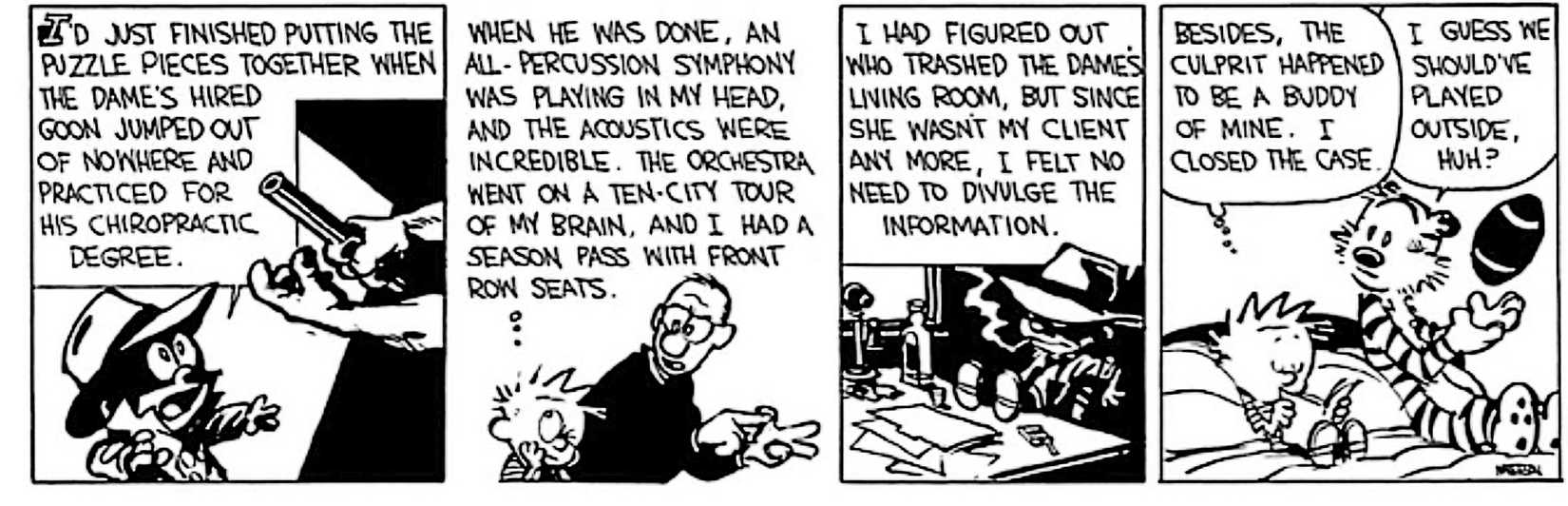
Calvin spends much of the series pretending to be someone else. Whether he transforms into Spaceman Spiff, Stupendous Man, or hard-boiled detective Tracer Bullet, imagination allows him to escape ordinary childhood. One memorable strip finds him fully committed to his detective persona, only for reality to arrive in the form of his father telling him it's time to stop playing after the living room has been left in complete disarray.
From Calvin's perspective, he has been solving an important mystery. From his father's perspective, the furniture has been overturned, the room is a mess, and bedtime has arrived. Calvin insists Hobbes was responsible for much of the chaos, while his father sees only another excuse from his endlessly imaginative son. The clash between fantasy and responsibility becomes the joke.
Children naturally sympathize with Calvin because adults seem to interrupt the fun at the worst possible moment. Re-reading the strip years later often flips that perspective entirely. Suddenly, it's easy to understand why Dad isn't interested in hearing another elaborate detective story while staring at a destroyed living room that someone still has to clean.
That role reversal is one of the reasons Calvin and Hobbes remains timeless. Growing older means discovering that imagination never completely disappears, but responsibilities eventually demand attention. Adults learn to balance creativity with chores, work, and family obligations. Calvin's father isn't trying to eliminate his son's imagination, he simply knows there are moments when real life has to take priority. It's a lesson many readers only appreciate after becoming adults themselves.
3 Calvin's Dad Delivers Surprisingly Honest Advice About Hobbies

Throughout the comic strip, Calvin's father occasionally offers philosophical observations that sound humorous at first before revealing unexpected wisdom. One of his most memorable comments comes when discussing hobbies, declaring that the secret to enjoying your job is having a hobby that's even worse than your job.
It's an intentionally cynical observation, but like many of his jokes, it contains a surprising amount of truth. Rather than describing hobbies as sources of personal fulfillment or creative expression, Calvin's father argues they simply provide perspective. If fixing bicycles, woodworking, or another demanding pastime becomes frustrating enough, suddenly going back to work doesn't seem nearly as bad.
Kids laugh because the logic sounds completely backward. Adults recognize that hobbies aren't always relaxing. Gardening involves constant maintenance. Home improvement projects rarely stay on schedule. Learning a musical instrument can be frustrating for years. Even recreational sports demand practice, money, and patience. Many favorite pastimes become surprisingly stressful despite remaining deeply rewarding.
That contradiction explains why the strip resonates more with age. Adults eventually discover that meaningful hobbies often require effort equal to, or greater than, their careers. Yet those challenges create satisfaction that routine work sometimes cannot provide. Calvin's father's joke exaggerates reality for comedic effect, but it captures an important truth: perspective shapes happiness. Sometimes struggling through a difficult hobby makes everyday responsibilities feel considerably easier by comparison.
2 Calvin's Parents Admit Nobody Really Knows What They're Doing

Some of the greatest Calvin and Hobbes strips don't feature Calvin at all. Instead, they quietly focus on his parents, allowing readers to glimpse conversations children were never meant to hear. One unforgettable late-night exchange finds Calvin's parents discussing adulthood, with his father admitting he once believed growing up meant automatically knowing the right answer in every situation.
He realizes instead that adulthood is largely improvisation. People make educated guesses, solve problems as they arise, and hope they're making the correct decisions. His reflection that life is essentially "ad-libbed" captures a universal realization shared by millions of adults who once assumed older people possessed endless confidence and certainty.
Children often imagine adults have every answer. Teachers, parents, and grandparents appear calm because experience hides uncertainty remarkably well. Returning to this comic decades later reveals how honest Watterson was about adulthood. Most people never reach a magical age where everything suddenly makes sense. They simply become better at handling uncertainty while continuing to learn every day.
The strip also highlights why Calvin's parents are among the comic's strongest supporting characters. They aren't perfect authority figures or exaggerated sitcom parents. They're ordinary people trying their best while raising an extraordinarily energetic child. That honesty transforms a relatively simple conversation into one of the series' most emotionally resonant moments, reminding readers that confidence often comes from persistence rather than certainty.
1 Hobbes' Promise During Calvin's Conversation About Death

Among the most emotional Calvin and Hobbes strips ever published is Calvin's conversation with Hobbes about death. Like many curious children, Calvin begins asking questions about mortality after realizing that every living thing eventually reaches the end of its life. It's a frightening realization that nearly everyone encounters while growing up, and Watterson approaches it with remarkable tenderness instead of fear.
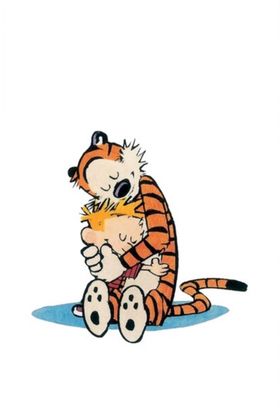
Calvin gradually begins accepting the concept in the abstract, recognizing that death is simply part of existence. Yet one possibility remains completely unacceptable to him: losing Hobbes. The idea that his closest companion could someday disappear overwhelms every attempt at logical understanding. In response, Hobbes simply embraces Calvin and gently promises that he isn't going anywhere.
Children often interpret the strip as reassurance that best friends stay together forever. Adults understand why the moment feels heartbreaking instead. They know that childhood cannot last forever, beloved pets eventually grow old, loved ones pass away, and every meaningful relationship becomes precious because time is limited. Hobbes' comforting words represent the emotional security everyone longs to hear when facing life's biggest uncertainties.
What makes the comic unforgettable isn't that it offers answers about death. It doesn't. Instead, it reminds readers that love, friendship, and compassion remain meaningful even when difficult questions have no satisfying solution. The final embrace between Calvin and Hobbes has become one of the defining images of the entire Calvin and Hobbes series because it perfectly captures what made Bill Watterson's masterpiece endure: beneath every joke, fantasy, and adventure was a profound understanding of what it means to grow up.
Writer Bill Watterson
Colorist Bill Watterson
Publisher Andrews McMeel Publishing








 English (US) ·