
Searchlight Pictures
There's something special about a mythology movie. Every culture has its own series of legends, heroes, and great evils, and as Cecil B. DeMille once famously said, "Give me any two pages of the Bible, and I'll give you a picture." Just like the Bible is full of incredibly epic and dramatic stories worthy of the big screen, there are countless texts, poems, and other stories around the world perfect for the kind of spectacle that only cinema can deliver.
While the best fantasy movies can offer an incredible and memorable watch, you almost have to wonder why exactly we need movies that invent fictional fantasy universes when real-world mythology is already filled with cinematic tales. Christopher Nolan's "The Odyssey" proved that there are still ways to keep classic myths and tales fresh, and the best mythology movies manage to make even the most well-known story feel new and exciting.
But while there are plenty of acclaimed and highly successful movies based on mythology, like "Jason and the Argonauts," "The Return," "Excalibur," or "The Tale of Princess Kaguya," there are plenty others that deserve just as much praise but have been largely forgotten by time. Some are recent movies that got lost in the endless sea of streaming releases, some are international movies that didn't necessarily become huge hits in the U.S., and others just fell through the cracks.
Let's take a look at five forgotten mythology movies that are still worth watching today.
Sinbad: Legend of the Seven Seas (2003)
DreamWorks Animation
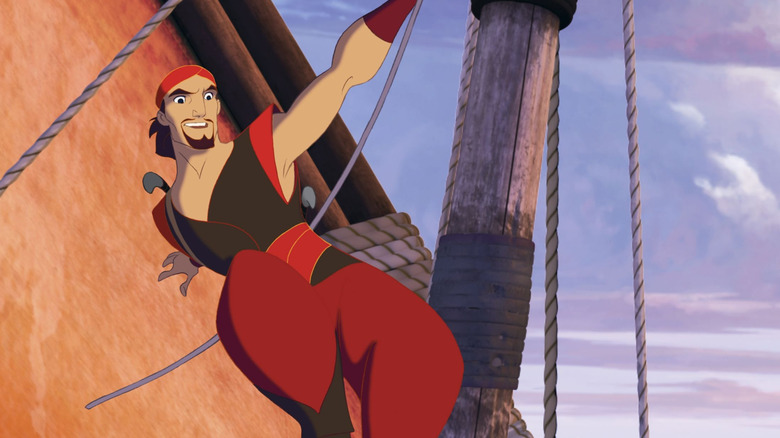
Early DreamWorks Animation was wild. Their productions were quite varied in tone, art style, and even genre, tackling Biblical epics, historical fantasy adventures, Westerns, stop-motion prison break movies, and irreverent fairy tale parodies. Arguably the most underrated of the studio's earliest films is "Sinbad: Legend of the Seven Seas." This was an animated movie that combined 2D and 3D animation and featured an incredible cast of voice actors that included Brad Pitt, Catherine Zeta-Jones, and Michelle Pfeiffer.
Yes, the film suffers from the horrendous whitewashing of the original tale's Arabic inspirations, making the titular Sinbad a Sicilian pirate who goes on a Greco-Roman inspired adventure. But it's still a hugely entertaining swashbuckling adventure film featuring all sorts of monsters and gods, a very good dog on a pirate ship, and plenty of sword fighting. The mix of 2D and 3D works great, and there are some spectacular set pieces in the film. Unfortunately, "Sinbad" was such a big flop that it nearly bankrupted DreamWorks, and forced the studio to make a complete switch from traditional 2D animation to exclusively 3D CGI features. Still, the movie remains an entertaining watch all these years later, with visuals that hold up and a tale of adventure bursting with mythological creatures that's different from any other big studio-animated film.
Iphigenia (1977)
Cinema V
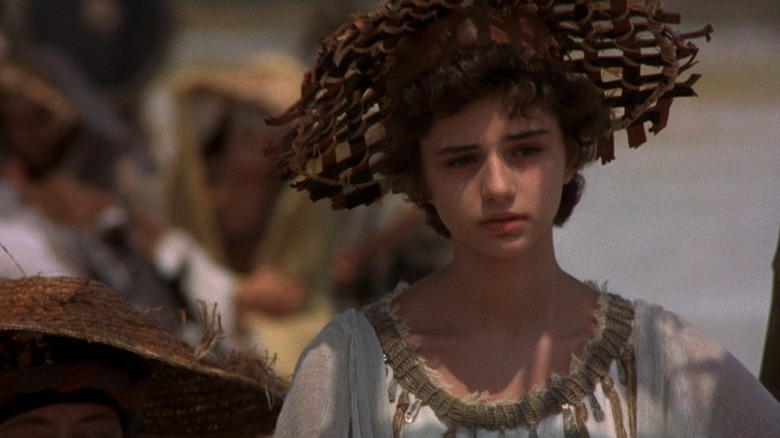
Though this movie remains quite popular and influential in Greece, the same can't be said for the rest of the world in 2026. If you watched Christopher Nolan's "The Odyssey" and were fascinated with the sheer coolness of the film's portrayal of Agamemnon (and then enraged by how stupid he actually is), then Michael Cacoyannis' 1977 Greek tragedy film "Iphigenia" should be next on your watchlist. It adapts the myth of the titular Iphigenia, who is Agamemnon's daughter with Clytemnestra and gets ordered by the goddess Artemis to be sacrificed in the prelude to the Trojan war. (The myth was also adapted more recently in Yorgos Lanthimos' "The Killing of a Sacred Deer.")
Cacoyannis delivers an astonishing film of epic scale that nevertheless feels quite intimate in its stakes. He makes Agamemnon a complex and layered man trapped in an impossible situation that slowly consumes his humanity, torn apart by politics and faith, by the expectations of a nation and his duty as a father. Then-13-year-old Tatiana Papamoschou delivers an incredibly standout performance as Iphigenia, capturing the confusion and pain of a child being put in the middle of a conflict with the gods themselves, and of seeing her own father considering to murder her for a war she has no role or stake in. It's a tour-de-force performance that makes this an emotionally devastating film to watch. No wonder that "Iphigenia" became an acclaimed movie, earning an Oscar nomination and a Palme d'Or nomination at the Cannes Film Festival.
The Great Adventure of Horus, Prince of the Sun (1968)
Toei Animation
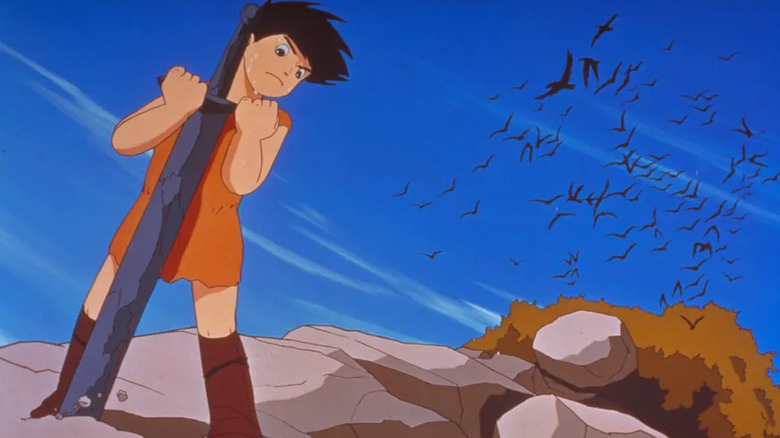
Originally a massive financial flop, "The Great Adventure of Horus, Prince of the Sun" is now considered one of the most influential anime feature films of all time. This is Isao Takahata's feature directorial debut and the earliest collaboration between Takahata and Hayao Miyazaki (almost 20 years before the founding of Studio Ghibli), and you can clearly see how the clean and simple character designs as well as the framing of action scenes influenced their work throughout their careers. The film is a reinterpretation of an epic of the Ainu people of Hokkaido, Japan, here set in a mythical Scandinavia during the Iron Age. We follow the titular Horus, who needs to travel to the lands of his ancestors after recovering the stolen Sword of the Sun from a rock giant in order to defeat the devil Grunwald.
This is an Isao Takahata movie through and through, meaning it's both a family-friendly flick while being a lot darker, more complex, and more violent than what Toei Animation released at the time. It opens with a wordless two-minute battle between the young Horus and a savage pack of wolves, delivering a sequence that's more dynamic and fluid than most big-budget modern animation. Even at almost 60 years old, "Horus, Prince of the Sun" remains an anime gem filled with spectacle and a complex story.
O'Dessa (2025)
Searchlight Pictures
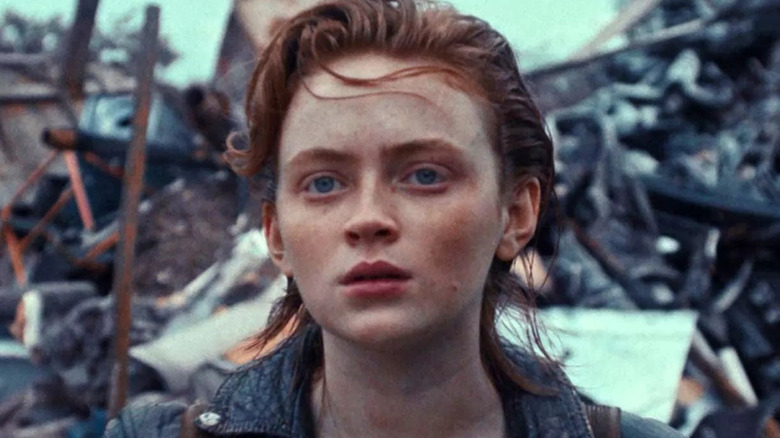
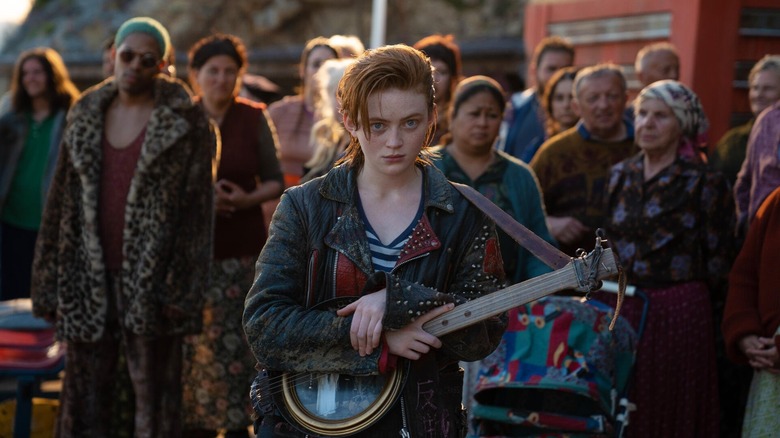
What happens when you mix "Streets of Fire" with the myth of Orpheus and Eurydice and add in the neon-lit cyberpunk look of "Far Cry 3: Blood Dragon?" You get the bold, catchy, vibrant cyberpunk rock opera "O'Dessa." If you already watched "Hadestown" and thought the story could use some bold 1980s sci-fi and fantasy aesthetic, this is the movie for you. It stars Sadie Sink as the titular O'Dessa, the youngest daughter of a family of musicians in a post-apocalyptic future devastated by something called plazma. She heads to the big city to follow her dreams, falling in love with a musician named Euri (Kelvin Harrison Jr.), only to catch the ire of a media mogul named Plutonovich (Murray Bartlett), who runs a reality game show to keep the people docile.
The film mixes naturalistic visuals with an '80s punk rock look, with Sadie Sink delivering an incredible gender norm-defying performance and a singing voice that's instantly charming and enchanting. As a reinterpretation of the Greek myth, it's a rather clever tale that turns Hades into a media mogul that uses reality game shows to prevent uprisings, while still retaining the archetypes and the rather tragic fate of its star-crossed lovers. For musicals fans, "O'Dessa" is full of catchy, energetic tunes worth listening to again and again.
Arion (1986)
Nippon Sunrise
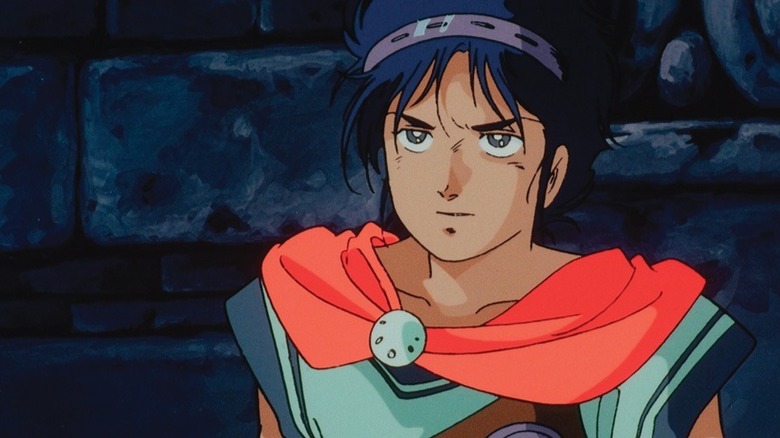
No, "Arion" is not based on actual myths, but instead, it takes Greek mythology and uses it as the setting for an epic quest of vengeance and violence that's pure 1980s anime badassery. Yoshikazu Yasuhiko (animation director of the original "Mobile Suit Gundam") directs this adaptation of his own manga, which follows a young man named Arion who was kidnapped by Hades as a child and raised with the belief that Zeus himself blinded his mother. Now, Arion is determined to kill the ruler of Olympus in order to cure his mom after years of training in the underworld.
What follows is a dark fantasy movie that plays a bit like the video game "Hades" in how it portrays a young protagonist's relentless journey through Greek myths, forging allies and encountering gods along the way. Arion's path is full of blood and carnage, as he faces mythical monsters and the never-ending schemes of the gods. It's a neat little story that weaves in elements from known myths and changes enough to fit this particular world and story. Visually, the film evokes other dark fantasy movies of the '80s like "Vampire Hunter D" in its aesthetic, with vibrant colors and evocative backgrounds.
The biggest strength in "Arion" is how Yasuhiko retains the many, many flaws of the Greek gods, treating them as human in their malice, their petty grievances, and the way they meddle in others' business. And it gets bonus points for actually letting Apollo be cool.



 English (US) ·