
 5 hours ago
4
5 hours ago
4
We’re absolutely hyped to announce the 2026 winners of the World Nature Photography Awards, and wow—this year hits different. From jaw-dropping wildlife encounters to quiet, poetic moments in nature, these images prove that when art and science link up, magic happens. Taking the top honor, World Nature Photographer of the Year, is Jono Allen for his unforgettable image “Mãhina”—a photograph that feels less like a picture and more like a heartbeat. Huge congrats to Jono and to every single winner who turned patience, grit, and vision into pure visual gold.
Now in its seventh year, the World Nature Photography Awards has become a global stage for photographers who don’t just shoot nature—they stand up for it. This competition celebrates the planet in all its raw beauty while reminding us that Earth isn’t just a backdrop for our lives; it’s the main character. Every frame is a love letter to wild places, endangered species, and the fragile balance holding it all together.
What makes these awards truly special is their mission. They believe photography has real power—the kind that stops your scroll, flips a switch in your brain, and nudges you toward action. These winning images spotlight melting ice, vanishing habitats, and resilient wildlife, but they also deliver hope. Hope that awareness leads to change, and change leads to a better tomorrow.
The 42 winning photographs from 2026 don’t just showcase technical brilliance; they tell stories that matter. They remind us why protecting this planet isn’t optional—it’s personal. One image at a time, these photographers are helping shape a future where nature still has a fighting chance.
You can find more info:
#1. Gold Winner of Underwater and Grand Prize Winner: Jono Allen, Australia
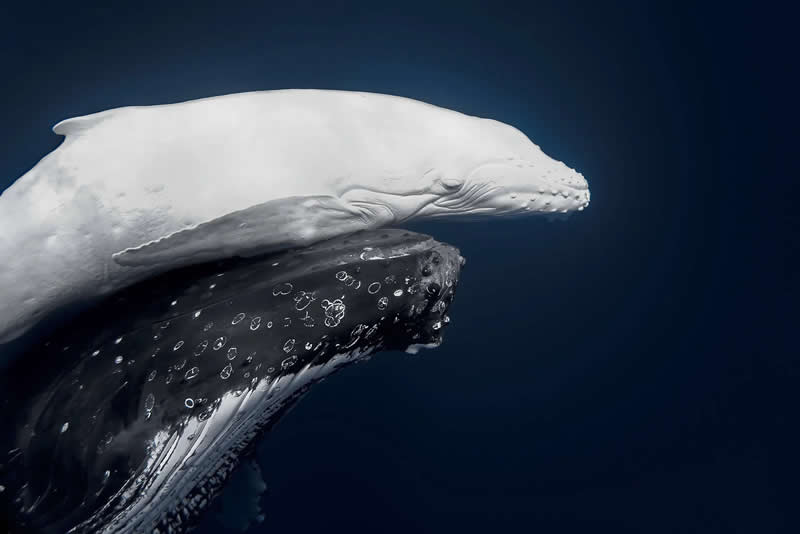
"Captured in the tropical waters of Vava’u, Tonga, this rare white humpback calf – named Mãhina, meaning “moon” in Tongan – glowed like a beam of light as she travelled through the deep blue water with her protective mother. With only 1 in 40,000 humpbacks born with this lack of pigmentation, her presence was not only breathtaking but symbolic. Watching this spectacular and curious moon white whale calf play and roll through the water represents the remarkable success story of a species given the chance to recover after being heavily targeted by whaling and once being brought to the brink of extinction."
#2. Underwater – Silver: Matthew Sharp, United Kingdom

#3. Underwater – Bronze: Aimee Jan, Australia

#4. Animal Portraits – Gold: Mary Schrader, USA

"It was a day defined by quiet connections. Beneath the lush canopy of Bwindi, I observed a young female gorilla gently nestled against the protective bulk of a silverback. The atmosphere was serene, filled with gentle sounds of the forest, until a sudden burst of delicate color broke through the calm. An unexpected visitor, a vibrant butterfly, appeared out of nowhere, fluttering gently through the air."
#5. Animal Portraits – Silver: Rich Brooks, USA

#6. Animal Portraits – Bronze: Elizabeth Yicheng Shen, Taiwan/USA

#7. Behaviour – Mammals – Gold: Vaidehi Chandrasekar, Singapore

"As the sun dipped low over the dry Makgadikgadi landscape in Botswana, a lone giraffe stepped to the water’s edge. Towering and graceful, it bent its long legs, lowering its neck for a drink. Then came a moment of magic. Having taken its fill, the giraffe lifted its head – and with a gentle swish, expelled a stream of water in an arc that shimmered in the golden light. The droplets danced in the air, forming a near-perfect circle before falling back to the earth. With the animal’s outline enhanced by the rim lighting, golden reflections sparkled off the airborne water. A rare and fleeting behaviour, made unforgettable by the setting sun. My desire was to capture the interplay of the golden light and the motion of the swishing of the water."
#8. Behaviour – Mammals – Silver: Michael Stavrakakis, Australia

#9. Behaviour – Mammals – Bronze: Paul Goldstein, United Kingdom

#10. Behaviour – Amphibians and reptiles – Gold: Dewald Tromp, South Africa

"The Namib desert is one of the most extreme environments on earth, with a complete lack of surface water and temperatures exceeding 45C in the daytime. Despite this, life is abundant of you know where to look. Sandstorms are frequent, with wind blowing down from inland mountains that stir up fine sediment and particles. A Namaqua chameleon has to endure the sting of pebbles blowing against its skin while we were lucky enough to escape to the relative comfort of our 4×4."
#11. Behaviour – Amphibians and reptiles – Silver: Roman Balaz, Slovakia

#12. Behaviour – Amphibians and reptiles – Bronze: Henning Olsen, Denmark

#13. Behaviour – Invertebrates – Gold: Minghui Yuan, China

"In the tropical rainforest of Xishuangbanna, I found a moss moth larva creating a protective net nest on newly grown tender leaves of plants. Moss moth larvae bite off their toxic hair like structures and use their sticky saliva to build their own houses. It uses its own poisonous fur as building material, which can resist attacks from parasitic wasps and ants. In the net nest, the moss moth larvae form some very thin and difficult to see silk, hanging themselves in the air as if they were lying in a hammock."
#14. Behaviour – Invertebrates – Silver: Reka Baranyi, Hungary

#15. Behaviour – Invertebrates – Bronze: Eduardo Salvador Cabrera, Spain

#16. Behaviour – Birds – Gold: Fenqiang Liu, USA

"Each spring, great egrets gather at Kraft Azalea Garden in Central Florida to nest high in the trees. Photographing from below, I look for moments when backlight reveals the elegance and structure of their wings in flight. I captured this image on an early April morning, as an egret passed between me and the sun just before landing."
#17. Behaviour – Birds – Silver: Vince Burton, United Kingdom

#18. Behaviour – Birds – Bronze: Hemin Patel, India

#19. People and nature – Gold: Deena Sveinsson, USA

"After an evening snowfall in the Grand Teton National Park, Wyoming, USA, the photographers woke up to a blanket of snow covering the sage flats. It was a relatively slow and boring morning watching the many bull moose eat their morning breakfast of bitter brush. A group of us photographers were photographing the bull moose eating his way in our direction. He would eat for about 10 minutes and then take a few steps only to start eating again. At some point, the bland bitter brush bored him and he decided to go on his walkabout."
#20. People and nature – Silver: Bill Klipp, USA

#21. People and nature – Bronze: Zhiyue Shi, China

#22. Plants and Gungi – Gold: Duncan Wood, Scotland, United Kingdom

"Golden autumn colours explode in this intimate portrait of an incredible, lichen-laden elder birch in full seasonal display — bold, brilliant, and full of character, like a woodland peacock. Taken in Glen Affric, this image captures a fleeting moment of drama and beauty from one of Scotland’s most vibrant autumn landscapes."
#23. Plants and Gungi – Silver: Giovanni Vicari, Italy

#24. Plants and Gungi – Bronze: Kai Hypen, Finland

#25. Nature art – Gold: Simon Biddie, United Kingdom

"Small reef fish, unassuming and often unseen, contribute to 70% of the fish biomass, making them a critical part of reef food chains. Small fish, like many of their land-based insect equivalents, evade predators by being experts in hiding. These small reef fish are also known as ‘cryptobenthic’ fish – crypto as they hide in crevices, or use camouflage. As part of the food chain, they are important in supporting larger fish found in these reefs. Of these class of fish, the gobies are thought to be the most important."
#26. Nature art – Silver: Indranil Basu Mallick, India

#27. Nature art – Bronze: Mark Bernards, Canada

#28. Planet Earth’s landscapes and environments – Gold: Miki Spitzer, Israel

"This is a drone photo of a natural geothermal pool in central Iceland at Hveravellir. In the photo, you can see the pool, which I think looks like a dragon’s eye."
#29. Planet Earth’s landscapes and environments – Silver: Stuart Chape, Australia

#30. Planet Earth’s landscapes and environments – Bronze: Thiago Campi, Brazil

#31. Black and white – Gold: Christopher Baker, USA

"An adult pond slider turtle perched atop a stump bathing in the early morning sun. I lay on the ground to get a low angle perspective of the scene and converted to black and white to enhance the textures of the turtle’s shell and skin, as well as the stump."
#32. Black and white – Silver: Ross Wheeler, United Kingdom

#33. Black and white – Bronze: Preeti and Prashant Chacko, United Arab Emirates

#34. Animals in their habitat – Gold: Charlie Wemyss-Dunn, United Kingdom

"A hungry brown bear launches headlong into a creek in Alaska’s Katmai National Park to try to catch one of the many sockeye salmon spawning in large numbers during their seasonal migration. Each August, large concentrations of brown bears gather along the rivers and creeks in Katmai, waiting for the annual arrival of salmon from the coast. I observed this scene after a two-hour walk from our camp from atop a cliff."
#35. Animals in their habitat – Silver: Jonathan Hodgetts, United Kingdom

#36. Animals in their habitat – Bronze: Harry Skeggs, United Kingdom

#37. Urban wildlife – Gold: Robert Gloeckner, USA

"In this striking image, a polar bear in Churchill, Manitoba, investigates a heap of discarded electronics and household items – part of a growing and very human-made trash trail that’s reshaping how wildlife interacts with civilization. In 2024, the town’s only trash facility burned to the ground. The incident underscored a growing concern: polar bears were increasingly scavenging garbage during the ice-free months, leading to a rise in human-wildlife conflicts."
#38. Urban wildlife – Silver: Arghya Adhikary, India

#39. Urban wildlife – Bronze: Rajarshi Banerji, India

#40. Nature Photojournalism – Gold: Alain Schroeder, Belgium

"Kayla, a 37-year-old 61.2 kg female, in the procedure room and her stomach shaved for an ultrasound. Socks have been placed on his extremities, and a fur hat with flaps on his head to avoid hypothermia. General caption Founded in 1997, Save the Chimps is the largest privately funded chimpanzee sanctuary in the world. Its mission is to provide a safe haven to captive chimps that have been exploited by humans for research, testing and entertainment."
#41. Nature Photojournalism – Silver: Sandesh Kadur, India

#42. Nature Photojournalism – Bronze: Jonathan Wosinski, France

In Summary
What are the World Nature Photography Awards?
A global photography competition celebrating the best nature and wildlife photographers while promoting environmental awareness.
Who won World Nature Photographer of the Year 2026?
Jono Allen won the top title for his powerful image “Mãhina.”
How many winners were selected in 2026?
A total of 42 remarkable winning photographs were awarded across categories.
What is the mission of these awards?
To showcase nature’s beauty, inspire conservation, and encourage people worldwide to protect the planet.
Why are these awards important?
They use photography as a tool to spark awareness, emotion, and action for a more sustainable future.




 English (US) ·