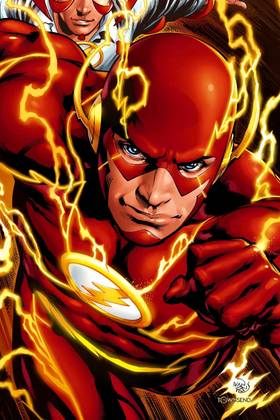
No Flash scribe has been better at that than Mark Waid. When he took on the challenge of writing Wally West's tales, the character was essentially a hero of one. He had friends — both super and not-so-super — but he didn't have what has become the "Flash Family." There weren't really any other speedsters rushing around at the time, but Waid, along with other plans within DC Comics, soon changed that. Jay Garrick and Johnny Quick were back. Jesse Quick and Impulse were introduced. XS was added to the Legion of Super-Heroes. And, of course, Max Mercury came in to teach them all the ways of the Speed Force.
All of this built up to the greatest Flash story ever told. One that centers on Wally West, but really shows just how important the family is, and how painful it is to lose a member.
Dead Heat Explored The Speed Force
Mark Waid first introduced the concept of the Speed Force in "The Return of Barry Allen," a story that is firmly about Wally West letting go of his impostor syndrome and learning to be the best Flash he could be. It became a major part of the lore with "Terminal Velocity," a story where Wally fully connects to the extra-dimensional energy and learns to control it. But it is in "Dead Heat" that Waid, along with artists Oscar Jimenez and Humberto Ramos, shows how the other speedsters connect with the Speed Force.
The story, which sees evil speedster Savitar return after bouncing off the Speed Force in the past and threaten to kill everyone else who taps into it so he can have all the power to himself, is the first time the Flash Family is truly put to the test. Where the family first started to appear in the previous stories, this is when they are forced to face their own limitations, starting with everyone but Wally losing their connection to the power. But, even without speed, Jay, Johnny, Jesse, Max, and Bart — as well as XS — prove themselves to be heroes.
Where the gang first comes together to battle Reverse-Flash — a lone enemy — and Kobra — a terrorist organization with tech, not superpowers — "Dead Heat" represents the first time DC's fastest heroes are forced to fight on a level playing field against an equally speedy Savitar and his Speed Ninjas. No longer able to rely on being quicker than their foes, they must prove their worth the hard way. Along the way, they learn more about the Speed Force itself, and what being connected to it can cost when Johnny Quick sacrifices himself to save his daughter. That moment serves as an important lesson to Bart, who has never really experienced loss before, and comes to see how his actions can affect others.
But what makes "Dead Heat" really pop is Waid's ability to let each member of the family shine, showing how a legacy of heroes is so much more than any one figure.
The Speed Ninjas And Savitar's Dream
Mark Waid is nothing if not an seemingly endless well of amazing superhero ideas. The writer has spent his life dreaming up challenges for superheroes to face, and, more often than not, he has created some of the most exciting and influential stories of the last 40 years. But his greatest idea may be Savitar's Speed Ninjas. Forcing the Flash Family to face off against enemies as fast as they are is already exciting, but making them highly skilled warriors who are much better fighters than anyone in the Flash Family, adds a level of danger that keeps the story moving at an intense pace.
And, Waid's choice of having the Speed Ninjas get faster each time one of them is beaten makes the whole thing even wilder. Sure, Wally, Jay, and Bart are able to knock out 20 Speed Ninjas, but that just means the next 20 will be stronger, even as the heroes get more and more exhausted. In all the years of Flash stories, there has never been a cooler henchman idea than the Speed Ninjas (something DC should really bring back into the mix!).
The story also goes against the usual superhero format with its ending. Where most stories end with the hero beating the villain, this is one where the only way to stop Savitar is to let him win. And this only works because the Flash Family know that allowing Savitar to enter the Speed Force will trap him forever. The entire tale hinges on this knowledge, something that had been well set up in early stories and specifically pointed out when Johnny Quick enters the Speed Force. This is a tale not about punishing the villain, but about letting them find the inner peace they desired.
"Dead Heat" may not be the most talked about Flash story, or the one most fans would list as their favorite. But it is the one that pushed the Flash legacy to the place it is now, giving each speedster a road to travel and a story of their own to tell.
Created By
Gardner Fox, Harry Lampert, Carmine Infantino
First Appearance
Flash Comics
Alias
Jay Garrick, Barry Allen, Wally West, Bart Allen, Avery Ho
Alliance
Justice Society of America, Justice League, Teen Titans
Race
Human
Franchise
D.C.







 English (US) ·