
 1 hour ago
21
1 hour ago
21
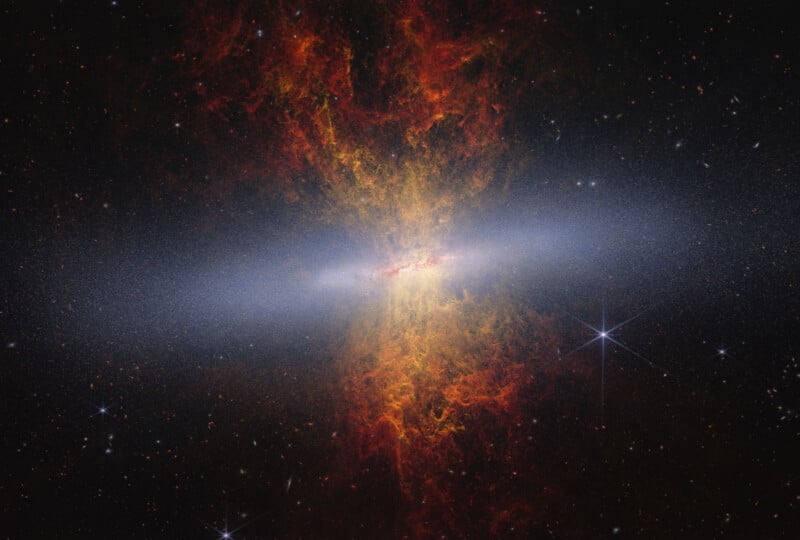 ‘Scientists used NASA’s James Webb Space Telescope to image edge-on starburst galaxy Messier 82 and trace its evolutionary history. This Webb and Hubble composite image includes 16.5 million stars (blue-white), dust grains (red-orange), and ionized hydrogen gas (yellow).’
The James Webb Space Telescope (JWST) recently spent 65 hours, or nearly three days, observing the famous spiral galaxy, Messier 82 (M82), also known as the Cigar galaxy. The resulting 223-megapixel image contains 16.5 million stars and brand-new details never seen before.
Messier 82 is a popular target for astronomers because it is a relatively nearby spiral galaxy with many distinct characteristics. Chief among them is the galaxy’s remarkably high levels of star formation.
Scientists believe the galaxy’s robust stellar population is the result of a galaxy merger, but this intense star formation will be short-lived, “even in astronomical terms.” M82, like all galaxies, will die, and scientists believe it will only live “a few hundred million years.”
“This temporary phase of extreme star formation relative to the galaxy’s mass, as well as its location in the local universe, are among the factors that make M82, also known as the Cigar galaxy, a one-of-a-kind environment to study,” NASA explains.
And study astronomers do. A team of them recently completed an imaging survey of M82 using the James Webb Space Telescope’s NIRCam (Near-Infrared Camera). The observations totaled 65 hours and helped the space telescope discover never-before-seen details, including M82’s “distended disk structure and millions of individual stars.” In total, the image above includes 16.5 million individual stars. To help put that into perspective, the next-nearest star to Earth besides the Sun is Proxima Centauri, which is roughly 25 trillion miles away.
“Webb’s high-resolution imaging, specifically of the main plane of the galactic disk, has unlocked vital information for astronomers as they seek to uncover M82’s formation history,” NASA says.
“M82 is a mess, but it’s a beautiful mess. We don’t fully understand what’s going on, especially concerning its evolutionary history. What could have triggered such an elevated rate of star formation? How long has this galaxy been driving plumes of material away from its center?” explains Adam Smercina, a NASA Hubble Fellow at the Space Telescope Science Institute in Baltimore, and incoming Assistant Professor at Tufts University in Massachusetts.
“M82 is an ideal galaxy evolution laboratory because it has properties that allow us to probe important physical processes, such as how stars form in such environments and how that activity drives outflows. M82 provides a simultaneous window onto many astrophysical questions, in a way that no other galaxy in the local universe can.”
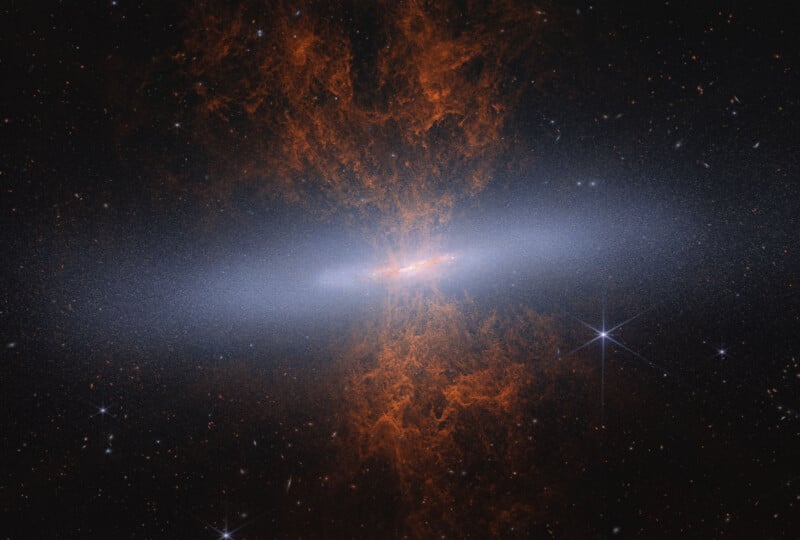 ‘NASA’s James Webb Space Telescope recently observed edge-on starburst galaxy Messier 82 (M82), nicknamed the Cigar Galaxy. Webb’s near-infrared-light view is a snapshot in time, revealing a scene that has been evolving over a couple hundred million years. In near-infrared light, astronomers can see the galaxy’s distended disk structure and millions of individual stars — approximately 16.5 million — for the first time.’ | NIRCam-only
As expected, JWST is far from the first telescope to peer deeply into the mysteries of the Cigar galaxy. The image at the top includes data from the legendary Hubble Space Telescope, which adds interesting color (wavelength) information, particularly dust grains (red-orange) and ionized hydrogen gas (yellow). The image above includes only data from NIRCam, and it’s nearly as spectacular and includes just as many stars, maybe even more, thanks to Webb’s superior ability to peer through cosmic gas and dust.
Webb’s exceptional capabilities are on full display in the comparison shot below, which shows Hubble’s image on the left and Webb’s on the right. Hubble does a great job at capturing M82’s fascinating gas and dust structure, while Webb can pierce through it.
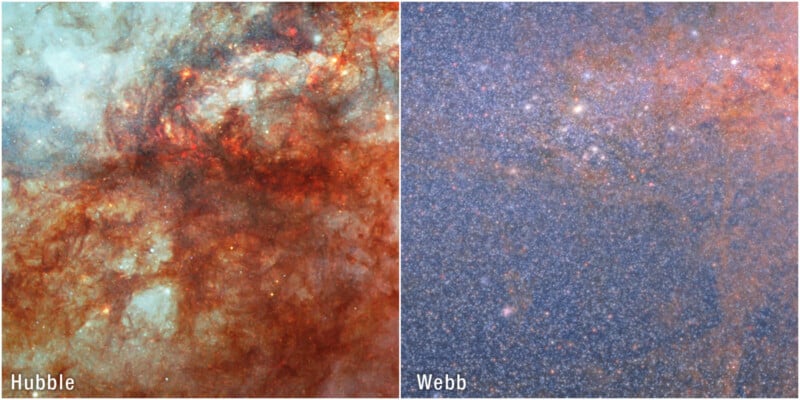
“The sheer number of stars that we were able to resolve with Webb is incredible,” says team member Benjamin Williams of the University of Washington. “It’s a whole different world from what we’ve been able to see with other telescopes. All of these stars collectively provide a detailed fossil record of the formation and evolution of M82.”
Scientists note that the star formation in M82 is about “10 times faster” than in the Milky Way galaxy. Determining exactly why that is has proven challenging, but astrophysicists are on a steady path toward greater understanding, and space telescopes like Webb are instrumental to that progress.
“Galaxies are such intricate ecosystems that if you truly want to understand them, you have to pull datasets from different missions together,” adds team member Kristen McQuinn of the Space Telescope Science Institute. “One mission cannot fully answer all of the questions we have about M82. Combining the data collected by different telescopes, like Webb and Hubble, is powerful. When you marry the datasets, you expand what you can probe, and the questions that you can pose are even more complex.”
Image credits: NASA, ESA, CSA, Adam Smercina (STScI, Tufts), Thomas Williams (University of Manchester); Image Processing: Alyssa Pagan (STScI)







 English (US) ·