
 3 hours ago
4
3 hours ago
4
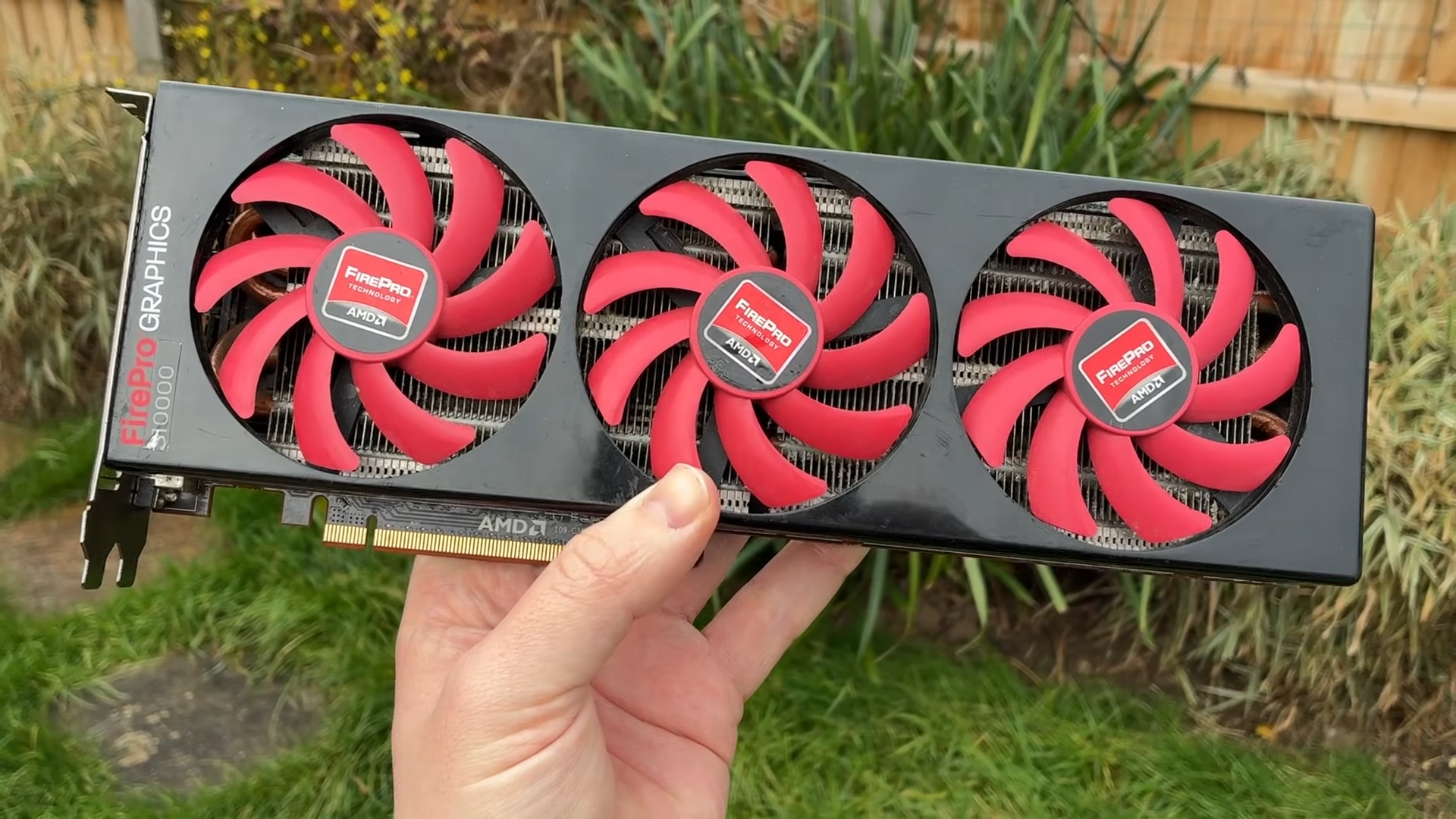
AMD's FirePro S10000 once served as the company's most powerful workstation graphics card back in 2012, putting two of the same Tahiti dies found in the Radeon HD 7950 on one Crossfire board. The world has long since moved on, but YouTube channel RandomGaminginHD found a used S10000 for sale and set out to see how powerful this card is in 2025 for gaming. Spoiler alert: this GPU was able to play Arc Raiders above 30 FPS, but using just one of its two GPUs.
Getting the S10000 gaming-ready, particularly to get both GPUs to cooperate in supported games, was no easy task. The GPU enthusiast had to make several changes to get the card to work at all with newer titles due to its age. This included using Windows 10 instead of Windows 11, and BIOS flashing the card so the S10000 would function with newer AMD Adrenalin drivers.
The AMD S10000 From 2012 - A $3600 Dual GPU Beast With Hidden Gaming Potential... - YouTube

First, running the GPU out of the box on Windows 10, RandomGaminginHD discovered several weird quirks with the card. The S10000 only supports up to FirePro driver version 17.4 and not AMD's Adrenalin counterpart, which is critical for getting game optimizations. Under GPU-Z, the card shows up under two distinct names, S10000 and W9000 X2.
After researching the GPU's name, RandomGaminginHD discovered that the two model names are, in fact, the same GPU, only the W9000 X2 was never released under that name. In fact, the enthusiast discovered that AMD had slapped a "S10000" sticker over a "W9000 X2" badge on his particular card, suggesting AMD renamed the graphics card from W9000 X2 to S10000 just before the product's release in November 2012.
The S10000 was technically gaming capable in its out-of-the-box form with the most recent FirePro drivers it supports, running Crysis at just above 60 FPS. However, the YouTuber discovered the FirePro drivers don't enable CrossFire support whatsoever, preventing the second GPU from spinning up in supported games.
To fix this, RandomGaminginHD BIOS-flashed the graphics card with firmware from a Radeon HD 7990 dual-GPU gaming card. This made the S10000 identify as an HD 7990 to Windows 10 and enabled support for AMD's Adrenalin drivers, specifically version 22.6.1 from 2022.
With the S10000 disguised as an HD 7990, performance increased substantially thanks to the 2022 Adrenalin drivers enabling Crossfire support. In Crysis, the S10000 was able to achieve over 110 FPS most of the time with both GPUs sitting at around 65% usage. RandomGaminginHD also tested Crysis 3, GTA V, and Mafia 2, and found all three titles ran well, especially Mafia 2, which was able to take full advantage of both GPUs —both sitting above 90% usage all the time.
Moving to modern games, our intrepid tester tried Arc Raiders, Cyberpunk 2077, and CS2. Despite all three titles lacking multi-GPU support, Arc Raiders and CS2 ran at playable frame rates, albeit with extremely low graphics settings. At the lowest settings — 70% resolution scaling at 1080p — Arc Raiders ran at around 40-45 FPS. CS2 fared better, with 120-160 FPS depending on the scene. Cyberpunk 2077 handled the worst on this card, producing just 20-30 FPS on the S10000 at the lowest settings with FSR set to its ultra performance profile.
The S10000 ranked among the most powerful workstation cards in 2012, as Nvidia had shied away from dual-GPU professional cards at the time. The S10000 sported two Tahiti GPUs featuring 1,792 shader cores, 112 TMUs, 32 ROPs, and 28 CUs each. Memory was split across two 384-bit memory interfaces for each GPU, and each chip was connected to 3GB of GDDR5.
RandomInGamingHD's work to resurrect his particular S10000 shows how potent the dual-GPU graphics card was at the time. It was essentially an HD 7990 consumer graphics card, but with disabled cores on each die. If the second GPU worked in today's titles, the S10000 would likely be capable of playing Arc Raiders near 60 FPS and Cyberpunk 2077 at playable FPS, but with Crossfire and SLI support long gone in modern games, this is the best performance we'll ever see from this graphics card in those titles.

Follow Tom's Hardware on Google News, or add us as a preferred source, to get our latest news, analysis, & reviews in your feeds.


 English (US) ·