
 1 hour ago
10
1 hour ago
10

Published Jul 28, 2026, 9:00 AM EDT
Magic 2012’s designers reveal how “dies” streamlined the game and why hexproof eventually gave way to ward
 Image: Wizards of the Coast
Dig through a bunch of old Magic: The Gathering cards, and you’re bound to read plenty of text that feels clunky. “Anurid Swarmsnapper may block as though it has flying.” (Isn’t that just reach?) “Multani cannot be the target of spells or abilities.” (Hey, that sounds like shroud.) Over its 33-year history, Magic has gradually developed a clearer vocabulary for concepts that once required entire sentences to explain. But sometimes that vocabulary begins with the players themselves — and 15 years ago, Magic 2012 made one of their most intuitive expressions an official part of the game. Creatures could finally die.
Released on July 15, 2011, Magic 2012 introduced “dies” as shorthand for a creature being put into a graveyard from the battlefield. It also formally named hexproof, an ability that had already appeared on cards like Troll Ascetic and Sacred Wolf, but previously required a full sentence of rules text.
These changes may not have been as flashy as the mythic rare Titans that appeared in the set, but they reflect a broader philosophy that still guides Magic even today: If players naturally understand and describe something a certain way, the game should pay attention.
“At the time, we liked using Core Sets as the spot where we rolled out updates to the essential rules of Magic,” designer Doug Beyer tells Polygon via email. “If something happened in a Core Set, that was our signal that told players, ‘This is what the Magic rules do now.’ Introducing hexproof instead of shroud and codifying ‘a creature goes to the graveyard from the battlefield’ as ‘dies’ were examples of that.”
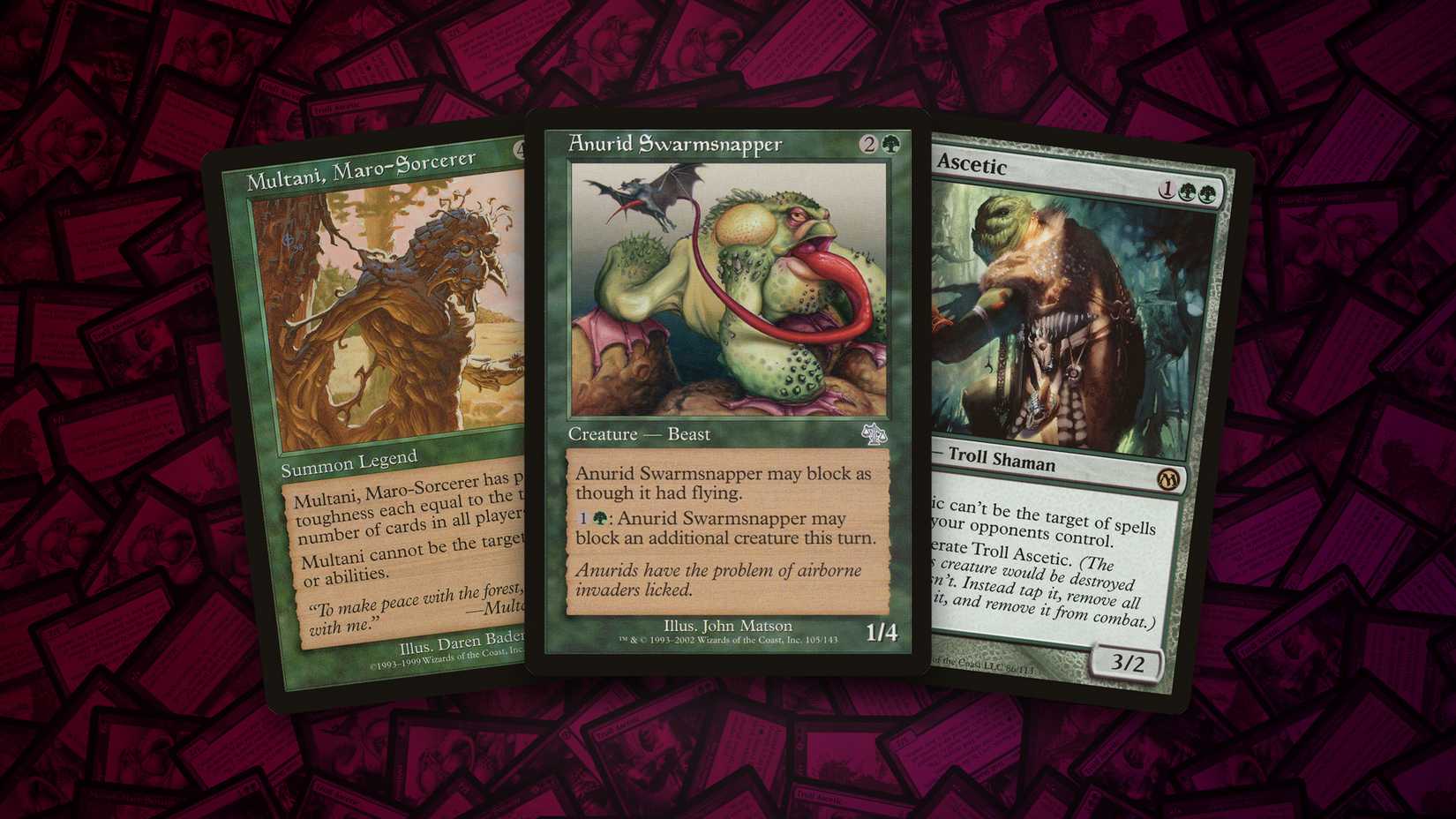 Image: Wizards of the Coast
Maybe artifacts and lands should die.
Introducing “dies” as an official keyword simply codified the way players — including those within Wizards’ walls — talk about the game.
“If this is what people already say, let’s enshrine that terminology and let the cards be cleaner,” Beyer says. “We’re always looking for system updates that make cards clearer and more fun to play, and a great way to do that is for the game to get closer to actual player behavior.”
Creatures dying makes sense, but what about other permanents that stick around on the battlefield? If they’re destroyed by another player, they also wind up in the graveyard. So why can't an artifact like Sol Ring "die" in the same way a creature does?
“Even though it would be shorter to write a card like Chromatic Star with ‘dies’ technology, we settled on limiting ‘dies’ to describe creatures only largely for flavor reasons,” Beyer says.
That restriction still comes with its own peculiarities. Can zombies really die in the traditional sense? Are constructs ever really alive to begin with? Dig deep enough into the flavor of Magic’s multiverse, and things get wonky very quickly.
“Any change is met with some resistance, even internally, but most folks could immediately see the upside of condensing a long, oft-repeated string of words into four easy-to-parse characters,” Magic's vice president Aaron Forsythe tells Polygon via email. “To this day, I wonder if we’re using it enough. Maybe artifacts and lands should die.”
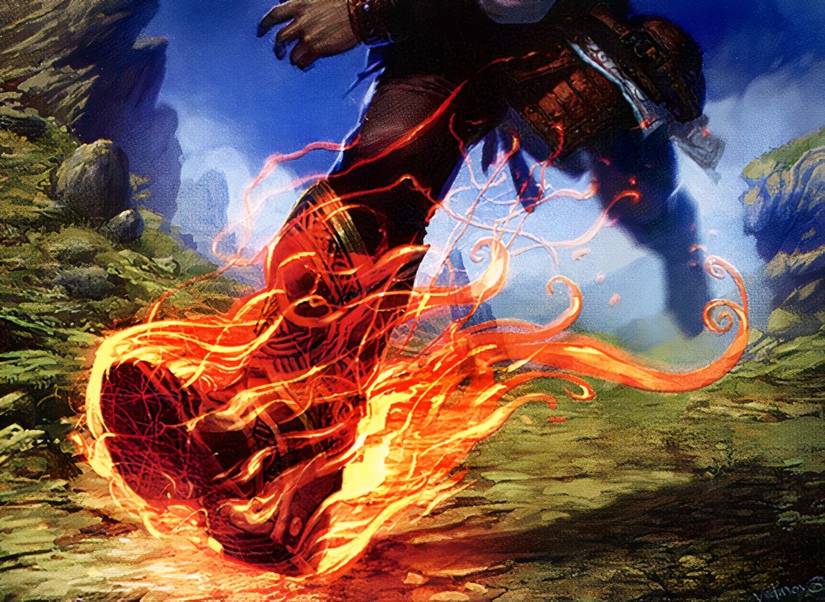 Though it's been reprinted numerous times, the original art by Svetlin Velinov remains the most popular for Swiftfoot Boots.Image: Wizards of the Coast
Hexproof also arose out of a disconnect between Magic’s rules and how people intuitively wanted to play the game. Before Magic 2012, the most prominent form of protection was shroud, which means a creature can't be the target of any spells or abilities. It’s an incredibly strong form of protection, but it’s a double-edged sword (or perhaps shield?), because it means you can't even equip or enchant your own creature. Hexproof iterated on shroud and made it so only your opponents can't target the protected creature, while its controller still can.
“We knew that a lot of players were either unaware or sad that shroud didn’t let them use combat tricks, equipment, Auras, etc. on their own creature,” Beyer says. “Keywording hexproof was a step towards letting players play the more natural-feeling version of the ability.”
Aside from “dies” and “hexproof,” Magic 2012’s most enduring legacy is that it introduced one of the most iconic Commander staples to the game. (The set was also released during the same summer that Wizards of the Coast officially recognized and began supporting Commander.) Swiftfoot Boots debuted with Magic 2012 as arguably the best showcase for hexproof. A two-cost equipment with an equip cost of one colorless mana, it gives the equipped creature hexproof and haste. Swiftfoot Boots has become an auto-include in any deck where protecting your Commander is a top priority, but that was actually never the intention when the card was designed.
“You can tell M12 was still developed with just 1-v-1 play in mind,” Forsythe said. “There are no legendary creatures at all (whereas M13 introduced some real all-timers like Krenko and Talrand). Even the big splashy-looking cards don’t even all work in Commander, like Doubling Chant.”
With Magic 2012, the awkwardness of shroud had been fixed, but hexproof ultimately emerged as perhaps too powerful. These days, ward is the game’s go-to form of protection, which allows opponents to target a permanent if they are willing to pay an additional cost (typically more mana or a few life points, but costs vary). Beyer sees protection, shroud, hexproof, and ward as successive attempts to solve the same fundamental problem: Players want their exciting creatures to survive long enough to matter, but their opponents still need meaningful ways to interact with them. Otherwise, games become more frustrating than they are fun.
“In the years since, we’ve seen that while hexproof might be more intuitive than shroud, games that actually hinge on untargetability are not that fun,” Beyer says. “Play Design has found that the softer, more opt-in protection of ward leads to more overall fun than strict untargetability. It makes both players feel like they get something while moving the game forward.”
While Magic has since done away with core sets in favor of 2024’s Foundations — which Forsythe prefers — he still laments what’s been lost.
“These sets were great places to put setting-agnostic cool individual Magic cards: Sundial of the Infinite. Vision of Beyond. Angelic Destiny. Rune-Scarred Demon,” he says. “Those cards have provided a lot of joy over the years!”






 English (US) ·