


Published Feb 8, 2026, 10:00 PM EST
An experienced Editor representing Canada via Screen Rant's Team Anime, J.R. has been reading manga since the first printing of Shonen Jump in North America. This passion drove him to write about anime, manga, and manhwa since 2022, having recently served as Lead Anime Editor for ComicBook.com.
His favorite moments in media coverage include reviewing the series premieres of Zom 100 and Bleach: TYBW Part 2 back-to-back and briefly meeting Junji Ito at a VIZ gallery event in 2023.
Sign in to your ScreenRant account
Anime has become more mainstream than ever before, thanks to unprecedented access to its biggest hits, and saturation for virtually any conceivable genre. However, it's not the first anime explosion that's graced the world, following cultural moments like the anime boom of the 1970s and, for a huge portion of today's mainstream audience, the 1990s were especially crucial.
For millennials, anime in the '90s was a formative cultural export that became an invaluable part of their media diet. While this included unforgettable experiences like OLM's Berserk and Pokemon dropping in the same year, and even underrated gems like The Vision of Escaflowne, other series are not as prominently discussed. In fact, some '90s anime are criminally forgotten.
Ghost Sweeper Mikami

Ghost hunting, exorcism, and anime are a rich mixture both in and out of the '90s, and while modern hits like Dark Gathering give noble or understandable motives, some spooky-types are in it for the money. In the case of Ghost Sweeper Mikami, countless spirits are displaced from their ancestral homes by rapid urbanization, creating huge demand for exorcists.
Ghost Sweeper Mikami focuses on one particular agency born from this demand, led by Reiko Mikami, a greedy exorcist charging high for her services, but backing it up with enormous talent. With the series animated by Toei Animation, it balances episodic storytelling with an overarching conflict with a powerful demon across a stellar 45-episode run.
Giant Robo: The Day the Earth Stood Still

While audiences were transfixed with franchises pumping out hits like Mobile Suit Gundam Wing or Mobile Fighter G Gundam, or generational phenomena like Neon Genesis Evangelion, the mecha anime scene stayed undeterred in the '90s. Such is the case with Giant Robo, incorporating characters from creator Mitsuteru Yokoyama's previous works, as well as wuxia themes and Hong Kong cinematic qualities.
Set in an alternate history where a supposed revolutionary energy solution is threatened by the terrorist organization led by Big Fire, BF Group featuring threats boasting superpowered Experts and even monsters at their disposal. Giant Robo tells the complicated truth behind their motives, while its protagonist, Daisaku Kusama, fights them alongside the Experts of Justice aboard the titular Robo mech.
Giant Robo delivered on multiple fronts while embodying the elements of what made '90s anime hits click: a careful seven-episode OVA delivery from 1992-1998, a mythic-scale melodrama to its plot, and phenomenal art direction to really sell the awesome scope of its central mech. While popular in certain circles, Giant Robo deserves greater exposure in its presently declining genre.
Legend of Basara

Adapting the even more underrated Basara manga, Legend of Basara is perfect for Yona of the Dawn fans, as well as a stellar '90s recommendation in general. It's also the earliest advertised anime bearing Yumeta Company's key and in-between animation. Exemplifying its era's moody vibes, Legend of Basara is emblematic of classic '90s fantasy anime.
The plot is also approachable, following Sarasa, who sets out to avenge her twin brother, Tatara, the latter being proclaimed as Japan's postapocalyptic savior. As Sarasa fights the brutal rulers of her land, she even falls into a complicated romance, where the pair are mutually unaware of their true allegiances, enhancing the drama and intrigue of this hit.
The Heroic Legend of Arslan

A strong case for watching its 2015 remake for stronger pacing, but the 1991-1992 films alongside its OVAs for the vibes, The Heroic Legend of Arslan's '90s anime is another fascinating product of its era, inspired by Persian folklore.
The Heroic Legend of Arslan introduces Prince Arslan, an idealistic young royal whose empathy becomes one of his strongest qualities, especially set against the era's brutal leaders. When Arslan's father, King Andragoras III, falls victim to a key betrayal, with their kingdom of Pars being overtaken by the neighboring Lusitania, Arslan must fight back without losing his sense of self.
Macross Plus

While the Macross franchise is well-known by mecha fans, especially for those craving more of a space opera experience propelled by killer diegetic music, it's broadly been underexposed, with modern audiences only recently getting easier access. As Shinichirō Watanabe's directorial debut under chief director Shōji Kawamori, Macross Plus is a more unusual OVA series than its peers.
Macross Plus is commonly recommended alongside franchise greats like The Super Dimension Fortress Macross: Do You Remember Love? and the original SDF Macross 1982 anime. Its plot features two rival fighter pilots, the programmer and object of both their affections, and the AI entertainer she created, Sharon Apple, who gradually grows rogue and dangerous.
The anime is possibly the best-looking Macross series, and although it focuses more on the rivalry and drama between pilots Isamu Alva Dyson and Guld Goa Bowman than the usual audiovisual spectacle for which Macross is otherwise known. Despite this difference, Macross Plus is arguably still the best-looking series, holding up well as a '90s anime classic.
Dear Brother...

Joining the Seiran Academy, Nanako Misonoo thought her future was bright, understandably, until her unexpected induction into "the Sorority", a coveted position which earns her some admiration, but even more scorn. She is perceived as not belonging in the group, encountering plenty of emotionally taxing social trials while narrating her journey to her mysterious "brother" via letters.
A shōjo classic from the same creator as The Rose of Versailles, it's unsurprising that Dear Brother... is a similar psychological ride, trading elite society leading into the French Revolution for elite society in an exclusive all-girls school. Dear Brother... channels emotion with particular expertise, deftly handling multifaceted female bonds with bold yuri undertones.
Kodocha

Behind the intentionally light cover of a whimsical coming of age rom-com featuring an impulsive, hyperactive young child star, Sana Kurata, and her unruly, disruptive classmate, Akito Hayama. But upon learning more about Akito's troubled home life, Sana gains some much-needed perspective, and the two mutually grow in one of the greatest '90s masterclasses in character development.
Sana's good heart can guide her into chaotic situations, while Akito's experiences with neglect and the cycle of abuse shaped his early life, but the two grow to support each other and their classmates. Animated by Studio Gallop, Kodocha is a stellar example of the incredible emotional depth and universal appeal of an all-timer shōjo series.
Outlaw Star

While continuously getting roses from discerning fans, Outlaw Star remains a tragically underrated hidden gem for the anime community from the '90s, deserving far more than its fate of being overshadowed by Cowboy Bebop. It's hard to see why it largely did, though, even hailing from the same studio despite being based on a manga that predated Bebop.
In Outlaw Star, bounty hunter Gene Starwind felt significant hurdles growing up due to a traumatic incident from his early teen years, although this didn't break his spirit. Now 20 years old, Gene goes into business with Jim Hawking, acquiring the Outlaw Star ship and an unlikely crew in search of the legendary treasure trove, the Galactic Leyline.
Future GPX Cyber Formula

Also animated by Sunrise, this 1991 anime handled character-driven racecar drama handily before Initial D was ever a big deal. Featuring the emergent Cyber Formula overtaking the classic Formula One, this anime presents a highly optimistic, if misguided, faith in the future of tech, particularly with AI as a tool.
With miraculous future tech at his disposal, Hayato Kazami shoots for glory in the Cyber Formula Grand Prix, his car perpetually kept cool, environmentally friendly, and carefully guided by AI navigation. Its various characters grow together, experience rivalries and setbacks, and its subsequent seasons and shows, namely Cyber Formula 2, 11, ZERO, SAGA, and SIN, get progressively better to watch.
Record of Lodoss War
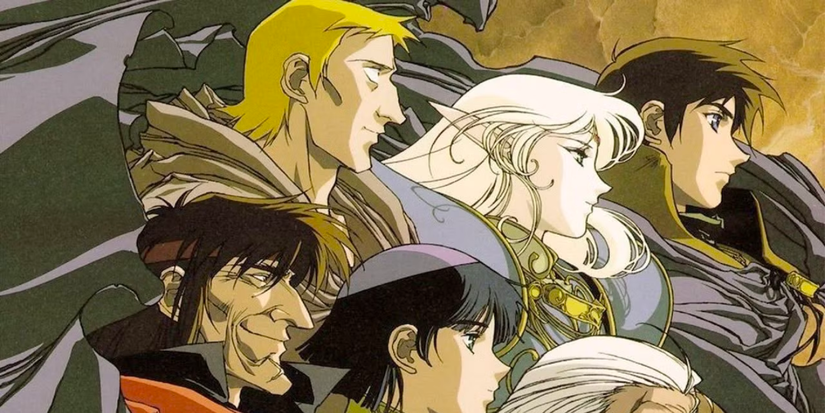
Despite being a well-represented franchise based on a D&D replay with novels, Record of Lodoss War has far less of a cultural footprint than other contemporary fantasy series like Berserk. It's even frequently overlooked in favor of recent hits like Frieren: Beyond Journey's End, despite itself still being one of fantasy anime's brightest gems.
Animated by Madhouse, this 13-episode OVA classic introduces fans to the classical fantasy-inspired adventures on the island of Lodoss, a place steeped in history of celestial conflict. The story joins swordsman Parn with his best friend Etoh the cleric, as well as the dwarf warrior Ghim, human sorcerer Slayn, human thief Woodchuck, and high elf Deedlit.
Together, Parn and his allies fight monsters, unearth mysteries, and combat particularly nefarious threats like Emperor Beld, Ashram, and Wagnard. Vibe-wise, Record of Lodoss War is peak '90s anime, despite not necessarily as heavily-watched by later generations, beloved by many, but undeservedly forgotten by many more.




 English (US) ·