
 49 minutes ago
10
49 minutes ago
10
Nothing hits quite like a good mystery. Whether it's a seemingly impossible murder, a missing person, or a conspiracy set against the backdrop of a small town, the best TV mysteries keep you guessing right up until the credits roll. They're the kinds of shows that make you scrutinize every passing detail and second-guess each new character. Still, despite the overriding conviction that you cracked the case long before the detectives, it’s almost always someone you least expect.
That’s the power of an insightful mystery series. Some of the greatest examples use their central investigations to explore complicated emotions, ranging from grief and loneliness to rage and guilt, while others hang their hats on more refined themes, focusing instead on institutional corruption and generational trauma. The most effective mysteries peer into the darkest recesses of human nature, showcasing some of the ugliest kinds of villains the world could ever imagine.
These days, there's no shortage of excellent mystery shows to get lost in. Action-packed thrillers like Reacher and The Terminal List offer that extra level of spectacle for those who can’t quite sit for a more methodical investigation, while the unforgettable Law & Order: SVU just aired its 28th season earlier this month. However, the following shows offer a bit more to their mysteries, featuring drawn-out investigations that keep you hooked to the very last word. From slow-burning Nordic noir to anime mind benders, these are the best mystery series ever put on TV.
10 Slow Horses (2022)
 Image: Apple TV
Not every great mystery begins with a dead body, and Slow Horses makes a compelling case for espionage as a genre built around the same pleasures of suspicion, misdirection, and assembled clues. The Apple TV series follows a team of disgraced British intelligence officers exiled to the Slough House, a bureaucratic dumping ground for MI5 agents who've made spectacular career-ending blunders, like mistakenly shutting down an airport mid-training exercise. Led by Jackson Lamb (Gary Oldman), a foul-mouthed Cold War veteran, the misfit squad of "slow horses" is relegated to soul-crushing paperwork only to repeatedly tumble into high-stakes conspiracies that the main desk at Regent's Park would prefer to keep buried.
Adapted from Mick Herron's novels, the series combines the tangled plotting of a spy thriller with the character dynamics of a workplace comedy. Yes, it’s not quite the same as True Detective or its noir ilk, but the mysteries of Slow Horses rewards close attention without sacrificing momentum, all while offering a more cynical view of institutional incompetence that makes it a welcome alternative to the polished heroics of more conventional espionage dramas.
9 River (2015)

A perfect critics' score on Rotten Tomatoes is enough to make River worth investigating, particularly for anyone who appreciates detective dramas built around complicated protagonists. Stellan Skarsgård stars as John River, a London police detective whose immense investigative capabilities are complicated by his tendency to see and converse with the dead. Among the apparitions haunting him is his recently murdered partner, Stevie (Nicola Walker), whose death becomes the central mystery of the series.
Like Luther, Bosch, and Sherlock, River belongs to the same tradition of one-name detective shows built around an investigator whose personal quirks are inseparable from their professional talents. On the other hand, Abi Morgan's six-episode drama is considerably more intimate than those comparisons might suggest. Beneath its murder investigation lies a moving portrait of grief, loneliness, and the fragile boundary between brilliance and instability.
8 The Killing (2011)

Few television mysteries understand the value of making an investigation feel genuinely exhausting quite like The Killing. The American crime drama follows detectives Sarah Linden (Mireille Enos) and Stephen Holder (Joel Kinnaman) as they investigate the murder of Seattle teenager Rosie Larsen. What initially appears to be a straightforward homicide gradually implicates the surrounding politicians, classmates, and members of the victim's own family, with each new revelation overcomplicating the case rather than bringing it closer to resolution.
The show's deliberately slow pace won't appeal to everyone, taking the course of two seasons to find closure for its first mystery, but that’s precisely what makes the investigation such an absorbing watch. Adapted from the Danish series Forbrydelsen, The Killing brings the brooding atmosphere and institutional distrust associated with Nordic noir to rainy Seattle. Its focus on the emotional toll of a single murder makes it an excellent companion to other character-driven crime dramas.
7 Broadchurch (2013)
 Image: Banijay
A murder in a quiet seaside town becomes an open wound in Broadchurch, a masterclass in British crime drama that transforms a tight-knit community into a claustrophobic web of suspicion. When 11-year-old Danny Latimer is found dead beneath the towering sandstone cliffs of West Bay, Dorset, local detective Ellie Miller (Olivia Colman), with close ties to the victim, is paired with brooding Alec Hardy (David Tennant), an outcast harboring his own checkered past.
Creator Chris Chibnall delivers a devastating portrait of small-town intimacy turned toxic, crafting a mystery where every revealed secret carves another fissure into a grieving community. Its emphasis on the human consequences of violence makes Broadchurch a natural companion to Happy Valley, another outstanding British crime drama about the personal costs of police work, and Dublin Murders, which weaves a present-day homicide investigation into the secrets of Ireland's past. What sets Broadchurch apart from those peers is how deeply it honors the Latimer family's grief, turning what could have been a cold procedural puzzle into an intensely heart-wrenching tragedy.
6 The Bridge (2011)
 Image: Hans Rosenfeld
The Bridge begins with a masterclass in macabre puzzle-box storytelling: a female corpse laid out across the exact midpoint of the Øresund Bridge, half in Sweden and half in Denmark. When crime scene techs separate the torso, they find two distinct victims — a high-profile Swedish politician and a forgotten Danish prostitute — forcing Swedish detective Saga Norén (Sofia Helin) and Danish investigator Martin Rohde (Kim Bodnia) into a complex joint jurisdiction.
Hans Rosenfeldt uses this grisly starting point to launch a bleak procedural where a shadowy killer turns brutal homicides into political manifestos on wealth inequality, state neglect, and institutional failure. Alongside genre pillars like The Killing and Broadchurch, The Bridge excels by anchoring its icy Scandinavian landscapes in personal stakes, proving that a killer’s twisted moral crusade is often just a cover for a far more devastating vendetta. The series inspired several international adaptations, including the British-French drama The Tunnel. Yet, for viewers drawn to intricate investigations, morally ambiguous characters, and chilly European landscapes, the original remains essential viewing.
5 Monster (2004)
 Image: Shogakukan
While anime often leans into supernatural horror or battle-shonen tropes, Naoki Urasawa’s Monster constructs its psychological nightmare out of a grounded ethical dilemma. Set in late-20th-century Germany, the story begins in 1986 when brilliant Japanese neurosurgeon Dr. Kenzo Tenma defies corrupt hospital politics to save a young boy with a gunshot wound to the head instead of the city’s mayor. Nine years later, that act of medical idealism turns catastrophic when the rescued boy has grown into a charismatic, sociopathic mastermind who orchestrates murders across a newly reunified Europe with quiet precision.
To stop the wave of executions, Tenma abandons his career, takes up arms, and embarks on a dangerous trek through German and Czech underworlds. Spanning 74 patient episodes, Monster resists quick procedural payoffs, taking its time to build an intricate web of traumatized orphans, covert military programs, and tragic bystanders. It stands as an uncompromising epic that tests whether unwavering human kindness can survive when forced to confront void-like villainy.
4 The X-Files (1993)
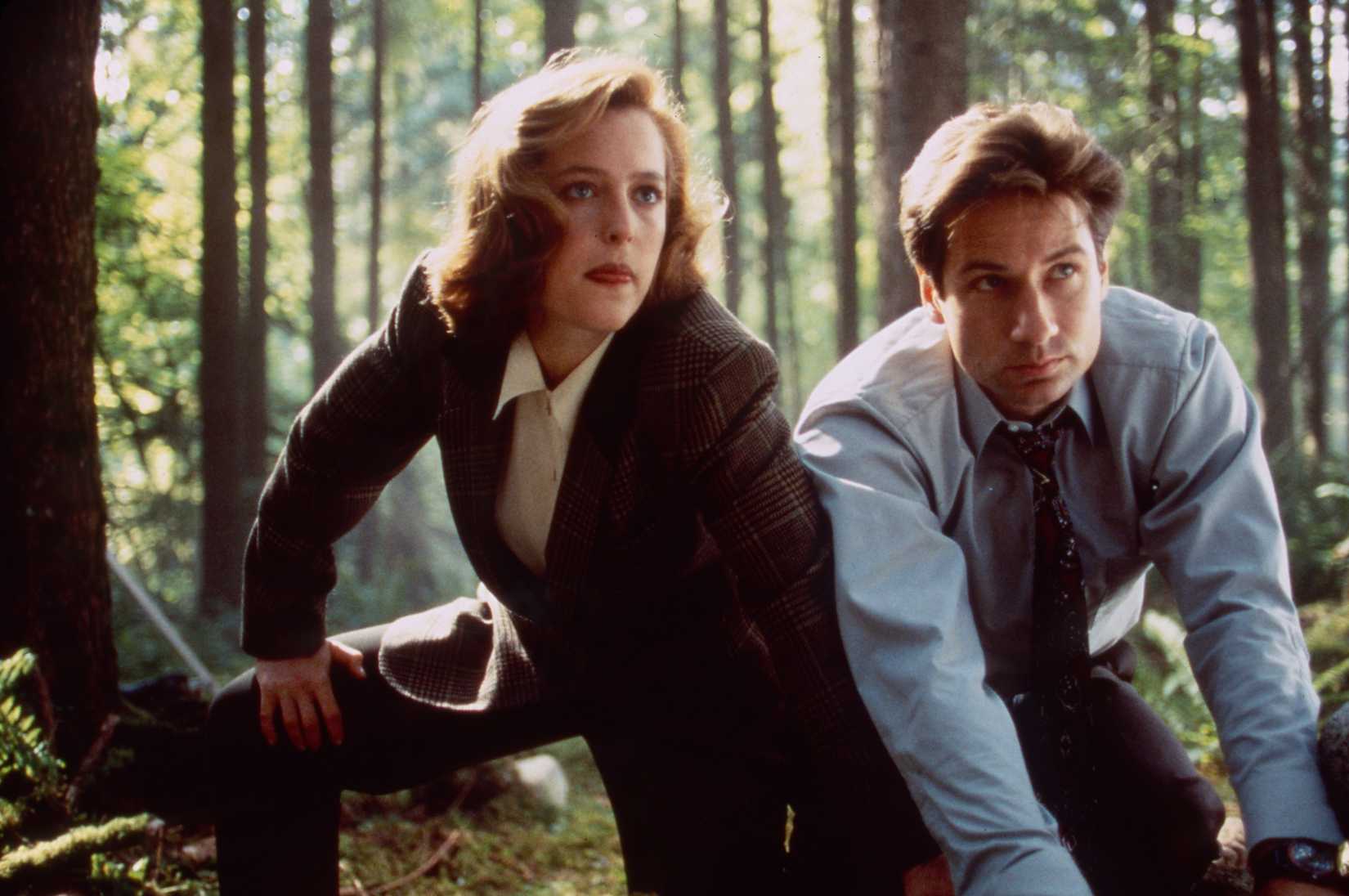 Photo: Chris H.B./Fox/Everett Collection
Long before conspiracy thrillers and paranormal procedurals dominated television, The X-Files turned the search for extraterrestrial truth into a cultural phenomenon. Operating out of a forgotten basement office in Washington, D.C., FBI agents Fox Mulder (David Duchovny) and Dana Scully (Gillian Anderson) investigate the Bureau's most unexplainable mysteries. Where Mulder charges into the unknown, propelled by obsessive faith in the impossible, Scully anchors the darkness in cold logic, her clinical skepticism constantly measuring his wild leaps of intuition. Together, they turn every investigation into a captivating tug-of-war between the drive to believe and the demand to know.
Creator Chris Carter masterfully balanced two distinct narrative tracks: monster-of-the-week standalone cases (from liver-eating mutants like Eugene Tooms to fluke-human hybrids) and a sprawling mythology weaving through the entire 11-season run. The overarching conspiracy unspools a shadow syndicate working alongside alien colonists to engineer a black oil virus ahead of a planned global invasion. Driven by the ideological friction between Mulder’s faith and Scully’s skepticism, The X-Files rewrote the rules of detective fiction by proving that the most terrifying mysteries are the ones government gatekeepers keep locked in the dark. Its influence can be felt in more recent genre mysteries such as The Outsider, which brings supernatural horror into a conventional murder investigation, and the Korean series Signal, which combines police procedural storytelling with a mysterious connection set across time.
3 Mindhunter (2017)
 Image: Netflix
Set against the late-1970s aftermath of the Manson Family and the Son of Sam, David Fincher’s Mindhunter explores the birth of modern criminal profiling within the FBI's Behavioral Science Unit. The series follows ambitious agent Holden Ford (Jonathan Groff), pragmatic veteran Bill Tench (Holt McCallany), and icy psychologist Dr. Wendy Carr (Anna Torv), all of whom willingly venture into maximum-security prisons to tape-record candid conversations with incarcerated serial killers, most notably Edmund Kemper (Cameron Britton).
Adapted from the true-crime memoirs of FBI agent John E. Douglas, the series eschews traditional action beats for clinical conversations in cramped interrogation rooms. As the team codifies terms like "organized" versus "disorganized" offenders to help catch active killers, including the Atlanta child murderer and the elusive BTK Strangler, Ford’s growing empathy with sociopaths threatens his own sanity. The show is a chillingly cerebral procedural that locates its horror not in gory crime scenes, but in the psychology of its antagonists, showing how easily violent pathology can mimic human logic.
2 Mare of Easttown (2021)

Kate Winslet delivers one of her finest performances in Mare of Easttown, an HBO crime drama that understands how a murder investigation can expose the fractures running through an entire community. Set in a working-class Philadelphia suburb where everyone is connected by blood, marriage, or decades of shared grudges, the series centers on Detective Mare Sheehan and her investigation into the murder of a young woman while struggling with her own family troubles and the lingering trauma of her son’s suicide.
What begins as a straightforward murder mystery unravels into a dense web of small-town hypocrisy, pointing fingers at everyone from volatile teenagers and grieving grandfathers to a secretive parish priest. Paired with county detective Colin Zabel (Evan Peters), an outsider eager to prove himself, Mare is forced to untangle a mess of local gossip, widespread opioid addiction, and volatile custody disputes while picking apart the lies of people she’s known her whole life. Like Sharp Objects (another fantastic HBO mystery series you don’t want to miss), Mare of Easttown uses a small-town murder to explore generational trauma, buried secrets, and the suffocating familiarity of a place where everyone seems to know everyone else. The newer Task, also created by Brad Ingelsby, offers another perspective of the crime-ridden communities and damaged people that make his work so compelling.
1 True Detective (2014)
 Image: HBO/Everett Collection
The first season of True Detective is, hands down, the gold standard for long-drawn, drama-bred mysteries. It’s one of those rare defining achievements of prestige television, a murder mystery that feels as interested in the nature of evil as it is in identifying a killer of the vilest sort. Matthew McConaughey and Woody Harrelson star as Louisiana detectives Rust Cohle and Marty Hart, whose investigation into a series of disturbing crimes stretches across decades and exposes the contradictions in their own lives.
The show’s true brilliance lies in how it seamlessly fuses standard police procedural beats with an almost cosmic existential horror. Elevated by Cary Joji Fukunaga’s visual framing of the Gulf Coast's decaying industrial outskirts, the series established a blueprint that subsequent anthology entries would build upon, from the Ozark backwoods of season 3 to the endless polar plains of Night Country. Though the quality across seasons fluctuates (most especially in its fourth outing), the franchise remains at its best when treating the crime not just as a puzzle, but as an existential infection that leaves its investigators permanently scarred. And with rumors of a potential series revival featuring the main stars of season 1, there’s no better time to revisit the greatest mystery show ever made.




 English (US) ·