
The Academy Award for Best Actress is probably what you'd expect it to be: the award given on Oscar night for Best Actress in a leading role. Categories can be a little funny sometimes, with certain actors or actresses maybe/arguably fitting into supporting roles more than leading ones, or vice versa, but that’s a different conversation for a different time. You can probably go elsewhere on the internet to find people talking about that.
Instead, what follows is an attempt to highlight some of the winners of the Best Actress Oscar who undeniably deserved it, by delivering especially great performances that also outshone the others nominated in the same category. Maybe some of these winners were obvious, too, because that’s just how it is sometimes. That’s what everyone says about Jessie Buckley in Hamnet (a sentence that will age very poorly if she doesn’t actually win at the Academy Awards ceremony being held in 2026).
10 Diane Keaton as Annie Hall
'Annie Hall' (1977)
In Annie Hall, Diane Keaton plays the titular character, and as far as the movie’s cast is concerned, the whole thing does belong to her. Emphasis on “the movie’s cast,” because, like it or not, Annie Hall is still Woody Allen’s movie, since he co-wrote and directed it while also starring alongside Keaton, but Diane Keaton does a lot to elevate the whole thing further, possibly turning it from a good movie into a great one.
She does it rather effortlessly, too. It’s not a showy or particularly flashy performance, since Annie Hall isn't too showy or flashy a movie in general, but she shows it’s possible to be a standout performer without doing the kind of things that make most standout performers, you know, stand out. It’s a perfect performance for this kind of movie, to put it all more succinctly.
9 Greer Garson as Kay Miniver
'Mrs. Miniver' (1942)
 Image via Loew's Inc.
The most well-known and acclaimed World War II movie made in 1942 was Casablanca, but that one didn’t get a wide release until 1943, so it competed against other 1943 movies at the 1944 Academy Awards. This is how Mrs. Miniver, released the same year as Casablanca's premiere, is also a Best Picture winner (they didn’t tie at the 1943 Academy Awards, in other words). They're also different enough in some ways, with Mrs. Miniver being more about a family unit, and with a narrative focus that’s largely on the civilian experience during the early stages of World War II.
Maybe it’s a bit of a melodrama, but at least it’s a good melodrama. There’s also a great performance in the titular role, given by Greer Garson. She was one of the greats, as far as Golden Age of Hollywood actresses go, and possibly even the most accomplished as far as World War II-era actors/actresses are concerned, since she was nominated for five other Academy Awards, on top of her win for Mrs. Miniver, between 1939 and 1945.
8 Kathy Bates as Annie Wilkes
'Misery' (1990)
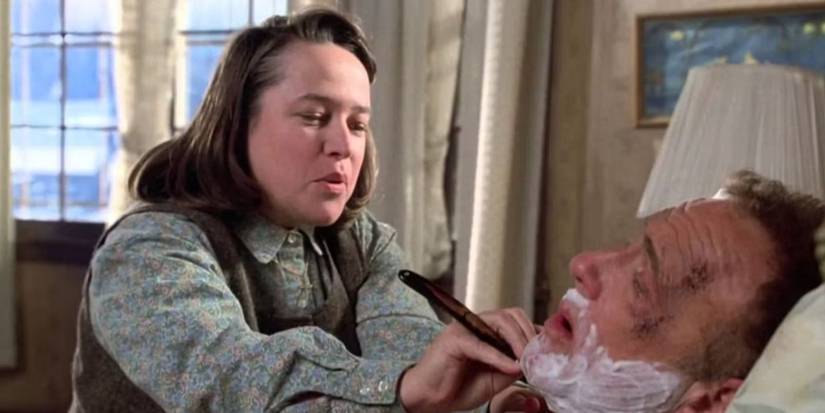 Image via Columbia Pictures
As an adaptation of one of the more suspenseful Stephen King novels, Misery really gets things right. There are a few changes made to the source material, but nothing drastic enough to the point where you get a different experience from one versus the other, as in both cases, the story’s claustrophobic and intense, with one main character being a captive, and the other main character being his captor.
Said captor is Annie Wilkes, and she’s perfectly played by Kathy Bates, with Misery being a breakout film role for her, but not one that led to type-casting, which is impressive to consider, in hindsight. She happens to have played one of the all-time great screen villains, but has done so much more than villainous roles since. Also, an honorable mention should go out to James Caan, who has to play the less flashy here, as the captive author, yet he’s also great, and watching his character battle Bates’ on a psychological (and eventually physical) front is never anything less than thrilling.
7 Natalie Portman as Nina Sayers
'Black Swan' (2010)
 Image via Fox Searchlight Pictures
Hey, another win for a horror movie; that’s always nice to see. It’s Natalie Portman’s performance in Black Swan, which is a film about the pursuit of perfection driving a young ballerina to madness. It would make for a good double feature with Whiplash, which does a similar thing, but for drumming, or if you want something slightly less intense, there’s always The Red Shoes (which, okay, is still pretty grim, especially by the standards of the 1940s, when it came out).
Regarding Portman and Black Swan, she’s been compelling in plenty of other movies, yet this film feels like it’s home to what’s easily her best performance overall (the best movie she’s been in, on the other hand, might be another story… maybe Heat?). She commits to this role in a remarkably intense way, and ends up being a major reason why, overall, Black Swan is so successfully nightmarish.
6 Liza Minnelli as Sally Bowles
'Cabaret' (1972)
 Image via Allied Artists
In 1972, The Godfather won Best Picture, and two other Oscars, but the big winner that year in terms of the most trophies received was Cabaret, with its wins including Bob Fosse for Best Director, and Liza Minnelli for Best Actress. She plays a cabaret singer named Sally Bowles, one of a handful of characters who engage in a party-heavy lifestyle during the Weimar era in Berlin, with the rise of Nazism being the thing that ultimately ended it. And, even if you only know a little bit about 20th-century history, you're probably aware of the war and turmoil that came next.
So, Cabaret is a musical, and an initially fun one, but you're having fun like the characters and then it hits you in the gut, ultimately being about what it eventually has to be about. There’s a fine line to walk for all the actors involved, given how thematically intense and complex Cabaret ultimately is, with Minnelli perhaps walking that line the best (her and Joel Grey, at least, who also won an Oscar for his performance here, in the Best Supporting Actor category).
5 Elizabeth Taylor as Martha
'Who's Afraid of Virginia Woolf?' (1966)
 Image via Warner Bros. Pictures
Of all the movies that throw a small number of characters into a confined setting and make them all deal with each other for a couple of hours, Who’s Afraid of Virginia Woolf? is easily one of the best. There are only four main actors in this, and given the film’s a classic, there’s no weak link in the cast, but it’s probably Elizabeth Taylor who stands out the most… but also, comparing the performances is silly when talking about the Academy Awards, since all were competing in different categories.
Maybe the main thing is that all four members of the main cast were nominated, with Richard Burton nominated for Best Actor, George Segal nominated for Best Supporting Actor, and Sandy Dennis winning Best Supporting Actress. You watch a movie like this for the performances, and regarding Elizabeth Taylor, it’s maybe the single best showcase of why she was considered one of the greatest actresses of her era.
4 Vivien Leigh as Blanche DuBois
'A Streetcar Named Desire' (1951)
 Image via Warner Bros. Pictures
Like Who’s Afraid of Virginia Woolf?, A Streetcar Named Desire was a film adaptation of a stage play, and both films allowed for some pretty great actors to cut loose and shine in the way that most good film adaptations of stage plays allow. A Streetcar Named Desire also came close to sweeping all four acting categories… funnily enough, it was only Marlon Brando who “lost,” as Vivien Leigh won Best Actress, Karl Malden won Best Supporting Actor, and Kim Hunter won Best Supporting Actress.
Marlon Brando’s performance is probably the most well-remembered today, but he’d win later on in his career on two occasions; first for On the Waterfront, and then for The Godfather. Regarding Vivien Leigh, she’s also fantastic here as the troubled and tragic Blanche DuBois, with this Best Actress win being arguably even more well-deserved than Leigh’s first Oscar win, which was for playing Scarlett O'Hara in Gone with the Wind.
3 Katharine Hepburn as Eleanor of Aquitaine
'The Lion in Winter' (1968)
 Image via AVCO Embassy Pictures
Okay, this one’s a little unusual. In 1968, there was a very rare tie in the Best Actress category, with Katharine Hepburn winning for The Lion in Winter, and Barbra Streisand winning for Funny Girl. With Streisand, she’s front and center throughout that entire movie, and is great, so it feels understandable why she won. In The Lion in Winter, Hepburn is also remarkable, though Peter O’Toole shines just about as brightly, and they have a comparable amount of screen time (great ensemble cast in that film, too).
The Lion in Winter could well be Katharine Hepburn's best performance, and was so deserving as a winner that even if it technically tied, it’s still worth citing here.
Also interesting is that Katharine Hepburn has the most Oscar wins of any actor or actress, with four, and O’Toole is tied with Glenn Close for the most nominations of any actor or actress without any wins (at eight). O’Toole got unlucky in 1962, since his Lawrence of Arabia performance competed against Gregory Peck’s in To Kill a Mockingbird, and Peck won, but O’Toole definitely should’ve won alongside Hepburn for The Lion in Winter. Anyway, Katharine Hepburn is amazing here; that’s the main thing. Sorry for the tangents. This could be her best performance, and she was so deserving as a winner that even if it technically tied, she's still worth citing here as one of the best and most undeniable acting winners in Oscar history.
2 Frances McDormand as Marge Gunderson
'Fargo' (1996)
 Image via Gramercy Pictures
Not that Fargo was ever anything less than great, but it has nonetheless held up rather perfectly in the 30 years since it came out. It’s one of the most well-balanced and engaging of all the Coen Brothers’ movies, riding a line between the duo’s comedic side and their grim/intense one, seeing as it’s about a criminal scheme that gets executed abysmally, which leads to a lot by way of comedy and tragedy at the same time… and without feeling like a tonal nightmare.
Frances McDormand gets to play the most competent and least foolish central character in the movie, and she’s great as an unconventional hero of sorts who enters the film fairly late for a leading role, but it makes sense and feels right because she dominates all the scenes she does appear in. McDormand would later win Best Actress for her performances in both Three Billboards Outside Ebbing, Missouri and Nomadland, but it’s probably Fargo that remains her most iconic movie/performance, and with good reason.
1 Meryl Streep as Zofia "Sophie" Zawistowska
'Sophie's Choice' (1982)
 Image via Universal Pictures
Meryl Streep gets to do a bit of everything, as far as all the things you could ask an actor or actress to do, in Sophie’s Choice. And she’s Meryl Streep, so she more than rises to the occasion. That’s underselling it. This movie feels like it might well have existed for the primary purpose of giving a more-than-capable actress one of the biggest roles possible, and Streep does indeed carry the whole movie, which kind of supports/backs up this overall feeling.
Narratively, Sophie’s Choice is about a woman dealing with immense grief following on from the end of World War II, especially regarding the choice she has to make, as the title alludes to. Sophie (played by Streep) goes through a lot physically and emotionally, and Streep is at her very best for every second she’s on-screen. You can maybe criticize other parts of Sophie’s Choice if you feel so inclined, but Meryl Streep’s performance here, in every way, is truly remarkable, and maybe even one of the best of all time (from all of cinema history, Oscar-winning or otherwise).

Sophie's Choice
Release Date March 4, 1983
Runtime 150 Minutes
Director Alan J. Pakula
Writers William Styron, Alan J. Pakula




 English (US) ·