
It's easy to argue that the final shot of a film is its most important. It's the final impression a film can make on an audience, but there are plenty of masterpieces that end with very mundane shots. Some shots are even misremembered as final ones because they've become more iconic than those that are. Almost everyone remembers the penultimate shot of Norman Bates at the end of Psycho, a skull superimposed over his face, but it's often forgotten that the actual final shot is one of Marion Crane's car being pulled out of a swamp. The fact is that not every final shot is the most memorable or the most perfect, but there are those that absolutely are.
The most perfect final shots of films from the 20th Century come from across different decades of film history and vastly different eras of filmmaking. From Hollywood's Golden Age through the independent 70s and the blockbuster 80s right up to the end of the 90s with a cult classic. Different genres, directors and styles of filmmaking are all represented, and each individual shot carries its own emotional energy. There's no one way to end to perfectly end a film, but these ten final shots of the 20th century all do it.
10 'Fight Club' (1999)
 Image via 20th Century Studios
Technically speaking, the very final image of David Fincher's essential satire of machismo and male identity, Fight Club, is a big ole dick. The hefty hog is a final act of rebellion in the film that calls back to an earlier moment, and possibly suggests that madman alter-ego Tyler Durden (Brad Pitt) is now in control of the projector. As much as I'd love to include a full frontal final shot, the real final shot of the movie is the Pixies-scored image of the Narrator (Edward Norton) and Marla (Helena Bonham Carter) watching financial buildings collapse in flames.
That indelible image, set to "Where is My Mind?" by the 90s alt-rock band, is burned into the memory of a lot of film bros and other young men, many of whom massively misinterpreted the meaning of the film they had just watched, hence the creation of genuine fight clubs in the wake of its cult success. The final destructive, anarchic and terroristic action taken in the film is the culmination of one man's war with himself and the cult of angry young men who become his followers. Fight Club rages against the machine but offers nothing substantive in its place, only more destruction. It's a film that leaves you feeling strange, thanks to the dissonance of its soundtrack choice against its somewhat surreal visuals. Then it hits you in the face with a penis.
9 'Raiders of the Lost Ark' (1981)
 Image via Paramount Pictures
Most adventure movies end with some kind of stinger that hints at future adventures to come. Whether filmmakers are trying to engage in sequel bait or not is immaterial. The core idea behind these attempts at pure escapism is that the audience should always be left wanting more. These movies have origins in printed pulps and matinée serials, which were designed as continuing stories where each climax could be followed by another call to adventure. The film that took all those influences and codified what a modern adventure movie should be was the Steven Spielberg-George Lucas joint Raiders of the Lost Ark, which ends with a fantastic final shot that suggests an entire world of mystery and adventure outside its frame.
After Indiana Jones (Harrison Ford) successfully defeats the Nazis and secures the fabled Ark of the Covenant, he brings the artifact home where it can be studied. Perpetuating colonial attitudes and cultural theft aside, the final shot hints at the sheer amount of power and deep levels of secrecy the American government is engaged in. The Ark, much to Jones' chagrin, is filed away in a crate in a warehouse filled with identical crates. Every crate represents another artifact or mystery of the unknown, hidden by a government that would rather bury history than engage with it. While Indiana Jones and the Kingdom of the Crystal Skull degraded some of the mystery and wonder of the warehouse, the ending of Raiders of the Lost Ark is still immaculate.
8 'Planet of the Apes' (1968)
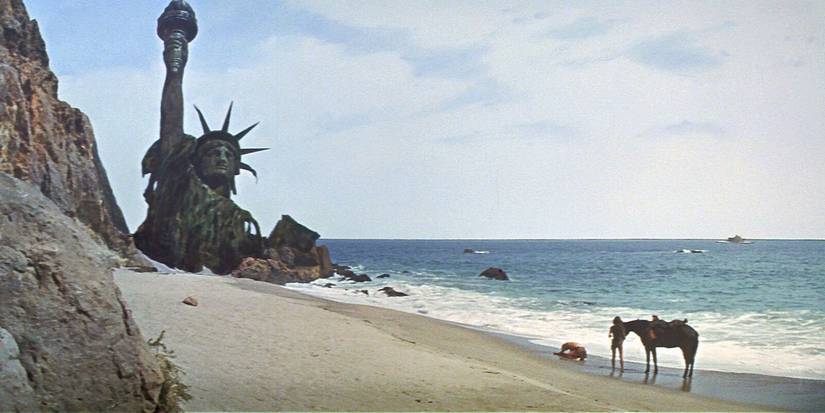 Image via 20th Century Studios
Sometimes there's no more adventure left in a cinematic world. Sometimes a film's final image is a definitive statement. Even though the sci-fi classic Planet of the Apes was followed by four sequels, not to mention a remake and a rebooted prequel trilogy, there's no denying the finality in its last shot. It's a shocking twist that's become so spread across pop culture, many film fans are aware of it without having viewed a single other frame of the film it's from. As written by master of the twist Rod Serling, it's one of the most iconic endings in film history, and its power is puntuated by the last shot.
Astronaut Taylor (Charlton Heston) has spent the entirety of the film's runtime thinking that the planet populated by highly intelligent apes is an alien one. He discovers there is a history of the primitive humans who also live on the planet, and it's only in the films final moments that he comes to understand that history is also his own. Taylor is on Earth, and the final shot drives that point home with the shocking image of a destroyed Statue of Liberty buried along the shoreline. It's an astonishing final shot of a shocking ending that still manages to be effective after decades of cultural dissemination and widespread parody.
 Image via Warner Bros.
Stanley Kubrick was a notoriously exacting filmmaker. The legends of his subjecting his cast and crew to dozens upon dozens of takes for individual shots is well known among cinephiles and even more casual film fans, but it's hard to argue with the results. His films often begin and end with shots that are icons within film history. Whether it's the Star Child of 2001: A Space Odyssey or the New Year's Eve photo in The Shining. These moments are proper final flourishes for their respective films, and many of Kubrick's final shots could feature here, but there's something particularly haunting about the last of Full Metal Jacket.
Tracking the experiences of a platoon of Marines through basic training and into battle during the Vietnam War, this masterpiece depicts a visceral deconstruction of their innocence. It's a tired criticism that the first half of Full Metal Jacket, which covers the basic training sequences, is far more effective than the second half set in combat. That's also like saying a perfect movie is better than an almost-perfect movie. The comparison isn't exactly fair, and the second half of the film is filled with incredibly haunting imagery that is paramount to its themes. That includes the film's final shot, where the Marines march across a bombed-out, burning city as they sing the theme song of The Mickey Mouse Club House. It's a discordant experience that perfectly summarizes the duality of man.
6 'The Texas Chain Saw Massacre' (1974)
 Image via Bryanston Distributing Company
While an impactful final shot can come from the careful precision and perfectionism of a filmmaker like Kubrick, it can also be the culmination of an unhinged production that pushed its cast and crew to their breaking points. That's what you're witnessing in the final mad moments of The Texas Chain Saw Massacre. The classic horror film was directed by Tobe Hooper on a low-budget during a sweltering Texas summer. The production design and props were cobbled together from genuine animal remains, and the actors were subjected to such intense heat and dangerous circumstances that it caused a great deal of animosity between them and Hooper. The difficulties of shooting The Texas Chain Saw Massacre have become part of its lore, and are clearly reflected in every sweaty, painful and torturous shot in the film, up to and including its last one.
As final girl Sally Hardesty (Marilyn Burns) makes her final escape from the cannibalistic Sawyer clan, she manages to hop into the bed of a truck and speed away from the chainsaw-wielding Leatherface (Gunnar Hansen). In frustrated response, the masked massacrer swings his chainsaw through the air in a mad dance against the rising sun. Hansen was wielding a real chainsaw for the shot, and his erratic movement was the result of exhaustion and true frustration, much of it aimed at Hooper, who supposedly had to duck out of the swing path to avoid getting hit. The full fury of Hansen is apparent in every frame of the film's final shot, which is horrifying and beautiful in equal measure.
5 'The Third Man' (1949)
 Image via Studiocanal
Unlike the finality of Planet of the Apes or the unfinished horrors of Full Metal Jacket and The Texas Chain Saw Massacre, the ending of The Third Man is open-ended pessimism. The lead character of Holly Martins, despite doing the right thing, is left dejected and alone. It's the antithesis of the Hollywood ending, and even coldly rejects the selfless heroism of something like Casablanca. It's a quintessential noir ending for a quintessential noir movie, and it's all captured in one cold shot where not a word is spoken.
After traveling to Vienna to see his friend Harry Lime (Orson Welles), Martins uncovers a dark conspiracy and discovers hard truths about Lime. His moral compass won't allow him to let Lime go free, and so he helps the police apprehend him, which ends with Lime's death. At his funeral, Martins waits to speak with Anna (Alida Valli), Lime's ex-girlfriend and Martins' potential paramour, but she walks right past him with no acknowledgment. It's a far cry from the original intended ending, written into the novella that was used as a script treatment for the film, where Martins and Anna walk away together, but director Carol Reed insisted on the more unsatisfying ending, creating an iconic final shot that preserves its potent pessimism.
4 'The Graduate' (1967)
 Image via United Artists
Even if two people do end up together at the end of a film, it doesn't guarantee that they'll have a happy ending. That's the predicament facing young Benjamin Braddock (Dustin Hoffman) and Elaine Robinson (Katherine Ross) at the end of the massively influential comedy The Graduate. The penultimate scene where Benjamin disrupts the wedding of Elaine to profess his love, and she in turn runs from the altar to join him, has been mimicked and repeated in dozens of romantic comedies in one form or another. Almost all of them include the triumphant moment between the two would-be lovers, as well as the ecstatic smiles they wear as they ride toward a future together, but they all exclude the final moment where those smiles shift to something far more uncertain.
Mike Nichol's 1967 film famously subverts the more idealistic ending of the Charles Webb 1963 novella by simple extension. Benjamin and Elaine are forced to sit with their decision as the shot refuses to end or allow them any kind of emotional victory. It turns a moment that in every other romantic comedy plays for pure elation, but in The Graduate, it becomes a symbol of youthful impetuousness turned sour by harsh reality. It set the standard that became the cliché and satirized it in the same shot. Despite decades of romantic comedies made in the decades since that have tried to convince us of the power of young love, the bracing uncertainty in the final shot of The Graduate is still far more perfect.
3 'The Godfather' (1972)
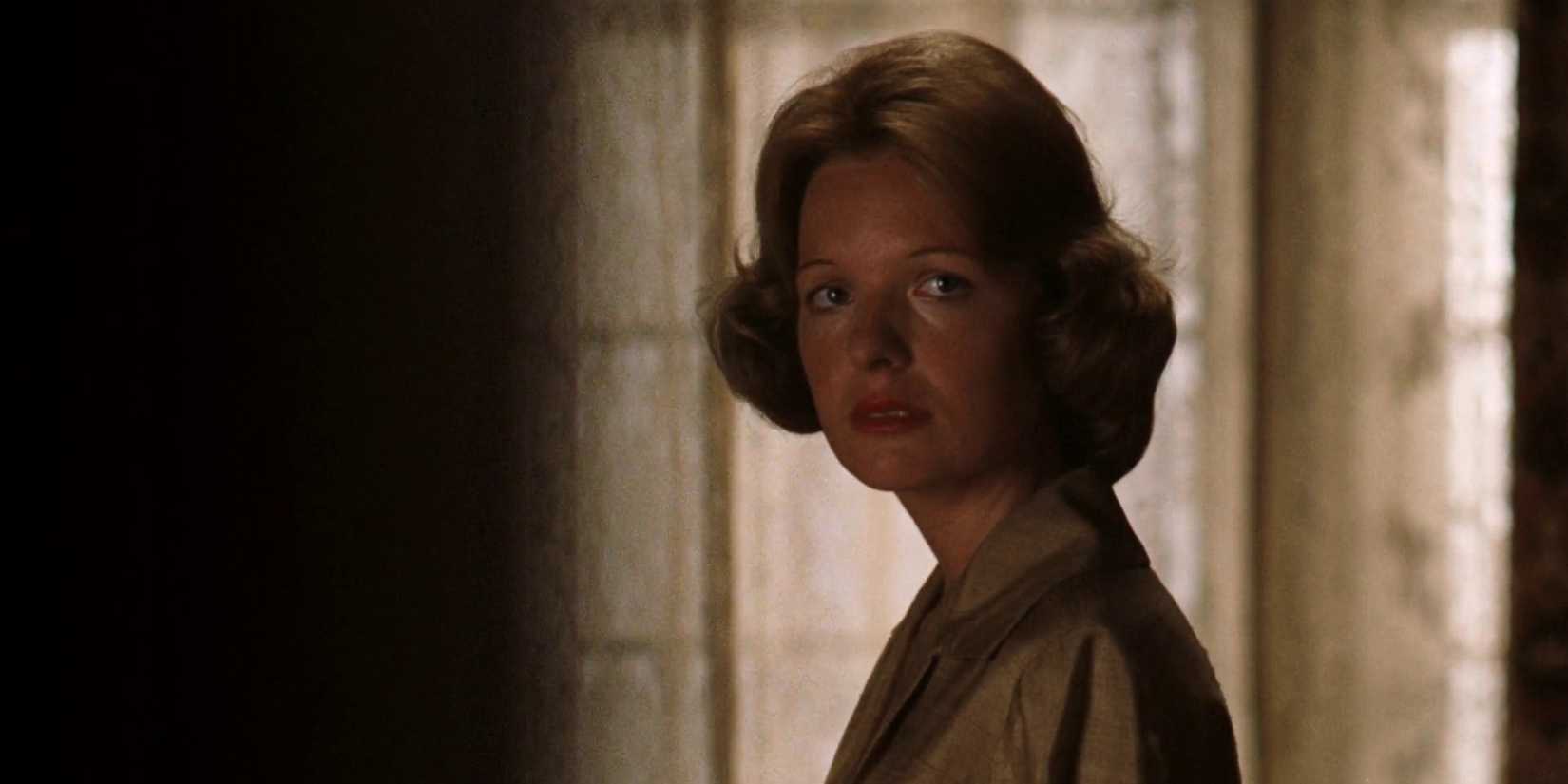 Image via Paramount Pictures
There's no uncertainty in the final moments of Francis Ford Coppola's American masterpiece The Godfather. Michael Corleone (Al Pacino), once the black sheep who wanted nothing to do with the family business, has fully ascended to power as the new Don, having killed off the heads of the New York Mafia. It's a powerful and poetic ending as seen through the eyes of Michael's young wife Kay (Diane Keaton). What makes the ending to such a magnificent particularly perfect is its staging and the performances of the actors. Through camera angles, lighting and a glassy-eyed stare, the film communicates a metric ton of emotion in mere seconds of screentime.
After initiating a mafia war after avenging the attempted murder of his father, Michael leaves New York and Kay behind, only to return years later to settle the ongoing hostilities that have claimed the lives of many. He sets about consolidating power by orchestrating a series of hits that kill not only the mafiosos in power but also the betrayers within Michael's own family, which includes his the abusive husband of his sister Connie (Talia Shire). When confronted by Kay about this murder, Michael lies and denies involvement. Kay's relief is short-lived as she witnesses others address her husband as Don Corleone, confirming his position of power. She's just as quickly shut out of his dark world of backroom dealings with a door that closes on her and wipes the screen to black so the audience can sit in the tragedy of the moment.
Collider Exclusive · Oscar Best Picture Quiz
Which Oscar Best Picture
Is Your Perfect Movie?
Parasite · Everything Everywhere · Oppenheimer · Birdman · No Country
Five Oscar Best Picture winners. Five completely different visions of what cinema can be — and what it can do to you. One of them is the film that was made for the way your mind works. Ten questions will figure out which one.
🪜Parasite
🌀Everything Everywhere
☢️Oppenheimer
🐦Birdman
🪙No Country for Old Men
FIND YOUR FILM →
01
What kind of film experience do you actually want? The best movies don't just entertain — they leave something behind.
ASomething that pulls the rug out — that makes me think I'm watching one kind of film and then reveals I'm watching another entirely. BSomething overwhelming — funny, sad, absurd, and genuinely moving, all at once. CSomething grand and weighty — a film that makes me feel the full scale of what I'm watching. DSomething formally daring — a film that pushes what cinema can even do. ESomething lean and relentless — pure tension with no wasted frame.
NEXT QUESTION →
02
Which idea grabs you most in a film? Great films are driven by a central obsession. What's yours?
AClass, inequality, and what people are willing to do when desperation meets opportunity. BIdentity, family, and the chaos of trying to hold your life together when everything is falling apart. CGenius, moral responsibility, and the catastrophic weight of a decision you can never take back. DEgo, legacy, and the terror of becoming irrelevant while you're still alive to watch it happen. EEvil, chance, and whether moral order actually exists or if we just tell ourselves it does.
NEXT QUESTION →
03
How do you like your story told? Form is content. The way a story is shaped changes what it means.
AGenre-twisting — I want it to start in one lane and migrate into something completely different. BMaximalist and genre-blending — comedy, action, drama, sci-fi, all in one ride. CEpic and non-linear — cutting between timelines, building a mosaic of cause and consequence. DA single unbroken flow — I want to feel like I'm living it in real time, no cuts to safety. ESpare and precise — every scene doing exactly what it needs to do and nothing more.
NEXT QUESTION →
04
What makes a truly great antagonist? The opposition defines the protagonist. What kind of opposition fascinates you?
AA system — invisible, structural, and almost impossible to fight because it has no single face. BThe self — the ways we sabotage, abandon, and fail the people we love most. CHistory — the unstoppable momentum of events that no single person can stop or redirect. DThe industry — the machinery of culture that chews up talent and spits out irrelevance. EPure, implacable evil — a force so certain of itself it becomes almost philosophical.
NEXT QUESTION →
05
What do you want from a film's ending? The final note is the one that lingers. What do you want it to sound like?
AShock and inevitability — a conclusion that recontextualises everything that came before it. BEarned emotion — I want to cry, laugh, and feel genuinely hopeful, even if the world is a mess. CDevastation and grandeur — an ending that makes me sit in silence for a few minutes after. DAmbiguity — something that leaves enough open that I'm still thinking about it days later. EBleakness — an honest refusal to pretend the world is tidier than it actually is.
NEXT QUESTION →
06
Which setting pulls you in most? Where a film takes place shapes everything — mood, stakes, what's even possible.
AA gleaming modern city with a hidden underside — beauty masking rot, wealth masking desperation. BA collapsing suburban life that opens onto something infinite — the multiverse of a single ordinary person. CThe corridors of power and science at a world-historical turning point — where decisions echo for decades. DThe grimy, alive chaos of New York and Hollywood — fame as both destination and trap. EVast, indifferent landscape — desert and highway where violence arrives without warning or reason.
NEXT QUESTION →
07
What cinematic craft impresses you most? Every great film has a signature — a technical or artistic element that makes it unmistakable.
AProduction design and mise-en-scène — every frame composed to carry meaning beneath the surface. BEditing and tonal control — the ability to move between registers without losing the audience. CScore and sound design — music that becomes inseparable from the dread and awe of what you're watching. DCinematography as performance — the camera not recording events but participating in them. ESilence and restraint — what's left unsaid and unshown doing more work than any dialogue could.
NEXT QUESTION →
08
What kind of main character do you root for? The protagonist is the lens. Who you choose to follow says something about you.
ASomeone smart and resourceful who makes increasingly dangerous decisions under pressure. BSomeone overwhelmed and ordinary who turns out to be capable of something extraordinary. CA brilliant, tortured figure whose gifts and flaws are inseparable from each other. DA self-destructive artist whose ego is both their superpower and their undoing. EA quiet, principled person trying to make sense of a world that has stopped making sense.
NEXT QUESTION →
09
How do you feel about a film that takes its time? Pace is a choice. Some films sprint; others let tension accumulate slowly, deliberately.
AI love a slow build when I know the payoff is going to be seismic — patience for a devastating reveal. BGive me relentless momentum — I want to feel breathless and emotionally spent by the end. CEpic runtime doesn't scare me — if the material demands three hours, give me three hours. DI want it to feel propulsive even when nothing is technically happening — restless energy throughout. EDeliberate and unhurried — I want dread to accumulate in the spaces between the action.
NEXT QUESTION →
10
What do you want to feel walking out of the cinema? The best films leave a mark. What kind of mark do you want?
AUnsettled — like I've just seen something I can't fully explain but can't stop thinking about. BMoved and energised — like the film reminded me what actually matters and gave me something to hold onto. CHumbled — like I've been in the presence of something genuinely important and overwhelming. DExhilarated — like I've just seen cinema doing something it's never quite done before. EHaunted — like a cold, quiet dread that stays with me for days.
REVEAL MY FILM →
The Academy Has Decided Your Perfect Film Is…
Your answers have pointed to one Oscar Best Picture winner above all others. This is the film that was made for the way your mind works.
Parasite
You are drawn to films that operate on multiple levels simultaneously — that begin in one genre and quietly, brilliantly migrate into another. Bong Joon-ho's Parasite is a film about class, desire, and the architecture of inequality that manages to be darkly funny, deeply suspenseful, and genuinely shocking across a single extraordinary running time. Your instinct is for cinema that hides its true intentions until the moment it's ready to reveal them. Parasite is exactly that — a film that rewards close attention and punishes assumptions, right up to its devastating final image.
Everything Everywhere All at Once
You want it all — and this film gives you all of it. The Daniels' Everything Everywhere All at Once is one of the most maximalist films ever made: action comedy, multiverse sci-fi, family drama, existential crisis, and a genuinely earned emotional core that sneaks up on you amid the chaos. You are someone who responds to ambition, who doesn't want cinema to choose between being entertaining and being meaningful. This film refuses that choice entirely. It is overwhelming by design, and its overwhelming nature is precisely the point — because the feeling of being crushed by infinite possibility is exactly what it's about.
Oppenheimer
You are drawn to cinema on a grand scale — films that understand history not as a backdrop but as a force, and that place their characters inside that force and watch what happens. Christopher Nolan's Oppenheimer is a film about the terrifying gap between what we can do and what we should do, told with the full weight of one of the most consequential moments in human history behind it. You want your films to feel important without feeling self-important — to earn their ambition through sheer craft and the gravity of their subject. Oppenheimer does exactly that. It is enormous, complicated, and refuses easy comfort.
Birdman
You are drawn to films that foreground their own construction — that make the how of the filmmaking part of the what it's about. Alejandro González Iñárritu's Birdman, shot to appear as a single continuous take, is cinema examining itself through the cracked mirror of a fading actor's ego. You respond to formal daring, to the feeling that a film is doing something that probably shouldn't be possible. Michael Keaton's performance and Emmanuel Lubezki's restless camera create something genuinely unlike anything else — a film that is simultaneously about creativity, relevance, self-destruction, and the impossibility of ever truly knowing if your work means anything at all.
No Country for Old Men
You are drawn to cinema that trusts silence, that refuses to explain itself, and that treats dread as a form of meaning. The Coen Brothers' No Country for Old Men is a film about the arrival of a new kind of evil — implacable, arbitrary, and utterly indifferent to the moral frameworks we use to make sense of the world. It is one of the most formally controlled films ever made, and its controlled restraint is what makes it so terrifying. You want your films to haunt you, not comfort you. You are not interested in resolution if resolution would be dishonest. No Country for Old Men is honest in a way that most cinema never dares to be.
↻ RETAKE THE QUIZ
2 'Sunset Boulevard' (1950)
.jpg?q=49&fit=crop&w=825&dpr=2) Image via Paramount Pictures
Image via Paramount PicturesIf you want tragedy, it doesn't get much more delusional or depressing than the end of Billy Wilder's darkly comic noir classic Sunset Boulevard. A tragicomic examination of the Hollywood system and its carnivorous appetite that picks the bones clean of an aspiring screenwriter and a former starlet, the film begins and ends with iconic imagery. It starts with Joe Gillis (William Holden) floating face down dead in a pool, and the ensuing film recounts how he came to be that way, ending with his murderer, Norma Desmond (Gloria Swanson) ready and waiting for her close up.
Wilder's film is a wickedly acid-tongued satire of Hollywood in its tale of how Gillis, by mere happenstance, becomes entangled in the life of former silent film star Desmond, who lives alone in her mansion with only her butler Max (Erich von Stroheim). The film blurs the lines of reality and fiction through its clever casting of filmmakers like Stroheim, along with others such as Cecil B. Demille playing themselves. That line, and the lens, blurs quite literally in the final shot as Desmond, while being arrested for the murder of Gillis, approaches the camera for her close up. It's a tragic yet iconic final image, with Swanson giving a hypnotically unhinged performance that sells the delusion. Sunset Boulevard is a dark gift wrapped in Tinseltown and tied up with a perfect final bow.
1 'The Searchers' (1956)
 Image via Warner Bros. Pictures
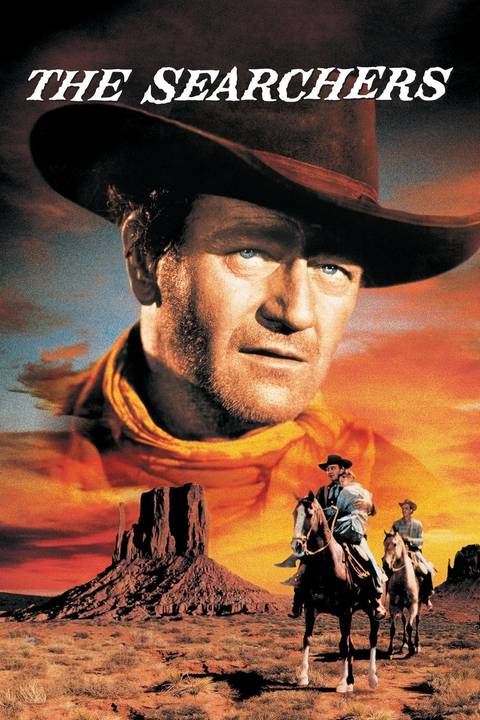
John Ford's The Searchers is a landmark Western that was a fulcrum point between the classics of the genre and the revisionist films that would dominate the next few decades. Viewed now, the separation between those two genre vantage points is even more obvious, with moments of profound violence and hatred punctured between hokey humor and romance. At the center of all of this is John Wayne, a complicated movie star, to say the least, but one who is more synonymous with Westerns than any other. His character of Ethan Edwards is one who is also caught between worlds. He's a man of violence, embittered by his own bigotry and bloody history, but he's also the only man capable of saving his niece who has been abducted by Comanche.
Ethan is a character who belongs to the violence of the Old West and is an anti-heroic herald of Western movie protagonists like those played by Clint Eastwood. He has no place in the civilized frontier, or in the kinds of black-and-white Westerns that made Wayne a star. He's a lonely, broken man. All of that is captured in the iconic final shot of The Searchers. Ethan has brought his niece back home after a years-long search filled with violence and vengeance. As the family rejoices inside, Ethan, framed by the doorway, walks away into the desolate desert. It's an image so potent and powerful that it feels like it should be the career crescendo for Wayne in Westerns, even though he continued to make them for two decades. The Searchers is a complicated film of contradictions that can be hard to defend, but there's no denying its impact or the perfection of its final shot.
The Searchers
Release Date May 26, 1956
Runtime 119 minutes
Director John Ford
Writers Frank S. Nugent
-

-

Jeffrey Hunter
Martin Pawley
![Alan Ritchson Officially Reveals Jack Reacher’s Real Superpower [Exclusive]](https://static0.colliderimages.com/wordpress/wp-content/uploads/2026/07/reacher-season-4-trailer-1.jpg?w=1600&h=900&fit=crop)





 English (US) ·