
 Image via Focus Features
Published Jun 21, 2026, 5:55 PM EDT
A New York native, Joe graduated from an avant-garde theater school upstate, where he was obsessed with sketch comedy. There, he and his lunatic friends founded The Sketchies — which still lives on at Skidmore College today. Living in New York City, a screenwriter friend of his then taught him how to write for film. This awakened a new passion in Joe. Since then his scripts have garnered over 200 festival selections, nominations, and wins all over the globe (including the BlueCat Best Feature award). Several of his screenplays have been made into feature films — some of them not that bad! Overall, he loves to create unique, hilarious, touching, and bizarre stories.
Sign in to your Collider account
Noir films of the 1940s, which drew influences from stark German expressionism, were inherently “heavy” by nature. The stories typically center on a troubled, introspective protagonist who becomes involved in a substantial crime of some sort, gets further sucked in by a femme fatale temptress, and ultimately has to come face to face with a corrupt authority figure or institution (all while the thick cloud of post-war angst hung over the action). And then, sometime in the 1970s, the form adapted, and the neo-noir hit the screens.
While the neo-noirs retained many of the oppressive characteristics of the originals, a lot of them injected lighter themes, more relevant to the times. The sex factor was ramped way up in numerous films, whereas other movies leaned more heavily into the wry comedy angle. Yet, some neo-noir flicks maintained the exceptionally weighty tones and topics of yesteryear. Resurrected from the uncharted depths of depression and depravity, here are the absolute heaviest neo-noir films of all time.
10 'L.A. Confidential' (1997)
 Image via Warner Bros.
A period piece neo-noir set in 1950s Los Angeles, this much-lauded film deals with a lot of pretty dense topics. It's centered on the crimes of the times and how law enforcement of the City of Angels dealt with the unspeakably corrupt legal system they were a part of. Director and co-writer Curtis Hanson crafted one of the best neo-noirs of the 1990s with L.A. Confidential — and definitely one of the heaviest, too.
After a multiple murder occurs, three L.A. cops are essentially put on the case. Each one of the three represents a different methodology in detecting. Ed Exley (Guy Pearce) does things in the standard procedural way, even if his ambition gets the best of him. Jack Vincennes (Kevin Spacey) is a detective who operates a bit outside the norm, as he leaks pertinent case info to the media for cash. Then there’s Bud White (Russell Crowe), a gumshoe who has no qualms about busting heads. The film also features Kim Basinger as a high-end prostitute, Lynn Bracken, in her Oscar-winning turn. All in all, the story is a complicated, intelligently woven one, with a sleekly stylish vibe and a very heady tone.
9 'After Dark, My Sweet' (1990)
 Image via Avenue Pictures Productions
Some neo-noir films stay true to the form, which intrinsically holds dark and hefty themes; others take things an even bleaker step further. This is the case with director/co-writer James Foley’s slow-burn masterwork After Dark, My Sweet. There’s one small yet outstanding aspect that brings this smoldering crime flick on to this list: the ending. So, there will be some sultry spoiling here; you are warned, my sweet…
The sordid tale follows Collie (Jason Patric, showing depths heretofore unseen), a boxer who’s taken a few too many shots to the head. He’s now a drifter who’s escaped a mental hospital. In an arid landscape he encounters Fay (the fetching Rachel Ward), a widow with a nefarious agenda. She entices Collie to help out with some chores…one of which involves a little kidnapping. Fay is aided by her shifty uncle Bud (the rodentia-faced Bruce Dern). When all is said and done, and the plan inevitably goes awry, Collie sacrifices himself to save the kid and protect Fay. It’s a sad end to a tragic figure, as true, fatal self-sacrifice of the protagonist is rarely seen in noirs, thus making this film decidedly, emotionally dense.
8 'Devil in a Blue Dress' (1995)
 Image via TriStar Pictures
Some neo-noirs are set in the time period of the original noirs, but that doesn’t make them any less neo. This is the case with Devil in a Blue Dress, director and co-writer Carl Franklin’s masterclass in mystery-crime storytelling. Dissecting the heavy themes of race, class disparity, post-war disillusionment, and economic destitution, this film succeeds on all levels. It lets the audience fully feel the depth and severity of the characters’ situations.
Ezekiel "Easy" Rawlins (Denzel Washington, brilliant in another starring role that seems specifically written for him) is a vet of the Great War, home and basically at a loss for what to do with the rest of his life. Easy is hired by DeWitt Albright (the always sleazy Tom Sizemore) to find a woman, Daphne Monet (the pulchritudinous and alluring Jennifer Beals). However, you guessed it, complications arise, bodies pile up, and Easy becomes the prime suspect. He gets in touch with an old buddy, Raymond "Mouse" Alexander (Don Cheadle), to help him weave his way through the volatile underworld of 1940s Los Angeles. A bit of a spoiler here, but the white-presenting Daphne is really biracial, and she’s been using her “whiteness” as a means to navigate her own way through this dangerous landscape. Heavy, indeed.
7 'Blue Ruin' (2013)
 Image via RADiUS-TWC
This film feels exceptionally weighty not only because of the dark themes of revenge, trauma, and persistent pain inherent to the story, but because of the exceptionally brutal and realistic manner in which the violence onscreen is displayed. Written and directed by Jeremy Saulnier, the extremely modestly-budgeted Blue Ruin is a neo-noir vengeance tale that leaves quite the deep, ruinous impact.
The simple story is that a laconic drifter named Dwight (Macon Blair in his breakout role) learns that the guy who killed his parents just got out of jail. He then sets out to kill the murderer, and kind of succeeds…all while dragging himself and his estranged sister, Sam (Amy Hargreaves), deeper into a chasm of anxiety, violence, and perpetual despair. The finale is quite the depress-fest, so strap in for that — but it does end with a tiny, faint glimmer of hope (otherwise it would be further down on this list).
6 'One False Move' (1991)
 Image via I.R.S. Releasing
When a film’s opening moments include multiple grisly murders, it's immediately apparent that the movie will be quite heavy in nature. Carl Franklin’s gritty crime thriller One False Move is a neo-noir that is steeped in ruthless acts of violence, razor-sharp commentary, and disturbing themes. Another racially-charged, tension-filled film, it keeps the audience on the edge of their seats the whole runtime.
A trio of thieves-turned-murderers, including Pluto (Michael Beach), the probably insane leader Ray (an oddly scary Billy Bob Thornton, who co-wrote the script), and Ray’s lover, the troubled Fantasia (Cynda Williams), escape L.A. after committing numerous homicidal acts. They head to Fantasia’s hometown, a little Southern berg presided over by Dale Dixon (Bill Paxton), a sheriff with his own traumatic past (which is entangled, coincidentally, with Fantasia’s…). In old school noir fashion, the film is crammed with irony and clever plot-twists — but in neo-style, it’s gruesome, animalistic, and unflinchingly heavy.
Collider Exclusive · Oscar Best Picture Quiz
Which Oscar Best Picture
Is Your Perfect Movie?
Parasite · Everything Everywhere · Oppenheimer · Birdman · No Country
Five Oscar Best Picture winners. Five completely different visions of what cinema can be — and what it can do to you. One of them is the film that was made for the way your mind works. Ten questions will figure out which one.
🪜Parasite
🌀Everything Everywhere
☢️Oppenheimer
🐦Birdman
🪙No Country for Old Men
FIND YOUR FILM →
01
What kind of film experience do you actually want? The best movies don't just entertain — they leave something behind.
ASomething that pulls the rug out — that makes me think I'm watching one kind of film and then reveals I'm watching another entirely. BSomething overwhelming — funny, sad, absurd, and genuinely moving, all at once. CSomething grand and weighty — a film that makes me feel the full scale of what I'm watching. DSomething formally daring — a film that pushes what cinema can even do. ESomething lean and relentless — pure tension with no wasted frame.
NEXT QUESTION →
02
Which idea grabs you most in a film? Great films are driven by a central obsession. What's yours?
AClass, inequality, and what people are willing to do when desperation meets opportunity. BIdentity, family, and the chaos of trying to hold your life together when everything is falling apart. CGenius, moral responsibility, and the catastrophic weight of a decision you can never take back. DEgo, legacy, and the terror of becoming irrelevant while you're still alive to watch it happen. EEvil, chance, and whether moral order actually exists or if we just tell ourselves it does.
NEXT QUESTION →
03
How do you like your story told? Form is content. The way a story is shaped changes what it means.
AGenre-twisting — I want it to start in one lane and migrate into something completely different. BMaximalist and genre-blending — comedy, action, drama, sci-fi, all in one ride. CEpic and non-linear — cutting between timelines, building a mosaic of cause and consequence. DA single unbroken flow — I want to feel like I'm living it in real time, no cuts to safety. ESpare and precise — every scene doing exactly what it needs to do and nothing more.
NEXT QUESTION →
04
What makes a truly great antagonist? The opposition defines the protagonist. What kind of opposition fascinates you?
AA system — invisible, structural, and almost impossible to fight because it has no single face. BThe self — the ways we sabotage, abandon, and fail the people we love most. CHistory — the unstoppable momentum of events that no single person can stop or redirect. DThe industry — the machinery of culture that chews up talent and spits out irrelevance. EPure, implacable evil — a force so certain of itself it becomes almost philosophical.
NEXT QUESTION →
05
What do you want from a film's ending? The final note is the one that lingers. What do you want it to sound like?
AShock and inevitability — a conclusion that recontextualises everything that came before it. BEarned emotion — I want to cry, laugh, and feel genuinely hopeful, even if the world is a mess. CDevastation and grandeur — an ending that makes me sit in silence for a few minutes after. DAmbiguity — something that leaves enough open that I'm still thinking about it days later. EBleakness — an honest refusal to pretend the world is tidier than it actually is.
NEXT QUESTION →
06
Which setting pulls you in most? Where a film takes place shapes everything — mood, stakes, what's even possible.
AA gleaming modern city with a hidden underside — beauty masking rot, wealth masking desperation. BA collapsing suburban life that opens onto something infinite — the multiverse of a single ordinary person. CThe corridors of power and science at a world-historical turning point — where decisions echo for decades. DThe grimy, alive chaos of New York and Hollywood — fame as both destination and trap. EVast, indifferent landscape — desert and highway where violence arrives without warning or reason.
NEXT QUESTION →
07
What cinematic craft impresses you most? Every great film has a signature — a technical or artistic element that makes it unmistakable.
AProduction design and mise-en-scène — every frame composed to carry meaning beneath the surface. BEditing and tonal control — the ability to move between registers without losing the audience. CScore and sound design — music that becomes inseparable from the dread and awe of what you're watching. DCinematography as performance — the camera not recording events but participating in them. ESilence and restraint — what's left unsaid and unshown doing more work than any dialogue could.
NEXT QUESTION →
08
What kind of main character do you root for? The protagonist is the lens. Who you choose to follow says something about you.
ASomeone smart and resourceful who makes increasingly dangerous decisions under pressure. BSomeone overwhelmed and ordinary who turns out to be capable of something extraordinary. CA brilliant, tortured figure whose gifts and flaws are inseparable from each other. DA self-destructive artist whose ego is both their superpower and their undoing. EA quiet, principled person trying to make sense of a world that has stopped making sense.
NEXT QUESTION →
09
How do you feel about a film that takes its time? Pace is a choice. Some films sprint; others let tension accumulate slowly, deliberately.
AI love a slow build when I know the payoff is going to be seismic — patience for a devastating reveal. BGive me relentless momentum — I want to feel breathless and emotionally spent by the end. CEpic runtime doesn't scare me — if the material demands three hours, give me three hours. DI want it to feel propulsive even when nothing is technically happening — restless energy throughout. EDeliberate and unhurried — I want dread to accumulate in the spaces between the action.
NEXT QUESTION →
10
What do you want to feel walking out of the cinema? The best films leave a mark. What kind of mark do you want?
AUnsettled — like I've just seen something I can't fully explain but can't stop thinking about. BMoved and energised — like the film reminded me what actually matters and gave me something to hold onto. CHumbled — like I've been in the presence of something genuinely important and overwhelming. DExhilarated — like I've just seen cinema doing something it's never quite done before. EHaunted — like a cold, quiet dread that stays with me for days.
REVEAL MY FILM →
The Academy Has Decided Your Perfect Film Is…
Your answers have pointed to one Oscar Best Picture winner above all others. This is the film that was made for the way your mind works.
Parasite
You are drawn to films that operate on multiple levels simultaneously — that begin in one genre and quietly, brilliantly migrate into another. Bong Joon-ho's Parasite is a film about class, desire, and the architecture of inequality that manages to be darkly funny, deeply suspenseful, and genuinely shocking across a single extraordinary running time. Your instinct is for cinema that hides its true intentions until the moment it's ready to reveal them. Parasite is exactly that — a film that rewards close attention and punishes assumptions, right up to its devastating final image.
Everything Everywhere All at Once
You want it all — and this film gives you all of it. The Daniels' Everything Everywhere All at Once is one of the most maximalist films ever made: action comedy, multiverse sci-fi, family drama, existential crisis, and a genuinely earned emotional core that sneaks up on you amid the chaos. You are someone who responds to ambition, who doesn't want cinema to choose between being entertaining and being meaningful. This film refuses that choice entirely. It is overwhelming by design, and its overwhelming nature is precisely the point — because the feeling of being crushed by infinite possibility is exactly what it's about.
Oppenheimer
You are drawn to cinema on a grand scale — films that understand history not as a backdrop but as a force, and that place their characters inside that force and watch what happens. Christopher Nolan's Oppenheimer is a film about the terrifying gap between what we can do and what we should do, told with the full weight of one of the most consequential moments in human history behind it. You want your films to feel important without feeling self-important — to earn their ambition through sheer craft and the gravity of their subject. Oppenheimer does exactly that. It is enormous, complicated, and refuses easy comfort.
Birdman
You are drawn to films that foreground their own construction — that make the how of the filmmaking part of the what it's about. Alejandro González Iñárritu's Birdman, shot to appear as a single continuous take, is cinema examining itself through the cracked mirror of a fading actor's ego. You respond to formal daring, to the feeling that a film is doing something that probably shouldn't be possible. Michael Keaton's performance and Emmanuel Lubezki's restless camera create something genuinely unlike anything else — a film that is simultaneously about creativity, relevance, self-destruction, and the impossibility of ever truly knowing if your work means anything at all.
No Country for Old Men
You are drawn to cinema that trusts silence, that refuses to explain itself, and that treats dread as a form of meaning. The Coen Brothers' No Country for Old Men is a film about the arrival of a new kind of evil — implacable, arbitrary, and utterly indifferent to the moral frameworks we use to make sense of the world. It is one of the most formally controlled films ever made, and its controlled restraint is what makes it so terrifying. You want your films to haunt you, not comfort you. You are not interested in resolution if resolution would be dishonest. No Country for Old Men is honest in a way that most cinema never dares to be.
↻ RETAKE THE QUIZ
5 'The Place Beyond the Pines' (2012)
 Image via Focus Features
Generational trauma is one of the big ones. It, obviously, transcends one person’s life and can permeate their subsequent offsprings’ whole beings. In director/co-writer Derek Cianfrance’s intense crime drama The Place Beyond the Pines, the sins of two separate fathers imbue the lives of their kids, in a truly deep and momentous way.
The three-part story breakdown is this: Luke (Ryan Gosling, reliable as always), a motorcycle stunt racer, learns that he’s actually a dad, and becomes determined to give his ex, Romina (the always captivating Eva Mendes), and their baby a nice life. Ergo, he needs more cash. He begins robbing banks, and this dovetails into the next chapter, as he comes face to face with a young cop with everything to prove, Avery Cross (Bradley Cooper). Needless to say, some lives are lost. The third portion of the tale kicks up 15 years later, and involves Luke and Avery’s kids, and their inevitable clash. When all is revealed, there is, ultimately, forgiveness, but it’s exceptionally weighty and rife with poignant implications.
4 'Affliction' (1997)
 Image via Lionsgate Films
You don’t need misty, rain-soaked streets to set your noir; Paul Schrader proved this with his gut-wrenching crime drama Affliction, which is set in the snow-covered woods of New England. The themes explored in this phenomenally complex and majestically shot film are quite heavy indeed, as rampant alcoholism is at the forefront and repressed child abuse is simmering on the back burner, just waiting to burn the whole thing down.
The tortured, ethically ambiguous protagonist of the tale is Wade Whitehouse (the scraggly-voiced Nick Nolte), the sheriff of a Podunk town in New Hampshire. A rich dude is “accidentally” killed while on a hunting excursion, and Wade is determined to wade through the subterfuge and get to the truth. In the process he must contend with his bastard of a dad, Glen (James Coburn, who took home an Oscar for this gruff and tumble role), and his daughter, Jill (Brigid Tierney), who rightly wants nothing to do with him. Needless to say, things keep getting worse and worse for poor Wade, and the frosty ending is downright brutal.
3 'A History of Violence' (2005)
 Image via Warner Bros. Pictures
As the title implies, this film is predicated on the barbarity endemic in human nature. The themes explored in this ultra-brutal film are about as heavy as it gets; the past is inescapable, people are inherently dangerous, and the murky things in our subconscious will inevitably bubble up and cause havoc. In a rare departure from sci-fi and horror, director David Cronenberg takes the audience on a journey that’s based in reality — and that’s probably the scariest part.
After opening with one of the most disturbing scenes in cinema history, the action shifts, and we’re introduced to Tom Stall (Viggo Mortensen), a mild-mannered diner owner…or so it seems. Soon it’s revealed that Tom’s got quite the past (truly A History of Violence), and it’s finally catching up with him (after he’s inadvertently put into the media spotlight after some unexpected "heroics"). The absolutely terrifying hit man Carl Fogarty (Ed Harris with creepy burn make-up) shows up in Tom’s little Indiana town and all hell is set to break loose. Tom grapples with his past, all while trying to keep things stable at home with his wife, Edie (the fierce Mario Bello). Things come to a head in one of the emotionally heaviest scenes ever, where Tom confronts his mob boss brother, Richie Cusack (William Hurt, totally killin’ it). Overall, this film is crammed with tension and devastatingly real, pitch-black motifs.
2 'Taxi Driver' (1976)
 Image via Columbia Pictures
Themes of underage prostitution, psychotic vigilantism, unprovoked violence, and unchecked mental illness are going to land a film on many lists that relate to “heaviness.” The profundity of Taxi Driver, brought to you by one of the best directors of the 20th and 21st centuries, Martin Scorsese, is just one of the highly compelling aspects of this neo-noir masterpiece.
For anyone who somehow missed this one, the fairly simple plot follows Vietnam veteran cab driver, Travis Bickle (Robert De Niro, back when he was only choosing quality films to star in), as he navigates both the glossy, upscale parts of New York City and the seediest, grimiest areas as well. As he metaphorically and psychically searches for a purpose, he encounters Iris (Jody Foster, in her first, Oscar-nominated, major role), a twelve-year-old prostitute. She’s remarkably spunky and seems to be able to hold her own, but Travis sees through this facade and determines that Iris needs to be freed from the filthy prison she’s condemned to (by the pimp Sport, played by Harvey Keitel, in his slimiest role ever). Once Travis shaves his hair into a Mohawk, you know it’s on. The profound weight of this noir revenge tale is almost too much to bear…so maybe just call an Uber.
1 'Chinatown' (1974)
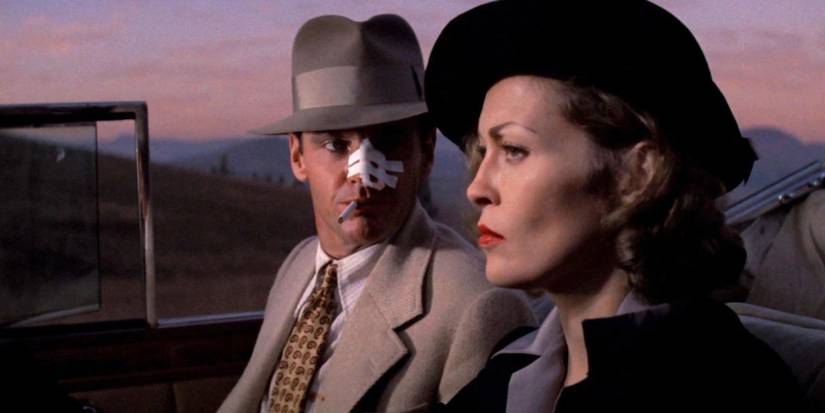 Image via Paramount Pictures
Weighing in as the absolute heaviest, this is arguably the best neo-noir ever — and, according to numerous critics and fans, the best movie of all time. That being said, Roman Polanski’s famed Chinatown is definitely deserving of the fanfare. And, it also should be regarded as the heaviest neo-noir because of the blazing themes of corruption, the ineptitude of authority, jealousy, familial trauma, political duplicity, murderous instinct, and, of course, aquatic schemes.
The story starts off plainly enough: a P.I., Jake Gittes (Jack Nicholson, in the role that cemented him as a Hollywood legend), in 1930s L.A. is hired to expose a “cheater.” Jake inadvertently falls down a rabbit hole of interwoven criminal plots and exposes a complex scam involving dams and the reallocation of water. In the midst of this, Jake gets entangled with the comely Evelyn Mulwray (Faye Dunaway) — she’s the one who hired him to spy on her hubby…but the real story here is much darker, and involves her father, Noah Cross (John Huston). Some spoiling here, so if you haven’t seen Chinatown yet, for the love of all that is cinematically holy, just go and stream it right now… Anyway, Evelyn tries to protect her child throughout most of the film, and at the end, it is revealed that she is also her “sister.” There aren’t many topics that are heavier than incest-rape, so Chinatown takes the awful cake in this category. It’s gritty, it’s real life…(forget it, Jake) it’s Chinatown…
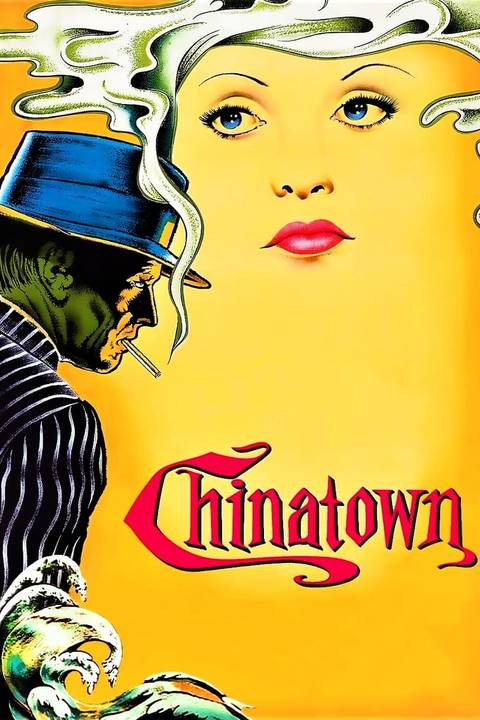
Chinatown
Release Date June 20, 1974
Runtime 130 minutes
Director Roman Polanski
Writers Robert Towne
-

-

Faye Dunaway
Evelyn Cross Mulwray








 English (US) ·