
 Image via Warner Bros.

Published Mar 21, 2026, 4:29 PM EDT
Diego Pineda has been a devout storyteller his whole life. He has self-published a fantasy novel and a book of short stories, and is actively working on publishing his second novel.
A lifelong fan of watching movies and talking about them endlessly, he writes reviews and analyses on his Instagram page dedicated to cinema, and occasionally on his blog. His favorite filmmakers are Andrei Tarkovsky and Charlie Chaplin. He loves modern Mexican cinema and thinks it's tragically underappreciated.
Other interests of Diego's include reading, gaming, roller coasters, writing reviews on his Letterboxd account (username: DPP_reviews), and going down rabbit holes of whatever topic he's interested in at any given point.
Sign in to your Collider account
War movies can be some of the most brutal films one could ever watch, but they can also be unexpectedly thrilling — in fact, they're often brutal and thrilling at the same time. That brings us to war thrillers, one of the most divisive subgenres that war cinema has ever produced. Can a movie possibly be anti-war if it also has elements of exciting action and nail-biting suspense? Do all war movies need to be anti-war to begin with?
There's no right or wrong answer to those questions, but not only is it perfectly possible to make a war thriller that's also effective as an anti-war statement: The subgenre's greatest examples of all time generally achieve that quite well. Even when they don't, and when they're just straight-up thrilling, they at least prove that a war thriller can be exciting without glorifying armed combat.
Collider Exclusive · Taylor Sheridan Universe Quiz
Which Taylor Sheridan
Show Do You Belong In?
Yellowstone · Landman · Tulsa King · Mayor of Kingstown
Four worlds. All of them brutal, complicated, and built on power, loyalty, and the price of survival. Taylor Sheridan doesn't write heroes — he writes people who do what they have to do and live with the cost. Ten questions will reveal which one of his worlds you were made for.
🤠Yellowstone
🛢️Landman
👑Tulsa King
⚖️Mayor of Kingstown
FIND YOUR WORLD →
01
Where does your power come from? In Sheridan's world, everyone has leverage. The question is what kind.
ALand, legacy, and a name that's been feared and respected for generations. BKnowing the deal better than anyone else in the room — and being willing to walk away first. CReputation. I've earned it the hard way, and everyone in the room knows it. DBeing the only person both sides will talk to. That makes me indispensable — and dangerous.
NEXT QUESTION →
02
Who do you put first, no matter what? Loyalty in Sheridan's universe is always absolute — and always costly.
AFamily — blood or chosen. The ranch, the name, the people who carry it with me. BThe company — or whoever's signing the cheques. Loyalty follows the contract. CMy crew. The men who stood with me when it counted — I don't abandon them for anything. DMy community — even when my community is a powder keg and I'm the only thing stopping it from blowing.
NEXT QUESTION →
03
Someone crosses a line. How do you respond? Every Sheridan protagonist has a line. What matters is what happens after it's crossed.
AQuietly, decisively, and in a way that sends a message to everyone watching. BI outmanoeuvre them legally, financially, and politically before they even know I've moved. CDirectly. Old school. You cross me, you hear about it to your face — and then you deal with the consequences. DI absorb it, calculate the fallout, and find the move that keeps the whole system from collapsing.
NEXT QUESTION →
04
Where do you feel most in your element? Sheridan's worlds are as much about place as they are about people.
AWide open land — mountains, sky, silence. Somewhere you can see trouble coming from a mile away. BThe oil fields of West Texas — brutal, lucrative, and indifferent to whoever happens to be standing on top of them. CA mid-size city where the rules haven't quite caught up yet — fertile ground for someone with vision and nerve. DA rust-belt town built around a prison — where everyone's life is shaped by what's inside those walls.
NEXT QUESTION →
05
How do you feel about operating in the grey? Nobody in a Sheridan show has clean hands. The question is how they carry the dirt.
AI do what has to be done to protect what's mine. I'll answer for it eventually — but not today. BGrey is just business. The line moves depending on what's at stake, and I move with it. CI have a code — it's not the law's code, but it's mine, and I don't break it. DI've made peace with it. Keeping the peace requires compromises most people don't have the stomach for.
NEXT QUESTION →
06
What are you actually fighting to hold onto? Every Sheridan character is fighting a war. The real question is what they're defending.
AA way of life that the modern world is doing everything it can to erase. BMy position — and the leverage that comes with being the person everyone needs to close a deal. CRelevance. I've been away, I've been written off — and I'm proving that was a mistake. DWhatever fragile order I've managed to build — because without it, everything burns.
NEXT QUESTION →
07
How do you lead? Authority in Sheridan's world is never given — it's established, maintained, and constantly tested.
ABy example and force of will. People follow me because they believe in what I'm protecting — and because they know what happens if they don't. BThrough negotiation and leverage. I don't need people to like me — I need them to need me. CBy being the smartest, most experienced person in the room and making sure everyone quietly knows it. DBy being the calm centre of a situation that would spiral without me — and accepting that nobody thanks you for it.
NEXT QUESTION →
08
Someone new arrives and tries to change how things work. Your reaction? Every Sheridan show has an outsider disrupting an established order. Sometimes that outsider is you.
AThey'll learn. Or they won't. Either way, the land was here before them and it'll be here after. BI figure out what they want, what they're worth, and whether they're an asset or a problem — fast. CI was the outsider once. I give them a chance — one — to show they understand respect. DNew players destabilise everything I've built. I assess the threat and manage it before it manages me.
NEXT QUESTION →
09
What has your position cost you? Nobody gets to where these characters are without paying for it. The bill is always personal.
AMy family's peace — maybe their innocence. The ranch demands everything, and I've let it take too much. BRelationships, time, any version of a normal life. The job eats everything that isn't nailed down. CYears. Decades in some cases. Time I can't get back — but I'm not done yet. DMy conscience, mostly. And the ability to ever fully trust anyone on either side of the wall.
NEXT QUESTION →
10
When it's over, what do you want people to say? Sheridan's characters all know the ending is coming. The question is what they leave behind.
AThat I held the line. That the land is still ours and everything I did was worth it. BThat I was the best at what I did and that no deal ever got closed without me at the table. CThat I built something real, somewhere nobody expected it, and I did it on my own terms. DThat I kept the peace when nobody else could — and that the town is still standing because of it.
REVEAL MY SHOW →
Sheridan Has Spoken You Belong In…
The show that claimed the most of your answers is the world you were built for. If two tied, both are shown — you're complicated enough to straddle two Sheridan universes.
🤠 Yellowstone
🛢️ Landman
👑 Tulsa King
⚖️ Mayor of Kingstown
You are a Dutton — or you might as well be. You understand that some things are worth protecting at any cost, and that the modern world's indifference to history, to land, to legacy, is not something you're willing to accept quietly. You lead from the front, you carry your family's weight without complaint, and when someone threatens what's yours, you don't escalate — you finish it. You're not cruel. But you are absolute. In Yellowstone's world, that combination of ferocity and loyalty doesn't make you a villain. It makes you the only thing standing between everything that matters and everyone who wants to take it.
You thrive in the chaos of high-stakes negotiation, where the money is enormous, the margins are thin, and the wrong word in the wrong room can cost everyone everything. You're a fixer — the person called when a situation is already on fire and needs someone with the nerve to walk into it. West Texas oil country rewards exactly what you are: sharp, adaptable, unsentimental, and absolutely clear-eyed about what people want and what they'll do to get it. You're not naive enough to think this world is fair. You're smart enough to be the one deciding who it's fair to.
You are a Dwight Manfredi — someone who has served their time, paid their dues, and arrived somewhere unexpected with nothing but their reputation and their wits. You adapt without losing yourself. You build loyalty through respect rather than fear, though you're not above reminding people that the two aren't mutually exclusive. Tulsa King is for people who are still standing when everyone assumed they'd be finished — who find, in an unfamiliar place, that they're more capable than the world gave them credit for. You don't need a throne. You build one, wherever you happen to land.
You carry the weight of a system that is broken by design, and you do it anyway — because someone has to, and because you're the only one positioned to do it without the whole thing collapsing. Mike McLusky's world is for people who are comfortable operating where there are no good options, only less catastrophic ones. You speak every language: law enforcement, criminal, political, human. That fluency makes you invaluable and it makes you a target. You've made your peace with both. Mayor of Kingstown belongs to people who understand that keeping the peace is not the same as being at peace — and who do the job regardless.
↻ RETAKE THE QUIZ
10 'Dunkirk' (2017)
 Image via Warner Bros. Pictures
Christopher Nolan has been one of Hollywood's leading voices in blockbuster filmmaking since he released Batman Begins in 2005, and he has never really stopped. One of his most underappreciated outings, however, also happens to be one of the greatest war movie masterpieces of the last century. It's, of course, Dunkirk, a harrowing recreation of the evacuation from the titular French city during World War II.
The movie is built on the basis of the same kind of structural playfulness and chronological twists that have come to define Nolan's whole filmography, and though it makes for an enthralling and adrenaline-pumping thriller, it can also be an absolutely brutal experience. Nolan carefully ensures that his grand action set pieces (largely reliant on practical effects rather than just CGI) keep the audience at the edge of their seats without ever romanticizing its historical subject.
9 'Son of Saul' (2015)
 Image via Mozinet
The Hungarian period tragedy Son of Saul is a war thriller through and through, but one far different from the kind of blockbuster-y experience that most people may initially think of when they hear "war thriller." It's a far more artsy and slower-paced piece, as well as an absolutely harrowing chronicle of a day and a half in the life of a member of the Sonderkommando in the Auschwitz concentration camp.
Holocaust films in general are, for obvious reasons, gut-wrenching movies by nature, but Son of Saul takes things a step further through its unique shooting style, where the camera stays exclusively focused on the main character's face for almost the entire runtime. It makes for one of the most essential war movies of the 2010s, an emotionally stirring and thematically profound powerhouse that makes no artistic compromises at any point during its runtime.
8 'The Train' (1964)
 Image via United Artists
The war genre is no stranger to mixing its genre elements with those of a spy thriller, and John Frankenheimer's The Train is one of the best examples of that mixture. It's based on a non-fiction book that documents the works of art placed in storage that were looted by Nazi Germany during World War II, and the way it explores the conflict between the preservation of material cultural heritage and the human cost of war is absolutely fascinating.
The movie's moral and psychological complexity makes for a hard-hitting, absolutely visceral thriller that refuses to ever let its big set pieces take over the thematic layers of the narrative. The Train is a gripping, highly philosophical gem bolstered by a terrific lead performance by Paul Lancaster, and undoubtedly one of the most emotionally and intellectually compelling war movies of the '60s.
7 'Fail Safe' (1964)
 Image via Columbia Pictures
Frankenheimer wasn't the only legendary filmmaker who made an extraordinary war movie in 1964. The great Sidney Lumet got together with his 12 Angry Men collaborator Henry Fonda to make Fail Safe, a political thriller about a nuclear crisis that perfectly reflects the nuclear paranoia that so many films from the Cold War era explored. Unlike The Train, it was a commercial disappointment, but much like The Train, it has aged wonderfully as one of the best war films of the '60s.
The political complexity of the movie is to be admired, and it has made it so that its narrative age terrifyingly well. Fail Safe is still every bit as scary today as it must have been back in 1964, and although it doesn't feature traditional sequences of military combat, it's still every bit as much of an edge-of-your-seat thriller as any war film full of grand action set pieces.
6 'The Great Escape' (1963)
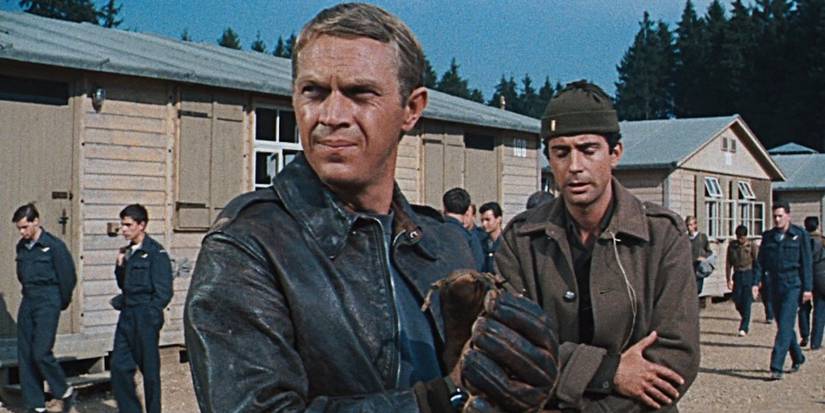 Image via United Artists
With a star-studded cast, a perfectly-paced three-hour runtime, and Steve McQueen at the very top of his game, director John Sturges created one of the most legendary war epics in history. The Great Escape is easily among the most perfect WWII movies of all time, and though its depiction of the mass escape of British Commonwealth POWs is heavily fictionalized, the fact that it's even inspired by a true story at all makes it a must-see for history buffs.
Those who dislike when war movies are focused on excitement and adventure will probably not love The Great Escape, but those who understand that these rousing tales of heroism are just as essential to the genre as anti-war arthouse dramas will be absolutely delighted by it. The Great Escape is one of the most thrilling movies of the 20th century, anchored by Elmer Bernstein's iconic score, one of the best of any film of the '60s.
5 'A Man Escaped' (1956)
 Image via Gaumont Film Company
Robert Bresson is not only one of the greatest French filmmakers in history, but also one of the most groundbreaking and influential European directors in the history of cinema. His work is a must-see for all those who love the Seventh Art, and A Man Escaped would be a phenomenal place to start. It's one of those near-perfect thrillers that almost nobody remembers, a masterful prison drama whose titular spoiler is entirely intentional.
A Man Escaped stands out thanks to its focus on humanist themes of freedom's struggle and survival against all odds.
That's because, even though it's definitely a thriller, A Man Escaped stands out thanks to its focus on humanist themes of freedom's struggle and survival against all odds, rather than pure suspense. It's a masterclass in the kind of minimalist filmmaking that Bresson is known for, stripping both the war genre and the very cinematic medium down to only their most essential elements. It's a truly fascinating experience.
4 'Inglourious Basterds' (2009)
Quentin Tarantino is well-known as one of the most acclaimed Hollywood filmmakers of modern times, as well as the man behind several of the greatest thrillers of the '90s and the 21st century. That includes the war epic Inglourious Basterds, a black comedy that puts a twist on the history of World War II that all fans of war cinema will surely be able to appreciate.
It's one of the most perfectly-directed action movies of all time, boosted by its exceptional cast (Christoph Waltz's Oscar-winning villainous performance standing out as one of the best of the 2000s) and by one of Tarantino's most intricate screenplays. From the opening scene to the infamous bar sequence, Inglourious Basterds is packed with some of the most perfectly suspenseful moments from Tarantino's entire filmography, and that's enough to make it one of the best war thrillers ever made.
3 'Army of Shadows' (1969)
 Image via Valoria Films
The Franco-Italian co-production Army of Shadows is an adaptation of Joseph Kessel's 1943 book of the same name, which mixes his own experiences as a member of the French Resistance with fictional versions of other Resistance members. It's one of the greatest—and most underrated, at least by the mainstream public—WWII movies ever made, and one of the most perfect war thrillers of all time.
When it first came out in France, Army of Shadows was poorly received due to its perceived glorification of Charles de Gaulle. If its modern reappraisal and the fact that cinephiles today consider it one of the greatest war films in history teaches us anything, it's that sometimes, all a war thriller needs in order to be appreciated as an undisputed masterpiece is the passage of time. It's a thriller that refuses to thrill, instead serving as a somber and ambitious study of sacrifice and paranoia during wartime.
2 'Battleship Potemkin' (1925)

Image via Goskino
Soviet cinema was the product of several of the greatest films of the entire 21st century, as well as the birthplace of many of the most influential filmmakers in history. That includes Sergei Eisenstein, whose war epic Battleship Potemkin is far and away one of the biggest cornerstones of cinema released during the 1920s. It's perhaps the most notorious example of the Soviet montage film movement and theory, which posed editing as the principal reason why cinema can serve as a storytelling medium.
But Battleship Potemkin isn't just a fascinating historical document: It's one of the best silent movies of all time, a revolutionary technical masterpiece that's still every bit as immensely thrilling today as it surely must have been for audiences back in 1925. It's also surprisingly brutal for a war film of the era, the Odessa Steps scene in particular being one of the greatest sequences in the history of war cinema.
1 'Come and See' (1985)
 Image via Sovexportfilm
The Soviet masterpiece Come and See is far and away the highest-rated European film on Letterboxd, and for good reason. This work of art by Elem Klimov is the closest that a war movie has ever come to feeling like a horror movie without actually being a horror movie, and that's what has allowed it to age as well as it has. It's no traditional coming-of-age; rather, it's the quintessential film that studies how war and violence don't just destroy innocence, but force it to mutate into something altogether grotesque.
Come and See wouldn't work half as well as it does without Aleksei Kravchenko delivering what's not just the greatest child acting performance in the history of cinema, but one of the greatest performances of all time in general. But aside from Kravchenko's transformative turn, Come and See is brutal thanks to Klimov's uncompromising direction, which explores the natural brutality of its story with raw, relentless realism—but never romanticization or sensationalism. It's one of the most perfect war movies ever made, and it's certainly the best war thriller ever made.
![New 100% RT Cyber Thriller Unleashes 10-Minute Sneak Peek [Exclusive]](https://static0.colliderimages.com/wordpress/wp-content/uploads/2026/01/wardriver-sasha-calle-dane-dehaan.jpg?w=1600&h=900&fit=crop)



 English (US) ·