
Upstairs-downstairs movies are all about class divides. They look at social hierarchies and secret lives, particularly the often complex, codependent relationships between rich employers and their servants. At their best, these films examine themes like power, loyalty, ambition, and social change from multiple perspectives at once.
The finest movies in this tradition lean toward historical drama, but they also include biting comedies and murder mysteries, or even a combination of all three. This list will rank the best upstairs-downstairs movies based on their overall quality and how well they tackle the subgenre's main concerns. There's much food for thought here, but there's also undeniable entertainment.
10 'The Servant' (1963)
 Image via Warner-Pathé
"I know my place. Do you know yours?" This drama was written by influential British playwright and screenwriter Harold Pinter. In it, wealthy young aristocrat Tony (James Fox) hires the impeccably polite Barrett (Dirk Bogarde) as his manservant, expecting the traditional hierarchy between employer and employee to remain unquestioned. Instead, Barrett gradually begins manipulating every aspect of Tony's life, reversing their relationship in ways that become increasingly unsettling.
This setup allows for a sharp examination of class and power. Tony and Barrett quietly struggle for dominance, to the point that it becomes difficult to identify who truly controls the household. The narrative momentum is driven by psychological tension and subtle shifts in authority; a tricky gambit that the cast and crew ultimately pull off. Story aside, The Servant has also been praised for its innovative use of sound and editing, getting more creative than one might expect from a drama of its era.
9 'A Room with a View' (1985)
 Image via Curzon Film Distributors
"Life should be lived passionately." This adaptation of the E.M. Forster classic was directed by James Ivory, who would later pen the screenplay for Call Me by Your Name. Set in the early 1900s, A Room with a View centers on the sheltered Lucy Honeychurch (Helena Bonham Carter) who, while visiting Florence, unexpectedly encounters the unconventional George Emerson (Julian Sands). His honesty and openness challenge everything she has been taught about marriage and propriety.
Through Lucy's views and relationship with George, the film poignantly contrasts rigid Edwardian social conventions with the possibilities and risks of personal freedom. A Room with a View is stately, heartfelt, and ultimately revealing, capturing an entire mindset through lush visuals and a love story that's as sentimental as it's thought-provoking.
8 'Howards End' (1992)
 Image via Sony Pictures Classics
"Only connect." Another Forster adaptation from James Ivory, Howards End explores the changing social landscape of early twentieth-century England through three families from different social strata. The cultured but financially insecure Schlegels, the wealthy Wilcoxes, and the struggling clerk Leonard Bast (Samuel West) become increasingly entangled through romance and tragedy. A who's-who of British talent fills out the cast, including Emma Thompson, Helena Bonham Carter, Vanessa Redgrave, and Anthony Hopkins.
Thompson won the Best Actress Oscar for her portrayal of the kind, intelligent Margaret Schlegel, the character who best embodies the film's belief in the power of empathy. Around her, the countryside estates and elegant drawing rooms become symbols of both privilege and exclusion, yet there's still a flicker of hope that things can change. All in all, Howards End is beautifully acted and deeply emotionally resonant, a classic British period drama about a classic British issue.
7 'The Remains of the Day' (1993)
 Image via Columbia Pictures
"Dignity comes at a cost." This strong adaptation of Kazuo Ishiguro's Booker Prize-winning book features Anthony Hopkins as Stevens, the impeccably professional butler of Darlington Hall, who devotes his entire life to serving his aristocratic employer (James Fox) with absolute loyalty. But as decades pass, his dedication costs him mounting opportunities for love, personal fulfillment, and even moral independence. Stevens' inability to acknowledge his feelings becomes increasingly tragic as the years slip away.
While that may not sound all that dramatic, The Remains of the Day becomes a heartbreaking study of duty and emotional repression. The relationship between Stevens and housekeeper Miss Kenton (Emma Thompson) provides the movie with its emotional center. Their connection unfolds almost entirely through restrained, stoic conversation, making every missed opportunity and every stolen glance deeply affecting. Theirs is a near-romance in the vein of In the Mood for Love, just as heartbreaking and ultimately rewarding
6 'The Leopard' (1963)
 Image via Titanus
"If we want things to stay as they are, things will have to change." Here, Italian director Luchino Visconti took on the ambitious task of translating Giuseppe Tomasi di Lampedusa's acclaimed novel to the screen. The Leopard examines the decline of the Sicilian aristocracy during Italy's unification through the eyes of Prince Fabrizio Salina (Burt Lancaster delivering one of his finest performances). As revolution reshapes the country around him, the Prince recognizes that the traditional social order sustaining his family's influence is quietly disappearing.
Indeed, a new ruling class is emerging, one driven by raw wealth rather than inherited status. In this regard, the movie gets unusually complex with its treatment of class dynamics, rendering all sides in shades of gray. Visually, The Leopard is a real feast: lavish palaces and breathtaking costumes emphasize the fading elegance of an entire civilization approaching its inevitable collapse.
5 'The Age of Innocence' (1993)
 Image via Columbia Pictures
"The worst prisons are often invisible." The Age of Innocence proved that Martin Scorsese is every bit as masterful with period romantic dramas as he is with crime epics. Set among New York's upper-class society during the 1870s, it follows respectable lawyer Newland Archer (Daniel Day-Lewis) as he becomes increasingly drawn to the unconventional Countess Ellen Olenska (Michelle Pfeiffer) despite his engagement to the impeccably proper May Welland (Winona Ryder).
In this world, high society is its own kind of jail, every decision constrained by stifling notions of reputation and respectability. Conversations are carefully calculated, and even a stray moment of emotional honesty can carry enormous consequences. The performances communicate a ton of emotional complexity beneath the impeccable manners and words unsaid, making the half-submerged tensions almost unbearable. Beautifully crafted and subtly moving.
4 'Gosford Park' (2001)
 Image via USA Films
"The servants know everything." Robert Altman flexed his muscle for ensemble drama once again with Gosford Park, a brilliant fusion of murder mystery and upstairs-downstairs drama. Written by Downton Abbey's Julian Fellowes and drawing heavily on Jean Renoir's The Rules of the Game, the film takes place during a lavish English country-house weekend in the 1930s. While wealthy aristocrats enjoy extravagant dinners and hunting parties above stairs, an equally fascinating community of butlers, maids, valets, and cooks quietly navigates its own intricate hierarchy below.
When murder interrupts the gathering, both worlds become inseparably connected. From here, an impressive array of subplots and character arcs unfold at once. Rather than focusing exclusively on the aristocracy, Altman grants equal attention to the servants, revealing how thoroughly their lives shape, and are shaped by, the households they support. He draws phenomenal work out of his fantastic cast, including the Oscar-nominated duo of Maggie Smith and Helen Mirren alongside Michael Gambon, Kristin Scott Thomas, and Clive Owen.
Collider Exclusive · Oscar Best Picture Quiz
Which Oscar Best Picture
Is Your Perfect Movie?
Parasite · Everything Everywhere · Oppenheimer · Birdman · No Country
Five Oscar Best Picture winners. Five completely different visions of what cinema can be — and what it can do to you. One of them is the film that was made for the way your mind works. Ten questions will figure out which one.
🪜Parasite
🌀Everything Everywhere
☢️Oppenheimer
🐦Birdman
🪙No Country for Old Men
FIND YOUR FILM →
01
What kind of film experience do you actually want? The best movies don't just entertain — they leave something behind.
ASomething that pulls the rug out — that makes me think I'm watching one kind of film and then reveals I'm watching another entirely. BSomething overwhelming — funny, sad, absurd, and genuinely moving, all at once. CSomething grand and weighty — a film that makes me feel the full scale of what I'm watching. DSomething formally daring — a film that pushes what cinema can even do. ESomething lean and relentless — pure tension with no wasted frame.
NEXT QUESTION →
02
Which idea grabs you most in a film? Great films are driven by a central obsession. What's yours?
AClass, inequality, and what people are willing to do when desperation meets opportunity. BIdentity, family, and the chaos of trying to hold your life together when everything is falling apart. CGenius, moral responsibility, and the catastrophic weight of a decision you can never take back. DEgo, legacy, and the terror of becoming irrelevant while you're still alive to watch it happen. EEvil, chance, and whether moral order actually exists or if we just tell ourselves it does.
NEXT QUESTION →
03
How do you like your story told? Form is content. The way a story is shaped changes what it means.
AGenre-twisting — I want it to start in one lane and migrate into something completely different. BMaximalist and genre-blending — comedy, action, drama, sci-fi, all in one ride. CEpic and non-linear — cutting between timelines, building a mosaic of cause and consequence. DA single unbroken flow — I want to feel like I'm living it in real time, no cuts to safety. ESpare and precise — every scene doing exactly what it needs to do and nothing more.
NEXT QUESTION →
04
What makes a truly great antagonist? The opposition defines the protagonist. What kind of opposition fascinates you?
AA system — invisible, structural, and almost impossible to fight because it has no single face. BThe self — the ways we sabotage, abandon, and fail the people we love most. CHistory — the unstoppable momentum of events that no single person can stop or redirect. DThe industry — the machinery of culture that chews up talent and spits out irrelevance. EPure, implacable evil — a force so certain of itself it becomes almost philosophical.
NEXT QUESTION →
05
What do you want from a film's ending? The final note is the one that lingers. What do you want it to sound like?
AShock and inevitability — a conclusion that recontextualises everything that came before it. BEarned emotion — I want to cry, laugh, and feel genuinely hopeful, even if the world is a mess. CDevastation and grandeur — an ending that makes me sit in silence for a few minutes after. DAmbiguity — something that leaves enough open that I'm still thinking about it days later. EBleakness — an honest refusal to pretend the world is tidier than it actually is.
NEXT QUESTION →
06
Which setting pulls you in most? Where a film takes place shapes everything — mood, stakes, what's even possible.
AA gleaming modern city with a hidden underside — beauty masking rot, wealth masking desperation. BA collapsing suburban life that opens onto something infinite — the multiverse of a single ordinary person. CThe corridors of power and science at a world-historical turning point — where decisions echo for decades. DThe grimy, alive chaos of New York and Hollywood — fame as both destination and trap. EVast, indifferent landscape — desert and highway where violence arrives without warning or reason.
NEXT QUESTION →
07
What cinematic craft impresses you most? Every great film has a signature — a technical or artistic element that makes it unmistakable.
AProduction design and mise-en-scène — every frame composed to carry meaning beneath the surface. BEditing and tonal control — the ability to move between registers without losing the audience. CScore and sound design — music that becomes inseparable from the dread and awe of what you're watching. DCinematography as performance — the camera not recording events but participating in them. ESilence and restraint — what's left unsaid and unshown doing more work than any dialogue could.
NEXT QUESTION →
08
What kind of main character do you root for? The protagonist is the lens. Who you choose to follow says something about you.
ASomeone smart and resourceful who makes increasingly dangerous decisions under pressure. BSomeone overwhelmed and ordinary who turns out to be capable of something extraordinary. CA brilliant, tortured figure whose gifts and flaws are inseparable from each other. DA self-destructive artist whose ego is both their superpower and their undoing. EA quiet, principled person trying to make sense of a world that has stopped making sense.
NEXT QUESTION →
09
How do you feel about a film that takes its time? Pace is a choice. Some films sprint; others let tension accumulate slowly, deliberately.
AI love a slow build when I know the payoff is going to be seismic — patience for a devastating reveal. BGive me relentless momentum — I want to feel breathless and emotionally spent by the end. CEpic runtime doesn't scare me — if the material demands three hours, give me three hours. DI want it to feel propulsive even when nothing is technically happening — restless energy throughout. EDeliberate and unhurried — I want dread to accumulate in the spaces between the action.
NEXT QUESTION →
10
What do you want to feel walking out of the cinema? The best films leave a mark. What kind of mark do you want?
AUnsettled — like I've just seen something I can't fully explain but can't stop thinking about. BMoved and energised — like the film reminded me what actually matters and gave me something to hold onto. CHumbled — like I've been in the presence of something genuinely important and overwhelming. DExhilarated — like I've just seen cinema doing something it's never quite done before. EHaunted — like a cold, quiet dread that stays with me for days.
REVEAL MY FILM →
The Academy Has Decided Your Perfect Film Is…
Your answers have pointed to one Oscar Best Picture winner above all others. This is the film that was made for the way your mind works.
Parasite
You are drawn to films that operate on multiple levels simultaneously — that begin in one genre and quietly, brilliantly migrate into another. Bong Joon-ho's Parasite is a film about class, desire, and the architecture of inequality that manages to be darkly funny, deeply suspenseful, and genuinely shocking across a single extraordinary running time. Your instinct is for cinema that hides its true intentions until the moment it's ready to reveal them. Parasite is exactly that — a film that rewards close attention and punishes assumptions, right up to its devastating final image.
Everything Everywhere All at Once
You want it all — and this film gives you all of it. The Daniels' Everything Everywhere All at Once is one of the most maximalist films ever made: action comedy, multiverse sci-fi, family drama, existential crisis, and a genuinely earned emotional core that sneaks up on you amid the chaos. You are someone who responds to ambition, who doesn't want cinema to choose between being entertaining and being meaningful. This film refuses that choice entirely. It is overwhelming by design, and its overwhelming nature is precisely the point — because the feeling of being crushed by infinite possibility is exactly what it's about.
Oppenheimer
You are drawn to cinema on a grand scale — films that understand history not as a backdrop but as a force, and that place their characters inside that force and watch what happens. Christopher Nolan's Oppenheimer is a film about the terrifying gap between what we can do and what we should do, told with the full weight of one of the most consequential moments in human history behind it. You want your films to feel important without feeling self-important — to earn their ambition through sheer craft and the gravity of their subject. Oppenheimer does exactly that. It is enormous, complicated, and refuses easy comfort.
Birdman
You are drawn to films that foreground their own construction — that make the how of the filmmaking part of the what it's about. Alejandro González Iñárritu's Birdman, shot to appear as a single continuous take, is cinema examining itself through the cracked mirror of a fading actor's ego. You respond to formal daring, to the feeling that a film is doing something that probably shouldn't be possible. Michael Keaton's performance and Emmanuel Lubezki's restless camera create something genuinely unlike anything else — a film that is simultaneously about creativity, relevance, self-destruction, and the impossibility of ever truly knowing if your work means anything at all.
No Country for Old Men
You are drawn to cinema that trusts silence, that refuses to explain itself, and that treats dread as a form of meaning. The Coen Brothers' No Country for Old Men is a film about the arrival of a new kind of evil — implacable, arbitrary, and utterly indifferent to the moral frameworks we use to make sense of the world. It is one of the most formally controlled films ever made, and its controlled restraint is what makes it so terrifying. You want your films to haunt you, not comfort you. You are not interested in resolution if resolution would be dishonest. No Country for Old Men is honest in a way that most cinema never dares to be.
↻ RETAKE THE QUIZ
3 'The Grand Budapest Hotel' (2014)
 Image via Searchlight Pictures
"Keep your hands off my lobby boy!" Ranking among Wes Anderson's very best work, The Grand Budapest Hotel transforms the upstairs-downstairs tradition into a whimsical yet bittersweet adventure. Legendary concierge Monsieur Gustave H. (Ralph Fiennes) presides over Europe's most elegant hotel with impeccable charm, while his devoted lobby boy Zero Moustafa (Tony Revolori) serves as his closest companion and eventual successor. Their friendship grows against a backdrop of political upheaval, murder, inheritance disputes, and the collapse of an entire social order.
Along the way, Anderson uses his unmistakable visual style, as rich as one of Mendl's cakes, to celebrate the illusion of a world of etiquette, hospitality, and old-fashioned civility. Indeed, beneath the film's humor lies a surprisingly poignant meditation on memory and the fragility of civilization, especially as the world Gustav embodies begins to crumble in the rising shadow of Nazi Germany.
2 'Parasite' (2019)
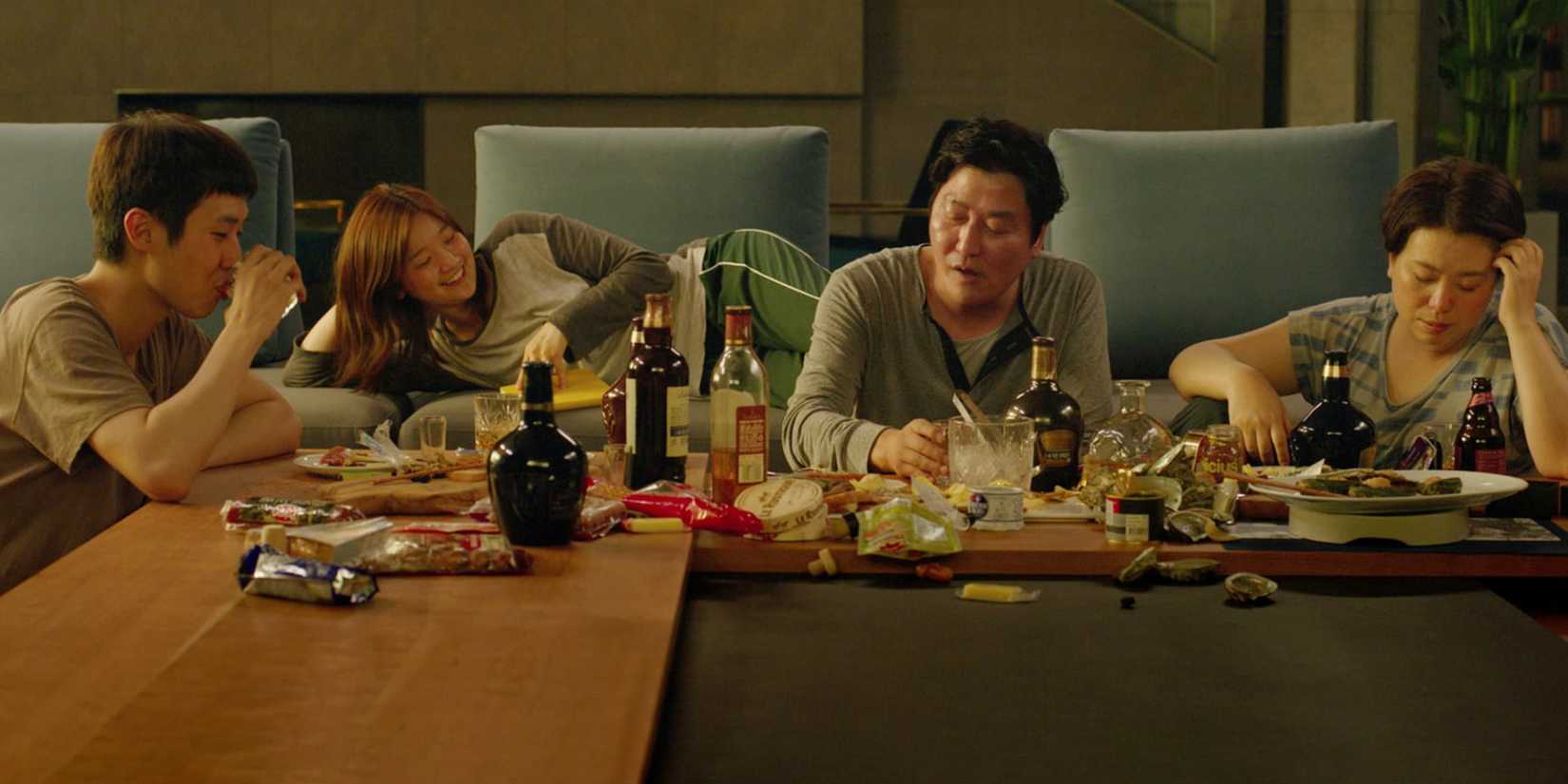 Image via NEON
"They're rich because they're nice." This movie struck a nerve on release, resonating with viewers all across the globe. Struggling financially, the Kim family infiltrates the wealthy Park household by securing jobs as tutors, drivers, and domestic staff through an elaborate web of deception. However, what begins as a clever social satire slowly evolves into an increasingly suspenseful and devastating examination of inequality that eventually verges on outright horror.
Crucially, Parasite refuses simplistic moral judgments. Both families are portrayed with empathy, allowing the system that keeps them divided to emerge as the true villain. The themes hit hard, amplified by Bong Joon Ho's razor-sharp direction. His visual storytelling is especially strong here; for instance, the Parks' luxurious modern home and the Kims' cramped semi-basement apartment become potent symbols for disparity. Likewise, shots of staircases reinforce the physical and economic distance separating the two families.
1 'The Rules of the Game' (1939)
 Image via Gaumont Film Company
"Everyone has their reasons." The Rules of the Game remains the definitive upstairs-downstairs film because it established the template nearly every later masterpiece would follow. It's about an escalating tragedy during a country-house gathering attended by aristocrats, servants, lovers, and guests. Jealousies, misunderstandings, romantic entanglements, and betrayals abound. Throughout it all, the boundaries separating masters and servants prove far more fragile than anyone initially realizes. In fact, the aristocrats and their employees mirror one another in revealing ways.
It all becomes a vivid snapshot of Europe on the eve of World War II, an entire social system unraveling before the audience's eyes. Initially misunderstood, The Rules of the Game's reputation steadily grew over time, and it's now widely regarded as one of the greatest movies ever made. Even today, its fluid camerawork and sophisticated ensemble storytelling feel strikingly modern.







 English (US) ·