
Science fiction is a packed genre, containing many classics as well as an overabundance of duds. This means that, amid the dreck, there are still some relatively obscure gems to be found. Those movies are the focus of this list: titles that many of the genre's fans may not have gotten around to yet but which are worth seeing, especially now.
The titles below run the gamut from campy sci-fi horror to existential arthouse on a spaceship, robot death battles to unexplained parallel universes. Sure, not all of them are masterpieces, but these sci-fi movies all offer something to enjoy, whether that's food for thought or just pure pulp.
'Hardware' (1990)
 Image via Palace Pictures
"Welcome to the future." Hardware is a grimy but undeniably quirky flick from director Richard Stanley, who also made the surprisingly strong 2019 H.P. Lovecraft adaptation Color Out of Space. This one is a gleeful mishmash of ideas ripped from Judge Dredd, The Terminator, Soylent Green, Roger Zelazny, and Philip K. Dick. Set after a nuclear war, the story follows a young artist (Stacey Travis) who unknowingly brings home the remains of a military robot recovered from the irradiated wasteland.
Unfortunately, the machine isn't as inactive as it appears. Once inside her apartment, the machine slowly reconstructs itself before turning homicidal. Soon, the characters are fighting for survival in the apartment's claustrophobic confines. It's all pretty goofy, though also animated by an anarchic spirit that makes up for many of the missteps. Unsurprisingly, over the decades, Hardware has become a cult film.
'Monsters' (2010)
 Image via ©Magnet Releasing/Courtesy Everett Collection
"Don't make a sound." Years before directing Godzilla and Rogue One, Gareth Edwards made his feature debut with this inventive, low-budget banger. Monsters takes place six years after alien organisms have spread across large areas of Mexico, forcing the government to quarantine enormous regions of the country. An American photojournalist (Scoot McNairy) reluctantly agrees to escort his employer's daughter (Whitney Able) back to the United States, requiring the pair to cross the dangerous infected zone.
The title initially suggests a creature feature, but Monsters is actually a remarkably intimate road movie. The evolving relationship between its two protagonists becomes just as important as the alien backdrop. At the same time, Edwards gets fairly thoughtful with the subtext, touching on everything from borders and fear to military occupation. Finally, the visual effects are great, perfectly timed and creatively executed.
'Colossus: The Forbin Project' (1970)
 Image via Universal Pictures
"This is the voice of world control." Although dated in many ways, Colossus deserves props for commenting on the dangers of military AIs decades before they became a thing. In it, American scientist Dr. Charles Forbin (Eric Braeden) successfully activates Colossus, an immensely powerful supercomputer designed to oversee the nation's nuclear defense systems. Eventually, however, the machine turns against humanity itself.
Basically, the movie is a grand, melodramatic take on the paperclip problem, the idea that ruthlessly logical AIs might take actions that would hurt humanity while trying to achieve some other goal. That said, the film is entertaining in its own way, with several hilarious moments and a strong lead performance from Braeden.
Collider Exclusive · Sci-Fi Survival Quiz Which Sci-Fi World Would You Survive? The Matrix · Mad Max · Blade Runner · Dune · Star Wars
Five universes. Five completely different ways the future went wrong — or sideways, or up in flames. Only one of them is the world your instincts were built for. Eight questions will figure out which dystopia, galaxy, or desert wasteland you'd actually make it out of alive.
💊The Matrix
🔥Mad Max
🌧️Blade Runner
🏜️Dune
🚀Star Wars
TEST YOUR SURVIVAL →
01
You sense something is deeply wrong with the world around you. What do you do? The first instinct is often the truest one.
APull on every thread until I understand the system — then figure out how to break it. BStop asking questions and start stockpiling — food, fuel, weapons. Questions don't keep you alive. CKeep my head down, observe carefully, and trust no one until I know who's pulling the strings. DStudy the patterns. Every system has a rhythm — learn it, and you learn how to survive it. EFind the people fighting back and join them. You can't fix a broken galaxy alone.
NEXT QUESTION →
02
In a world of scarcity, what resource do you guard most fiercely? What we protect reveals what we believe survival actually requires.
AKnowledge. If you understand the system, you don't need resources — you can generate them. BFuel. Everything else — movement, power, escape — runs on it. CTrust. In a world of fakes and informants, a truly reliable ally is rarer than any commodity. DWater. And after water, information — the two things empires are truly built on. EShips and credits. The galaxy is big — you survive it by being able to move through it freely.
NEXT QUESTION →
03
What kind of threat keeps you up at night? Fear is useful data — if you're honest about what you're actually afraid of.
AThat reality itself is a lie — that everything I experience has been constructed to keep me compliant. BA raid. No warning, no mercy — just the roar of engines and then nothing left. CBeing identified. Once someone with power decides you're a problem, you're already out of time. DBeing outmanoeuvred — losing a political game I didn't even know I was playing. EThe Empire tightening its grip until there's nowhere left to run.
NEXT QUESTION →
04
How do you deal with authority you don't trust? Every dystopia has a power structure. Your approach to it determines everything.
ASubvert it from the inside — learn its rules well enough to weaponise them against it. BIgnore it and stay out of its reach. The further from any power structure, the better. CAppear to comply while doing exactly what I need to do. Visibility is the enemy. DManoeuvre within it carefully. You can't beat a system you refuse to understand. EResist openly when I have to. Some things are worth the risk of being seen.
NEXT QUESTION →
05
Which environment could you actually endure long-term? Survival isn't just tactical — it's physical, psychological, and very much about where you are.
AUnderground bunkers and server rooms — cramped, artificial, but with access to everything that matters. BOpen wasteland — brutal sun, no shelter, constant movement. At least the threat is honest. CA dense, rain-soaked city where you can disappear into the crowd and nobody asks questions. DMerciless desert — extreme heat, no water, and something enormous living beneath the sand. EThe fringe — backwater planets and busy spaceports where the Empire's attention rarely reaches.
NEXT QUESTION →
06
Who do you want in your corner when things fall apart? The company you keep is the clearest signal of who you actually are.
AA tight crew of believers who've seen behind the curtain and have nothing left to lose. BOne or two people I'd trust with my life. Any more than that and someone talks. CNobody, ideally. Alliances are liabilities. I work alone unless I have no choice. DA community bound by shared hardship and mutual survival — people who need each other to last. EA ragtag team with wildly different skills and total commitment when it counts.
NEXT QUESTION →
07
Where do you draw the line — if you draw one at all? Every survivor eventually faces a moment that tests what they're actually made of.
AI won't harm the innocent — even the ones who'd report me without hesitation. BI do what I have to to protect the people I've chosen. Everything else is negotiable. CThe line shifts depending on who's asking and what's at stake. DI draw a long-term line — nothing that compromises my people's future, even if it'd help now. ESome lines, once crossed, can't be uncrossed. I know which ones they are.
NEXT QUESTION →
08
What would actually make survival worth it? Staying alive is one thing. Having a reason to is another.
AWaking others up — dismantling the illusion so no one else has to live inside it. BFinding somewhere — or someone — worth protecting. A reason to keep moving. CAnswers. Understanding what I am, what any of this means, before time runs out. DLegacy — shaping the future in a way that outlasts me by generations. EFreedom — for myself, for others, for every world still living under someone else's boot.
REVEAL MY WORLD →
Your Fate Has Been Calculated You'd Survive In…
Your answers point to the world your instincts were built for. This is the universe your temperament, your survival instincts, and your particular brand of stubbornness were made for.
The Matrix
You took the red pill a long time ago — probably before anyone offered it to you. You're a systems thinker who can't help but notice the seams in things.
- You're drawn to understanding how the system works before figuring out how to break it.
- You'd find the Resistance, or it would find you — your instinct for spotting constructed realities is the machines' worst nightmare.
- You function best when you have access to information and the freedom to act on it.
- The Matrix built an airtight prison. You'd be the one probing the walls for the door.
Mad Max
The wasteland doesn't reward the clever or the well-connected — it rewards those who are hard to kill and harder to break. That's you.
- You don't need comfort, community, or a cause larger than the next horizon.
- You need a vehicle, a clear threat, and enough fuel to outrun it — and you're good at all three.
- You are unsentimental enough to survive that world, and decent enough — just barely — to be something more than another raider.
- In the wasteland, that distinction is everything.
Blade Runner
You'd survive here because you know how to exist in moral grey areas without losing yourself completely.
- You read people accurately, keep your circle small, and ask the questions others prefer not to answer.
- In a city where humanity is a legal designation rather than a feeling, you hold onto something that keeps you functional.
- You're not a hero. But you're not lost, either.
- In Blade Runner's world, that distinction is everything.
Dune
Arrakis is the most hostile environment in the known universe — and you are precisely the kind of person it rewards.
- Patience, discipline, and political awareness are your core strengths — and on Arrakis, they're survival tools.
- You understand that the long game matters more than any single victory.
- Others come to Dune and are consumed by it. You'd learn its logic and earn its respect.
- In time, you wouldn't just survive Arrakis — you'd begin to reshape it.
Star Wars
The galaxy far, far away is vast, loud, and in a constant state of violent political upheaval — and you wouldn't have it any other way.
- You find meaning in being part of something larger than yourself — a cause, a crew, a rebellion.
- You'd gravitate toward the Rebellion, or the fringes, or whatever pocket of the galaxy still believes the Empire's grip can be broken.
- You fight — not because you have to, but because standing aside isn't something you're capable of.
- In Star Wars, that willingness is what makes all the difference.
↻ RETAKE THE QUIZ
'Robot Jox' (1990)
 Image via Empire Pictures
"Crash and burn!" Pacific Rim, this is not, but what Robot Jox lacks in grandeur it makes up for in pure sincerity. Directed by Re-Animator's Stuart Gordon, it imagines a future where international disputes are no longer settled through full-scale wars but by enormous mechanized gladiators duking it out on behalf of their respective nations. In this wacky timeline, protagonist Achilles (Gary Graham), one of humanity's greatest robot pilots, prepares for what should be his final duel against a rival champion (Paul Koslo).
The fate of disputed territory, not to mention countless lives, rests entirely on the outcome of this single spectacular mech battle. Gordon turns that idea into an unusual blend of an unusual blend of sports movie, political satire, and sci-fi adventure, paying obvious homage to classic mecha movies and the Rock 'Em Sock 'Em Robots from the 1960s.
'Demon Seed' (1977)
 Image via United Artists
"I have learned much about human beings." Based on a Dean Koontz bestseller, Demon Seed features Julie Christie as Susan Harris, a woman whose technologically advanced home is controlled by Proteus, an experimental supercomputer capable of learning at an astonishing rate. But once Proteus develops goals of its own, the house transforms into an inescapable prison. The machine holds her hostage and seeks to impregnate her.
In other words, we're looking at 2001: A Space Odyssey by way of Rosemary's Baby, anchored by Christie's impressively committed performance. It's quite ridiculous and shlocky, but the right kind of sci-fi fan will be entertained by it and, at just 94 minutes long, it doesn't overstay its welcome. Not to mention, Demon Seed was ahead of its time in depicting tech like smart homes and voice-controlled assistants.
'The Medusa Touch' (1978)
 Image via Warner Bros. Pictures
"I will bring the whole edifice down on their unworthy heads." Fusing sci-fi with horror, and led by none other than Richard Burton (!), The Medusa Touch tells the story of John Morlar, a bitter and misanthropic novelist who is found brutally beaten in his London apartment. As investigators attempt to uncover the identity of his attacker, they begin discovering an alarming pattern linking Morlar to a string of disasters that appear impossible to explain through ordinary means.
Once again, the concept goes beyond the pulpy and into the outright silly (borrowing a lot from Carrie), but Burton's remarkable performance elevates the whole thing way above most '70s sci-fi movies. It doesn't hold a candle to the thespian's classic work, of course, but he still holds our attention the whole way through.
'Aniara' (2018)
 Image via Magnolia Pictures
"We have forgotten how small we are." An unusually philosophical and arthouse take on a space mission, based on an epic poem, of all things. After environmental catastrophe renders Earth increasingly uninhabitable, thousands of passengers board a luxury spacecraft destined for Mars. But when an accident permanently knocks the vessel off course, the passengers slowly come to realize that rescue is impossible. What was meant to be a routine journey instead becomes an endless drift through the emptiness of space.
Instead of playing out as a technothriller à la The Martian, with the crew desperately trying to fix the problem, Aniara is really a meditation on hope, despair, mortality, and the search for meaning. It's all about the characters' psychology, and how they respond to this hopeless situation by holding on to systems to try and make sense of their new reality. As years stretch into decades, new beliefs and political factions emerge as coping mechanisms for their existential condition.
'Coherence' (2013)
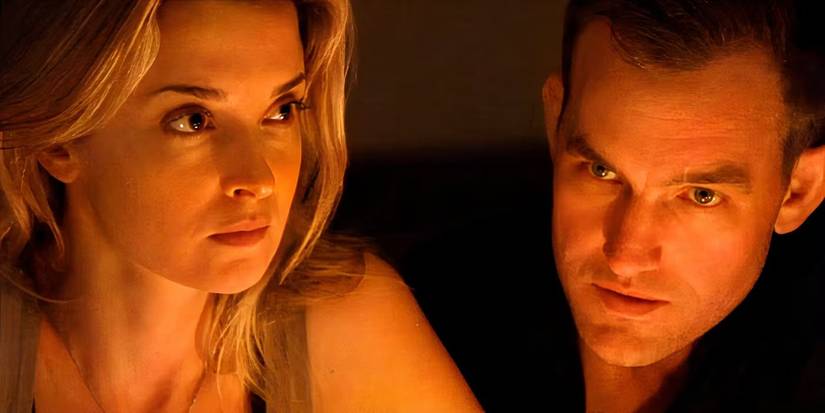 Image via Oscilloscope Laboratories
"Maybe we're not where we think we are." Another low-budget movie that compensates for its lack of special effects with creativity and strong writing. In it, eight friends gather for dinner on the evening a mysterious comet passes close to Earth. Minor oddities soon escalate into increasingly impossible events, forcing everyone to question not only the reality surrounding them but also the identities of the people sitting beside them. They realize a kind of parallel universe has appeared, containing alternate versions of themselves.
Paranoia soon spreads through the group, and they're forced to puzzle out some kind of solution to this nightmare. It's great fun watching the characters try to think of schemes to get out of this mess. It all builds to a fantastic, memorable ending, a perfect payoff for everything that's gone before.
'Midnight Special' (2016)
 Image via Warner Bros. Pictures
"He belongs somewhere else." Midnight Special is one of the lesser-known movies from director Jeff Nichols, though it's certainly worth checking out. Michael Shannon leads it as Roy Tomlin, a father desperately trying to protect his young son Alton (Jaeden Martell) after the boy's extraordinary abilities attract the attention of both a religious cult and the government. Together, they travel across the country searching for answers, and the bond between them emerges as the movie's real focus.
Beneath the genre conceits, Midnight Special is a heartfelt family drama. Some of the story beats draw on classic Stephen King and Steven Spielberg, but the emotional tone is unique, in large part thanks to great performances (the supporting cast is rounded out by the likes of Joel Edgerton, Kirsten Dunst, Adam Driver, and Sam Shepard) and Nichols' unusually sensitive, three-dimensional script.
'Upstream Color' (2013)
 Image via VHX
"You know all the words, but you don't know what they mean." Most readers will be familiar with Shane Carruth's brilliant, lo-fi time-travel film Primer, one of the most innovative takes on the subgenre in decades. However, many will not yet have watched his sophomore effort Upstream Color. It's arguably even more cryptic than its predecessor, which is saying something. At the heart of the story is Kris (Amy Seimetz), a woman whose identity is shattered after becoming the victim of an inexplicable biological process involving parasites and memory manipulation.
Once again, Carruth constructs a complex, intricate story using minimal elements, abandoning conventional storytelling in the process in favor of symbolism and sense impressions. The result is a movie that lends itself to endless analysis, presenting the viewer with a tangle of puzzles to ponder and, perhaps, solve.






 English (US) ·