
Embracing a sense of wonder and imaginative awe, fantasy has long been an essential pillar of cinema, one that has used the innate visual allure of film and the excitement of otherworldly ideas to present some of the greatest stories the medium has ever seen. Every great story needs a great ending, a grand climax that weaves everything that came before it together in an impactful conclusion that caps off the narrative beautifully and embeds itself in the minds of viewers.
Ranging from defining masterpieces of the 21st century to enduring classics released many decades ago, from infectious and lively adventures to twisted fairy tales, these fantasy movies execute their endings to perfection. Whether they are happy and triumphant, sorrowful, or something in between, these fantastic finales are among the greatest cinema at large has ever seen.
'The Green Knight' (2021)
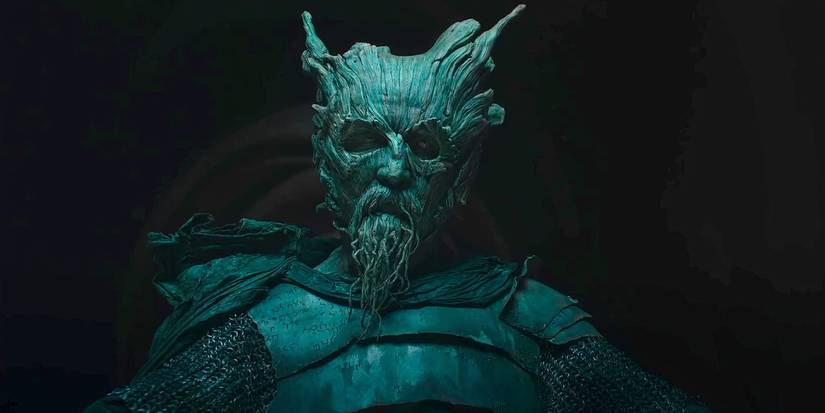 Image via A24
Presenting a dark spin on Arthurian legend, The Green Knight subverts traditional fantasy notions of heroism, valor, and courage to instead function as a character study of cowardice and vanity. King Arthur’s (Sean Harris) nephew, Sir Gawain (Dev Patel), sets out to claim glory by slaying the Green Knight (Ralph Ineson), but his mettle is tested as he must face ghosts, thieves, and giants on his conquest.
The ending is a fascinating examination of consequence, honor, and mortality, with Gawain escaping the Green Knight’s lair and returning to Camelot, where he fathers a son with Essel (Alicia Vikander), marries a noblewoman, and becomes king after Arthur’s death. Then it cuts back to the Green Knight’s chapel, revealing the life he embarked on was merely a fabrication as Gawain accepts his fate, showing bravery and acceptance in the process. Given the ambiguity of what truly becomes of Gawain, the conclusion highlights his spiritual growth rather than his literal end, and it’s more compelling because of it.
'Pinocchio' (1940)
 Image via RKO Radio Pictures
From the 1930s and '40s right up until the modern day, animated cinema has been a source of many of film’s defining fantasy masterpieces across the decades. Few movies capture the warm allure and wonder of both the storytelling form and the genre as 1940’s Pinocchio, a fun-loving and fantastical gem of family entertainment. It follows the titular wooden puppet as he aspires to prove himself to be brave, truthful, and selfless in the hope that it will grant him the opportunity to live as a real boy.
During the film’s climax, Pinocchio (Dickie Jones) showcases the quality of his character by making the ultimate sacrifice to save his creator and father, Geppetto (Christian Rub). As he lies lifeless on the bed, being mourned by his loved ones, his grand wish is granted, and he returns to life as a living, human boy. Beautifully constructed and incredibly well-earned, Pinocchio’s conclusion is a triumphant ode to courage that is a heartwarming highlight of Disney’s entire filmography.
 Image via DreamWorks Animation
From one of the pioneering masterpieces of early animation to a modern marvel that has become an instant classic of family adventure. The How to Train Your Dragon trilogy offers a breathtaking and richly endearing immersion into a fantasy world where humanity and dragons are constantly at war. However, through Hiccup’s (Jay Baruchel) qualities of compassion, doubt, empathy, and his somewhat outcast standing within his clan, he befriends the dragon he sets out to kill and ushers in a new era of harmony and co-operation between the species.
The trilogy becomes a powerful observation of spirited friendship and unwavering trust, but it comes to a somber ending when Hiccup realizes he must part ways with Toothless in order for both of them to grow. It’s an emotional sequence that, while showcasing Hiccup’s pleasant life with Astrid (America Ferrera), still captures a poignant sense of loss even as the two friends reunite years later. Hopeful, though painfully mature, How to Train Your Dragon: The Hidden World delivers a perfect ending to what is one of the greatest animated trilogies of all time.
Collider Exclusive · Middle-earth Quiz
Which Lord of the Rings
Race Do You Belong To?
Hobbit · Elf · Dwarf · Man · Orc
Middle-earth is home to many peoples — the courageous, the ancient, the stubborn, the ambitious, and the wretched. Ten questions will determine which race truly claims your soul. The answer may surprise you. Or it may confirm what you already suspected.
🌿Hobbit
🌟Elf
⚒️Dwarf
⚔️Man
💀Orc
01
What does your ideal day look like? How we rest reveals as much as how we fight.
02
How do you feel about the passing of time? Our relationship with mortality shapes everything we value.
03
Danger is approaching. Your first instinct is to: Fight, flight, or something in between — it's more revealing than you'd think.
04
You stumble upon a great treasure. What do you feel? What we desire — and what we do about it — is the true test.
05
How important is community and belonging to you? No race of Middle-earth is truly alone — but some prefer it that way.
06
How ambitious are you, honestly? Ambition is neither virtue nor vice — it depends entirely on what you want.
07
Where do you feel most at home in the natural world? Middle-earth is vast — and every race has its place within it.
08
What kind of strength do you most respect? Every race defines strength differently — and they're all at least a little right.
09
What do you want to leave behind when you're gone? Legacy is the story we tell ourselves about why any of this matters.
10
Be honest — what do you actually want most out of life? The truest question always comes last.
Middle-earth Has Spoken You Belong To…
The race that claimed the most of your answers is your true kin. If two tied, both are shown — you walk between worlds.
◆ A TIE — YOU WALK BETWEEN TWO RACES ◆
🌿
Your Race
The Hobbits
You are, at your core, a creature of comfort, community, and quiet joy — and there is nothing small about that. Hobbits are proof that heroism does not require ambition, that the bravest heart can beat inside the most unassuming chest. You value good food, warm hearths, close friends, and a world that stays largely untroubled by dark lords and quests. When adventure does find you — and it will — you rise to it not because you sought it, but because the people you love needed you to. That is not ordinary. That is the rarest kind of courage in all of Middle-earth.
🌟
Your Race
The Elves
Ancient, graceful, and carrying a weight of memory most mortals cannot fathom, you are one of the Elves. You see the world in its fullness — its beauty, its impermanence, the unbearable ache of watching everything you love eventually fade. You pursue perfection not from pride, but because excellence is how you honour the time you have been given. Others may see you as remote or melancholy. They are not wrong, exactly. But they mistake depth for distance. You feel everything — which is precisely why you have learned to carry it so quietly.
⚒️
Your Race
The Dwarves
Stubborn, proud, fiercely loyal, and possessed of a work ethic that would exhaust most other races before breakfast — you are Dwarf-kind through and through. You do not ask for approval and you do not offer it cheaply. Your loyalty, once given, is given for life. Your grudges last longer. You love deeply and defend ferociously, and the things you build — with your hands, with your sweat, with generations of accumulated craft — are made to last. Not for glory. Because anything worth doing is worth doing properly, and you have never once done anything by half measures.
⚔️
Your Race
The Race of Men
Mortal, ambitious, flawed, and magnificent — you belong to the most complicated race in Middle-earth, and that complexity is your greatest strength. Men are capable of cowardice and extraordinary bravery, of cruelty and breathtaking sacrifice, sometimes within the same breath. You feel the urgency of your finite years, and it drives you. You want to matter. You want to leave something behind. You fall, and you rise, and the rising is what defines you. Tolkien called mortality the Gift of Men — not a curse, but a fire that burns bright precisely because it does not burn forever. That fire is you.
💀
Your Race
The Orcs
Brutal, survivalist, and contemptuous of anything that can't defend itself — you answered with the instincts of an Orc, and there is a certain savage honesty in that. You do not dress up your desires in polite language or pretend you want things you don't. You want power, survival, and to never be at the bottom of any hierarchy ever again. Orcs are not evil by nature — they were made from something that was once good, and broken into this shape by forces they did not choose. What remains is fierce, territorial, and deeply aware that the world is not kind. You've made your peace with that. The question is what you do with it.
'The Fall' (2006)
 Image via Roadside Attractions
An underrated masterpiece that presents a stunning display of cinema at its most visually enrapturing, The Fall enthralls viewers in a transfixing world of beauty. It revolves around the story of heroism and defiance a paralyzed Hollywood stuntman shares with a young girl in a hospital. Exceptional in its ability to interweave 1920’s Los Angeles with a breathtaking mosaic of otherworldly excellence, its journey juggles ravishing escapism with the grim reality Roy (Lee Pace) faces due to his disability to engrossing effect.
While an invigorating adventure, there is an air of damnation that hangs over much of Roy’s story. Still, it rewards viewers with a sublime finale that serves as both a hopeful testament to human perseverance and a touching nod to the silent era of filmmaking. As Alexandria’s (Catinca Untaru) broken arm heals, she states that Roy made an unexpected recovery from his injury as a montage plays out of some of the most iconic and intense stunts of silent cinema, with Alexandria imagining Roy executing them.
'Shrek 2' (2004)
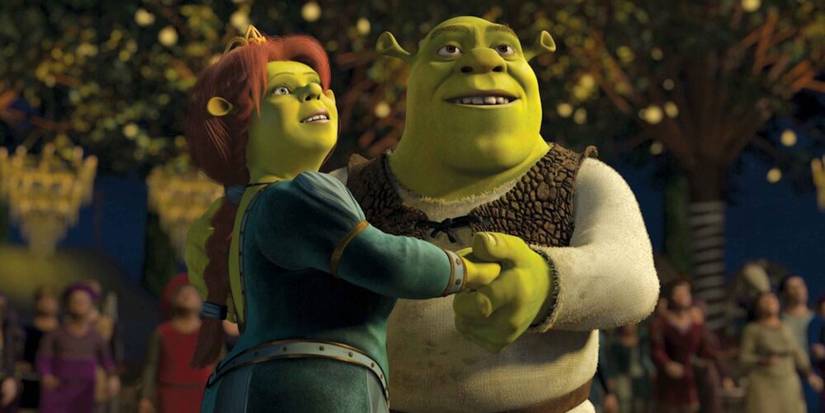 Image via DreamWorks Animation
The first two Shrek movies are true masterpieces of animation and subversion, making a mockery of fantasy fairy tales while reconstructing their core themes of true love, self-acceptance, and the nature of beauty into something refreshing and modern. Shrek has a particularly powerful resolution in this regard in the form of Shrek (Mike Myers) and Fiona’s (Cameron Diaz) marriage, but Shrek 2 perhaps surpasses its predecessor with added dramatic might and a more intricate thematic ideal.
After having to contend with the Fairy Godmother’s (Jennifer Saunders) schemes, Shrek and Fiona make the purposeful decision to abandon their human forms and live as ogres happily ever after. Adding more emphasis to the first film’s central themes, while also being complemented by King Harold’s (John Cleese) noble sacrifice and Donkey (Eddie Murphy) and Puss in Boots’ (Antonio Banderas) rendition of “Livin’ La Vida Loca,” Shrek 2 concludes with a perfect combination of resonance, purity, and fun.
'The Seventh Seal' (1957)
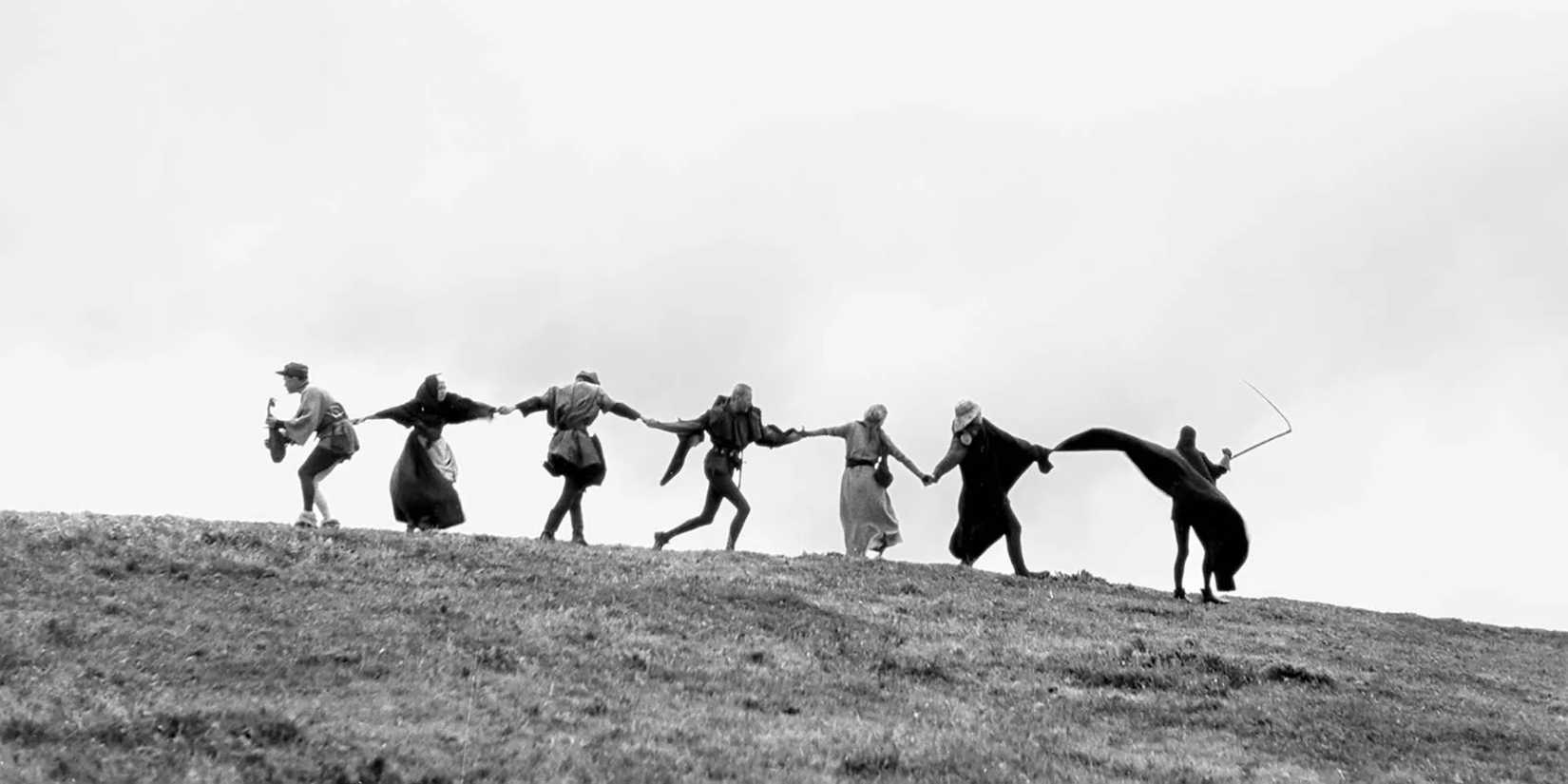 Image via AB Svensk Filmindustri
A defining triumph of international cinema that explores Ingmar Bergman’s philosophical drama of faith, mortality, and purpose against an intriguing period backdrop, The Seventh Seal is one of the greatest and most cerebral fantasy films ever made. It follows Crusade knight Antonius Block (Max Von Sydow) as he returns to his homeland to find it devastated by the plague. As he journeys through the nation, he is also visited by Death (Bengt Ekerot) and challenged to a game of chess to determine his fate.
The film’s climax is richly symbolic and relentlessly eerie, with Block and several of his companions entranced in a Dance of Death over a hill and away from the morning’s light. While the intricate details are enigmatic and can be interpreted by each viewer, the final scene posits that mortality is a great equalizer of humanity while also offering a sense of hope in the survival of Jof (Nils Poppe), Mia (Bibi Andersson), and their baby. It casts an image that is truly unforgettable while bringing an appropriately thought-provoking resolution to the story.
'Pan’s Labyrinth' (2006)
 Image via Warner Bros. Pictures
Bittersweet resolutions are certainly not a rarity in fantasy cinema, least of all in dark fairy tales, but Pan’s Labyrinth takes the tonally divided approach to an entire new level. At the behest of her sadistic stepfather working for the military in Francoist Spain, Ofelia (Ivana Baquero), along with her mother, is relocated to a woodland mill where she meets a faun who tells her she is the long-lost princess of the Underworld and can return to her rightful place if she completes three challenging tasks.
The movie presents a faultless balance between real-world horrors of war, violence, cruelty, and political subjugation, and the eerie terror of the fantasy realm Ofelia must navigate. The conclusion is shocking, with Captain Vidal (Sergi López) shooting Ofelia and leaving her to die. As she bleeds out, it is revealed that her sacrifice saw her pass the final test, and she is admitted to the Underworld, but it is impossible not to be devastated as her passing in the real world is mourned. It sees poignant tragedy and fairy tale triumph collide in stunning fashion, delivering an ending that champions Ofelia’s innocence while staying true to the brutality of the picture.
'The Wizard of Oz' (1939)
 Image via Metro-Goldwyn-Mayer
Despite the fact that it was released almost 90 years ago, The Wizard of Oz remains one of the most iconic, beloved, and important titles in the history of fantasy cinema. A cheerful adaptation of Frank L. Baum’s novel, the musical adventure follows Dorothy (Judy Garland) as she travels the magical land of Oz with newfound friends in search of a way to return to Kansas. The ending sees her succeed in returning home, but perhaps not in the way many would have expected.
Framing her time in Oz as a fever dream she experiences after suffering a head injury, The Wizard of Oz concludes with an ode to the value of home and family, and a statement that self-discovery and development reside within an appreciation of what one already has. It ensures the treacherous "it was all a dream" trope is still rewarding, however, making it a moment of coming-of-age clarity for Dorothy as she utters the immortalized final line, “There’s no place like home.”
'The Lord of the Rings' Trilogy (2001-2003)
 Image via New Line Cinema
There is a joke that The Lord of the Rings trilogy features an abundance of endings that transpire in procession over the last half-hour of The Return of the King. So, which ending is best? The only answer is all of them. Every single resolution each character receives is emotionally gratifying and completely appropriate, whether it is Aragorn (Viggo Mortensen) becoming the King of Gondor, the hobbits’ being honored before Middle-earth in the devastatingly beautiful “You bow to no one” scene, or even their return to the serenity of The Shire.
Of course, the final minutes pack an emotionally loaded resolution as well, with Frodo (Elijah Wood) departing Middle-earth for the Undying Lands and having to leave his friends behind in the process. It’s an ethereal, delicate climax that tugs at the heartstrings, not only with the upsetting image of the hobbits sobbing as they bid their friend farewell, but with its quiet meditation on notions of lasting trauma and the emotional burden of self-sacrifice and heroism. Complimented by Howard Shore’s stunning score, it is a perfect and deft ending to what is the greatest epic trilogy cinema has ever seen.
'It’s a Wonderful Life' (1946)
 Image via Paramount Pictures
A quintessential Christmas classic even 80 years on, It’s a Wonderful Life is the pinnacle of grounded fantasy cinema at its warmest and most endearing. When George Bailey (James Stewart) plans to kill himself after a financial disaster, angel Clarence Odbody (Henry Travers) is tasked with looking over the man’s humble life of generosity and sacrifice to figure out how to save him. When George wishes he’d never been born, Clarence grants him his wish and shows him just how the community of Bedford Falls would look had George never existed.
Powerful, precise, and profoundly life-affirming, It’s a Wonderful Life is an ode to everyday heroes and human decency, ideals that come home to roost in the film’s gorgeous climax when the community rallies to help George and his family. Between George becoming the richest man in town and Clarence finally earning his elusive wings, It’s a Wonderful Life presents a masterclass in how to end a story. It’s rewarding, cathartic, and overwhelmingly feel-good, and it stands tall among the greatest movie endings of all time, let alone just in fantasy cinema.

Its a Wonderful Life
Release Date December 20, 1946
Runtime 130 minutes
Director Frank Capra
![Disney+’s New 8-Episode Star Wars Series Officially Brings Back Prequel-Era Duels [Exclusive]](https://static0.colliderimages.com/wordpress/wp-content/uploads/2026/06/copy-of-collider-template-63.jpg?w=1600&h=900&fit=crop)
![Star Wars' Newest Spin-Off Series Blasts Off With a Huge Season 2 Update [Exclusive]](https://static0.colliderimages.com/wordpress/wp-content/uploads/2026/04/star-wars-logo.jpg?w=1600&h=900&fit=crop)



 English (US) ·