

Published Aug 16, 2026, 9:00 PM EDT
Nicholas Becher is a gaming journalist with an MFA in Creative Writing from FAU. With extensive experience playing video games, he covers all forms of gaming content at Screen Rant, from breaking news to the latest fan theories. Most-played games range from Clair Obscur to Civ to Elden Ring to Halo 2 and beyond.
The sci-fi genre has undergone a massive evolution throughout the history of gaming, with open-world games becoming the ideal medium in terms of immersion and world-building. Credit is still owed to early titles that were limited by technology, and though they relied on simple visuals and procedural systems to create the illusion of enormous universes, the sense of free exploration laid the groundwork for what followed.
As hardware improved, developers were able to construct increasingly detailed worlds and more complex systems, with games such as Fallout redefining the genre with extensive character choice and reactive worlds, while later releases like No Man’s Sky pushed procedural exploration to a whole new level.
Modern titles such as Cyberpunk 2077 and the Death Stranding franchise have taken the genre yet another leap forward, using overwhelmingly massive environments and hugely ambitious stories that have changed the landscape forever.
10 Fallout

It's nearly impossible to choose which Fallout title to include on a best-of list, so I've gone ahead and generalized it to the entire franchise. Every entry in the series (even Fallout 76) has pushed the limits of what's possible in the post-apocalyptic sci-fi world.
Starting from the very first entry, the Fallout games' immersive RPG systems made the player feel like an actual part of the world where their choices had an impact on how things played out, both in combat and in terms of how the narrative unfolds.
Fallout 3 and New Vegas still rank among the most beloved open-world RPGs ever created, while Fallout 4 continued to push the boundaries of the genre. While we may be in for a long wait for Fallout 5, the franchise's influence has crept into the mainstream with the success of the Amazon Fallout show, which highlights just how impressive and iconic the Wasteland has become.
9 Starfield
Starfield may not have received quite the acclaim that many gamers expected based on how it was hyped before launch, but it stands among the most elaborate and technically complex open-world sci-fi games out there. Its enormous galaxy spans hundreds of star systems and more than a thousand planets, combining planetary exploration with space travel, shipbuilding, faction questlines, resource gathering, and Bethesda’s familiar role-playing systems.
While its reliance on procedural generation and segmented exploration proved divisive, the sheer scope of the game is undeniably impressive. Not very many games have attempted to give players this much freedom to build a character, customize a spacecraft, and carve out their own path across an entire galaxy, and Starfield delivers on all three fronts.
8 Cyberpunk 2077

Cyberpunk 2077 got off to a rocky start when it first released, but that first iteration is almost unrecognizable at this point when looking back thanks to CD Projekt Red's various quality of life improvements and updates over the years. The Phantom Liberty DLC added an entirely new storyline and the district of Dogtown, while the massive Update 2.0 overhauled perks, cyberware, vehicle combat, enemy AI, and the police system.
Update 2.1 made the experience even more refined, with the NCART metro, letting players repeat races, and adding more activities, while later updates expanded character and vehicle customization as well. The open-world of Night City is unmatched in the sci-fi genre, and has arguably surpassed what developers originally promised.
7 S.T.A.L.K.E.R.

Both the original S.T.A.L.K.E.R trilogy and S.T.A.L.K.E.R 2: Heart of Chornobyl deserve recognition for their uniquely terrifying open-world sci-fi environment. The original entry and its immediate prequel/sequel built a survival experience where radiation, mutants, anomalies, hostile factions, and the environment itself was out to destroy you.
Heart of Chornobyl modernized that formula with a larger, more seamless Zone, modernized graphics, and more environmental detail while still maintaining the original oppressive vibe. There simply are not many open-world games that make exploration feel this dangerous, unpredictable, and rewarding, where just a routine trip across the map will give you serious anxiety.
6 Elite

Elite and Frontier: Elite II stand among the most important open-world sci-fi games ever made. They established ideas the genre still relies on today, with the original Elite giving players remarkable freedom for a 1984 title, allowing them to explore a vast procedurally generated galaxy, trade goods, hunt pirates, and choose their own path as opposed to a linear narrative you might expect from the time.
Frontier: Elite II improved on the original dramatically, releasing in 1993 and introducing a huge modeled galaxy where you could land on planets, and added much more detailed trading and deeper space simulation as well. Decades before modern games like No Man’s Sky and Starfield, the Elite games were already pursuing the fantasy of letting gamers live freely among the stars, with modern entries in the franchise like Elite Dangerous continuing to deliver decades later.
5 Midwinter
It's likely you haven't heard of Midwinter if you never lived through the late '80s and early '90s era of computer gaming, but this is arguably one of the most underrated open-world sci-fi games ever made. Created by Mike Singleton, it featured seriously impressive 3D visuals for the time and a surprisingly massive open world.
Set after a meteor strike plunges Earth into a global winter, players control police captain John Stark as he recruits soldiers and civilians to resist the invading General Masters. Midwinter helped pave the way for modern open-world design by blending exploration, survival, strategy, vehicles, and player freedom in ways few games had attempted before.
4 Death Stranding
What can be said about Hideo Kojima's visionary Death Stranding series that hasn't been said already in countless 10/10 reviews across the gaming industry? Both entries have redefined what's possible in the sci-fi space, introducing some of the most immersive cinematic open-world experiences ever.
While the games are essentially immersive walking sims, with their graphics, character development, world-building, bizarre supernatural concepts, asynchronous multiplayer systems, and deeply cinematic storytelling, the Death Stranding games offer an open-world experience unlike virtually anything else in the genre.
3 Outer Wilds

Outer Wilds is one of the most unique open-world sci-fi games out there, developed by a relatively small indie studio called Mobius Games back in 2019. Its 22-minute time-loop mechanic and compact solar system may sound limiting on paper, but the way this factors together to encourage exploration and forces players to use their sleuthing skills to solve puzzles is unlike any other game in the genre.
In Outer Wilds, your progress is completely reliant on what you learn from each world. You travel freely between unique planets with their own physics and ecosystems, investigate ancient ruins left by an extinct alien civilization called the Nomai, and gradually piece together why the time loop exists and what happened to the solar system.
2 NieR: Automata

NieR: Automata transformed a Japanese cult sensation, Drakengard, into a global phenomenon through to 2010’s NieR. Its success has since produced the Ver1.1a anime adaptation, the mobile spin-off NieR Re[in]carnation, and several major crossovers as well. Its semi-open world remains a must-play in the sci-fi space, connecting haunting ruins, forests, deserts, and amusement parks, while shifting genres between action RPG, bullet hell arcade-style combat, platforming, and side-scrolling.
NieR: Automata is incredibly immersive not because of its scale per se, but because every location, the soundtrack, and perspective shifts deepen its melancholy atmosphere and enrich the story significantly. Although fans continue to hope for NieR 3, Square Enix has yet to officially announce a new mainline entry, leaving the future of Yoko Taro's acclaimed sci-fi universe a mystery.
1 No Man's Sky
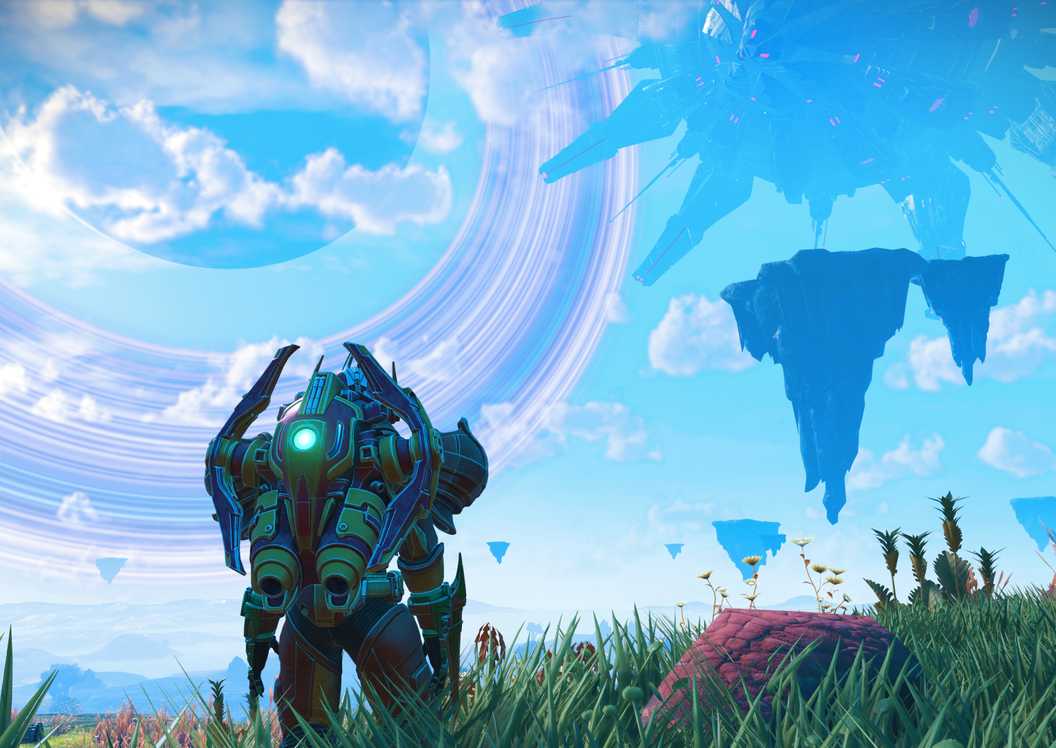
No Man's Sky has become a quintessential sci-fi experience in its decade-long run, and even after ten years, the game is still getting free content updates on a regular basis. Overcoming its disastrous launch back in 2016, the game as it exists now is light years away from where it started. With Hello Games making its way into the fantasy space with Light No Fire, assuming the studio is improving on the established formula in No Man's Sky, gamers are in for a serious treat when it eventually releases.
Until then, there's literally an entire universe to explore in No Man's Sky, with Sean Murray revealing earlier this month that, despite tens of millions of players spending hundreds of millions of hours exploring over the previous decade, less than 1% of its planets had actually been visited. Few statistics better illustrate just how far open-world sci-fi games have come, from the procedural galaxies of Elite to a universe so incomprehensibly vast that its players may never come close to seeing everything it contains.

No Man's Sky
Release Date August 9, 2016
Director Sean Murray





 English (US) ·