
 Image via The Samuel Goldwyn Company

Published Feb 20, 2026, 3:57 PM EST
Jeremy has more than 2300 published articles on Collider to his name, and has been writing for the site since February 2022. He's an omnivore when it comes to his movie-watching diet, so will gladly watch and write about almost anything, from old Godzilla films to gangster flicks to samurai movies to classic musicals to the French New Wave to the MCU... well, maybe not the Disney+ shows.
His favorite directors include Martin Scorsese, Sergio Leone, Akira Kurosawa, Quentin Tarantino, Werner Herzog, John Woo, Bob Fosse, Fritz Lang, Guillermo del Toro, and Yoji Yamada. He's also very proud of the fact that he's seen every single Nicolas Cage movie released before 2022, even though doing so often felt like a tremendous waste of time. He's plagued by the question of whether or not The Room is genuinely terrible or some kind of accidental masterpiece, and has been for more than 12 years (and a similar number of viewings).
When he's not writing lists - and the occasional feature article - for Collider, he also likes to upload film reviews to his Letterboxd profile (username: Jeremy Urquhart) and Instagram account.
He has achieved his 2025 goal of reading all 13,467 novels written by Stephen King, and plans to spend the next year or two getting through the author's 82,756 short stories and 105,433 novellas.
Sign in to your Collider account
Normal documentaries and nice and everything. You’ve probably seen your fair share of them, at this point. They’ll be about something you’ve heard of, they’ll be structured in a certain way, and they’ll feature some fairly standard kinds of interviews and maybe even narration throughout. The following documentaries are not quite so normal, and the usual things can’t really be expected here.
Some of the following films might have a few things that feel documentary-like, but then some are arguably more arthouse in nature, and arthouse movies are all concerned with rewriting (or outright breaking) cinematic rules and conventions. So, if you want normal or dependable stuff, you're not going to get it here. But if you want documentaries that largely challenge the format of documentary filmmaking, as you might usually understand it, then these could be worth checking out.
10 'Symbiopsychotaxiplasm: Take One' (1968)
 Image via Take One Productions
Fittingly for a movie with such a strange title, it’s quite hard to describe what Symbiopsychotaxiplasm: Take One is even about. It might be easiest to describe in terms of what it might well have inspired, because it all feels a bit like something Abed from Community would do, or maybe like a proto-Nathan Fielder sort of project, in terms of not really knowing which layer of reality (if any) we’re watching.
It’s sort of about the making of some strange movie, but it’s also about the making of that movie, without multiple layers of reality at play, and the whole thing being wonderfully confounding. You can call Symbiopsychotaxiplasm: Take One ahead of its time, since there are things now, in the 21st century, that you can compare it to (Synecdoche, New York also comes to mind), but for 1968, this was pretty damn unique.
9 'Sans Soleil' (1983)
 Image via Argos Films
There are a few abstract documentaries that are naturally going to be listed here, and Sans Soleil is one of them. This one was directed by Chris Marker, who belonged to the French New Wave movement and very much did his own thing, here especially so, since Sans Soleil is about… something? Uh, it’s like, um… it’s abstract. It really is very, very abstract.
There’s some narration that ponders existence and traveling and all that (plus some other things… probably?), and all the while, you see images from various places in the world. It gives the feeling of going around the world, in a way, but it leaves, up to the viewer, the question of why you're basically being flung around the globe. It’s an interesting experience, though, even with it being so hard to define and/or summarize, in the end.
8 'The Wild Blue Yonder' (2005)
 Image via Werner Herzog Filmproduktion
There are some other Werner Herzog documentaries that could go here, since most of his work is pretty offbeat and very much different from what you're used to seeing, but The Wild Blue Yonder is especially so. It’s sort of about an alien living on Earth, which might not make it sound very documentary-like, but then it does use a lot of real-life footage that it recontextualizes in interesting ways.
It’s about the planet, and then part of it is about looking for a place to live that’s not the planet, and then parts of it are also about an alien living/barely surviving on Earth. That stuff isn't very documentary-esque, admittedly. But if you’ve got something vaguely about the planet, alongside Werner Herzog sort of making a work of fiction that’s also not entirely fictional/sci-fi, then maybe you can put The Wild Blue Yonder here, for present purposes.
7 'Blue' (1993)
 Image via Zeitgeist Films
Plenty of the arthouse documentaries here are pretty wild and dazzling on a visual front, but Blue (not to be mixed up with Three Colours: Blue, released the same year) takes what feels like the complete opposite approach. It’s striking in its own way; in how far it goes toward minimalism, because you don’t get any visuals in Blue beyond a plain blue screen for about 79 minutes.
It’s all abstract, of course, but also hard not to be moved by, especially once you understand the history of its production of the facts surrounding the last stages of the filmmaker’s life.
It’s more interesting than just looking at a color, though, because it’s what Blue does with sound that ensures it stands out. The filmmaker, Derek Jarman, was dying from AIDS-related complications during its production, and his real-life limited vision was conveyed through the lack of visuals in Blue. And, further, all the sounds explore – or sometimes narrate – what he was going through and feeling at the time. It’s all abstract, of course, but also hard not to be moved by, especially once you understand the history of its production of the facts surrounding the last stages of the filmmaker’s life (Jarman himself passed away the year after Blue was first released).
6 'The Five Obstructions' (2003)
 Image via Koch-Lorber Films
Pretty much anything directed by Lars von Trier counts as an arthouse film, perhaps to an even greater extent than Werner Herzog. That goes for anything he does that’s kind of a documentary, too, so here’s The Five Obstructions, which is also credited as a movie Jørgen Leth co-directed. And Leth is essentially the subject of this documentary, as a filmmaker who has to remake a short film he made a few decades prior.
Basically, it boils down to Lars von Trier giving him increasingly strange and difficult rules he has to stick to while continually remaking/remixing his short film a few different times. So, The Five Obstructions is a documentary about filmmaking, and it’s sometimes quite funny, too; maybe funnier than it is strange (and it’s no stranger to being strange, either).
5 'Moonage Daydream' (2022)
 Image via NEON
The thing about David Bowie is that you probably can’t make a normal documentary about him and have it do him justice, so instead, you pretty much have to make something like Moonage Daydream. It tries to depict, in a typically out-there way, who David Bowie was and why his music was so special, albeit without ever getting to the core of it all, because that’s impossible to do.
Moonage Daydream lays out how Bowie always shook things up and adopted different personas and styles throughout his music career, and it does a good job at making you realize just how unusual and singular Bowie was. If you want to fully understand the man and his body of work, you won’t really find that full understanding here, but you also won’t exactly find that anywhere, so this is the next best thing: a documentary that’s intense and great at delivering a certain vibe more than it delivers information of a more typical/expected kind.
4 'Häxan' (1922)
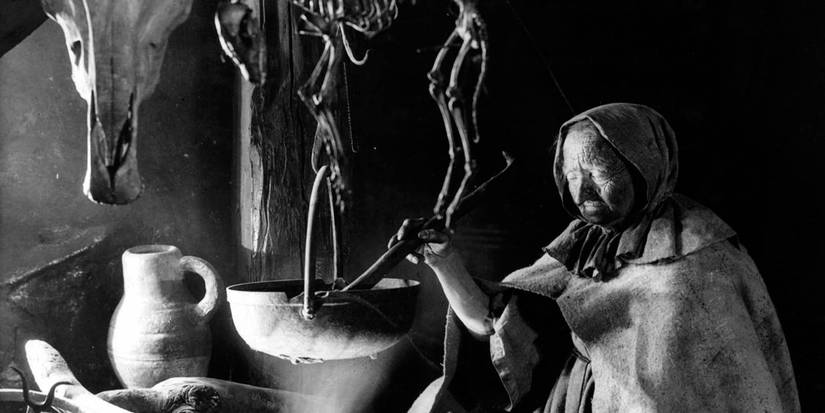 Image via Svensk Filmundistri
More of a folk horror movie than a documentary, it might seem thereby kind of questionable to include Häxan here, though it is both. And it’s revolutionary on both counts. It’s ahead of its time as a horror movie about witchcraft and other supernatural things, and then it also functions as an ahead-of-its-time documentary about… well, the same topics. There’s quite a bit by way of (admittedly dated) information and context here.
Perhaps the most important thing to mention here is that Häxan is undeniably fascinating. It’s one of the more unnerving films that’s 100+ years old out there for sure, and parts are likely to still get under your skin. It’s perhaps easier to recommend as a work of horror than a documentary in the traditional sense, yet the fact that it does both at the same time (and did so such a long time ago) makes it worth highlighting here.
3 'Baraka' (1992)
Pair Baraka with the aforementioned Sans Soleil, if you want, as a documentary that’s very broadly about life and the experience of living on Earth, all in an abstract sort of way. Here, though, it might be a little easier to feel moved by the images you see and the music you hear, though not quite to the same (powerful) extent as one other movie from 1982 that also belongs in this strange camp of documentaries, and will be elaborated upon shortly.
With Baraka, it’s about the world. Like, the camera sort of goes everywhere, and you just have to take in all the sights and sounds without any narration or interviews. It’s striking, and successfully immersive, on top of being oddly moving in parts. You might well feel like Roy Batty at the end of Blade Runner by the end of Baraka, telling others that you’ve “seen things” they “wouldn’t believe.”
2 'Man with a Movie Camera' (1929)
 Image via VUFKU
Watching Man with a Movie Camera now, almost a century on from when it was made and released, is an honestly pretty wild experience. On a visual front, everything here was so ahead of its time and creative, because the documentary presents shot after shot that feels surprising and almost otherworldly. But it’s not about being out of this world or anything too crazy.
Instead, Man with a Movie Camera is about life in the USSR during the 1920s. It’s just a series of images of people doing stuff, and that might not sound exciting, yet it’s the way everything's captured that makes the movie special. It’s genuinely engaging, for a film of its age and for a film without much of a “story” or “concept,” and what it does offer ends up being more than enough, truth be told.
1 'Koyaanisqatsi' (1982)
 Image via New Cinema
Beating Sans Soleil by a year, and indeed preceding Baraka, too, Koyaanisqatsi is, essentially, the definitive arthouse (or weird, for lack of a better word) documentary movie. Like, ever. This one has no narration, dialogue, or interviews, and instead paints a portrait of the world through images and a striking score, telling a story, nonetheless, about the natural world being overtaken by industrial/destructive things.
There’s some awe to be found in the non-natural landscapes Koyaanisqatsi depicts, but more horror than when it comes to the natural landscapes, and the contrast between the two is always interesting and thought-provoking. You do get to think about a lot here, with there not really being a choice when the movie is otherwise quite passive with its lack of people speaking, but the approach works for sure, and Koyaanisqatsi does also end up rewarding repeat viewings.

Koyaanisqatsi
Release Date April 27, 1983
Runtime 86 minutes
Director Godfrey Reggio
Writers Alton Walpole, Godfrey Reggio, Michael Hoenig
-

Ed Asner
Self - On TV (archive footage) (uncredited)
-
Pat Benatar
Self (archive footage) (uncredited)
-
Jerry Brown
Self - On TV (archive footage, uncredited)
-





 English (US) ·