
 Image via Fox

Published May 14, 2026, 5:31 PM EDT
Michael John Petty is a Senior Author for Collider who spends his days writing, in fellowship with his local church, and enjoying each new day with his wife and daughters. At Collider, he writes features, reviews, recaps, and conducts interviews. In addition to writing about stories, Michael has told a few of his own. His novella, The Beast of Bear-tooth Mountain, was released in 2023. His Western short story, The Devil's Left Hand, received the Spur Award for "Best Western Short Fiction" from the Western Writers of America in 2025. Michael currently resides in North Idaho with his growing family.
Sign in to your Collider account
The '90s was full of iconic television that is still rewatched by many today. From science fiction and fantasy to sitcoms, police procedurals, and medical dramas, there was something in the water in the 1990s when network television raised the bar for quality storytelling and lovable, relatable characters. But while you've likely already seen the classics, don't sleep on many of the decade's overlooked triumphs.
Whether you love genre content or simple slice-of-life material, there's something out there for everyone. From short-lived series to long-running staples, there are plenty of great shows out there that we've either forgotten about or let slip out of the modern (pop) cultural consensus. With that in mind, give these '90s shows a shot if you're looking to binge something other than Seinfeld or The X-Files...
10 'The Young Indiana Jones Chronicles' (1992-1996)

After Indiana Jones and the Last Crusade, George Lucas simply wasn't finished with Indiana Jones. In his hopes to expand on Indy's story, he worked around being unable to use Harrison Ford (much) by de-aging the character and revisiting his youth. The Young Indiana Jones Chronicles, also known as The Adventures of Young Indiana Jones, largely featured Sean Patrick Flanery as a young Indy as he traveled the globe.
For two seasons and 28 total episodes (plus a handful of made-for-TV movies), an older Indy (played by George Hall) recalled his youthful adventures all across the map. From America and Asia to Europe and Africa, there was nowhere where Indy was afraid to go. Not only does the adventurer meet several historical figures along his way, but he finds himself often in the sorts of danger that we can only imagine Harrison Ford in — it's one television series that has aged like fine wine.
9 'Lois & Clark: The New Adventures of Superman' (1993-1997)
 Image via ABC
It had been since the 1950s that Superman was a live-action staple on television, and so the '90s reintroduced the Man of Steel to the small screen with Lois & Clark: The New Adventures of Superman. Taking inspiration from the era of Superman published by DC Comics at the time, Lois & Clark was part-superhero series, part-workplace romance drama — and it worked like a charm. Dean Cain's Clark Kent and Teri Hatcher's Lois Lane were perfect for each other, even if they didn't always get along.
Lois & Clark rans for four seasons before it was sadly canceled on a cliffhanger, but that doesn't mean that you shouldn't give The New Adventures of Superman a go. Although not as action-packed as some of the superhero productions we're used to today, this very '90s take on the Man of Steel and his supporting cast is loads of fun. As far as Superman shows go, it's one of the best live-action interpretations of the character.
8 'The Magnificent Seven' (1997-2000)
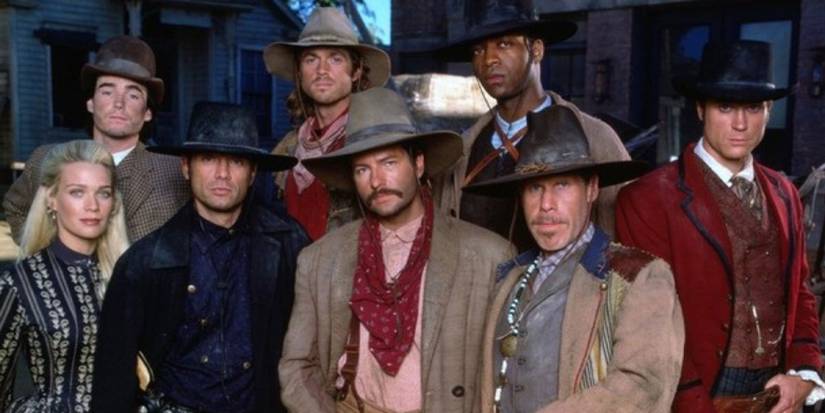 Image via CBS
A vastly underrated Western series, The Magnificent Seven rebooted the classic horse opera franchise for the small screen, this time with an emphasis on each member of the gunslinging group. After a premiere episode that's essentially a remake of the original 1960 film, each new episode focuses primarily on one or two of the Seven, pushing them into the spotlight and giving the audience time to actually care about their individual backstories and interests. It's a great ride, one that may just surprise you.
Indeed, with a stunning cast that includes Michael Biehn, Eric Close, Ron Perlman, and Laurie Holden, you can't go wrong with this two-season action-packed Western adventure. Evoking many of the classic Western programs that were popular during the '50s and '60s, it modernizes the Old West with pure '90s flavoring. It's an easy series to plow through if you're in the mood.
7 'Eerie, Indiana' (1991-1993)
 Image via NBC
Considered something of a precursor to Stranger Things looking back, Eerie, Indiana dealt with all the weird and unexplained things that happen across the Midwest several years before The X-Files would take a gander through a more conspiratorial lens. Part horror, part science fiction, the series dealt with a new bizarre happening each week that got weirder with each episode. Even so, it's a blast from the past that is overdue for another look.
Eerie, Indiana was great because it took a look at the paranormal, the strange, the macabre through the eyes of its young protagonists, but never in a way that felt too hokey or corny (despite Indiana being well known for the produce). For only a single season of 19 episodes, this NBC program gave audiences of all ages an outlet through which to enjoy all the merits of speculative fiction. It was one-of-a-kind.
6 'Homicide: Life on the Street' (1993-1999)
 Image via NBC
While it's true that Homicide: Life on the Street has been credited with being a groundbreaking and powerful television drama, many have forgotten about it in recent years in favor of programs like Law & Order (which it crossed over with back in the day). Following a group of investigators from Baltimore PD's homicide unit, the series was a detailed and engaging look at big city crime that pushed the boundaries of network television. It's dark, dramatic, and quite existential.
Although it featured an ensemble cast, Andre Braugher's Detective Frank Pemberton was arguably its biggest star. For seven seasons and 122 episodes (plus a feature film conclusion), Homicide: Life on the Street was once counted among TV Guide's "Best Shows You're Not Watching," but you really should. With a strong television legacy, Homicide deserves another look decades later.
5 'Brimstone' (1998-1999)
 Image via Fox
You may have forgotten that Brimstone even existed, but those who recall the supernatural cop drama likely haven't been able to forget it. After Ezekiel "Zeke" Stone (Peter Horton) is killed and sent to Hell, he returns to this mortal coil at the behest of the Devil himself (played masterfully by John Glover), who gives him a chance to send 113 escapees from the pit back downstairs. The catch? If he can't do it, he'll spend eternity in Hell without the possibility of parole.
If you forgive Brimstone for its major lapses in theology, it's an engaging police drama about a man tormented by his past and hoping to atone for the actions that sent him to Hell in the first place. In many ways, it was a precursor to Kevin Bacon's short-lived The Bondsman, though Brimstone lasted slightly longer. With only a single 13-episode season, this one will be a quick binge — one that was certainly ahead of its time.
4 'Dark Skies' (1996-1997)
 Image via NBC
When NBC decided it was time to cash in on The X-Files craze of the mid-90s, Dark Skies was the network's result. Only this time, the series didn't follow FBI agents chasing UFOs, but an unlikely couple from the 1960s who stumble upon an extra-terrestrial conspiracy to secretly replace high-level members of government over the course of decades to prepare for an alien invasion. Okay, it's still a little like The X-Files, but the distinct period setting, compelling tone, and engaging leads (Eric Close and Megan Ward) made it worth it on its own.
Dark Skies was never quite given a fair shake due to the X-Files comparisons, but had the show been able to last beyond its single 19-episode season, it may have surprised everyone. From what creators Brent V. Friedman and Bryce Zabel have explained, the show would have jumped decades every season until it hit the 21st century, and then all hell would've broken loose. While Dark Skies only went a year, it's one of those shows that was canceled way too soon.
3 'Are You Afraid of the Dark?' (1992-1996, 1999-2000)
 Nickelodeon
Before Goosebumps, there was Are You Afraid of the Dark? This horror anthology was geared toward youngsters on Nickelodeon, featuring an ensemble cast and a host of spooky campfire tales that asked you that burning title question. Although it's been rebooted a few times since it originally aired, the '90s version of the program is still the most beloved, and for good reason.
Full of wacky and fun tales of the Midnight Society delighted viewers for five seasons between 1992 and 1996, only for the program to be revived for another two years afterward. Anyone whose seen Are You Afraid of the Dark? likely has their own favorites, but if you want ours, here are some of the best episodes to revisit before next Halloween. You won't be sorry.
2 'Sports Night' (1998-2000)
 Image via ABC
The West Wing may have been Aaron Sorkin's real claim to fame in the '90s, but right before that series was picked up, he first got his taste for network television with Sports Night. The comedy drama followed a group of television professionals as they wrestle with the high pressures of live television and the ethical drama that ensues. Josh Charles, Peter Krause, and Felicity Huffman were among the show's major stars.
Easily one of the best sports shows out there, Sports Night ran only two seasons and 45 episodes. Sorkin and his team certainly delivered, and though the prolific writer had to deal with more network push back here than he would on his later series, that arguably worked in the show's favor. It may have been short lived, but Sports Night continues to make an impact on those who revisit it today.
1 'Millennium' (1996-1999)
 Image via 20th Century Fox
When Fox wanted Chris Carter to develop another series after The X-Files, Millennium was the result. Following former FBI profiler Frank Black (Lance Henriksen), the Washington-based series starts as a serial-killer-of-the-week-type show with minor conspiratorial threads and spiritual undertones, only to really hit its stride in the second season. As Frank continues his work with the mysterious Millennium Group, he begins to believe that there's more to the group than meets the eye.
Henriksen is a knock-out in this series, and while Millennium has garnered a devoted cult following over the years, it's still not available on streaming or other digital platforms. For three seasons and 67 episodes, we followed the life of Frank Black as he wrestled with his strange gift to see into the minds and hearts of criminals — as well as forces invisible to the naked eye. Following the show's premature cancellation, Millennium crossed over with The X-Files during the latter's seventh season to wrap things up.
Collider Exclusive · TV Medicine Quiz Which Fictional Hospital Would You Work Best In? The Pitt · ER · Grey's Anatomy · House · Scrubs
Five hospitals. Five completely different ways medicine goes sideways on television — brutal, chaotic, romantic, brilliant, and ridiculous. Only one of them is the ward your instincts were built for. Eight questions will figure out exactly where you belong.
🚨The Pitt
🏥ER
💉Grey's
🔬House
🩺Scrubs
FIND YOUR HOSPITAL →
01
A critical patient comes through the door. What's your first instinct? Medicine under pressure reveals who you actually are.
AStay completely present — block everything else out and work through it step by step, right now. BTriage fast and delegate — get the right people on the right problems immediately. CTrust my gut and move — I work best when I stop overthinking and just act. DAsk the question everyone else is ignoring — what's the thing that doesn't fit? ETake a breath, make a joke to cut the tension, and then get to work — panic helps no one.
NEXT QUESTION →
02
Why did you go into medicine in the first place? The honest answer says more about you than the one you'd give in an interview.
ABecause I wanted to be where it matters most — right at the edge, when someone's life is actually on the line. BBecause I wanted to help people — genuinely, one patient at a time, in a system that makes it hard. CBecause I was drawn to the intensity of it — the stakes, the drama, the feeling of being fully alive. DBecause medicine is the most interesting puzzle there is — and I needed a problem worth solving. EBecause I wanted to make a difference — and also, honestly, I didn't know what else to do with my life.
NEXT QUESTION →
03
What do you actually want from the people you work with? Who you want beside you under pressure is who you are.
ACompetence and calm — I need people who don't fall apart when things get bad. BTrust and reliability — I want to know that when I pass something off, it's handled. CConnection — I want colleagues who become family, even if that gets complicated. DIntelligence and the willingness to be challenged — I have no interest in people who just agree with me. EFriendship — people I actually like spending twelve hours a day with, because those hours are going to happen either way.
NEXT QUESTION →
04
You lose a patient you fought hard to save. How do you carry it? Every doctor who's worked a long shift has had to answer this question.
AI carry it. All of it. I don't look for ways to put it down — that weight is part of doing this work honestly. BI process it and move — you have to, or the next patient suffers for the one you just lost. CI feel it deeply and lean on the people around me — I don't think you're supposed to handle that alone. DI go back over every decision — not to punish myself, but because I need to understand what I missed. EI grieve it genuinely, find some way to laugh about something unrelated, and try to be kind to myself — imperfectly.
NEXT QUESTION →
05
How would your colleagues describe the way you work? Your reputation on the floor is usually more accurate than your self-image.
AIntense and completely present — no small talk during a shift, but exactly who you want there. BSteady and dependable — not the flashiest in the room but never the one who drops something. CPassionate and occasionally chaotic — brilliant on the hard cases, prone to drama everywhere else. DBrilliant and difficult — right more often than anyone else, and everyone knows it, including me. EWarm and self-deprecating — not the most intimidating presence, but genuinely good at this and easy to like.
NEXT QUESTION →
06
How do you feel about hospital protocol and procedure? Every institution has rules. What you do with them is a choice.
AProtocol is the floor, not the ceiling — I follow it until the patient needs something it can't provide. BI respect it — the system is broken in places, but the structure is there for a reason and I work within it. CI follow it until my instincts tell me not to — and my instincts are usually right, even when they cause problems. DRules are for people who haven't thought hard enough about when to break them. EI try to follow it and mostly do — with a few memorable exceptions that still come up in meetings.
NEXT QUESTION →
07
What does this job cost you personally? Nobody works in medicine without paying a price. What's yours?
AEverything outside these walls — I've given this job my full attention and the rest of my life has gone around it. BMy idealism, mostly — I came in believing the system could be fixed and I've made a complicated peace with that. CStability — my personal life has been as chaotic as the OR, and that's not entirely a coincidence. DMy relationships — I am not easy to know, and the people who've tried to would probably agree. EMy sense of gravity — I use humour as a coping mechanism, which not everyone appreciates in a hospital.
NEXT QUESTION →
08
At the end of a long shift, what keeps you coming back? The answer to this question is the most honest thing about you.
AThe fact that it's real — that nothing else I could be doing would matter this much, right now, today. BThe patients — individual human beings who needed something and got it because I was there. CThe people I work with — I have walked through impossible things with these people and I'd do it again. DThe next unsolved case — there's always another puzzle, and I'm not done yet. EBecause despite everything — the exhaustion, the loss, the absurdity — I actually love this job.
REVEAL MY HOSPITAL →
Your Assignment Has Been Made You Belong In…
Your answers have pointed to one fictional hospital above all others. This is the ward your instincts, your temperament, and your particular brand of dysfunction were built for.
The Pitt
You are built for the most unsparing version of emergency medicine television has ever shown — one that puts you inside a single fifteen-hour shift and doesn't let you look away.
- You need your work to be real, not romanticised — meaning over drama, honesty over aesthetics.
- You find purpose inside the work itself, not in the chaos surrounding it.
- You've made peace with the fact that this job takes from you constantly, and gives back in ways that are harder to name.
- Pittsburgh Trauma Medical Center demands exactly that kind of person — and you would not want to be anywhere else.
ER
You are the person who keeps the whole floor running — not the most brilliant in the room, but possibly the most essential.
- You show up, do the work, absorb the losses, and come back the next day without needing the job to be anything other than what it is.
- You care about patients as individual human beings, not as cases to solve or dramas to live through.
- You believe in the system even when it fails you — and you understand that emergency medicine is about holding the line just long enough.
- ER is television about endurance. You have it.
Grey's Anatomy
You came to medicine with your whole self — your ambition, your emotions, your relationships, your history — and you have never quite managed to leave any of it at the door.
- You feel things fully and form deep attachments to the people you work with.
- Your personal and professional lives are permanently, chaotically entangled — and that entanglement drives both your greatest disasters and your most remarkable saves.
- You understand that extraordinary medicine often happens at the intersection of clinical skill and profound human connection.
- It's messy at Grey Sloan. You would not have it any other way.
House
You are drawn to the problem above everything else — the symptom that doesn't fit, the diagnosis hiding underneath the obvious one.
- You're not primarily motivated by the patient as a person — though you are capable of caring, even if you'd deny it.
- You work best when the stakes are highest and the standard answer is wrong.
- Princeton-Plainsboro exists to house one extraordinary, impossible mind — and everyone around that mind is there because they're smart enough to keep up.
- The only way forward here is to think harder than everyone else in the room. That is exactly what you do.
Scrubs
You understand that medicine is tragic and absurd in almost equal measure — and that the only sane response is to hold both of those things at the same time.
- You are warm, self-aware, and funnier than most people in your field.
- You use humour to get through terrible moments — and at Sacred Heart, that's not a flaw, it's a survival strategy.
- You lean on the people around you and let them lean back. The laughter and the grief are genuinely inseparable here.
- Scrubs is a show about learning to become someone worthy of the job. You are still very much in the middle of that process — which is exactly right.
↻ RETAKE THE QUIZ







 English (US) ·